
Nizwa sits where an oasis city meets the western Hajar world. For honey, that meeting matters more than the postcard.
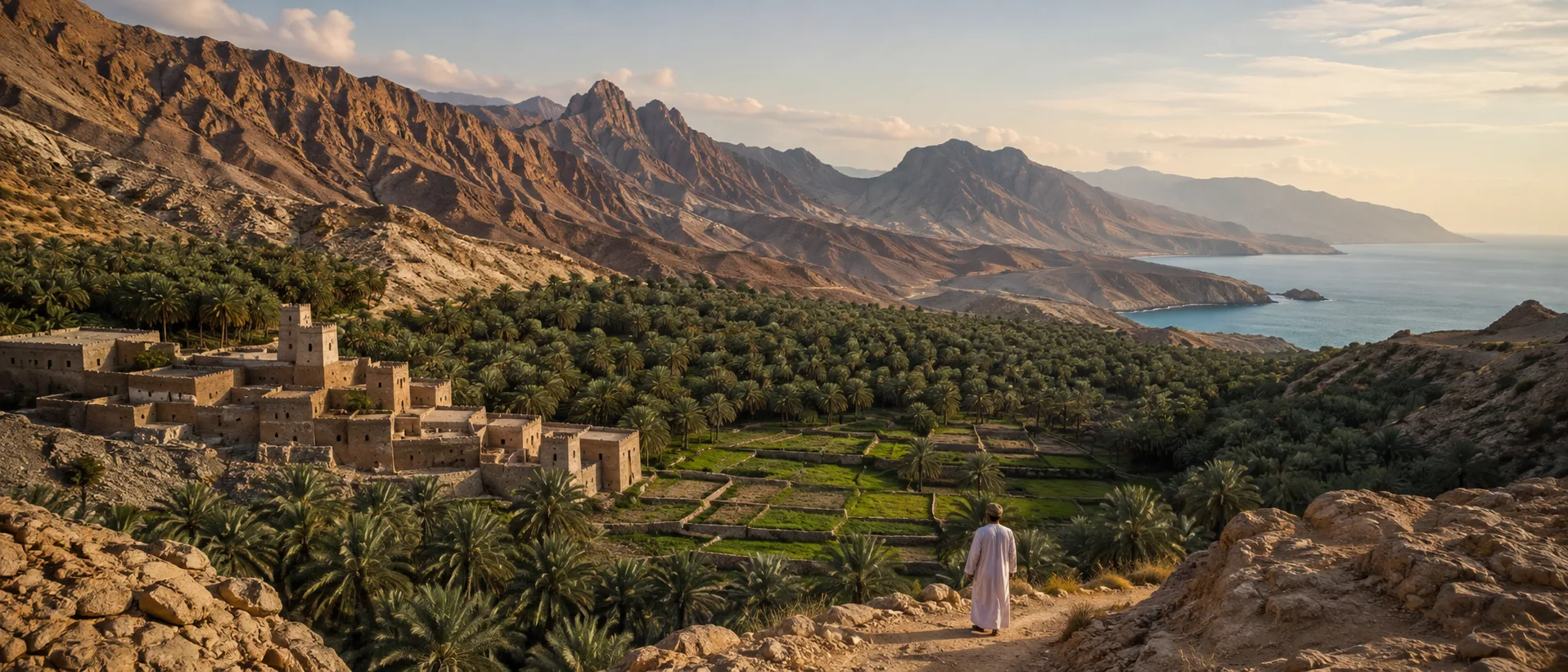
Nizwa is famous for a fort, a souq and an interior landscape of palms and mountains. For MESKI, the interesting question is what happens when that landscape is read from the point of view of a bee.
Nizwa is a useful place to stop saying ‘Omani honey’ as if that were enough
Nizwa sits in Al Dakhiliyah, the interior governorate that produced 176,428 kilograms of honey in 2025. The city itself is a market and cultural centre at the base of the western Hajar system, with routes climbing toward Jabal Akhdar and crossing a landscape of wadis, villages, date palms and irrigated agriculture. That is already enough variation to make one national honey label feel too broad.
I am not going to invent a precise Nizwa production number when the public data I found is for Al Dakhiliyah as a governorate. That distinction matters. Nizwa can be the centre of a honey story without pretending every kilogram produced in the governorate came from the city.
The mountains are close enough to change the conversation
Visit Oman describes Jabal Akhdar as part of the Hajar range in Al Dakhiliyah, rising to almost 3,000 metres, with the Saiq Plateau around 2,000 metres and terraced orchards cut by wadis. Nizwa lies below this mountain world. For bees and beekeepers, altitude is not scenery. It changes temperature, flowering windows and the sequence in which plants become available.
A colony near a lower wadi does not experience the same microclimate as one managed higher in the mountains. Cooler nights, shade, moisture pockets and exposure can all alter plant behaviour. The jar never tells you this by colour alone.
The cliff is beautiful. The bee is usually more interested in the less glamorous patch where water made something flower.
Meskaoui
Wadis are not empty spaces between mountains
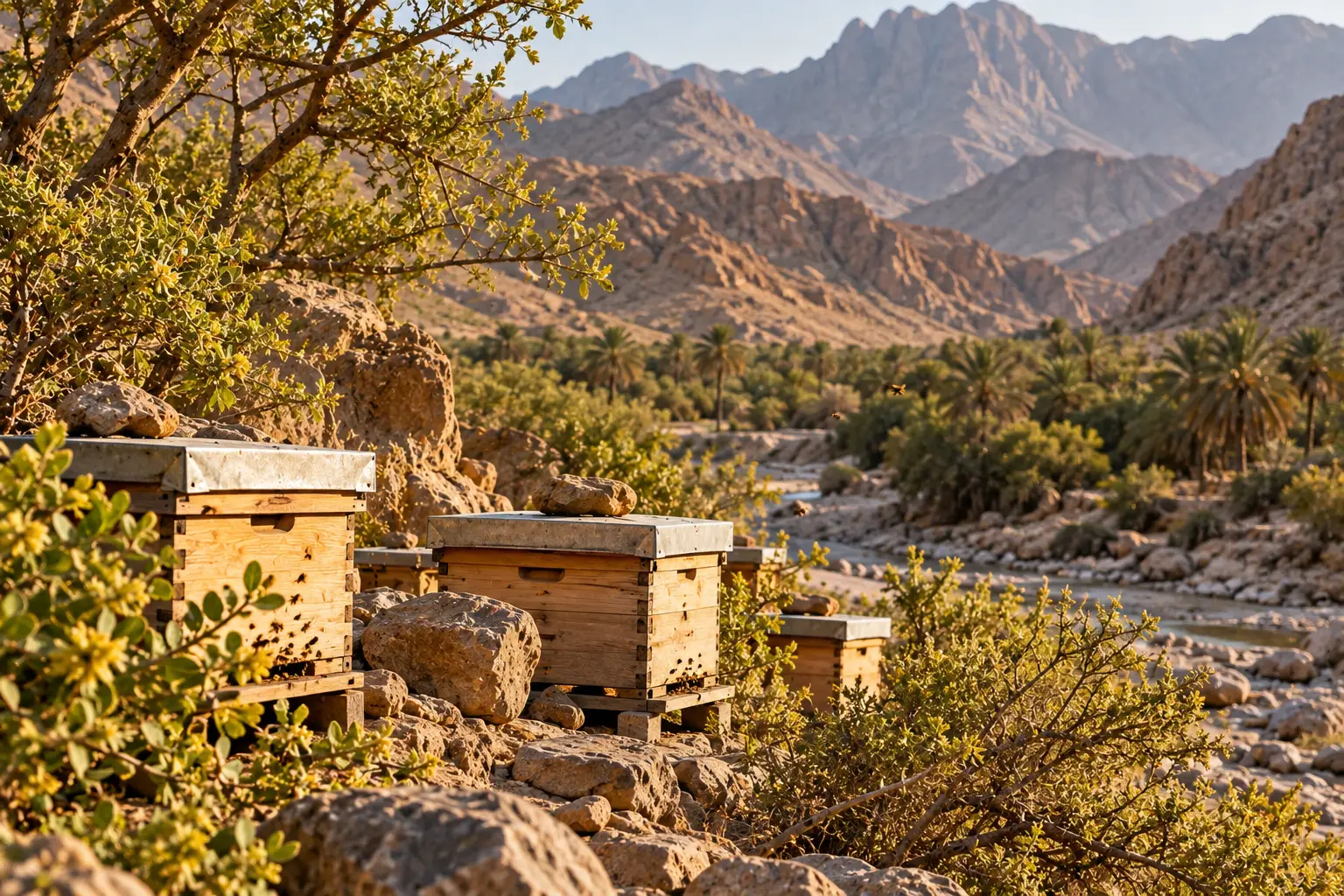
On a map a wadi may look like a line. Ecologically it can be a corridor where water collects, vegetation concentrates and flowering becomes more reliable after rain. In an arid country, small differences in water availability matter disproportionately.
This is why I like to think of mountain honey as wadi honey as well. The cliff may be spectacular in the photograph, but the bees are interested in flowers, not drama. The productive zone can be the less photogenic channel where soil, runoff and vegetation meet.
Sidr near Nizwa is still a seasonal event
Sidr is widely planted and naturally present across parts of Oman, and it is one of the trees highlighted by Oman’s national wild-tree planting initiative. But saying ‘Nizwa Sidr’ should not end the explanation. When did the flowering happen? What else was blooming? Were the colonies positioned near concentrated stands or scattered agricultural trees?
A strong Sidr claim is not created by adding the word Nizwa to the label. It becomes meaningful when location, flowering period, beekeeper records and the final batch fit together.
Samar enters when the heat changes
Samar honey belongs to another part of the calendar. Official Omani figures from several governorates show Samar as a major harvest, not a curiosity. Its flowering and nectar flow can occur under hotter conditions than many consumers imagine bees working in.
This gives Omani honey a useful seasonal contrast. Sidr and Samar are not just two flavours on a shelf. They are two moments in the year, each exposing the colony to different heat, forage and management decisions.
The city market can hide the distance between jar and hive
Nizwa Souq is one of the city’s best-known places to encounter Omani produce, crafts and food. A jar there may come from nearby, from another wilayat in Al Dakhiliyah or from farther away. Market location and harvest location are not the same thing.
That is not a criticism. Markets have always connected regions. It simply means a buyer should ask where the honey was harvested rather than assuming that everything sold in Nizwa is automatically Nizwa honey.
Nizwa should open the question of origin, not end it.
Meskaoui
Manah gives us one useful local scale
Manah, another wilayat in Al Dakhiliyah, reported approximately three tonnes of Sidr and Samar honey in a 2025 season, produced by more than 100 beekeepers managing around 1,400 hives. I like this figure because it brings the national statistics back down to human scale.
Three tonnes can sound small beside 934,443 kilograms nationally. But for local families and beekeepers, it represents colonies, work, equipment, heat and seasonal risk. Honey is easier to respect when the numbers return to people.
Aflaj and palms remind us that water structures the whole landscape
Al Dakhiliyah is also aflaj country. The UNESCO-listed aflaj systems of Oman demonstrate how communities distributed scarce water to sustain palms and agriculture in extremely arid conditions. Bees do not drink irrigation history, but the managed landscape created by water influences the vegetation available to them.
Nizwa’s palm gardens and nearby cultivated zones therefore matter alongside wild forage. A honey landscape can contain both human agriculture and uncultivated vegetation. Terroir is not the absence of people. It is the relationship between ecology and human land use.
Why one Nizwa jar may differ from another
Two jars sold under the same regional name can come from different apiary sites, different weeks and different years. One may be dominated by a targeted flowering. Another may contain a broader mixture because other plants were active at the same time. One may have been stored perfectly. Another may have spent too long in heat.
This is why sensory comparison is interesting but not enough. A darker jar is not automatically stronger. A thicker jar is not automatically more authentic. The useful comparison is between traceable harvests.
What I look for in mountain honey
I look for a clear origin and a beekeeper who can explain the season without reciting a brochure. I like smaller lots when the reason for keeping them separate makes sense. I like honey that still has aroma rather than only sweetness. I like knowing whether the site was a wadi, orchard edge, foothill or higher mountain apiary.
None of those preferences proves superiority. They simply help me understand why the jar exists. That is enough. Honey becomes more interesting when the landscape is not reduced to decoration.
Nizwa is a doorway, not a guarantee
Nizwa is one of the best names through which to enter the interior of Oman, but the name should open questions rather than close them. Ask whether the honey is actually from Nizwa, from another Al Dakhiliyah wilayat, or simply purchased in Nizwa. Ask which flowering. Ask which season.
If the answers are precise, the name becomes useful. If they are vague, the fort and mountains on the label are just very beautiful packaging.
From Nizwa to the wider Omani map
Our broader guide to Omani honey compares major producing governorates, while the Honey Atlas follows the trees themselves. This article sits between them: smaller than a country, larger than a single hive.
That middle scale is where terroir becomes practical. We can talk about mountains and wadis without pretending one city controls an entire ecological region.
Nizwa, Manah and the danger of borrowing a famous name
Nizwa is the name visitors know. Manah, Bahla, Al Hamra and other nearby wilayats may be less powerful on a foreign label. That creates a temptation to let Nizwa represent everything around it. We should resist that unless the harvest really belongs there.
A good regional story can mention the wider Al Dakhiliyah context while still naming the actual apiary area. Precision makes the famous place stronger, not weaker.
Why cooler nights can matter without becoming a health claim
Mountain and foothill microclimates can change when flowers open, how long nectar remains available and how colonies regulate themselves. These are ecological questions, not medical promises about the honey.
I mention this because mountain honey marketing often jumps from altitude to exaggerated health language. We do not need that jump. The environmental story is already interesting enough.
A jar can contain a route
A beekeeper may move colonies, buy queens, feed during scarcity or transport honey after extraction. None of this automatically damages authenticity. What matters is whether the route is understood and whether the label describes the harvest honestly.
The romantic image of one hive sitting untouched beside one tree all year is sometimes true and often too simple. Real beekeeping is work.
A note on certainty
One rule matters across all MESKI field articles: separate what the source proves from what the landscape merely suggests. A flowering tree does not prove a monofloral honey. A famous market does not prove harvest origin. A mountain photograph does not prove remoteness.
This restraint can make the prose less dramatic, but it makes the story stronger. The reader should know where evidence ends and interpretation begins.
Why this matters commercially too
Good editorial work and good commerce are not enemies. A customer who understands season, tree and origin is more difficult to impress with empty packaging, but also more capable of appreciating a genuinely rare harvest.
That is the kind of customer MESKI should want. Authority built through careful explanation lasts longer than a slogan.
A note on certainty
One rule matters across all MESKI field articles: separate what the source proves from what the landscape merely suggests. A flowering tree does not prove a monofloral honey. A famous market does not prove harvest origin. A mountain photograph does not prove remoteness.
This restraint can make the prose less dramatic, but it makes the story stronger. The reader should know where evidence ends and interpretation begins.
Why this matters commercially too
Good editorial work and good commerce are not enemies. A customer who understands season, tree and origin is more difficult to impress with empty packaging, but also more capable of appreciating a genuinely rare harvest.
That is the kind of customer MESKI should want. Authority built through careful explanation lasts longer than a slogan.
Questions People Ask
Nizwa is the centre of Al Dakhiliyah, Oman’s second-largest honey-producing governorate in 2025. Public figures are available for the governorate, not a precise Nizwa-only total.
Official figures reported 176,428 kilograms for Al Dakhiliyah Governorate.
Sidr and Samar are important, alongside mixed floral harvests depending on apiary location and season.
The mountain system changes altitude, temperature, water and flowering patterns in the wider region, but individual honey origin still needs to be traced to an apiary area.
No. A market is a place of sale, not proof of harvest origin. Ask where the apiary or beekeeper is located.
Wadis can concentrate runoff, soil moisture and vegetation, creating important forage corridors in otherwise dry landscapes.
Yes indirectly. Aflaj and other irrigation systems sustain palms and cultivated vegetation that can become part of the wider forage environment.
No. Mountain location alone does not prove botanical origin, lack of contamination or superior quality.
Ask for the actual harvest area, flowering source, season, batch identity, beekeeper or supplier chain and storage conditions.
Go smaller than the country name
Read the honey through Nizwa, Manah, the wadis and the mountain calendar, then return to the wider Omani map.