
Accredited science — NMR, pollen analysis, HMF, traceability — is the only reliable bridge between a label’s promise and what is truly in the jar.
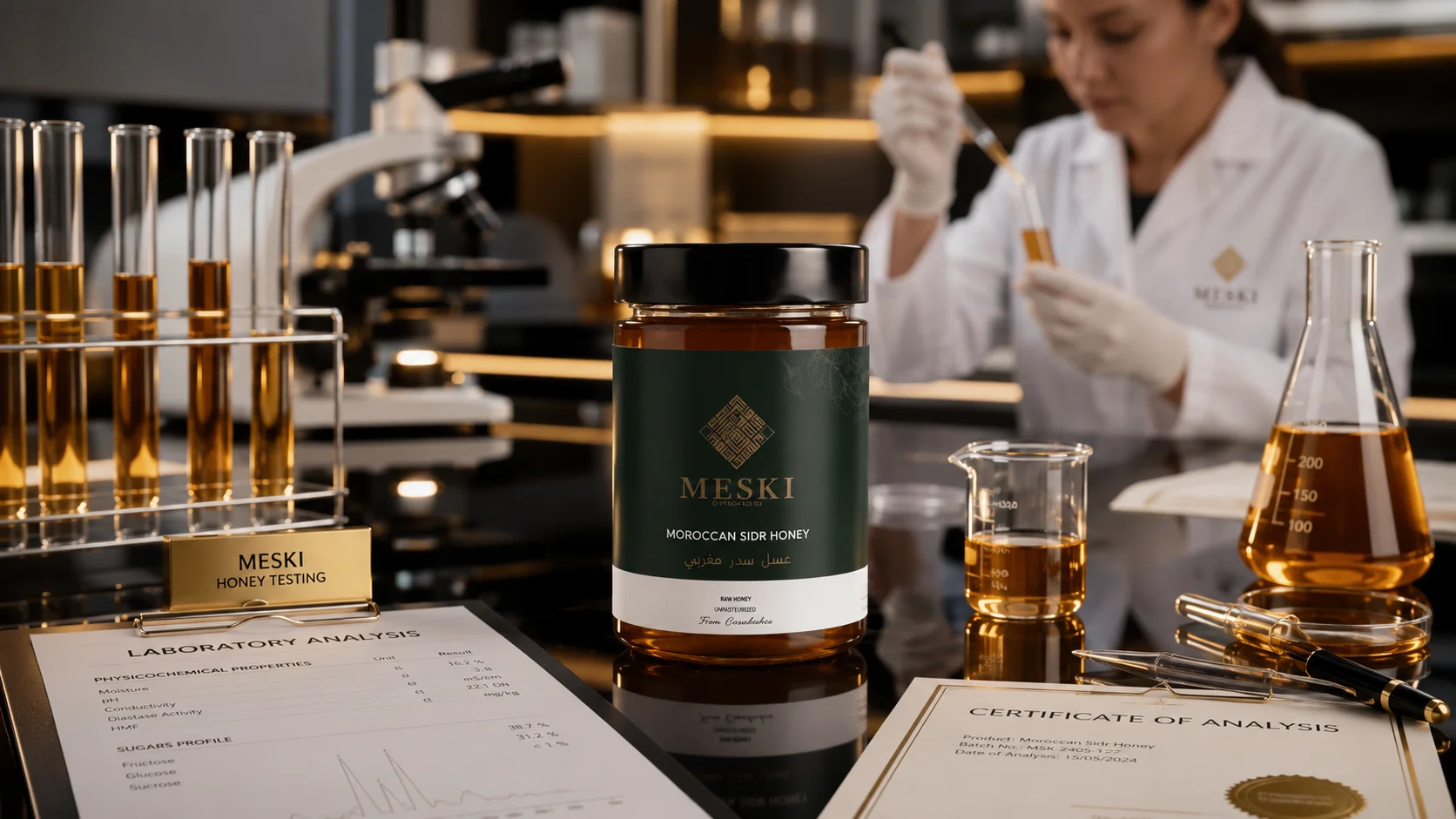
In a market where honey fraud is documented by food safety authorities across the EU, the US, and the GCC, laboratory testing has become the most authoritative guarantee of premium honey quality. No colour chart, no seller’s word, and no visual inspection can replace the precision of accredited scientific analysis — especially when purchasing rare varieties such as Yemeni Sidr or Omani raw honey.
Why Laboratory Testing Is Essential for Premium Honey
Honey shelves worldwide carry products that range from the genuinely exceptional to the subtly deceptive. Food safety authorities have repeatedly documented cases of honey adulterated with sugar syrups, mislabelled by botanical or geographical origin, or prematurely extracted and therefore prone to fermentation. The stakes are real: when you invest in a premium raw honey, you deserve certainty, not approximation.
Laboratory testing transforms that certainty from an aspiration into a verifiable fact. It is the chain of evidence connecting the hive to your table — and for Meski, committed to offering only authenticated, traceable honeys, it is a non-negotiable foundation of quality.
How Laboratories Verify Honey Authenticity
Authenticity testing begins with a fundamental question: is this honey what it claims to be? Modern food science laboratories employ a layered battery of techniques to answer it with precision and independence.
Spectroscopic and Isotopic Analysis
Nuclear Magnetic Resonance (NMR) spectroscopy has emerged as the gold standard for honey authentication. By producing a detailed molecular fingerprint, NMR can simultaneously identify a honey’s geographical and botanical origin, detect the presence of foreign sugars, and compare the result against vast reference databases of verified samples worldwide. A Yemeni Sidr honey, a Corsican AOP honey, or an Emirati desert honey each carry a distinct molecular signature — one that cannot be convincingly mimicked.
Isotopic analysis — particularly Carbon-13 (¹³C) isotope ratio analysis — adds a further dimension. Genuine floral honey and honey fraudulently extended with cane or corn syrup differ measurably in their carbon isotope ratios, making adulteration detectable even when carried out in small proportions.
Sugar Profile Testing
Authentic honey has a characteristic sugar composition dominated by fructose and glucose, with smaller amounts of sucrose, maltose, and higher sugars. High-Performance Liquid Chromatography (HPLC) maps this profile with precision. Any anomaly — an unusual sucrose spike or an atypical glucose-to-fructose ratio — signals the laboratory to investigate further. For monofloral honeys like Yemeni Do’ani Sidr, which carries a distinctive sugar signature linked to the Ziziphus tree’s nectar, this analysis is particularly revealing.
Testing Honey Purity and Detecting Adulteration
Purity testing focuses not simply on verifying origin, but on ensuring that nothing extraneous has been added to what nature and the beekeeper produced.
Common Adulterants and How They Are Identified
The most frequently detected adulterants in honey are high-fructose corn syrup (HFCS), rice syrup, and beet sugar syrup — inexpensive sweeteners that can closely mimic honey’s appearance and basic taste. More sophisticated laboratories also screen for artificial enzymes added to simulate diastase activity normally produced by bees during maturation.
| Adulterant / Contaminant | Detection Method | Risk Level |
|---|---|---|
| High-fructose corn syrup | ¹³C isotope ratio / NMR | High |
| Rice syrup | HPLC sugar profiling | High |
| Antibiotic residues | ELISA / LC-MS/MS screening | Critical |
| Pesticide residues | Multi-residue GC-MS/LC-MS | Critical |
| Artificial enzymes | Diastase activity assay | Moderate |
Antibiotic residue screening is equally important, particularly for honeys sourced from regions where veterinary drug use in beekeeping is less regulated. Accredited laboratories test for compounds such as chloramphenicol, tetracyclines, and sulfonamides — substances that have no place in a premium raw honey. Pesticide residue analysis — screening for organophosphates and neonicotinoids — rounds out the purity picture.
Buyer’s Note
A honey that passes sugar authenticity tests but carries detectable antibiotic or pesticide residues remains a compromised product. A thorough certificate of analysis covers all three dimensions: origin, purity, and contaminant screening.
Understanding Pollen Analysis and Botanical Origin
Of all the tests available to the honey quality specialist, pollen analysis is perhaps the most poetic — a microscopic reading of the landscape through which the bees have flown.
Melissopalynology: The Science of Honey Pollen
Melissopalynology is the scientific discipline dedicated to the study of pollen grains found in honey. Bees inevitably carry pollen into the hive alongside nectar; this pollen becomes embedded in the final honey, creating a botanical record of every flower visited. Under microscopy — and increasingly through automated image analysis — a trained palynologist can identify the species of each pollen grain, determine their relative proportions, and cross-reference these against known regional plant populations.
For a honey labelled as monofloral, pollen analysis is the definitive test. European regulatory guidelines generally require that a monofloral honey contain a minimum threshold of the named pollen type — typically 45% or more depending on the species. Anything less is a misrepresentation, however sincere the seller’s intentions.
Why This Matters for Sidr Honey
Yemeni Sidr honey — harvested from wild Ziziphus trees in the valleys of Hadramaut and the highlands of Doa’n — commands among the highest prices of any honey in the world precisely because of its rarity, provenance, and complex flavour profile. That rarity also makes it a frequent target for mislabelling. A certified pollen analysis report, conducted by an accredited laboratory, is the buyer’s most reliable guarantee that what is described on the label corresponds faithfully to what is in the jar.
Omani Sidr and Emirati honey varieties — harvested from distinct ecosystems along the Hajar mountains or the flowering desert plains — carry equally identifiable pollen profiles, allowing laboratories to distinguish not only botanical origin but geographical provenance with considerable accuracy. Explore our verified Omani Sidr Honey and Emirati Sidr Honey UAE — both sourced with full traceability documentation.
Hadramaut & Doa’n Valleys
Wild Ziziphus spina-christi trees at altitude. Dominant pollen: Ziziphus spp. >45%. Among the world’s most rigorously authenticated monofloral honeys.
Hajar Mountain Apiaries
Distinct ecosystem producing identifiable Sidr pollen profiles. Geographical provenance verifiable by melissopalynology and isotopic analysis.
Desert Flowering Plains
Emirati honey from desert Sidr and Samar species carries a unique pollen signature confirming its Gulf provenance — confirmed by laboratory cross-referencing.
Measuring Moisture Content and HMF Levels
Beyond origin and purity, two physicochemical parameters speak directly to a honey’s condition, stability, and the care taken during handling: moisture content and Hydroxymethylfurfural (HMF).
The Role of HMF as a Freshness Marker
HMF is a compound that forms naturally in honey as fructose breaks down over time or when honey is exposed to heat. In a freshly harvested, carefully stored raw honey, HMF levels are extremely low — often below 5 mg/kg. As honey ages or is subjected to excessive heat during processing, HMF accumulates. This makes it one of the most reliable indicators of a honey’s age and the temperatures it has endured between hive and jar.
International Standards: Codex Alimentarius
The international benchmark is clear: according to the Codex Alimentarius standard (CXS 12-1981), established by the FAO and WHO, HMF content after processing and blending must not exceed 40 mg/kg — with an allowance of up to 80 mg/kg for honeys produced and consumed in tropical regions, where ambient temperatures naturally accelerate HMF formation.
Moisture content is measured by refractometry and must remain below 20% in most international standards to prevent fermentation. A honey with excessive moisture — often a sign of premature harvesting before the bees have fully concentrated the nectar — is unstable: it will ferment in the jar, developing off-flavours and losing the characteristics that define a premium product. Diastase activity, another enzymatic marker, provides a complementary view of honey’s biological integrity — a high diastase number confirming that the honey’s natural enzyme profile has been preserved from hive to jar.
How Traceability Protects Consumers
Laboratory testing is most powerful when it exists within a complete chain of traceability — a documented trail connecting each jar to a specific hive, beekeeper, harvest season, and accredited testing event.
Without traceability, a certificate of analysis can be legitimate for one batch but misappropriated to cover another. A serious premium honey brand maintains batch-level records: the date of harvest, the GPS coordinates of the apiary, the beekeeper’s identity, the laboratory that conducted testing, and the specific tests performed. This documentation — made available to the consumer via request or QR code on packaging — transforms a product claim into a verifiable commitment.
In the Gulf region, where gifting culture elevates honey to the status of a meaningful, considered present, this traceability carries additional resonance. When you offer a jar of authenticated Sidr honey to a guest or business partner, you offer not merely a sweetener, but a documented story: of land, of tradition, of scientific rigour applied in service of integrity.
Harvest Documentation
Date of harvest, GPS coordinates of the apiary, and beekeeper identity are recorded at source.
Accredited Laboratory Testing
ISO/IEC 17025-certified laboratory conducts NMR, pollen analysis, HMF, moisture, antibiotic, and pesticide screening on each batch.
Certificate of Analysis Issued
Batch-specific COA documents all parameters, laboratory identity, accreditation number, and test dates.
Consumer Accessibility
Documentation made available on request or via QR code — full transparency from hive to jar.
Why Certified Laboratory Reports Build Trust
A laboratory report from an institution certified under ISO/IEC 17025 — the international standard for testing laboratory competence — is not simply a piece of paper. It is an assertion of independence. The laboratory has no commercial interest in the honey’s sale; its role is purely analytical, and its results are reproducible and peer-verifiable.
For the educated consumer, asking a honey brand for its certificate of analysis is no different from asking a jeweller for a gemological certificate. It is a reasonable, legitimate, and increasingly expected request — one that a brand confident in its product will welcome rather than deflect. The willingness to share laboratory documentation openly is itself a quality signal: it separates brands that rely on opacity from those that invite scrutiny.
Authenticated Sourcing
Every honey in the Meski collection is sourced with traceability and laboratory verification as prerequisites — not optional extras.
Geographical Heritage
From the Hadramaut valleys of Yemen to the Hajar mountains of Oman, provenance is documented and verifiable at batch level.
Independent Verification
Certificates of analysis from ISO/IEC 17025-accredited laboratories accompany each product before it reaches our shelves.
Choosing Premium Honey with Confidence
The practical upshot of everything discussed above is a clear checklist for any buyer approaching the premium honey market — whether for personal consumption or for gifting in the Gulf.
Ask for the Certificate of Analysis
A reputable seller will have one. It should specify the laboratory, its accreditation, the tests performed, and the results obtained.
Verify Botanical Origin Claims
A monofloral honey should be backed by pollen analysis confirming the dominant plant species. For Sidr, this is non-negotiable — look for Ziziphus spp. above 45% of total pollen count.
Check HMF and Moisture Figures
HMF should ideally be well below 20 mg/kg in a fresh raw honey; moisture below 18% indicates a well-matured, stable product.
Look for Antibiotic and Pesticide Screening
Premium honeys from conscientious producers should be clean on both counts — and the certificate should confirm it explicitly.
Confirm Traceability
Can the seller tell you where, when, and by whom the honey was harvested? If the answer is vague, treat that as a significant signal.
Verify Laboratory Independence
ISO/IEC 17025 accreditation is the benchmark for analytical credibility. An in-house test is not a substitute.
Premium honey is one of the few foods on earth that has remained essentially unchanged for millennia — bees, flowers, time, and care. The laboratory does not alter that simplicity; it authenticates it. It gives the modern buyer the confidence to trust what the ancient world took on faith.
Explore Meski’s Laboratory-Verified Honey Collection
Each jar in our collection is sourced with full traceability documentation and accredited laboratory verification — from rare Yemeni Do’ani Sidr to authentic Omani and Emirati varieties.
Frequently Asked Questions About Honey Lab Testing
Nuclear Magnetic Resonance (NMR) spectroscopy is currently considered the gold standard for comprehensive honey authenticity testing. It produces a molecular fingerprint that can simultaneously detect adulteration, verify botanical origin, and identify geographic provenance — all from a single sample analysis.
HMF (Hydroxymethylfurfural) is a compound that accumulates in honey over time or when it is exposed to heat. A low HMF level — ideally below 10–15 mg/kg — indicates a fresh, carefully handled honey. The Codex Alimentarius international standard sets the maximum permissible level at 40 mg/kg for most countries, with 80 mg/kg permitted for tropical-region honeys.
Melissopalynology — the microscopic analysis of pollen grains in honey — identifies the plant species from which bees collected nectar. Authentic monofloral Sidr honey must show a pollen profile where Ziziphus species pollen is dominant, typically above 45% of total pollen count. Any product below this threshold cannot legitimately be labelled as monofloral Sidr.
No. A certificate of analysis (COA) is a laboratory report confirming a honey’s physicochemical parameters, purity, and botanical origin. Organic certification is a separate designation issued by an accredited certifying body, requiring beekeepers to meet specific land-use and management criteria. The most rigorous premium honeys carry documentation on both fronts. Both are valuable and serve distinct purposes.