
A resin tree in Dhofar connected desert water points, fortified ports and distant civilisations long before modern luxury had a logo.
Frankincense smoke is the end of a long story. To understand why Oman’s luban mattered, we need to travel backwards from the burner to the tree, the caravan oasis and the ports that carried resin toward the wider world.
The road begins with a wounded tree
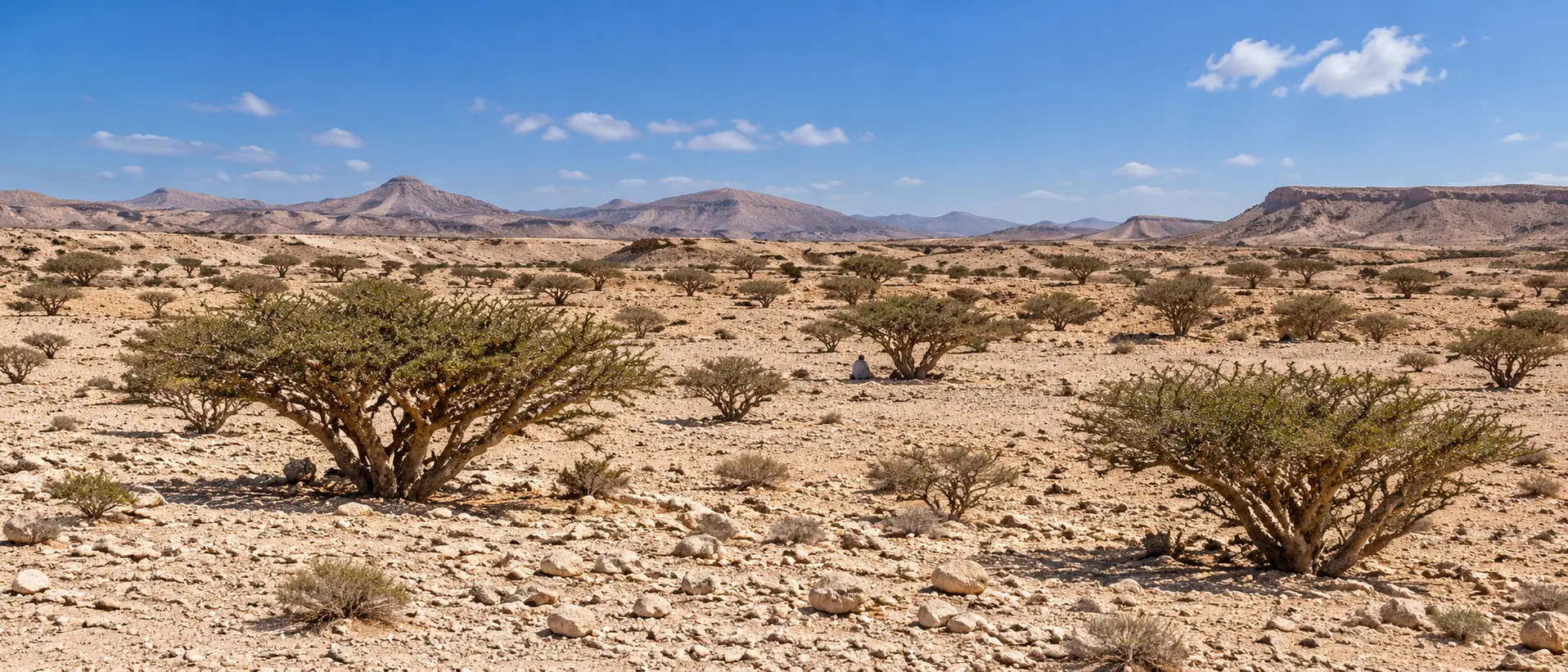
Frankincense is often presented as a finished object: pale resin tears in a bowl, smoke rising from charcoal, perfume in a bottle. In Dhofar the story begins earlier, with Boswellia sacra growing on rocky slopes and dry wadis where the tree is cut carefully so resin can exude and harden.
Razat Royal Farm describes trees beginning to produce resin from around eight to ten years of age. The National Museum explains that Dhofar is one of the few places where Boswellia sacra thrives naturally, supported by the region’s distinctive monsoon-influenced climate. Before the caravan, before the port and before the incense burner, there is ecology.
Wadi Dawkah is not just a plantation for photographs
Wadi Dawkah is one of the four components of UNESCO’s Land of Frankincense. UNESCO describes it as an outstanding example of the growth of Boswellia sacra, with trees still found and frankincense still harvested there. The wadi drains seasonally from the mountains toward the desert edge.
I like this starting point because trade histories often begin with merchants. Here the commodity is alive first. If the tree cannot survive, there is no route to romanticise.
The commodity was alive before it was luxurious.
Meskaoui
Shisr was about water as much as trade
North of Salalah, near the Empty Quarter, Shisr or Wubar functioned as an inland oasis and caravan station. UNESCO notes its importance as a water supply point on routes linking the Nejd and interior production zones to the coast.
That detail is easy to overlook. A caravan route is not simply a line between two famous places. Animals and people need water. Goods need security. A successful trade network depends on boring infrastructure as much as valuable cargo.
Khor Rori turned resin into maritime movement
Khor Rori, identified with the ancient port settlement of Sumhuram, lies east of Salalah. UNESCO describes it as a fortified harbour that became a major hub controlling the Dhofar incense trade in antiquity. The site connected inland resin to the Indian Ocean.
Once frankincense reached a port, the story widened dramatically. The National Museum notes long-distance trade links from the third millennium BCE with Mesopotamia, the Indus Valley civilisation and ancient Egypt. Dhofar was remote, but its resin was not provincial.
Al Baleed belongs to a later chapter
Al Baleed, on the coast at Salalah, represents another phase in the trade network. UNESCO notes its importance as a fortified harbour connected to maritime exchange, with finds indicating links to distant regions including China.
This is why I prefer ‘roads’ in the plural. There was no single timeless Frankincense Road. Routes shifted. Ports rose and declined. Political control changed. Maritime trade reconfigured older patterns. The resin remained valuable while the network around it evolved.
The incense burner brings the route back home
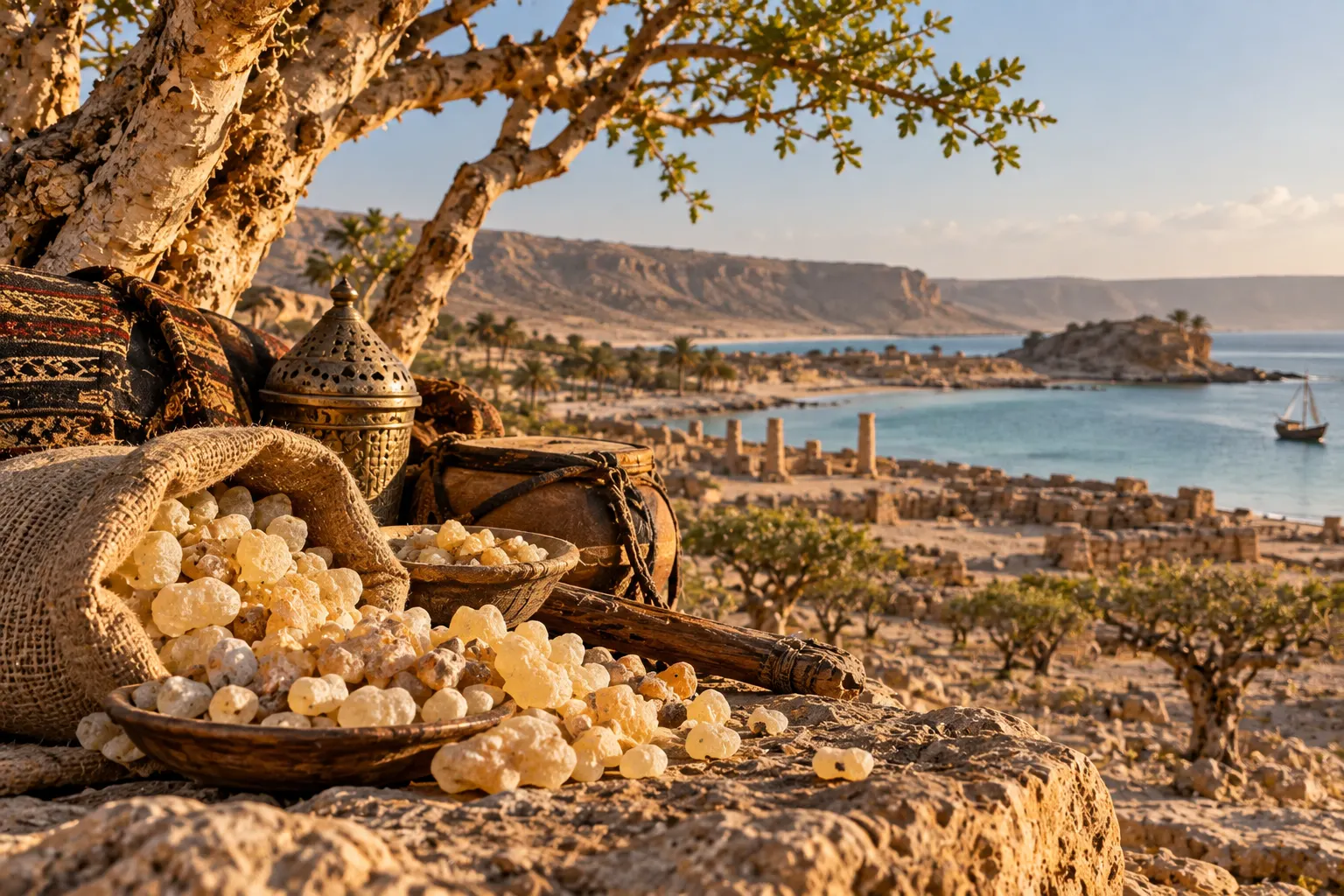
Long-distance trade can make frankincense sound like a product exported for other civilisations. Omani archaeology says otherwise. The National Museum has displayed ancient incense burners from Oman, including finds with traces of burned aromatic material dating back millennia.
This matters because frankincense was both commodity and domestic material. It could travel very far and still belong to everyday life at home. A luxury export does not stop being local because foreigners valued it.
A trade route is not a romantic line on a map. It is water, animals, security, storage, ports and somebody willing to keep moving.
Meskaoui
Why Dhofar frankincense became prestigious
Quality is often discussed through colour, size and collecting area, and Razat Royal Farm notes that quality varies according to region of collection. The National Museum points to Jabal Samhan as producing some of the finest grades. Those differences remind us that frankincense, like honey, should not be flattened into one word.
Tree health, tapping practice, landscape and grading all matter. A beautiful white resin tear may signal one grade, but consumer language can become simplified quickly. The more famous the product, the more carefully origin and grade deserve to be explained.
The smoke became perfume without leaving Oman behind
Frankincense did not remain only in traditional burners. Modern Omani perfumery has used it as a signature material, and the National Museum has highlighted collaborations linking Omani frankincense to contemporary high perfumery. That continuity is interesting because it is not simple preservation.
The material moves from tree to resin, from resin to smoke, from smoke to extraction and composition. Tradition survives not because every use stays unchanged but because the material keeps finding new forms.
And yes, the bees visit the flowers too
Frankincense is famous for resin, not nectar. That is exactly why the bee story is easy to miss. Razat Royal Farm states that honey is produced from Boswellia sacra flowers. So the tree has at least two very different relationships with people: one through wounded bark and resin, another through flowering and bees.
This does not mean every Dhofar honey is frankincense honey. It does not mean the blossom harvest is abundant every year. It means that the botanical link is real enough to treat seriously. Our separate article on frankincense honey in Oman goes deeper into that question.
Honey should remain a side road in this article
MESKI sells honey, so it would be easy to drag every frankincense paragraph toward a jar. I do not want to do that. The Land of Frankincense is important without honey. Its trees, caravan oasis, fortified ports and trade history deserve their own space.
The honey belongs here as one surprising branch of the tree’s story, not as the reason the route mattered. Keeping that proportion makes the internal link stronger because we are not pretending the past existed to support our product catalogue.
A route built from ecology, logistics and desire
What made frankincense powerful was not one thing. The tree grew in a limited ecological zone. Resin could be harvested, graded and transported. Caravans crossed dry country using water points. Ports moved cargo onward. Distant consumers valued the smell enough to sustain the network.
Remove any part and the story changes. This is where the history becomes more interesting than the myth. Luxury is rarely just an object. It is an entire system that makes a rare object move.
Following the road today
The four UNESCO components allow the route to be read almost physically: Wadi Dawkah for the tree, Shisr for inland movement and water, Khor Rori for the ancient maritime connection, Al Baleed for a later coastal trading centre. The sites do not recreate one perfect historical moment, but together they show the logic of production and distribution.
If you continue from here to our Trees of Oman article, frankincense becomes one tree among several. That shift is useful. A tree can dominate world trade history and still share its landscape with other species.
The khareef is part of the tree’s geography
Dhofar’s southwest monsoon, locally known as khareef, brings moisture and cloud to the southern mountains. The National Museum specifically links the natural success of Boswellia sacra in Dhofar to this climatic setting.
That does not mean frankincense wants a wet tropical forest. The tree remains adapted to harsh rocky country. The interesting part is the boundary: enough seasonal moisture and the right terrain to support a species that still looks as if it belongs to dryness.
Harvesting resin is an intervention, not a passive collection
Frankincense does not simply fall from the tree ready for a souq. Bark is incised, resin exudes and hardens, and repeated tapping has to be managed. The quality of practice matters for both yield and tree health.
This is where heritage and sustainability meet. A famous old commodity can still be damaged by poor modern harvesting. Respect for tradition should include respect for the living tree.
Why the ports mattered as much as the perfume
Khor Rori and Al Baleed remind us that high-value goods need infrastructure. Warehouses, fortifications, freshwater access, ships and political control all shaped whether resin could leave Dhofar safely.
Luxury histories often celebrate the final consumer and forget the systems that made movement possible. I prefer the systems. They tell us who carried the weight.
A note on certainty
One rule matters across all MESKI field articles: separate what the source proves from what the landscape merely suggests. A flowering tree does not prove a monofloral honey. A famous market does not prove harvest origin. A mountain photograph does not prove remoteness.
This restraint can make the prose less dramatic, but it makes the story stronger. The reader should know where evidence ends and interpretation begins.
Why this matters commercially too
Good editorial work and good commerce are not enemies. A customer who understands season, tree and origin is more difficult to impress with empty packaging, but also more capable of appreciating a genuinely rare harvest.
That is the kind of customer MESKI should want. Authority built through careful explanation lasts longer than a slogan.
Questions People Ask
The most famous Omani frankincense comes from Dhofar in southern Oman, where Boswellia sacra grows naturally.
It is a UNESCO World Heritage property made up of Wadi Dawkah, Shisr, Khor Rori and Al Baleed, illustrating production and trade in frankincense.
Shisr functioned as an inland oasis and caravan station, including an important role in water supply on routes through the desert interior.
Khor Rori, associated with ancient Sumhuram, was a fortified coastal harbour and major hub in the incense trade.
Al Baleed was a later fortified port at Salalah connected to wider Indian Ocean trade.
The National Museum describes long-distance frankincense trade links from the third millennium BCE.
Razat Royal Farm states that honey is produced from the flowers of Boswellia sacra in Dhofar.
No. Dhofar has diverse vegetation. A frankincense honey claim still needs botanical and harvest traceability.
It preserves a major landscape of Boswellia sacra and represents the production side of the wider frankincense trade system.
Follow the resin before the smoke
Continue into Dhofar through the frankincense tree, its rare honey connection and Oman’s wider landscape of trees.