
Qatar’s trees make more sense when we stop asking only for names and start asking where they grow, whether they are native and what the habitat tells us.
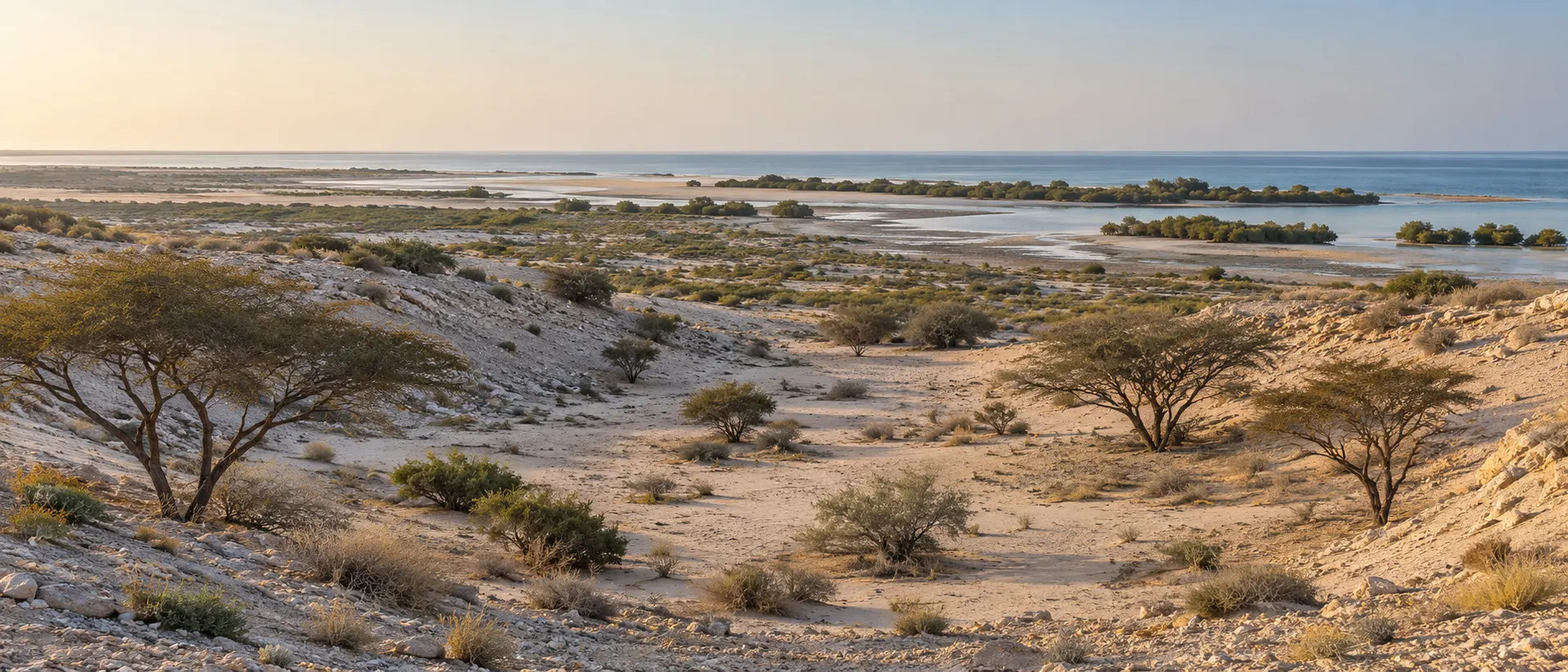
Qatar is often imagined as a nearly treeless peninsula. The closer you look, the more precise the story becomes: Samr in sandy depressions, rare Ghaf at the edge of its range, several different Ziziphus hiding behind the word Sidr, and mangroves standing in salt water.
Qatar is not treeless, but the map matters
From a distance Qatar can look like a country of limestone, sand and low scrub. That makes every large green tree feel planted. The reality is more interesting. Some tree species are native and adapted to local desert depressions, some are naturally coastal, some are rare survivors at the edge of their regional range, and some familiar ‘local’ trees are introduced or mostly cultivated.
This is exactly why I wanted to write this article. The question is not simply ‘what trees grow in Qatar?’ It is which species, in which habitat, and whether they are truly native, planted, naturalised or surviving in tiny populations.
Samr: one of the trees that really belongs to the desert
Qatar e-Nature lists Samr, Acacia tortilis, as native and very common. It occurs in sandy depressions, wadis and larger runnels, often on slightly raised ground around their edges. Its flowering is recorded around May and June.
That habitat description tells us more than a generic desert photograph. Samr does not need a lush oasis to belong. It survives in places where water is brief and uneven, making use of depressions and runoff patterns that are easy to miss if we imagine the desert as flat emptiness.
A tree list is not a landscape. Habitat is the part that makes the names meaningful.
Meskaoui
Ghaf: native, important and surprisingly rare in Qatar
Ghaf, Prosopis cineraria, is strongly associated with the UAE, but it also has a native history in Qatar. Qatar e-Nature describes it as native and rare, with surviving mature trees concentrated mainly in two areas of central and northern Qatar. The source estimates that no more than about 50 native trees may remain across the country.
That is a remarkable contrast. A tree can be culturally important across the Gulf and still be almost absent as a naturally surviving population in one country. Qatar sits at the western edge of the Ghaf’s Gulf distribution, which helps explain why the story here is different from the Emirates.
The word Sidr becomes complicated very quickly
This is where botanical names save us from marketing confusion. Qatar e-Nature lists Ziziphus mauritiana under the name Sidr, but classifies it as introduced and common in cultivated areas and gardens. It also lists Ziziphus spina-christi, Christ’s Thorn, as introduced locally and mostly associated with planted areas.
At the same time, Ziziphus nummularia, called Kenar or Sidr-Kenar in Arabic, is native and occurs in central and southern Qatar in sandy depressions. So ‘Sidr in Qatar’ is not one botanical sentence. We need to know which Ziziphus is being discussed.
Kenar: the native Ziziphus people overlook
Ziziphus nummularia is a shrub or small tree that Qatar e-Nature records as native, flowering from March to May and occurring in sandy depressions, sometimes dominant or mixed with acacias. Its fruit is edible, and the plant can help trap sand and reduce erosion.
This species is especially important for MESKI because it forces us to slow down. A commercial label may say Sidr. A botanist asks which species. A beekeeper then asks whether there were enough flowering plants within forage range to support a meaningful honey claim. Those are different questions.
Mangroves: Qatar’s trees that stand in salt water
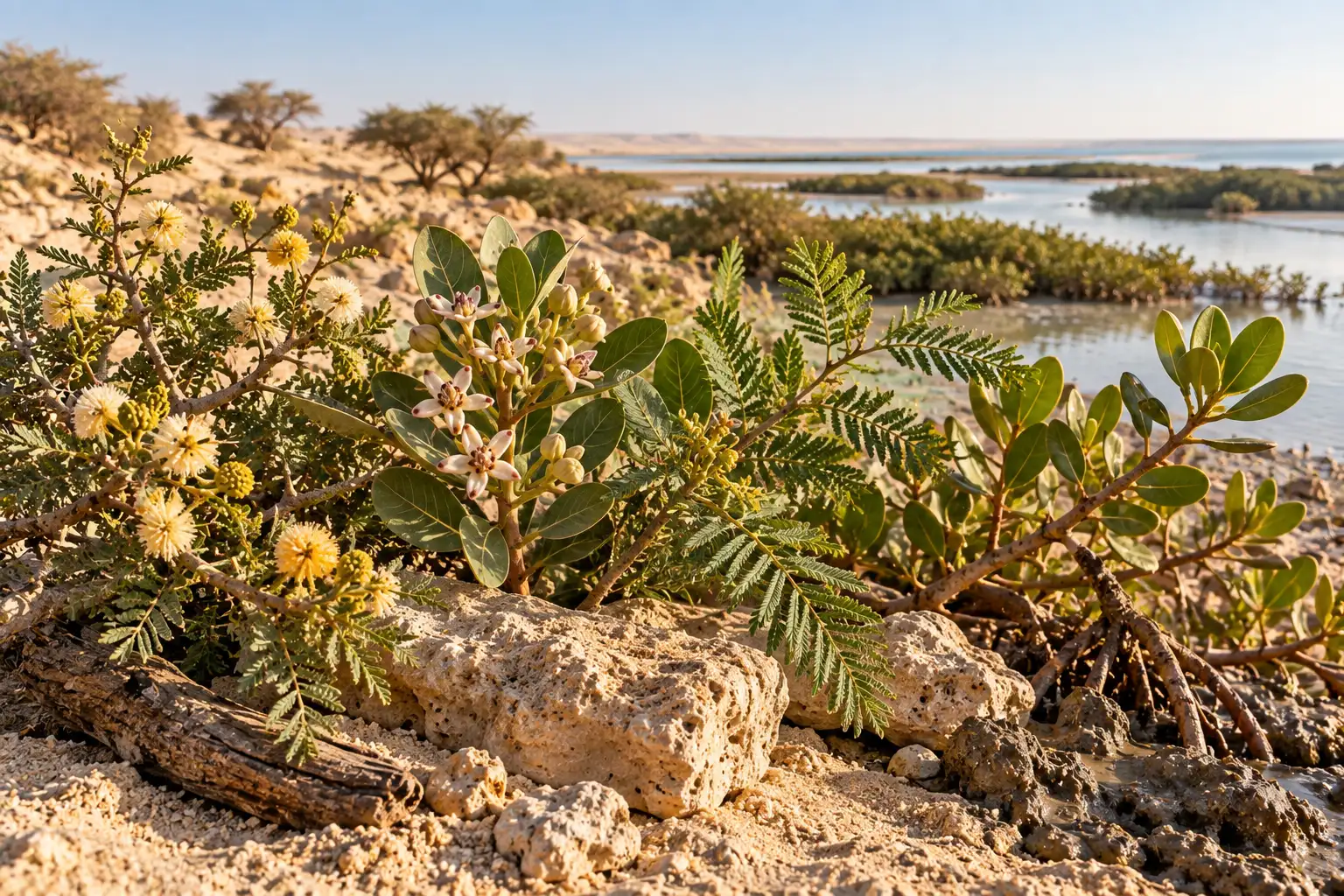
On the coast, the landscape changes completely. Avicennia marina, the grey mangrove, forms mangrove ecosystems in sheltered tidal areas. Qatar e-Nature notes that mangroves occur naturally at Al Thakhira and that planting programmes from the 1980s expanded them to other coastal locations.
Mangroves survive salinity through specialised adaptations including salt management and pneumatophores, root structures that rise from oxygen-poor sediments. If Samr teaches us how a tree survives dry depressions, mangrove teaches the opposite lesson: how a tree survives too much salt water.
The word Sidr is useful until it makes us forget that different Ziziphus species are different plants.
Meskaoui
Date palms are culturally local even when agriculture is the main habitat
The date palm, Phoenix dactylifera, belongs to Qatar’s agricultural and cultural landscape rather than its wild desert in the same way as Samr. That difference should not make it less important. Palms turn water management into shade, food and settlement.
Qatar joined the multinational UNESCO inscription in 2022 for the knowledge, skills, traditions and practices associated with the date palm. The heritage is not a claim that every palm grove is wild. It is about what communities learned to do with the tree over generations.
Planted does not mean fake
One mistake in nature writing is to treat introduced or planted species as if they do not count. A road-planted Sidr can still feed insects, shade people and become part of a neighbourhood. A planted mangrove can still create habitat. Urban ecology is real ecology.
The important thing is accuracy. If a species is introduced, say it. If a native population is rare, say that too. We do not need to make every tree ancient and indigenous for the landscape to be interesting.
Where should you look for these trees?
Samr belongs to sandy depressions and wadi-like runoff features. Native Ghaf survives in very limited central and northern areas. Kenar occurs in central and southern sandy depressions. Mangroves are coastal, with Al Thakhira the best-known natural example and other planted coastal stands elsewhere. Cultivated Sidr species and date palms are easier to encounter around farms, gardens, roadsides and settlements.
This geography matters because a tree list without habitat becomes decoration. If you know where a tree wants to live, the country stops looking empty and begins to look structured.
And what about honey?
Samr and Sidr immediately attract honey questions, while mangrove honey is known in the wider Gulf. But this article is not going to claim that every Qatari population produces a commercial monofloral honey. Botanical presence is only the first condition. Bees also need sufficient flowering density, timing, colony placement and limited competition from other nectar sources.
Our separate guide to buying Sidr honey in Doha explains why a tree name alone is not proof of a jar’s origin. The future individual tree articles will go deeper into the ‘honey or not?’ question species by species.
Qatar teaches a useful lesson about national symbols and biological reality
Ghaf is the clearest example. Across the Gulf it carries strong cultural meaning, but in Qatar the native population is tiny. Sidr is another: the familiar word covers species with different status. Mangrove looks impossible in a desert country until you reach the coast.
This is why I like trees as a way of reading a country. They resist slogans. They force us to look at soil, water, salt, distribution and names carefully.
From Qatar to the Arab tree atlas
This article belongs inside our larger Honey Atlas world but it is not a honey article. It also points toward our future hub, The Trees of the Arab World, where each species will have room for botany, culture, history and, only when justified, bees.
The tree comes first. If honey appears later, it has to earn its place botanically.
Native, introduced and planted are not moral categories
Botanical status can sound judgmental when it is not. Native describes historical ecological presence. Introduced describes arrival through human activity. Planted describes deliberate placement. None of these words means beautiful or ugly, useful or useless.
Keeping the categories clear simply lets us understand Qatar’s landscape honestly. A planted Sidr beside a road can matter ecologically while still not being part of an ancient wild population.
Why rare Ghaf should change the way we photograph Qatar
If native Ghaf numbers are as low as Qatar e-Nature reports, a photograph of one mature wild tree is not just a generic desert symbol. It represents a very small surviving population.
That should make visual storytelling more careful. We should not casually place endless Ghaf forests in generated or staged Qatar scenes because the picture would contradict the ecology we are trying to explain.
Trees and bees need different maps
A botanist maps where a plant exists. A beekeeper also needs flowering density, timing, access and colonies within forage range. Those maps overlap but are not identical.
This is why a national flora database can prove that a tree occurs in Qatar without proving that a commercial monofloral honey from that tree is available in meaningful quantity.
A note on certainty
One rule matters across all MESKI field articles: separate what the source proves from what the landscape merely suggests. A flowering tree does not prove a monofloral honey. A famous market does not prove harvest origin. A mountain photograph does not prove remoteness.
This restraint can make the prose less dramatic, but it makes the story stronger. The reader should know where evidence ends and interpretation begins.
Why this matters commercially too
Good editorial work and good commerce are not enemies. A customer who understands season, tree and origin is more difficult to impress with empty packaging, but also more capable of appreciating a genuinely rare harvest.
That is the kind of customer MESKI should want. Authority built through careful explanation lasts longer than a slogan.
A note on certainty
One rule matters across all MESKI field articles: separate what the source proves from what the landscape merely suggests. A flowering tree does not prove a monofloral honey. A famous market does not prove harvest origin. A mountain photograph does not prove remoteness.
This restraint can make the prose less dramatic, but it makes the story stronger. The reader should know where evidence ends and interpretation begins.
Why this matters commercially too
Good editorial work and good commerce are not enemies. A customer who understands season, tree and origin is more difficult to impress with empty packaging, but also more capable of appreciating a genuinely rare harvest.
That is the kind of customer MESKI should want. Authority built through careful explanation lasts longer than a slogan.
Questions People Ask
Native trees and tree-like species include Samr, rare native Ghaf, Kenar and naturally occurring mangrove in suitable habitats, among others.
Yes. Qatar e-Nature lists Acacia tortilis as native and very common in sandy depressions, wadis and larger runnels.
Yes, but it is rare. Qatar e-Nature estimates that only a small number of native mature trees survive.
It depends on the species. Qatar e-Nature lists Ziziphus mauritiana and Ziziphus spina-christi as introduced, while Ziziphus nummularia, Kenar, is native.
Avicennia marina occurs naturally at Al Thakhira and has also been planted in several other coastal areas.
Date palms are mainly part of cultivated and oasis landscapes. Their cultural importance is tied to agriculture, food, crafts and heritage.
No. Honey requires enough flowering plants within forage range, suitable weather and colony placement. A tree’s presence alone is not enough.
Mangroves can provide forage for bees, but a specific monofloral commercial claim requires local harvest evidence and traceability.
Vernacular names such as Sidr can refer to more than one species. Scientific names prevent different plants from being collapsed into one marketing term.
Read the country through habitat
Continue from Qatar’s trees into Sidr honey, mangroves and the wider tree atlas of Arabia.