
Saudi honey is not one flavour. From Aseer and Tihama to Jazan, Al-Baha and beyond, trees, altitude and seasonal hive movement create a much larger map.
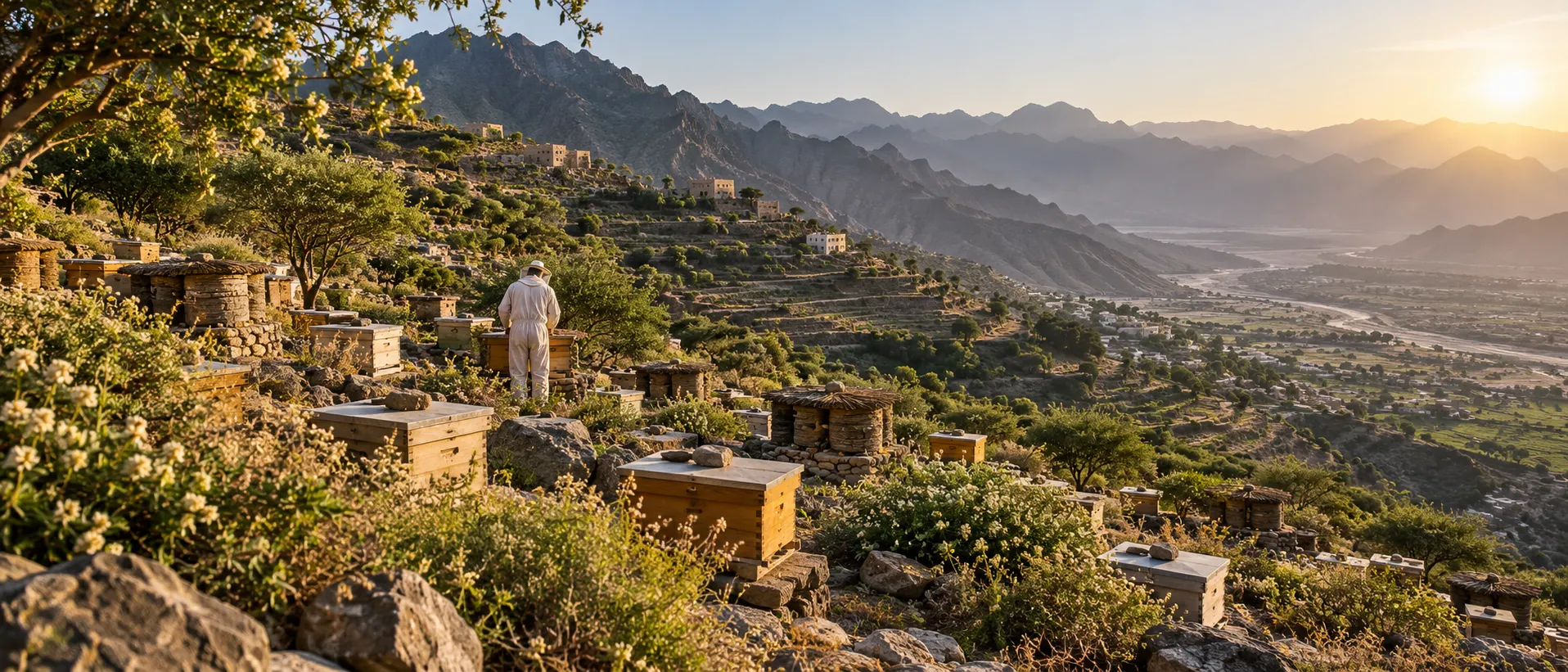
Search for Saudi honey and Sidr usually arrives first. It deserves its reputation, but it should not erase Talh, Samar, Sumra, Majra or the regional systems that make Saudi beekeeping interesting. The useful question is not simply “What is the best Saudi honey?” It is where the hives were, what was flowering, and what the beekeeper did as the season moved across the landscape.
Saudi Arabia is not one honey landscape
Saudi honey is often reduced to a single famous word: Sidr. That misses the geography. The Kingdom stretches from humid Red Sea lowlands to high escarpments, dry interior plateaus and northern landscapes with very different flowering calendars. A jar from Aseer does not begin in the same ecological world as a harvest from Madinah, Jazan or Najran. For a serious buyer, the country name is therefore the first line of the story, not the last. Region, forage and season are what turn a national label into something you can actually understand.
Official Saudi sources describe a large and growing beekeeping sector, with thousands of licensed beekeepers and around twenty recognised honey varieties. The most frequently named include Sidr, Talh and Samar. Markets in Aseer also use names such as Sumra and Majra. Transliterations vary, and local names do not always map neatly onto one botanical species, so I prefer to keep the market name while asking the producer what plant and region stand behind it.
Sidr remains the reference point, but origin still matters
Sidr honey comes from nectar associated with Ziziphus trees, a family deeply familiar across Arabia. In Saudi Arabia, Sidr carries prestige because the tree is adapted to demanding environments and because good harvests can be dense, aromatic and memorable. Yet the word Sidr alone does not tell you whether the honey came from Aseer, Jazan, Al-Baha or another region. It also does not prove that the harvest is monofloral. The useful questions stay simple: where were the hives, when did the Sidr flower, and how is the batch documented?
Aseer is especially important because its mountains and Tihama lowlands create several flowering zones within one region. Saudi reporting places the Sidr season there around late summer and early autumn, with beekeepers moving hives to follow forage. That movement is not a weakness in the idea of terroir. It is part of the terroir story, because the beekeeper is reading altitude, temperature and flowering rather than leaving colonies in one place all year.
Talh honey belongs to the acacia conversation
Talh is one of the most prominent Saudi honey names after Sidr. Saudi food authorities describe it as honey associated with acacia blossoms, while local usage can cover trees that buyers outside the region might group too quickly under a generic acacia label. Talh honeys are often valued for a strong, warm profile, but sensory descriptions should never become authentication rules. A dark colour cannot prove Talh, and an intense taste cannot replace traceability.
In Aseer, seasonal movement between mountain and coastal zones helps beekeepers reach different acacia flowering periods. This is a useful reminder that honey is agricultural before it is luxurious. Rainfall, heat, altitude and flowering density can move from one year to the next. A serious seller should therefore be comfortable saying that two Talh harvests are not identical, even if both are genuine.
Samar and Sumra show why local names need context
Samar is a familiar honey name across Oman, the UAE and Saudi Arabia, and Saudi sources include Samar among the country’s notable varieties. In markets you may also encounter Sumra or Samra. The spellings can reflect Arabic transliteration as much as a different product category. Rather than treating every spelling as a separate botanical truth, ask what local tree the seller means and where the harvest was produced.
This matters commercially because prestigious regional names can become detached from the plant. A jar labelled “Saudi Samar” should still have a producer, a region and a harvest identity. The same discipline applies when buying Omani Samar or Emirati Samar. MESKI’s Gulf Honey Charade makes the same point across borders: the market where you buy honey is not the place that defines its origin.
Majra is worth knowing, but not exaggerating
Majra appears in Saudi market reporting, particularly around Aseer, alongside Sidr, Sumra and Talh. It is less internationally familiar, which makes it interesting, but unfamiliarity should not be converted automatically into rarity or superiority. Local naming can vary, and English spellings such as Majra or related forms may not always be consistent between sellers and reports.
For a buyer, this is exactly the kind of honey that rewards questions. Ask the beekeeper what plant is meant locally, where it flowers, when the harvest happens and whether the jar represents a single dominant source or a broader seasonal honey. A less famous honey with a clear origin can be more interesting than a famous name carried by a vague label.
Aseer and Tihama explain the logic of moving hives
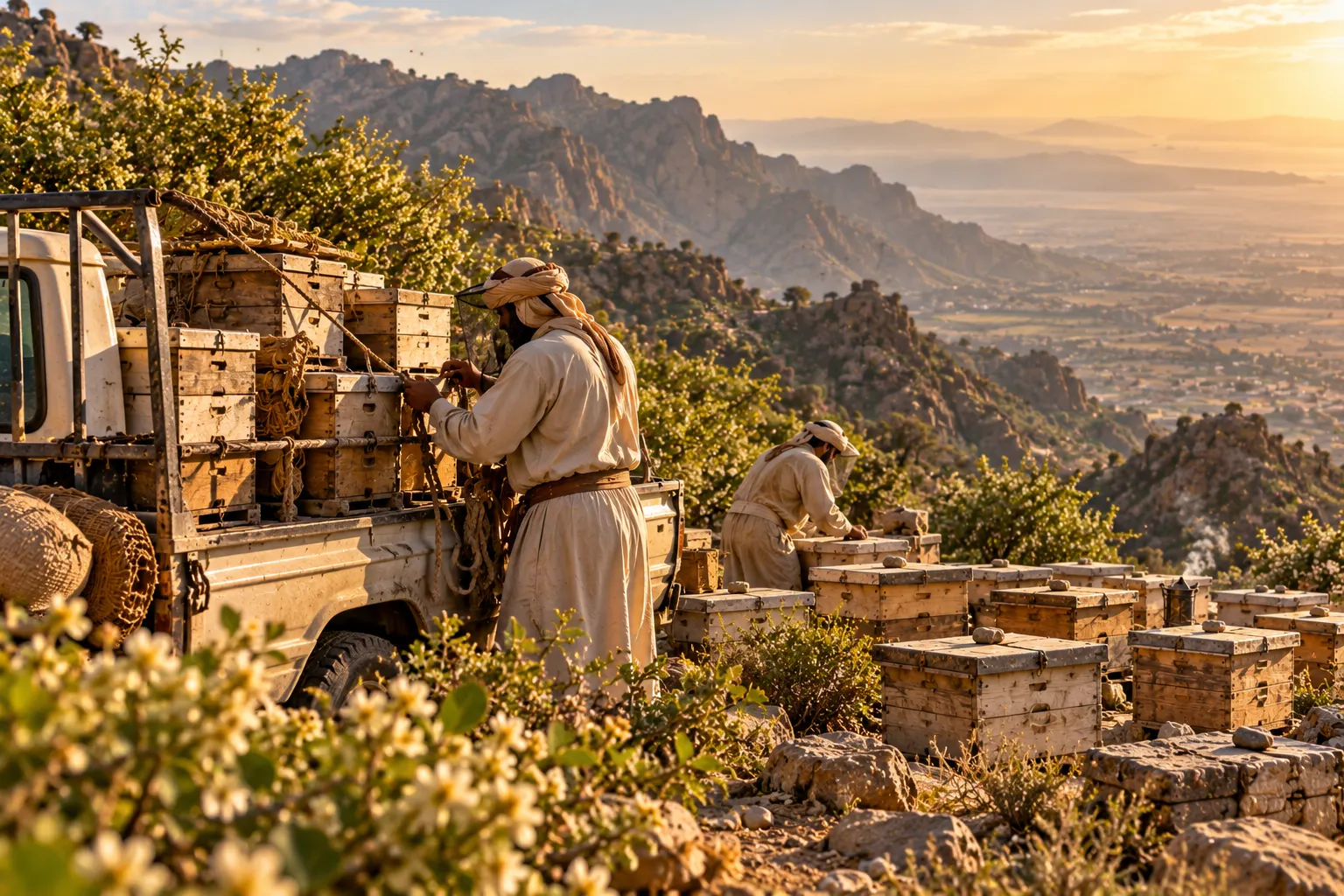
One of the most revealing details in Saudi beekeeping is seasonal hive migration. In Aseer, beekeepers move between the Sarawat highlands and the Tihama plains as flowering changes. Official Saudi reporting describes Sidr peaking later in the year, while Talh and spring wildflower harvests come earlier. The movement also helps colonies avoid the harshest lowland summer heat.
This practice changes how we should think about “local” honey. Local does not always mean a hive that never moves. It can mean a beekeeper working within a known regional circuit, following the same valleys, escarpments and flowering zones each season. The important thing is honesty about the route. If a batch is sold as Aseer honey, the producer should be able to explain what Aseer means in practical terms.
Jazan, Al-Baha, Najran and other regions broaden the map
Aseer deserves attention, but it is not the whole Saudi honey story. Jazan hosts major honey festivals and produces many named varieties. Al-Baha has a deep beekeeping identity linked to the southwest highlands. Najran, Madinah, Makkah and other regions support their own beekeeping systems, while government queen-rearing and colony projects now span several parts of the Kingdom.
This diversity is useful for consumers because it creates alternatives to buying only by prestige. Someone who enjoys intense dark honey may prefer one regional harvest, while another person may choose a lighter seasonal profile. The right comparison is not “Saudi versus Yemeni” as if two countries each produced one flavour. It is one documented harvest against another documented harvest.
How to read a Saudi honey label
Start with country, then region. Look for the floral source and ask whether it is a dominant forage claim, a traditional market name or a tested monofloral designation. Find the producer or beekeeper where possible. Check harvest or batch information, storage guidance and whether the seller can connect any laboratory report to the actual jar in front of you.
Do not use thickness, colour or crystallisation as shortcuts for authenticity. Natural honey varies. Saudi food regulation addresses composition and quality requirements, but a compliant jar can still be poorly explained at retail. Regulation is the floor. For premium honey, traceability is what helps you understand why one jar costs more than another.
Which Saudi honey should you try first?
If you already know Yemeni or Omani Sidr, a well-documented Saudi Sidr is a natural starting point because it lets you compare the same broad floral family across another landscape. Talh is the next obvious step for someone who wants a more distinctly Saudi market reference. Samar or Sumra can connect the Saudi tasting table to neighbouring Gulf traditions, while Majra offers a chance to discover a name that is still less familiar internationally.
I would resist ranking them before tasting. The useful goal is not to build a medal table of tree names. It is to understand how season, region and beekeeper create difference. Saudi Arabia becomes much more interesting as a honey country once Sidr is allowed to be the beginning of the map instead of the entire map.
Saudi honey belongs in a wider Arabian atlas
MESKI’s Sidr Honey by Country and our Omani honey guide both begin with the same principle: origin should remain visible. Saudi honey deserves the same treatment. A jar sold in Dubai or Doha remains Saudi if that is where it was harvested, and the Saudi region can matter almost as much as the national origin.
The strongest future for premium Saudi honey is therefore not a louder luxury vocabulary. It is a more precise one: Aseer Sidr, a documented Talh season, a Jazan beekeeper, a traceable Samar batch. The more specific the story becomes, the less the buyer needs empty words such as “royal”, “pure” or “best”.
What regulation can tell you, and what it cannot
Saudi regulation matters because it creates a baseline for food safety and composition. SFDA material refers to national standards covering honey types, handling, enzyme activity, moisture, acidity and other requirements. Government support for queen breeding, local bee strains and regional beekeeping also shows that honey is being treated as an agricultural sector rather than only a heritage product.
Yet regulation cannot choose the most interesting jar for you. A compliant honey can still be generic, poorly stored or weakly described. A small regional batch can be fascinating without carrying extravagant branding. For premium buying, regulation answers “is this food being controlled?” while provenance answers “why should this particular harvest matter?” Both questions belong together.
Frequently Asked Questions
Sidr, Talh and Samar are among the best-known Saudi honey types. Markets and regional festivals also feature names such as Sumra, Majra, Qatad, Salam and other local seasonal honeys.
Important beekeeping regions include Aseer, Al-Baha, Jazan, Najran, Madinah, Makkah and other parts of the Kingdom. Geography and flowering differ significantly between highlands, Tihama and interior regions.
Saudi Sidr honey is honey harvested in Saudi Arabia from bees foraging substantially on Sidr or Ziziphus blossoms. The region, season and traceability still matter because Saudi Sidr is not one uniform product.
Talh is a major Saudi honey category associated with acacia-type flowering. Local botanical usage can vary, so buyers should ask which tree, region and harvest the seller is describing.
Names and transliterations vary by market. Samar, Samra and Sumra can be used around related local acacia honey traditions, but a seller should explain the precise local tree and origin rather than relying on spelling alone.
Majra is a honey name reported in Saudi markets, especially in the southwest. It is less internationally familiar than Sidr or Talh, so buyers should ask what local plant and harvest the seller means.
In regions such as Aseer, beekeepers move colonies between lowlands and mountains to follow different flowering seasons and avoid extreme heat. Seasonal movement is part of local beekeeping strategy.
No. Colour depends on floral source, season, storage and natural composition. Darkness, thickness or price cannot authenticate origin or prove superior quality by themselves.
Ask for the harvest country and region, floral source, producer, season or batch, storage conditions and any analysis linked to that specific batch. Clear provenance is more useful than prestige language.
Continue through the Honey Atlas
Compare Saudi honey with documented harvests from Oman, Yemen, the UAE and Qatar, always keeping the flowers and the region ahead of the market name.