
In 1893, a dispute over who could exercise power inside Qatar became a battle whose meaning outlived the Ottoman troops who fought it.
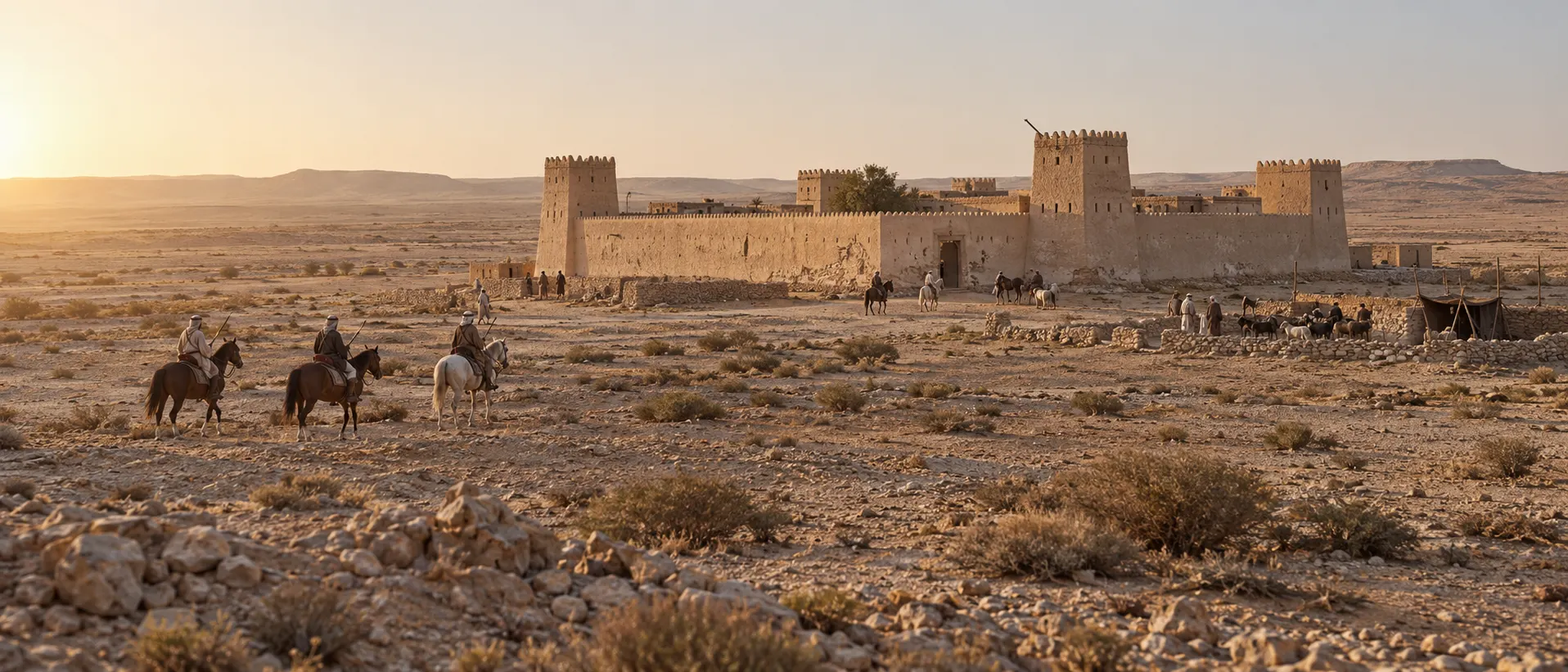
National histories often compress a complicated century into one clean moment. Al Wajbah deserves better. Sheikh Jassim bin Mohammed Al Thani did defeat an Ottoman force in 1893, and Qatar remembers the battle for good reason. But the deeper story is not that an empire arrived one morning and Qatar became independent by sunset. It is the story of an existing relationship that broke when outside administration pushed beyond what local authority would accept.
Before Al Wajbah, there was already a political Qatar
It is tempting to begin the story with gunfire in 1893, but that would make the battle carry too much weight. Qatar did not appear suddenly at Al Wajbah. Political authority had been taking shape for decades through tribal alliances, maritime settlements, trade, pearling and the leadership first associated with Mohammed bin Thani and then with his son Jassim. We explored that earlier landscape in our article on Mohammed bin Thani before modern Doha. Al Wajbah belongs to the next chapter: what happens when a local leader whose authority is already real meets an imperial administration that wants its own authority to become more direct.
That distinction matters. A battle can become a national symbol later, but historians still have to ask what existed before it. By the 1870s and 1880s, Jassim was not simply a man resisting outsiders. He was also negotiating recognition, titles, revenue and security inside a Gulf where Ottoman, British, Bahraini, Abu Dhabi and tribal interests overlapped. Qatar was a peninsula, a pearling economy and a political space in formation at the same time.
Jassim worked with the Ottoman state before he fought its troops
The Amiri Diwan records that Jassim’s relationship with the Ottoman authorities became close enough for him to receive the title of kaimakam, an administrative rank, and later the honorary title Kapuji-bashi. Those titles are important because they complicate the simple story of permanent resistance. Ottoman recognition could strengthen Jassim’s standing, while Jassim gave the empire a locally powerful figure through whom influence might be exercised.
This was normal politics for the period. Rulers and tribal leaders could accept an imperial title without surrendering every aspect of local autonomy. The Ottoman state could claim sovereignty while depending on men whose authority came from families, alliances, settlements and armed followers that Istanbul did not create. The relationship worked while both sides could live with that ambiguity.
The problem was not a flag on a map, but how directly power would be exercised
Tension grew when the Ottoman administration tried to turn nominal or negotiated authority into more direct administration. Qatar Digital Library records disputes around taxation, a proposed customs house at Al Bida and Ottoman concern about Jassim’s relations with tribes accused of raiding or piracy. From the Ottoman side, these were questions of order, revenue and government. From Jassim’s side, they touched the practical limits of outside interference in a place where he already exercised authority.
That is why I would not reduce the conflict to a slogan about freedom. The disagreement was about who could summon whom, who could collect revenue, who could punish, who could establish institutions and who ultimately decided what happened inside Qatar. Political identity often becomes visible in exactly those administrative arguments before it appears in a battlefield narrative.
The Wali of Basra came to Al Bida in 1893
British archival summaries preserved by Qatar Digital Library say that the Wali of Basra arrived at Al Bida in early 1893 and called Jassim to meet him. Jassim, staying inland, feared arrest and declined to place himself directly in the Wali’s hands. He proposed alternatives for negotiation. The Wali, according to those records, insisted that Jassim come in person.
The episode shows how much politics could turn on physical presence. To enter another man’s camp under uncertain conditions was not a neutral administrative appointment. It could mean recognition, submission or detention depending on what followed. Jassim’s refusal was therefore a political act before it was a military one.
The detention of Ahmed changed the calculation
Archival accounts state that Jassim sent his brother Ahmed as an intermediary and that the Wali eventually detained Ahmed along with other prominent men. This was the moment when negotiation narrowed sharply. The Amiri Diwan describes Ottoman insistence on direct intervention as the road to confrontation. British reports, written from their own imperial perspective, give more procedural detail and place responsibility for provoking the crisis largely on the Wali.
We should use both kinds of source carefully. The official Qatari account explains why Al Wajbah became a landmark in national history. British files preserve contemporary administrative observations, but Britain had its own strategic interests in the Gulf and was never a neutral spectator. Agreement between sources is useful. Disagreement is also useful because it reminds us not to turn an archive into a single voice.
Al Wajbah was a battle of terrain as much as numbers
The fighting unfolded around Wajbah, inland from Al Bida. Contemporary British reports describe Ottoman troops moving against Jassim, local forces gathering quickly and Ottoman detachments becoming separated while pursuing smaller groups. The surviving accounts disagree on precise casualty figures, and some numbers are clearly estimates. I prefer not to turn uncertain losses into dramatic arithmetic.
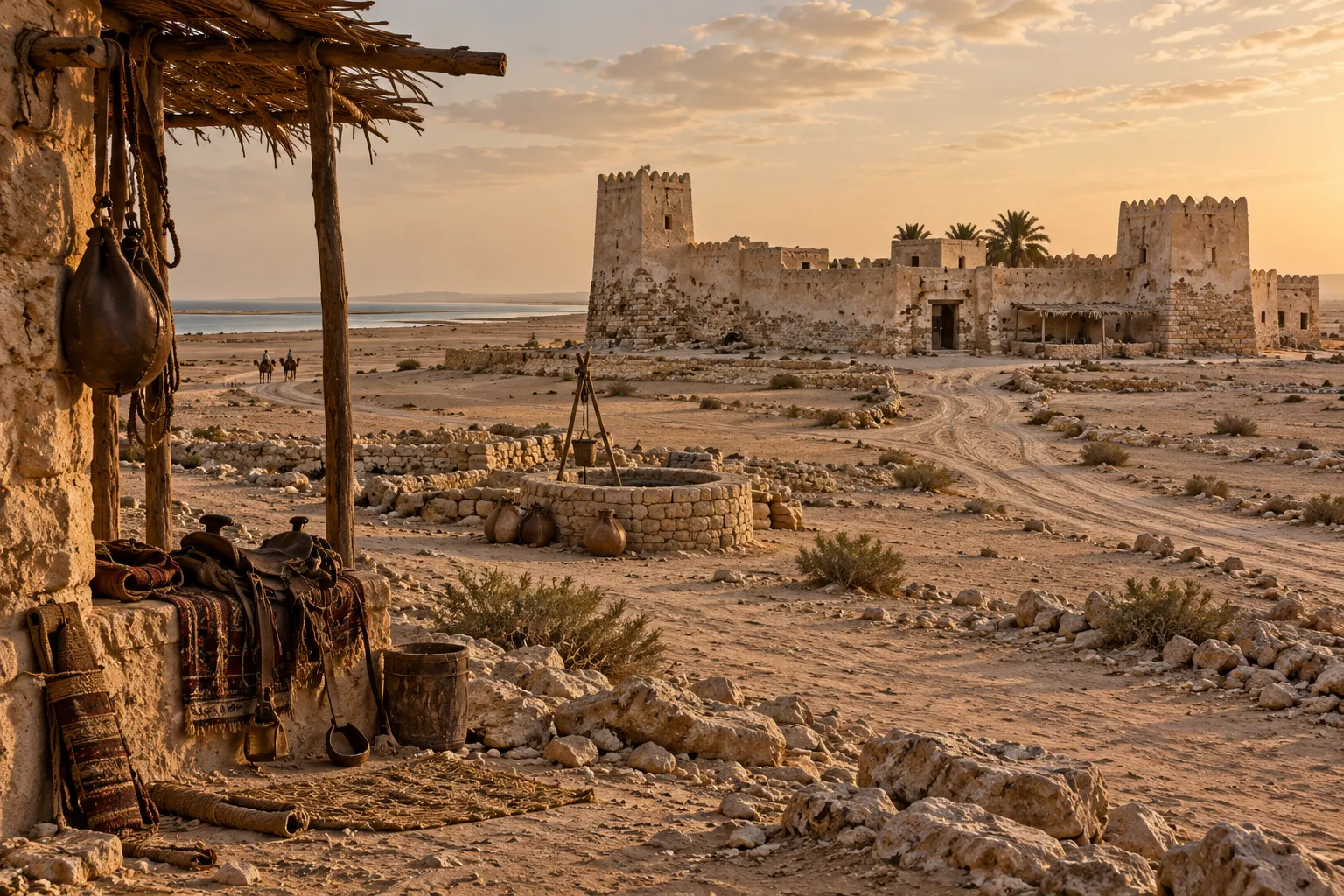
What is clearer is the operational result. Ottoman forces failed to impose the outcome they wanted and withdrew toward the fort at Al Bida under the protection of naval guns. Jassim’s side retained the ability to pressure the garrison and its water supply. The geography of wells, distance and desert movement mattered. This was not a European battlefield placed in Qatar. It was a Gulf confrontation shaped by local terrain and local knowledge.
The battle did not end with a declaration of independence
This is the point most worth protecting from simplification. Al Wajbah did not produce a modern independence document, and the Ottoman relationship did not disappear the next morning. The Amiri Diwan notes that the Wali of Basra was removed and held responsible, while relations between Jassim and the Ottoman state were later restored. Qatar Digital Library records negotiations, the release of detainees and a settlement around Jassim’s official position.
So why does the battle matter? Because the confrontation demonstrated a limit. The empire could claim authority, but direct intervention against Jassim had failed militarily and politically. Local power had shown that it could not simply be bypassed. That is a different claim from saying Qatar became fully independent in 1893, and it is historically stronger.
Political identity is often asserted before it is legally defined
A modern state has borders, ministries, citizenship law, diplomatic recognition and institutions that nineteenth-century Qatar did not yet possess in their current form. But political identity can exist before all of those structures are complete. It appears when a community recognises who can legitimately negotiate on its behalf, when outside powers discover that local authority has limits they cannot ignore, and when later generations remember a confrontation as part of a shared political story.
Al Wajbah fits that pattern. The battle did not create every element of Qatari statehood, but it strengthened Jassim’s position and became a reference point for the idea that Qatar’s internal affairs could not simply be reorganised from outside.
Al Wajbah matters most when we resist making it simpler than it was.
Meskaoui
Jassim should not be reduced to one victory
Battle anniversaries can flatten a life. Jassim’s political importance also came from decades of negotiation, tribal leadership, trade, religious learning, regional relations and the slow consolidation of authority. If we remember only the cavalry and the fort, we miss the harder work of politics that came before and after.
That broader perspective also links him back to Mohammed bin Thani. The father’s period belongs to the emergence of recognised leadership on the peninsula; the son’s period shows that leadership being tested against a larger imperial structure. Read together, the two lives explain more than either biography alone.
Al Zubarah reminds us that Qatar was never only Doha
Any history of Qatar that moves directly from Al Bida to modern Doha risks shrinking the peninsula. Northern settlements and older commercial centres mattered too. Al Zubarah shows how pearling, trade and regional movement had already created wealth and political competition on Qatar’s coast long before Al Wajbah.
That older maritime history matters because Jassim’s authority operated over a society connected to the sea as well as the desert. Revenue, security, boats, tribal movement and commercial routes were not background details. They were the material world from which politics was built.
The Ottoman archive and the Qatari memory answer different questions
An administrative report wants to know who disobeyed an order, how many troops moved, which official should be blamed and what settlement should follow. A national memory asks why an event mattered to the people who inherited it. Those are not identical questions, and forcing one source to answer the other can distort both.
For MESKI, the useful approach is to let the layers remain visible. The Amiri Diwan is explicit that Al Wajbah became a landmark in Qatar’s history. The British records preserve details of summonses, detention, military movement and negotiation. Together they show how a local confrontation became larger than a single afternoon.
From Wajbah to the Qatar we recognise now is not a straight road
After 1893 came more Ottoman years, changing British policy, the First World War, the 1916 treaty relationship with Britain, the oil era and eventually independence in 1971. Al Wajbah should not be made to predict all of that. History looks inevitable only when read backwards.
What the battle gives us is something more precise: a moment when Jassim bin Mohammed Al Thani proved that political authority inside Qatar had to be negotiated with him, not simply declared over him. That is enough to explain why the episode still carries weight.
Why the story still belongs beside modern Doha
Today Qatar presents itself through museums, diplomacy, architecture, sport and a capital transformed beyond recognition. In our cultural route through Doha, the question was how a fast-changing country chooses what to preserve. Al Wajbah is part of the answer because political memory survives differently from a building or an object.
You can restore a fort. You can display a document. But the deeper task is to remember what an event did and did not mean. For Al Wajbah, the strongest version is not the loudest. It is the one that recognises an Ottoman-Qatari relationship before the clash, a real military victory, continued negotiation afterwards and a lasting change in how Jassim’s authority was perceived.
Sources and Archive Notes
The Amiri Diwan biography of Sheikh Jassim bin Mohammed bin Thani describes his Ottoman titles, the dispute over direct intervention and Al Wajbah as a landmark in Qatar’s history.
Qatar Digital Library preserves British India Office reports from 1893 and later historical précis that describe the summons to Jassim, the detention of Ahmed, the fighting around Wajbah and the negotiations that followed. Those documents reflect British imperial interests and should be read as archival evidence, not as a neutral voice.
This article deliberately avoids precise casualty totals because contemporary and retrospective estimates vary. It also avoids describing 1893 as instant legal independence, since both Qatari and archival sources show continued political relations after the battle.
Questions People Ask
The confrontation took place in 1893. Contemporary records differ on the exact sequencing of individual engagements, but the crisis centred on the Ottoman campaign against Sheikh Jassim that spring.
Forces loyal to Sheikh Jassim bin Mohammed Al Thani fought Ottoman troops operating under the authority of the Wali of Basra.
Tensions grew over direct Ottoman intervention, administrative control, revenue and Jassim’s refusal to submit personally to the Wali under conditions he distrusted.
Yes. The Amiri Diwan records that he held Ottoman titles including kaimakam. That makes the later conflict a breakdown inside an existing political relationship, not a first encounter.
Archival accounts state that Ahmed and other prominent men were detained during failed negotiations and were later released as part of the settlement after the fighting.
No. Al Wajbah did not create immediate modern independence. Ottoman-Qatari relations continued, although the battle strengthened Jassim’s local authority and demonstrated limits to direct Ottoman intervention.
No. The relationship was repaired and Ottoman presence did not simply vanish after the battle. Qatar’s later political status developed through further stages.
It is remembered as a landmark in which Sheikh Jassim successfully defended local political authority and emerged with greater regional stature.
Mohammed bin Thani belongs to the earlier consolidation of leadership on the peninsula. Jassim inherited that political foundation and faced the sharper question of how it would coexist with Ottoman imperial authority.
Read Qatar as a connected history
Continue from Mohammed bin Thani to Al Zubarah and the cultural memory of modern Doha.