
A fortified pearl town rose on Qatar’s coast, traded across the Indian Ocean, burned in 1811, faded away — and then survived beneath the sand.
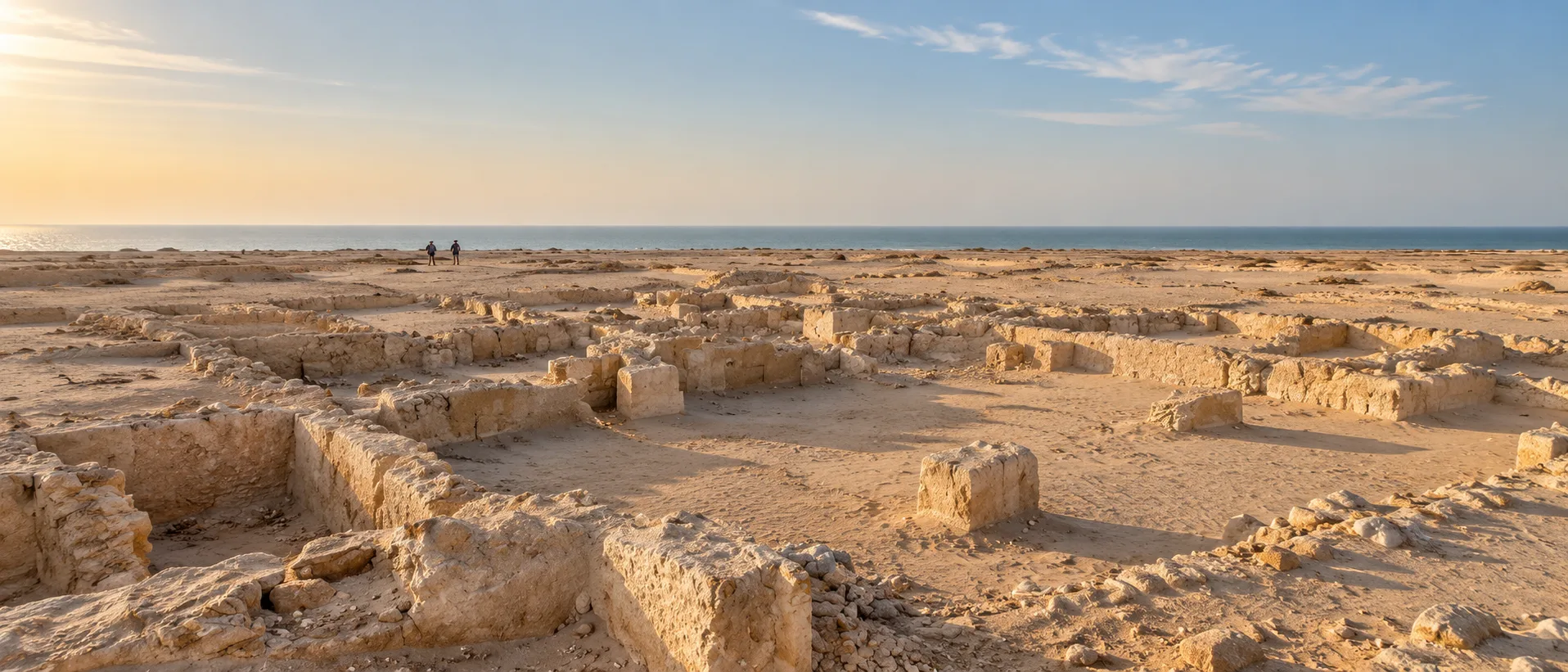
There are ruins that survive because people protect them. Al Zubarah survived for another reason: after the city declined, the desert began to cover it. Beneath that sand remained the plan of a Gulf trading town once filled with pearl merchants, houses, mosques, markets, date presses, sailors and goods arriving from far beyond Qatar.
A City That Survived Because It Disappeared
Most successful Gulf ports were rebuilt, expanded or absorbed by newer cities. Al Zubarah followed a stranger path. It flourished rapidly, was largely destroyed in 1811, declined, and by the early twentieth century had been abandoned. Then wind-blown desert sand gradually covered the fallen stone and mortar.
That burial was destructive to the living town but protective to the archaeological one. UNESCO records remains of streets, courtyard houses, mosques, palaces, fishermen’s huts, the harbour and defensive walls. Qatar Museums describes Al Zubarah as the best-preserved example of an eighteenth- to nineteenth-century trading and pearl-fishing town in the Gulf.
The city survived because nobody built another city directly on top of it.
Before Doha Dominated the Map
It is difficult to look at Qatar today without Doha occupying almost the entire mental picture. Al Zubarah reverses that perspective.
In the mid-eighteenth century, merchants established a fortified settlement on Qatar’s northwest coast. UNESCO attributes its foundation to Utub merchants from Kuwait. Within decades it had become a major centre for pearling and trade, connected to Arabia, Western Asia and the Indian Ocean.
This was not a fishing camp waiting for modernity. It had markets, large houses, mosques, industrial activity, fortifications and an organised street plan.
Pearls Were Not Decoration. They Were an Economy.
Today a pearl is usually encountered as jewellery. In eighteenth-century Al Zubarah, pearls were labour, risk, credit, commerce and wealth.
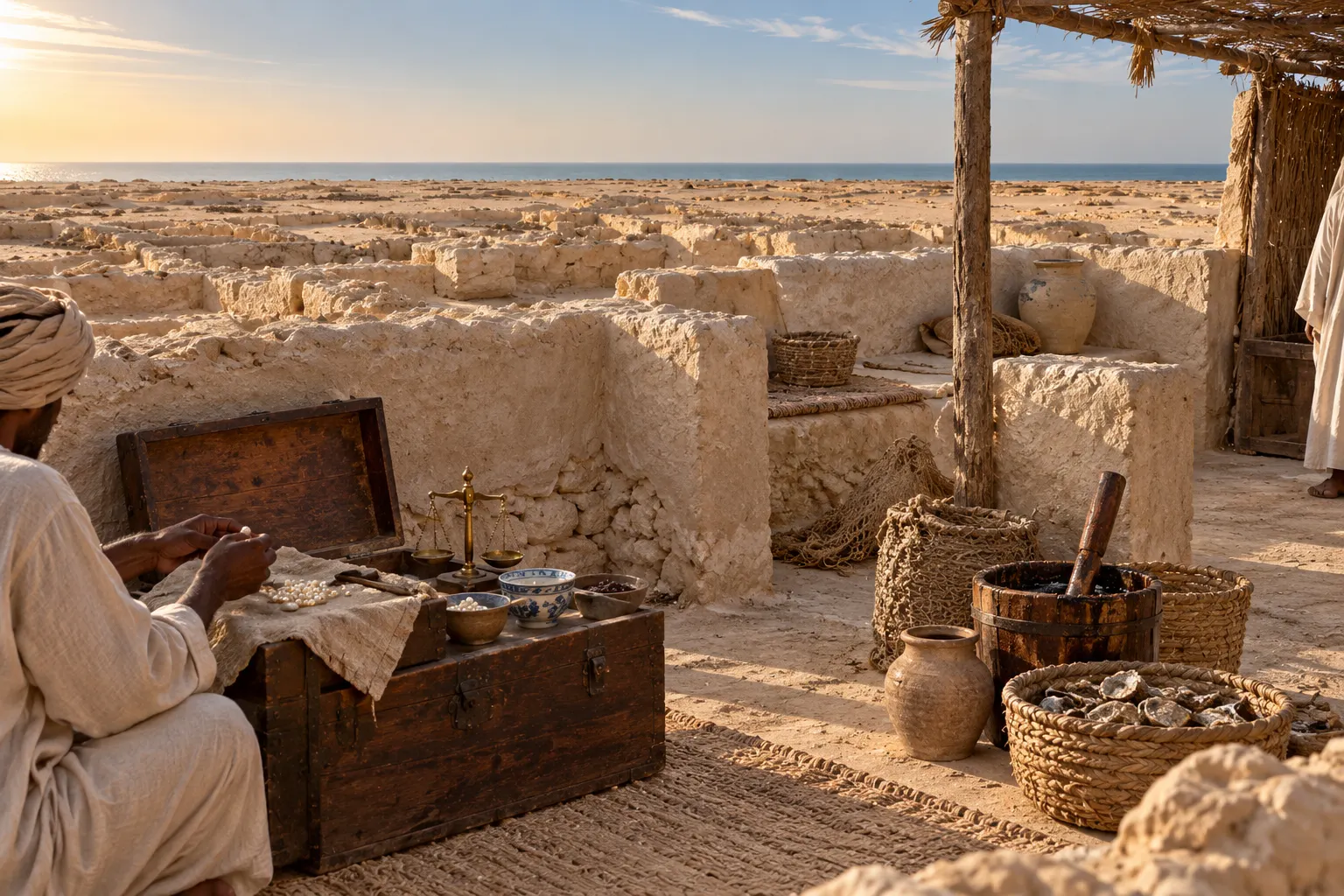
Divers went to the pearl banks. Boats carried crews for long seasons. Merchants evaluated, financed and sold the harvest. Qatar Museums has even recovered an eighteenth-century pearl merchant’s chest near Al Zubarah, a small object that could hold scales, records and tools used in the trade.
Our article on traditional gifts from Qatar explains why pearls still carry cultural meaning today, even though the old pearling economy has vanished.
The Sea Connected Al Zubarah to a Much Larger World
UNESCO describes trading links reaching the Indian Ocean, Arabia and Western Asia. Archaeology makes those words tangible.
Qatar Museums has presented ceramics from China, Japan and the Gulf among finds connected to the town. A port city could be physically small and globally connected. Goods moved through dhow routes, merchants carried languages and habits, and imported objects entered private homes.
The pre-oil Gulf was not isolated. It was connected differently.
Dates Belonged to the Economy Too
Pearls dominate the story because they were high-value exports, but archaeology reminds us that cities cannot live on prestige goods alone.
Qatar Museums has documented more than sixty date presses, or madabis, in the Al Zubarah suq area. They were used to produce dibs, date syrup, and their concentration suggests organised production.
I love this detail because it puts an ordinary food beside the famous pearl. One product crossed oceans because it was precious. Another made a local fruit easier to store, share and trade.
Before Refrigeration, Food Had to Survive the Journey
Before supermarket logistics and cold chains, food had to make sense in heat, on boats and across distance. Dates, syrup, dried fish, grains and spices mattered because travel was slow and storage was difficult.
The point is not that people lived on a romantic handful of dates. Ports imported and exchanged a wide range of goods. The point is that preservation shaped what travelled.
Honey belongs naturally to that wider history even when it is not the subject of Al Zubarah. Some foods were made for journeys long before anyone used the phrase supply chain.
Water Was Trade Infrastructure
A port can have a sea full of water and still face the problem of drinking water.
UNESCO’s Al Zubarah property includes nearby Qal’at Murair, where archaeological evidence helps explain how desert water supplies were managed and protected. Wells, channels and water control were not background details. They were part of whether a settlement could survive.
Before oil, roads and air conditioning, water was infrastructure in the most literal sense.
The City Had Courtyards and Ordinary Mornings
Archaeology becomes more interesting when we stop looking only for rulers and battles.
Al Zubarah preserves courtyard houses, fishermen’s huts, markets, mosques and industrial areas. Domestic spaces reveal cooking, date-syrup production and imported ceramics entering family life.
People woke up. Food was prepared. Merchants waited. Sailors repaired things. Someone worried about a boat that had not returned. A lost city matters because ordinary life was once ordinary there.
Fortified Against a Competitive Gulf
Al Zubarah’s walls remind us that trade and security were inseparable.
UNESCO places the town within a wider chain of fortified Gulf trading settlements that competed across centuries of Indian Ocean commerce. Prosperity attracted attention, and Qatar Museums notes that the town was burned to the ground in 1811 after repeated attacks.
A rich port had to protect its market, its people, its water and the wealth moving through it.
1811 Was a Destruction, Not the Exact End
History often gets flattened into one date. Al Zubarah was largely destroyed in 1811, but UNESCO states that final abandonment came in the early twentieth century.
People leave cities in stages. Trade routes change. Political power shifts. Buildings are reused, repaired or left behind. Population thins.
By the time the last occupation faded, Al Zubarah’s great commercial moment was already memory.
Then the Desert Became the Archivist
Once the town was abandoned, walls collapsed and desert wind began to cover them.
UNESCO describes this layer of sand as protective. That is the extraordinary reversal at the heart of Al Zubarah: the same environment that made settlement difficult later helped conserve the city’s plan.
The desert kept the outline of a city after the city had stopped keeping itself.
Why the Real Ruins Matter
There is a difference between walking through architecture recreated to suggest the past and walking over the remains of a real city.
At Al Zubarah, the gaps matter. Much of the power lies in knowing that the lines in the ground are not a stage set. Qatar Museums notes that only parts of the town have been excavated.
I prefer that incompleteness. It leaves room for archaeology instead of turning the site into theatre.
Do Not Confuse the 1938 Fort With the Eighteenth-Century City
Visitors naturally associate Al Zubarah with the square fort that appears in photographs. But the standing Al Zubarah Fort dates to 1938, long after the city’s main pearling age.
The UNESCO property is much larger and includes the archaeological town and nearby Qal’at Murair. The fort is a useful landmark, not the whole story.
From Al Zubarah to Souq Waqif
If Al Zubarah shows one older Gulf trade system, Souq Waqif shows a later and still living one.
Our Souq Waqif visitor guide begins with the same idea: markets matter because goods, information, habits and people move through them.
The goods changed. The scale changed. Doha replaced Al Zubarah as the country’s dominant urban centre. But the Gulf’s habit of acting as a meeting point did not begin with airports.
Al Zubarah and Qalhat: Two Ports, Two Different Silences
This article has a natural companion in Oman: The Port Where Arabia Met India: The Lost City of Qalhat.
Qalhat belonged to another period and political world, but the connection is useful. Both remind us that Arabian ports linked inland products to Indian Ocean trade. Both later lost their central role. Both are now read through ruins.
One sits on Qatar’s coast beneath desert sand. The other lies on Oman’s coast between mountain and sea.
Sources & Further Reading
The principal historical framework comes from the UNESCO World Heritage Centre entry for Al Zubarah, which documents the pearling economy, trade links, 1811 destruction, later abandonment and preservation under sand.
Qatar Museums provides local archaeological context through its Al Zubarah heritage-site guide, research on the date presses and suq excavations, and the pearl merchant’s chest.
Scenes of waiting, work and daily life are editorial reconstruction built around the archaeology, not claims that we know the thoughts of individual residents.
The City the Desert Kept
Al Zubarah became rich because the sea connected it to the world. It became archaeologically precious because the desert later covered what remained.
Between sea and sand sits a story of pearls, dates, water, imported ceramics, houses, merchants and people who once believed their city would continue.
It did not continue. But the street plan remained long enough for us to return.
Questions People Ask
A fortified Gulf trading town best known for pearling and long-distance commerce in the late eighteenth and early nineteenth centuries.
UNESCO states that the town was mostly destroyed in 1811. Final abandonment came later, in the early twentieth century.
After abandonment, wind-blown desert sand gradually covered collapsed structures and helped protect the archaeological remains.
Palaces, mosques, streets, courtyard houses, fishermen’s huts, harbour remains, defensive walls, water-related structures and cemeteries.
Its trade reached the Indian Ocean, Arabia and Western Asia, and archaeology shows imported materials from distant regions.
Yes. Qatar Museums has documented more than sixty date presses in the suq area.
No. The standing fort was built in 1938, after the city’s main commercial period.
It was inscribed on the UNESCO World Heritage List in 2013.
Follow the Old Gulf Ports
Al Zubarah is one piece of a larger maritime story. Continue through Qatar’s markets and the Omani port that once connected Arabia to India.