
This is not a ranking. It is a preference for honey that still feels attached to a difficult landscape.
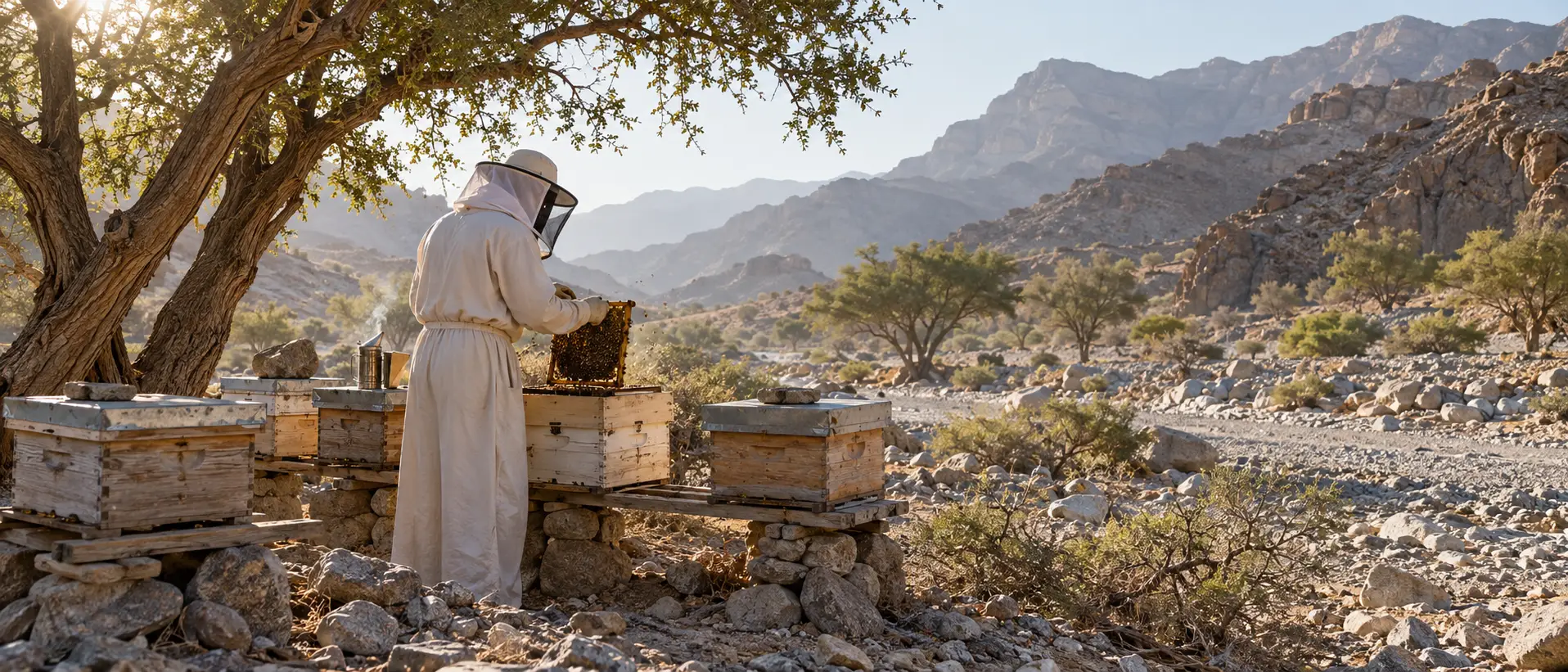
I like mountain honey more. There, I said it. Now comes the important part: explaining why without pretending that elevation turns every jar into something superior.
This is a preference, not a universal ranking
I keep coming back to mountain honey. That is a personal preference, not a claim that every mountain harvest is better than every valley, coastal or plain honey. I want to start there because food writing becomes dishonest very quickly when taste is dressed up as science.
What I like is the combination of landscape, effort, smaller forage pockets and the feeling that a harvest still belongs to a specific place. Sometimes that produces a honey I love. Sometimes it does not. Mountains do not sign quality certificates.
Difficulty of access changes the beekeeper’s work
Mountain apiaries can be harder to reach. Roads may be narrow, equipment has to be moved farther, terrain can slow inspection and harvest, and colonies may be distributed across sites that are inconvenient compared with flat agricultural land.
I like knowing that difficulty when it is real because it explains part of the economics of a small batch. It does not make the honey morally superior. It simply means the work behind a jar may be very different.
A mountain photograph can make me want the honey. It cannot make me trust the honey.
Meskaoui
The forage can be more fragmented
Mountain vegetation is often patchy. One wadi holds moisture, another slope stays dry, one altitude flowers earlier and another later. Bees respond to that mosaic rather than to the view we see from a road.
This can produce interesting seasonal differences. It can also make monofloral claims harder if several plants bloom together. Again, the mountain creates questions before it creates answers.
I like the distance from dense urban environments, with a big caveat
Part of my attraction is that mountain apiaries can be farther from heavy traffic, large urban centres and some forms of industrial pressure. I find that reassuring when the actual site supports the story.
But remoteness is not purity. Scientific reviews use bees as biomonitors because they collect environmental signals across their forage area. Pollutants can come from traffic, agriculture, air, water or long-range transport. A mountain photograph cannot prove a clean environment.
Bees do not respect the edge of the photograph
A hive placed beside a beautiful slope does not mean the bees remain on that slope. Depending on forage availability, honey bees can travel kilometres. One review notes that colonies integrate environmental information over a substantial surrounding area.
This is why I prefer beekeepers who understand the whole forage map: roads, farms, settlements, water points, flowering stands and seasonal movement. The honest mountain story is larger than the hero image.
Altitude changes climate indirectly
Higher ground can mean cooler nights, different wind exposure, altered humidity, shorter or delayed flowering and different vegetation. In Hatta, Dubai Municipality notes a mountain reserve ranging roughly from 250 to 1,060 metres, with wadis distributing rainwater and supporting distinctive flora.
In Oman, mountain and wadi environments also help create regional differences in Sidr and Samar harvests. The effect of altitude is real, but it acts through ecology. Altitude is not a mineral added to honey.
Documents decide whether I believe the story. Taste decides whether I love the jar.
Meskaoui
Wadis are usually more important than dramatic peaks
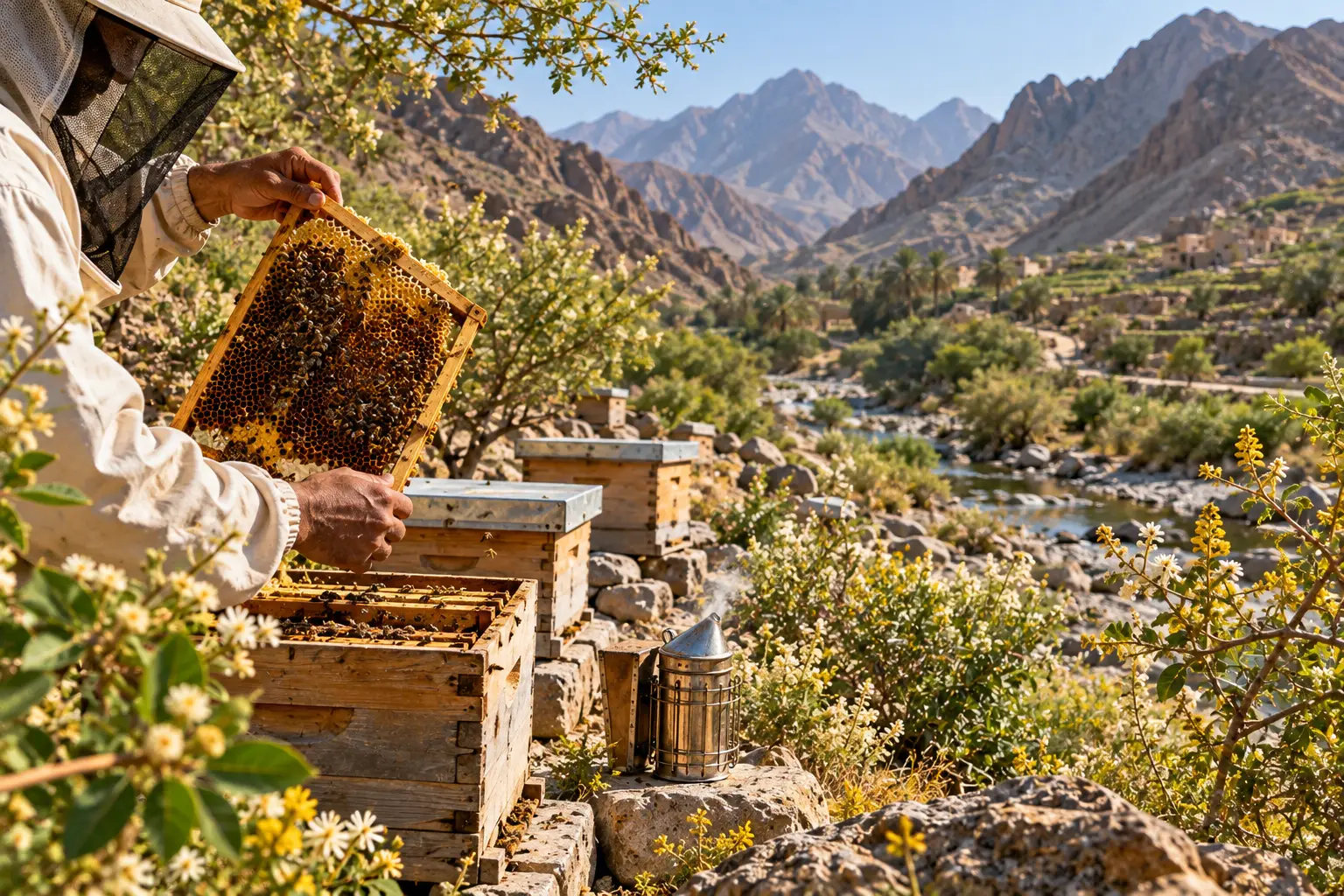
I love mountains visually, but bees are practical. A dry peak may be useless while a modest wadi below it concentrates moisture, flowering shrubs and agricultural edges.
This is why my favourite mountain honey stories are often really water stories. Where did runoff stay? Which slope held vegetation? Which terrace flowered? The answer is less romantic and more interesting.
Small batches attract me
Mountain sites can sometimes produce smaller or more separated harvests. When a beekeeper chooses to keep one flowering period apart from another, the jar can preserve more seasonal identity.
I am not saying small always means better. Small can also mean inconsistent, poorly handled or under-tested. What I like is the possibility of precision: this site, this month, this flowering.
I prefer variation to factory consistency
If a natural honey tastes exactly the same every year, I start asking how much blending was required to create that consistency. Large brands may need a stable profile, and there is nothing inherently wrong with blending when it is honestly described.
But personally I enjoy variation. A darker year, a more aromatic batch, a faster crystallisation, a different balance. Agricultural products should be allowed to remember the season.
Mountain honey should not become another myth
The phrase mountain honey is powerful marketing. It can suggest purity, health, tradition and remoteness without proving any of them. That makes it dangerous.
I want to keep the phrase but remove the magic. Tell me the mountain range, altitude if useful, forage, harvest month and apiary conditions. Then the word mountain starts meaning something.
Hatta explains why I like this category
Hatta is a good example because the mountains, wadis, farms and desert-adapted trees sit close together. Local producers offer different seasonal honeys, including wildflower and Ghaf, and Dubai Municipality has built a public honey festival around local production.
Our Hatta honey article goes deeper into those conditions. What attracts me is not simply elevation. It is the number of ecological changes packed into a small area.
Oman gives the preference another scale
Oman’s honey map is larger. Mountains, wadis, plains and Dhofar produce very different contexts, and 2025 production data show a sector spread across several governorates.
This diversity is one reason I enjoy Omani mountain honey. A jar from Al Dakhiliyah is not interesting because Oman is exotic. It is interesting when the beekeeper can connect it to a specific flowering landscape.
Yemen reminds us that mountain prestige creates fraud risk
High-reputation Yemeni Sidr is a perfect warning. Scientific work has tried to authenticate botanical and geographical origin precisely because famous premium honey attracts adulteration and mislabelling.
The more we romanticise mountain origin, the more valuable the word becomes and the more carefully we should verify it. Desire should increase scrutiny, not reduce it.
What I look for before I buy
I want a named region, not only mountain honey. I want a harvest period. I want to know whether the honey is claimed as monofloral or mixed floral. I want a batch identity and sensible storage. If the seller has analysis, I want it connected to the actual lot.
Then I taste. Taste decides whether I love it. Documents decide whether I believe the story.
Why I keep coming back
I like honey that makes me picture the route to the hive. I like when the landscape explains the aroma instead of serving as decoration. I like the difficulty, the seasonality and the possibility that next year’s jar will not be identical.
Does mountain honey automatically mean better honey? No. Do I often prefer it? Yes. That is enough for a personal article.
I do not need mountain honey to be healthier
I am not looking for a medical excuse for my preference. Honey from a mountain does not become medicine because the road was difficult.
What I want is flavour, aroma, origin and a relationship to place. Removing exaggerated health claims actually makes the category more interesting to me.
A difficult landscape can protect small differences
Where access is harder and forage is separated by altitude or wadi systems, it may be practical to keep some harvests apart. That can preserve differences that would disappear in a large blended supply chain.
This is not guaranteed, but when a beekeeper uses the landscape to separate lots thoughtfully, I pay attention.
Maybe I am biased
I grew interested in honey through origins and difficult landscapes, so of course I am biased toward places that give me more geography to think about. I am fine admitting that.
Preference becomes a problem only when we disguise it as a universal rule. I can love mountain honey and still buy an exceptional coastal or desert harvest tomorrow.
One last MESKI rule
I would rather leave a documented limit visible than fill it with a perfect story. A tree can be real and a honey claim still need proof. A brand can be prestigious and a historical anecdote still need sourcing.
That distinction is part of the Journal’s voice. Curiosity is stronger when it is allowed to say: this is what we know, and this is where the evidence stops.
What makes the story worth publishing
The subject earns its place when it teaches something beyond the product: how a landscape works, how a gift carries meaning, how a material moves through history or how a beekeeper reads a season.
If the reader only remembers the jar, we have written an advertisement. If the jar becomes more interesting because the world around it is clearer, we have written MESKI.
One last MESKI rule
I would rather leave a documented limit visible than fill it with a perfect story. A tree can be real and a honey claim still need proof. A brand can be prestigious and a historical anecdote still need sourcing.
That distinction is part of the Journal’s voice. Curiosity is stronger when it is allowed to say: this is what we know, and this is where the evidence stops.
What makes the story worth publishing
The subject earns its place when it teaches something beyond the product: how a landscape works, how a gift carries meaning, how a material moves through history or how a beekeeper reads a season.
If the reader only remembers the jar, we have written an advertisement. If the jar becomes more interesting because the world around it is clearer, we have written MESKI.
Questions People Ask
No. Mountain origin can create distinctive forage and climate, but quality depends on the actual harvest, beekeeper, storage and traceability.
Not automatically. Mountain sites may be farther from dense urban pollution, but bees forage widely and environmental contaminants can travel.
Bees commonly forage beyond the immediate hive area and can travel kilometres when resources require it, so the wider landscape matters.
Indirectly. Altitude can change temperature, humidity, wind and flowering, which changes the forage available to bees.
Rainfall, flowering timing, temperature, available plants and colony conditions all change from season to season.
No. Small batches can preserve seasonal identity, but they still need good beekeeping, hygiene, storage and honest labelling.
Yes. A prestigious geographic story can actually increase fraud risk because the name commands a higher price.
A meaningful region, harvest period, forage claim, batch identity, supplier or beekeeper chain and storage information are useful.
For the combination of landscape, seasonality, smaller forage pockets and the sense of a traceable place, while recognising that this is a personal preference.
Preference should create better questions
Continue into Hatta, Nizwa and the Honey Atlas, where mountain honey becomes a set of real places instead of one romantic category.