
Saudi Arabia · Oasis & Culture
Al Ahsa Oasis:
Dates, Water and a Different Saudi Arabia
From outside, an oasis can look familiar: palms, water and shade. Walk deeper and every oasis begins to reveal a different relationship with fruit, land, language and memory.
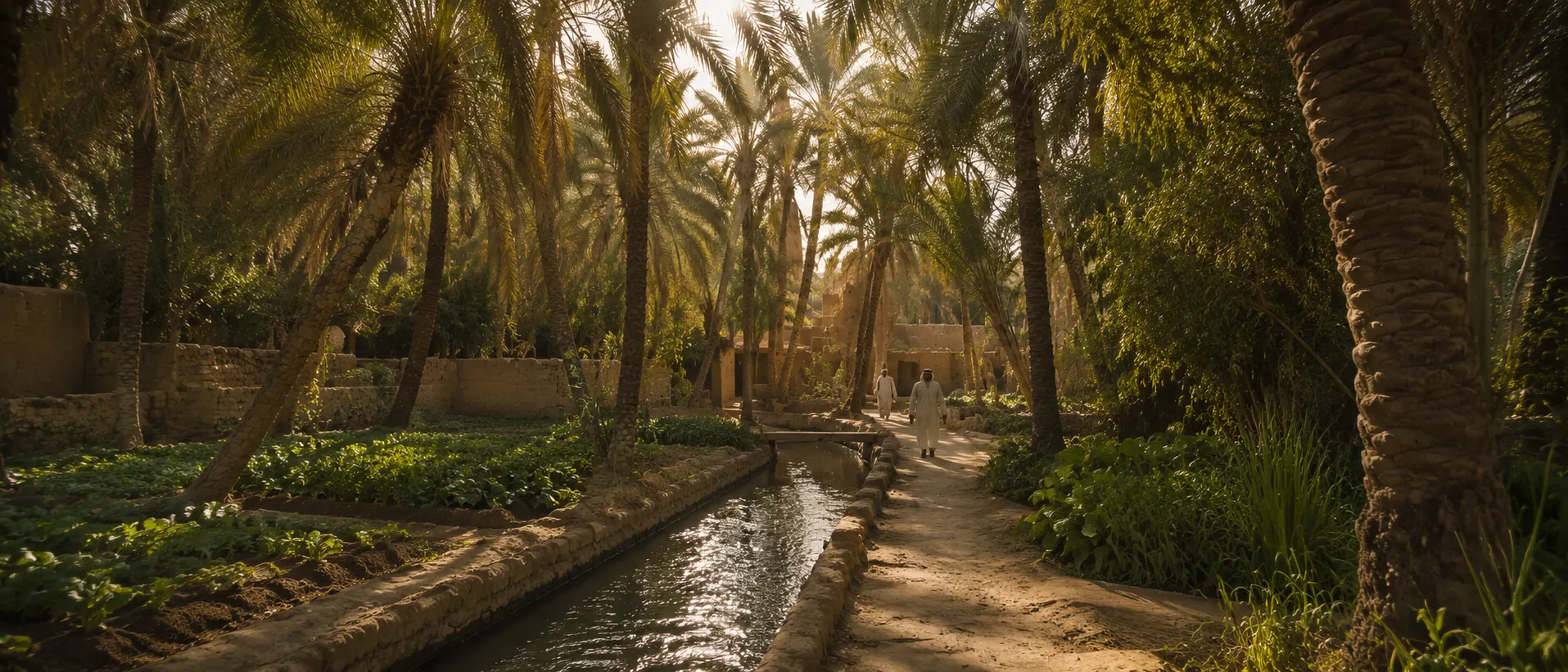
Oases give me a feeling I recognise immediately.
Shade after heat. Water beside dry land. Palm leaves moving above narrow paths. Fruit hanging where the landscape outside seems to promise almost nothing.
Morocco, Oman, Saudi Arabia.
The first sensation can feel strangely familiar. The details never are.
“An oasis can give you the feeling of déjà vu, then offer you a fruit, a word or a habit that reminds you that you have arrived somewhere else.”
Meskaoui
Al Ahsa Is More Than a Palm Grove
UNESCO describes Al Ahsa, in eastern Saudi Arabia, as an evolving cultural landscape made of gardens, canals, springs, wells, a drainage lake, historic buildings, urban fabric and archaeological sites.
It is therefore misleading to imagine one endless block of date palms.
The oasis is a network of natural resources and human decisions accumulated over a very long period.
More Than 2.5 Million Date Palms
UNESCO records more than 2.5 million date palms within the wider Al Ahsa cultural landscape.
The number is impressive, but quantity is not what interests me most.
What interests me is the idea that so many palms can grow from a long relationship between groundwater, channels, cultivation and settlement.
A green landscape in a desert environment is rarely an accident.
The Date Palm Is Familiar, the Date Is Not
This is one of the pleasures of oasis cultures.
You recognise the palm immediately. Then someone offers you a date and the familiarity disappears.
The fruit may be softer, firmer, darker, more caramel-like, less sweet, more fibrous or eaten at another stage of ripeness.
The palm is shared language. The variety is local accent.
Some Trees Feed the Palm Grove Without Producing Dates
Oasis agriculture is rarely built from one plant alone.
Other fruit trees, crops and vegetation can occupy different levels of the cultivated space, benefiting from shade and irrigation.
The palm canopy may dominate the view, but beneath it is another agricultural world.
Water Made Settlement Possible
UNESCO links Al Ahsa’s long human occupation to its springs, wells and canal networks.
Where water can be managed, people can stay.
Where people stay, they build houses, markets, mosques, gardens and memory.
Qaisariya Souq and the Human Side of the Oasis
The UNESCO property includes Suq al-Qaysariyah in Al Hofuf among its components.
This is important because an oasis is not only agricultural.
Fruit must be sold. Goods move. Crafts develop. People meet.
The market is where the cultivated landscape becomes social life.
A Shared Language, Different Accents
I often think about Arab countries in the same way.
Arabic gives millions of people a common base. Pronunciation changes. Vocabulary shifts. Yet people still find ways to understand one another.
Traditions can work the same way. Coffee, dates, hospitality, modest dress, family gatherings and the rhythm of Ramadan may feel familiar across borders, while the details remain local.
For me, that does not weaken a shared culture. It makes it richer.
Why Al Ahsa Belongs in the Story of Saudi Arabia
Saudi Arabia is often reduced visually to desert, Riyadh skylines, Makkah, Madinah or the monumental landscapes of AlUla.
Al Ahsa offers another image.
Water. Agriculture. Date palms. Old settlements.
A living cultural landscape that did not stop evolving when modern Saudi Arabia arrived.
Al Ahsa Oasis
UNESCO recognises Al Ahsa as an evolving cultural landscape showing a long relationship between water management, agriculture, settlement, historic architecture and oasis life.
UNESCO records more than 2.5 million date palms across the Al Ahsa cultural landscape.