
Food & Hospitality · Honey Academy
One Name, Many Baklavas: Why I Still Prefer My Mother’s
Baklava crosses borders and changes with them. Pistachio, walnut, almond, sugar syrup, honey. I still come back to my mother’s.
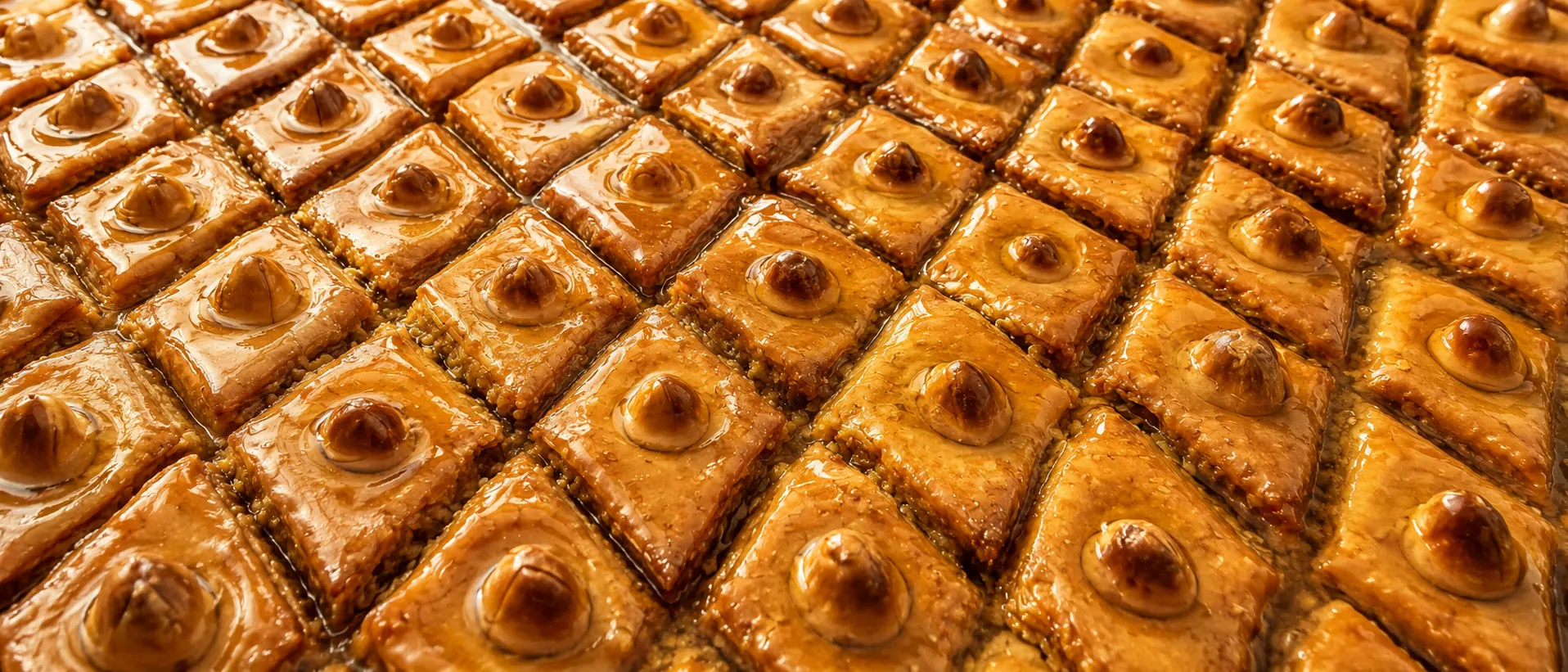
Baklava is one of those foods that teaches you very quickly that a name can travel farther than a recipe.
Say “baklava” in Türkiye, “baklawa” in Lebanon, or “pakhlava” farther east, and everyone seems to know what family of pastry you mean. Thin layers. Butter or ghee. Nuts. Sweetness. A tray cut into pieces and shared.
Then you taste them.
And suddenly the similarities become much less important than the differences.
The nuts change. The syrup changes. The perfume changes. The colour changes. Even what people consider the “right” level of sweetness changes.
I enjoy discovering those differences. I really do.
But I have one problem.
I grew up with my mother’s baklawa as my reference.
That has made me difficult.
Türkiye: pistachio, precision and syrup
Gaziantep baklava is probably one of the clearest examples of how specific a regional baklava can become. The registered Gaziantep version is built around very thin pastry, Antep pistachios, butter, semolina cream and syrup. Official Turkish descriptions also emphasise the pistachio, the fine layers and a sugar-and-lemon syrup rather than honey.
I respect that completely.
In fact, that is one of the things I like about travelling through food. A recipe does not need my approval to be authentic to the people who make it.
But it also means that when someone says “baklava,” I no longer assume we are talking about the same dessert.
Lebanon: the perfume can change everything
Lebanese baklawa often moves in another direction. The sweetness commonly comes from an atter, a sugar syrup scented with orange blossom water or rose water. The nut mixture and the colour of the pastry can also be lighter and more restrained than some neighbouring versions.
That orange blossom aroma is beautiful.
It can turn a simple syrup into something immediately recognisable.
But this is where my personal taste begins to interfere with my respect for tradition.
If I am making baklawa at home for myself, I do not want sweetness to be only sugar carrying a perfume.
I want the sweetness itself to have a story.
Greece: honey enters the conversation
Cross again into Greece and honey appears much more naturally in many baklava recipes, often alongside sugar, walnuts, cinnamon or other spices. Even within Greece, there is no single tray that explains everything. Regional pastries and syrup traditions vary.
This is closer to the direction I like.
Not because honey automatically makes a baklava “better.” That would be too easy, and it would erase the logic of other traditions.
I simply like what happens when the sweetener has its own aroma, its own origin and its own character.
Azerbaijan: the same family, another language
Travel farther and the pastry changes again. Azerbaijani pakhlava can bring walnuts, cardamom, saffron and honey into the same conversation. Even inside Azerbaijan, regional forms differ in shape and preparation.
This is the part I find fascinating.
We keep recognising the same family of dessert, but every place seems to dress it in its own memory.
A recipe can cross a border without arriving unchanged. That is not a weakness. That is how food remembers where it has been.
Meskaoui
North Africa: almonds, orange blossom and family recipes
North Africa gives the story yet another accent. Algerian baklawa is particularly associated with almonds, orange blossom and, in many family preparations, honey. In Morocco, I would be more careful about pretending there is one official national baklava that everyone makes the same way. There is not one tray that can speak for every Moroccan home.
And perhaps that is exactly why this part matters so much to me.
For me, Morocco enters this story through family.
Through the version made at home.
Through my mother.
I rarely buy baklava
I know this is unfair to many excellent pastry shops.
But I rarely buy it.
I can admire a Turkish baklava. I can enjoy Lebanese orange blossom. I can understand why someone loves a very sweet syrup. I can happily taste a walnut version, a pistachio version or an almond one.
Then my brain does something annoying.
It compares everything with my mother’s.
And my mother usually wins.
There is no scientific explanation for this.
It is memory. It is habit. It is the taste you learned before you learned to compare tastes.
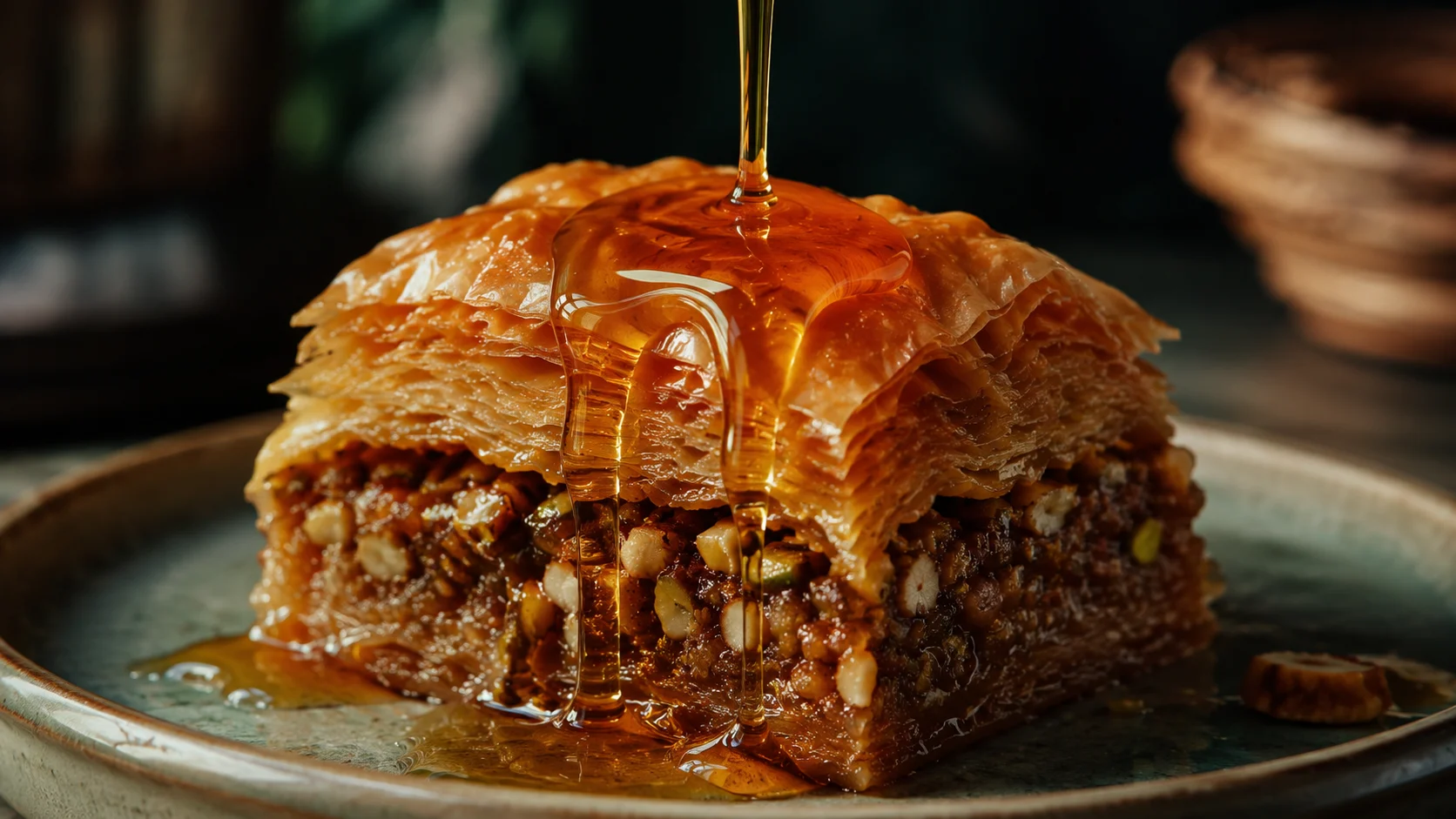
And then I made the problem worse with honey
At some point, I started making my own choice for the syrup.
If I am going to make baklawa for myself, I want a real honey.
Not because I am trying to correct centuries of pastry tradition. I am not. A classic Gaziantep baklava should remain itself. A Lebanese baklawa scented with orange blossom should remain itself.
This is simply my tray.
And on my tray, I like pure raw honey with character.
Sometimes Sidr.
Sometimes a honey from Socotra when I want something more forceful and aromatic.
That changes the dessert completely.
The sweetness is no longer neutral. The honey starts speaking with the nuts and the butter. A dark or intense honey can push the baklawa into something richer, deeper and almost excessive.
Which is exactly the point.
My little luxury baklawa
I sometimes call it my luxury baklawa.
Not because I add gold leaf. Not because it needs a velvet box. And certainly not because I need to make it look expensive.
It is luxurious because I use a honey that I would happily eat by the spoon, and then I decide to sacrifice some of it to a tray of baklawa.
That is already a serious decision.
Raw honey is a taste choice here, not a slogan
I use the word raw carefully.
For me, in this recipe, the attraction is not a health promise. It is flavour and identity. I do not want to take a honey chosen for its aroma and turn it into an anonymous boiled sweetness.
I want to recognise it.
If I choose Sidr, I want some of that character to remain. If I choose a stronger Socotra honey, I want to know that it is there.
Otherwise, for my own taste, I might as well use sugar and keep the honey for breakfast.
“If it is only sugar, I can eat my own sugar”
I say this jokingly, but there is some truth in it.
A sugar syrup with orange blossom can be delicious. It can be traditional. It can be perfectly made.
I am not arguing against it.
I am simply explaining why, at home, I go in another direction.
If the entire sweetness comes from sugar, I start thinking: if I am going to eat sugar, I already have sugar at home.
So I choose the honey.
And then I choose a honey that refuses to disappear.
The recipe belongs to the person who makes it
Perhaps that is what baklava teaches best.
There are famous versions, protected versions, regional versions and family versions. There are recipes people defend fiercely and recipes that change every generation.
They do not have to cancel one another.
The Turkish tray can remain Turkish. The Lebanese tray can smell of orange blossom. The Greek tray can carry honey and walnut. Azerbaijani pakhlava can bring saffron and cardamom. North African families can make almonds and floral water part of their own language.
And I can still prefer my mother’s.
That is the beauty of it.
The one I keep for myself
When I use a beautiful Sidr or a stronger honey from Socotra, I admit that I become slightly less generous.
This is the tray I call “for the family,” while quietly calculating how many pieces are left.
I love it too much.
Hmmmm.
If you want some, no problem. Let me know. I like sharing.
But careful…
Not too much.
Baklava, Honey and Family Recipes
Not in the protected Gaziantep Baklavası specification. Its syrup is made with sugar or sweetener, and the specification explicitly says honey should not be used. Using Sidr honey is therefore my own family-style variation, not a claim about traditional Gaziantep baklava.
Many Lebanese baklawa recipes use a sugar syrup perfumed with orange blossom water or rose water. That floral syrup can change the character of the pastry even when the basic family of filo, butter and nuts remains familiar.
Yes, in a personal recipe. Sidr brings its own aroma and depth, so the result will not taste like a neutral sugar syrup. I use it because I want the sweetener itself to remain part of the flavour rather than disappear behind the pastry.
Because the name covers many regional and family traditions. The nuts, fat, syrup, floral water, spices, pastry thickness and baking style can all change from one country or household to another.
A powerful honey can remain noticeable beside butter and nuts instead of acting only as sweetness. In my own version, that makes the baklava deeper and more intense, which is why I save that variation for the trays I enjoy most.
Continue at the Table
From a family tray of baklava to the honeys, places and food memories that give sweetness its character.