
Culture & Traditions · Memory
Balqees:
The Name Memory Refused to Lose
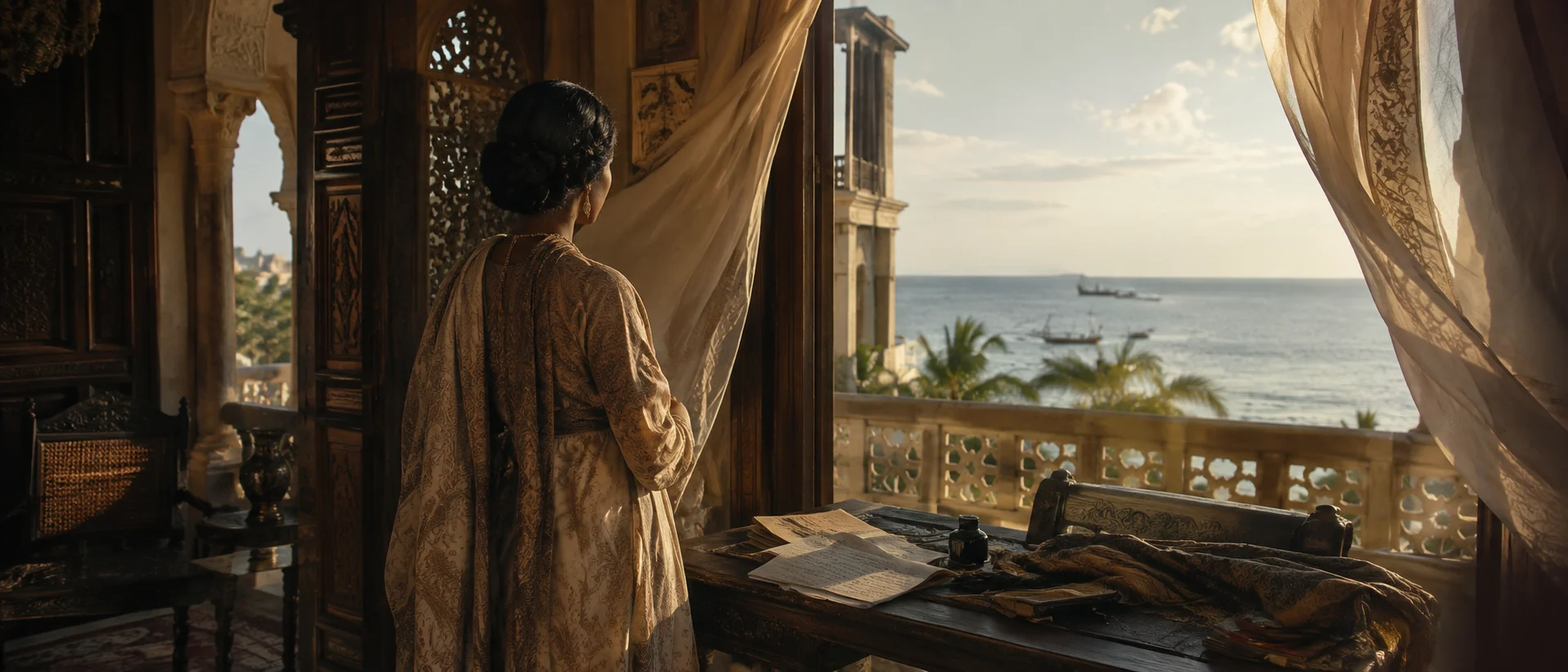
The Quran tells us about her throne, her people, her decisions and her encounter with Solomon. It does not tell us her name. And yet, centuries later, millions know her as Balqees.
Some names survive because they were written into history.
Others seem to survive because people kept carrying them.
Balqees belongs to the second kind.
In Arabic, her name is written بلقيس.
In English, you will find Bilqis, Balqees and sometimes Balkis.
The spellings move. The woman behind them remains strangely familiar.
That is what interests me most.
Not only who the Queen of Sheba was, but how a name can become part of collective memory
even when the sacred text that tells her story never gives it to us.
First, a Woman Without a Name
In Surah An-Naml, the hoopoe returns to Solomon with news from Saba. It says that it found a woman ruling over them, that she had been given much, and that she possessed a magnificent throne.
The narrative continues. She receives Solomon’s letter. She gathers her council. She asks for their opinion. She chooses to send a gift before taking the next step. Later she travels, sees what has happened to her throne, enters the palace and finally speaks for herself.
There is detail. There is movement. There is character.
But there is no personal name.
The Quran calls the place Saba and describes the woman who rules it. It never says: her name was Bilqis.
You can read the passage directly in Surah An-Naml, verses 22 to 44.
“History preserves what was written. Memory sometimes preserves what history forgot.”
Meskaoui
What the Story Preserves Instead
I find the absence of her name interesting because the story does not make her absent. Quite the opposite.
We see a ruler faced with unexpected information. We see her consult those around her rather than rush into a decision. We see diplomacy before confrontation. We see a woman who observes, questions and changes her position when what she encounters changes her understanding.
A name would have made her easier to label. The story gives us something harder to reduce: a sequence of choices.
Perhaps that is one reason she remained memorable. Before later generations gave us the name Balqees, the narrative had already given her a presence.
So Where Does the Name Balqees Come From?
The name appears in the later Arabic and Islamic exegetical tradition.
Classical commentators identify the ruler of Saba as Balqis. Al-Zamakhshari, for example, refers to her as Balqis bint Sharahil in his commentary on verse 27:23. Other tafsir traditions also preserve the name.
That distinction matters.
It is accurate to say that Balqees is the traditional Arabic name of the Queen of Sheba. It is not accurate to say that the Quran itself names her Balqees.
The difference is small in one sentence and enormous in historical terms.
For a classical commentary example, see Al-Zamakhshari on Surah An-Naml 27:23.
Bilqis, Balqees, Balkis: Which Spelling Is Correct?
They point to the same Arabic name: بلقيس.
Bilqis is common in more formal transliteration. Balqees is a familiar modern English spelling. Balkis appears in other linguistic traditions.
I would not spend too much time trying to make one spelling defeat the others.
A transliteration is a bridge between alphabets. Bridges change shape depending on where they are built. The Arabic name remains بلقيس.
What Does Balqees Mean?
This is where certainty becomes dangerous.
You will find websites giving confident meanings for the name Balqees. Some present one etymology as if it were settled fact. Historical tradition is much clearer about using the name than about proving one universally accepted origin for it.
So I prefer a less impressive answer and a more accurate one: the exact etymology of Balqees is not securely established enough to pretend that one popular translation settles the question.
Sometimes admitting what we do not know protects a story better than decorating it.
The Bible Does Something Similar
The Hebrew Bible also presents her by title rather than by a personal name. In 1 Kings 10 she is simply the Queen of Sheba, arriving to test Solomon with difficult questions.
The details differ between traditions, and they should not be flattened into one account. But there is a curious point of contact: one of the most remembered queens in human culture reaches us first through titles, actions and stories rather than through a securely recorded personal name.
The biblical passage can be read in 1 Kings 10.
Saba Was More Than a Setting
The name may live in tradition, but Saba itself belongs to a real South Arabian history.
UNESCO’s World Heritage listing for the ancient Kingdom of Saba at Marib describes a sophisticated civilisation that prospered through control of the incense trade and through remarkable irrigation, architectural and administrative achievements.
That archaeological world deserves its own story. We already explore the kingdom, Yemen, Marib and the wider Queen of Sheba tradition in The Queen of Sheba: The Woman Who Was Never Named.
This page has a narrower purpose. It stays with the name.
For the archaeology of Saba itself, see UNESCO: Landmarks of the Ancient Kingdom of Saba, Marib.
Why Would People Preserve a Name the Text Did Not?
We cannot stand inside the centuries and watch the name travel from one generation to the next. We have commentaries, retellings and traditions. We do not have every voice in between.
But this is where history touches something I think about often.
Families preserve things that archives do not. Villages preserve names for places that maps ignore. A grandmother can keep a recipe alive without ever writing it down. A gesture at the table can cross three generations without anyone deciding that it is “heritage”.
It simply continues.
Then one day someone looks back and realises that something fragile has survived.
“I think a name survives not because it was carved into stone, but because generation after generation found it too precious to let disappear.”
Meskaoui
This Is Why Balqees Feels Close to MESKI
Not because I want to claim her story as ours. It is not.
What feels close is the question behind it: what do we choose not to let disappear?
A name. A place. The way bread was made. The chair where a grandmother used to sit. The sound of water moving through an oasis. A family story that seems ordinary until the people who remember it begin to leave.
This is also the reason I began The Fortress of Memories. Not to turn memory into history, but to give memory somewhere to remain.
There is a difference. History asks us to prove. Memory sometimes asks us simply to remember honestly.
A Name Can Become a Small Archive
When people say Balqees today, they are not only pronouncing six Arabic letters.
The name carries a queen. Saba. Solomon. A throne. A journey. Layers of religious commentary. Centuries of storytelling. And all the questions that remain unresolved between them.
That is what names sometimes do.
They become small archives that fit inside the mouth.
The Part We Should Not Invent
There is a temptation with an old story to fill every silence.
If the text does not give a name, we want to explain exactly where the later name came from. If an etymology is uncertain, we want to choose the most beautiful meaning. If archaeology gives us Saba, we want every legendary detail to become archaeological fact.
I think the opposite approach gives Balqees more dignity.
Keep the layers visible.
The Quranic account is one layer. Classical commentary is another. Biblical tradition is another. Archaeology is another. Popular memory is another.
They can speak to each other without pretending to be the same source.
What Remains
We may never know with certainty what the woman who ruled Saba called herself.
Perhaps that should bother us. Perhaps it should also humble us.
History is full of people whose names disappeared completely. Here, something different happened.
A woman remained. Then a name remained beside her.
Balqees.
Not because we can point to one surviving line from her lifetime and say, “Here. This settles everything.” But because generations continued to say it.
Sometimes a civilisation leaves stone. Sometimes it leaves a word. And sometimes the word travels farther.
Balqees, Bilqis and the Queen of Sheba
No. Surah An-Naml tells the story of a woman ruling Saba, but the Quran does not give her a personal name. The name Bilqis or Balqees appears in later Arabic and Islamic commentary and tradition.
In Arabic and Islamic tradition she is widely known as بلقيس, transliterated as Bilqis, Balqees or Balkis. The Quran itself does not state this name, and the biblical account calls her the Queen of Sheba rather than giving a personal name.
Balqees is written بلقيس in Arabic.
Yes. They are different English transliterations of the Arabic name بلقيس.
Popular explanations vary, but the exact etymology is not securely established enough to present one modern translation as certain. Classical tradition is clearer about the use of the name than about one definitive meaning.
The ancient Kingdom of Saba was centred in South Arabia, with major archaeological remains around Marib in present-day Yemen. UNESCO lists seven archaeological sites there as the Landmarks of the Ancient Kingdom of Saba.
Continue the Story
One woman, three ways of approaching what survived: history, Arabic memory and personal memory.