
Everyone knows the word mocha. Far fewer remember that it began as Al-Makha, a Yemeni Red Sea port whose name travelled across the world with coffee.
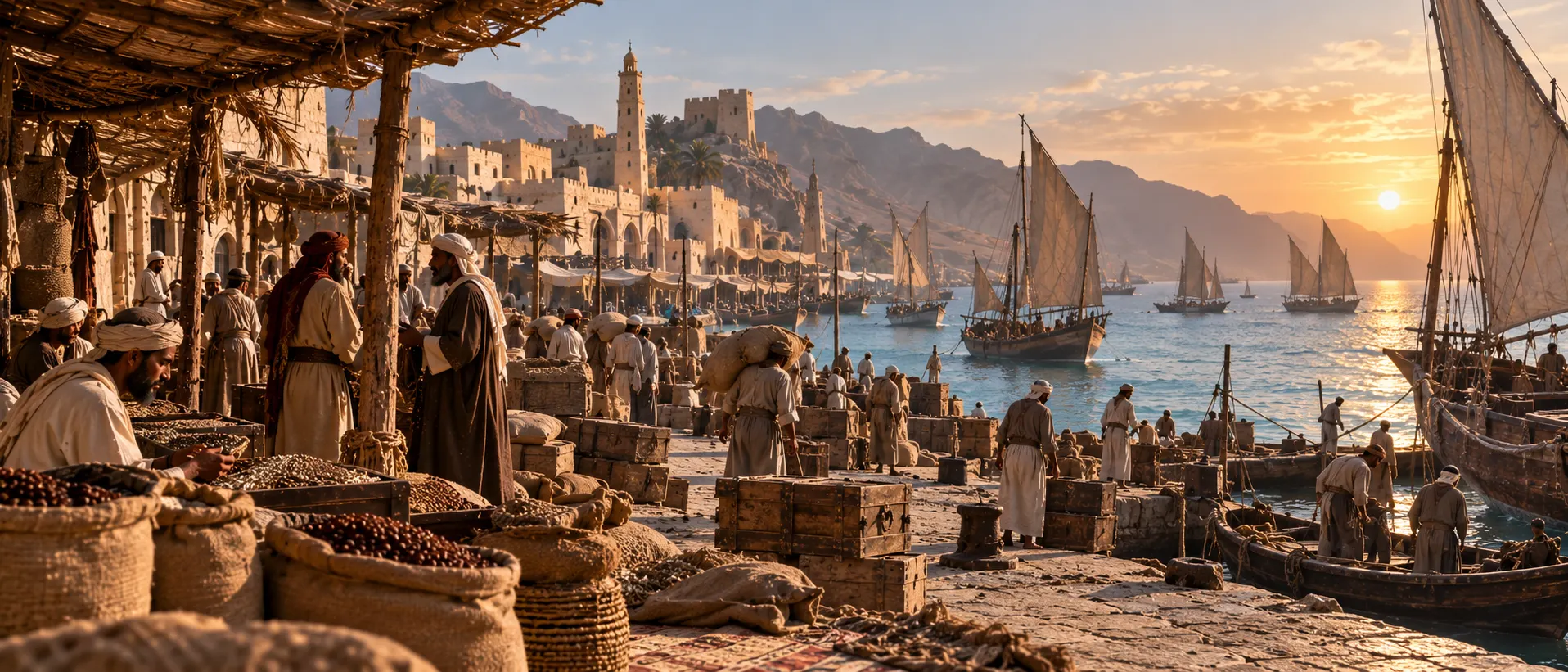
The more I explore Arabia, the more I discover how many famous words have roots people no longer recognise. Mocha is one of them. We think of a drink, a menu, a flavour. But before mocha became that, it was a Yemeni port. And behind that port stood mountains, coffee terraces, trade routes and a heritage far richer than the modern shorthand suggests.
A Word Everyone Knows, a Place Many Have Forgotten
Mocha is one of those words that travelled farther than its homeland.
Today people meet it on café menus, on dessert labels or in supermarket drinks, and many assume it belongs to an Italian coffee bar or to a European chocolate tradition.
But mocha was a place before it was a flavour.
It was Al-Makha, the Yemeni port on the Red Sea whose name travelled with coffee until it entered languages that slowly forgot where it came from.
The more I explore Yemen from a distance, the more I keep finding doors like this: a famous word, an overlooked origin, and behind it an entire civilisation of terraces, trade and hospitality.
Long Before ‘Mocha’ Meant Coffee Plus Chocolate
The original meaning had nothing to do with syrup, whipped cream or café sweetness.
Mocha referred to Yemeni coffee associated with the port of Al-Makha, through which coffee from Yemen became known across wider markets.
That does not mean every bean was grown beside the coast.
It means the port became the commercial name attached to the coffee leaving Yemen for the Ottoman world and beyond.
A harbour gave its name to a drink, and later the world kept the name even while changing the drink.
The Mountains Came Before the Port
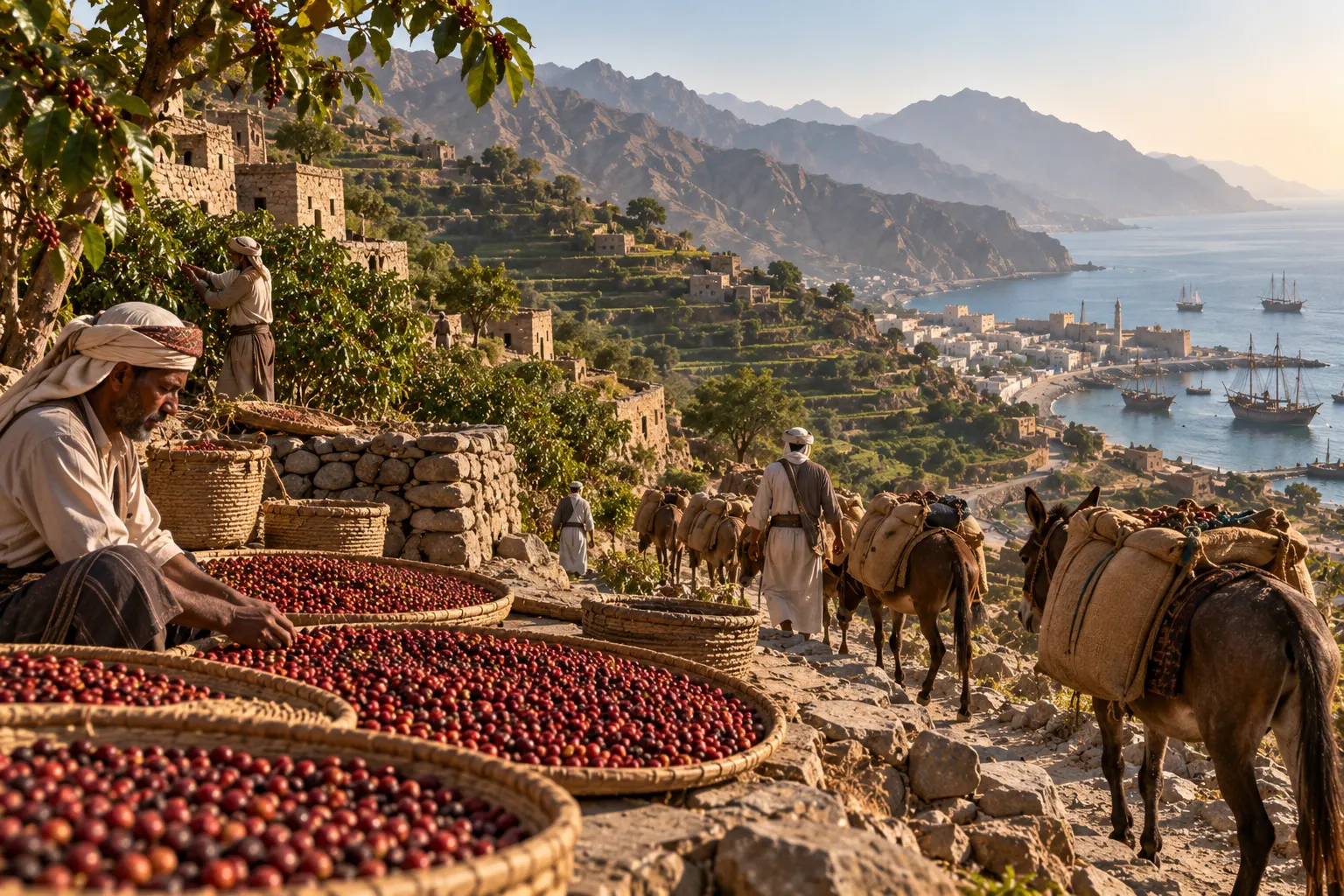
If Al-Makha became famous, the mountains made that fame possible.
Yemeni coffee belonged to terraces and highland villages before it belonged to ships.
Farmers cultivated coffee in difficult mountain environments, drying cherries naturally and building a culture around the crop long before modern specialty coffee started rediscovering Yemen.
The coast exported what the uplands had already made precious.
The port is the doorway, but the terraces are the house.
Yemen’s Coffee Culture Was Never Only About Export
That point matters to me a lot.
When a place becomes globally famous for one product, outsiders often imagine that the entire culture exists only to send that product abroad.
But Yemen did not live for Europe’s cup.
Coffee belonged to local life too: to gatherings, to conversation, to devotion, to everyday energy and, in older accounts, to late-night religious vigils.
Before it became world commerce, it was already social life.
A Red Sea Port Between Arabia, Egypt and Wider Seas
Al-Makha’s location made it ideal for movement.
On the Red Sea, facing routes toward Africa and connected northward toward Egypt and the Ottoman domains, the port became one of the great names in the history of coffee.
From there, beans and reputation travelled together.
Merchants bought, loaded, negotiated and carried away a name that would survive even after the monopoly weakened.
This is how a port enters language.
So Why Do People Think Mocha Is European?
Because names can be detached from origins when products travel far enough.
The later Western habit of calling a chocolate-coffee drink ‘mocha’ helped bury the older Yemeni meaning under a newer taste association.
That second life of the word is real, but it is not the beginning.
The beginning is Yemeni.
And once you know that, the word never tastes quite the same again.
Yemen Keeps Doing This to Me
I knew Yemeni coffee mattered. I did not fully realise how deeply the word mocha itself belonged to Yemen.
That discovery sits beside many others that keep pulling me back toward Yemeni heritage.
There is Balqees, the Queen of Sheba, whose story still opens a door between legend, trade and memory.
There is Sidr, one of the great honeys of Arabia, and there is Socotra, the island whose biodiversity feels almost unreal until you start reading about it seriously.
Then there are mangoes, pomegranates, incense routes, mountain villages and ports like Al-Makha that quietly changed the vocabulary of the world.
Balqees, Sidr and the Feeling of a Larger Civilisation
If you have already read our essay on The Queen of Sheba, you know Meski never approaches Yemen as a single product story.
That would be too small.
Yemen’s coffee, like its honey, belongs to a wider heritage of trade, cultivation, story and place.
And when honey enters the picture, we naturally move toward our Yemeni Do’ani Sidr Honey and the landscapes that made such products precious in the first place.
The point is not to force commerce into history. It is to show that living products still carry old geographies inside them.
Socotra Belongs in the Conversation Too
Socotra seems at first like another Yemen entirely, an island world of dragon’s blood trees, strange forms and a biodiversity that feels almost mythical.
But it belongs to the same national and civilisational imagination that makes Yemen endlessly rich. If you want to continue that direction later, keep an eye on our upcoming Socotra piece: Socotra, Honey and an Island Unlike Any Other.
When people reduce Yemen to headlines, they miss this abundance of worlds.
The country contains ports, mountains, honey valleys, legends and islands that each deserve a full article of their own.
Coffee Travelled, but So Did Ways of Drinking
Another thing I love about Arabian food culture is that products travel together with gestures.
In some places coffee is light and spiced. In others it is darker, denser or prepared through different rituals.
Even within the Arab world, a shared name does not always mean the same taste.
That is why our Arabic Coffee article matters here too.
Words travel. Techniques travel. But local identity keeps reshaping both.
What the Port Did That the Mountains Could Not
A mountain can grow coffee, but a port can send it into history.
Al-Makha concentrated exchange.
It created a recognisable point where farmers, inland traders, warehouse networks, maritime merchants and distant markets met one another.
That concentration turned coffee into a world word.
The port did not invent Yemeni coffee, but it gave it a name the world could carry.
Mocha Does Not Replace the Rest of Yemen
There is a temptation, especially in Western coffee culture, to reduce Yemen to a single iconic export story.
But Yemen is too large in meaning for that.
Coffee is one of its doors. So is honey. So are perfume routes, old cities, island ecologies and stories of queens and caravans.
That is why Meski’s Yemen cluster keeps widening rather than narrowing.
The more I read, the less I want to flatten the country into one famous cup.
A Quiet Link Between Coffee and Honey
Coffee and honey belong together in another way too: both depend on landscapes people often ignore.
Terraces, blossoms, altitude, season and care change flavour before any consumer writes tasting notes.
When we speak of Yemeni honey, especially Do’ani Sidr, we are still speaking about place.
And if you want the more unusual edge of that conversation, our article on Yemeni Cave Honey shows how quickly Yemen turns one curious product into a larger cultural question.
Products are never just products there.
I Still Dream of Discovering Yemen From the Inside
It is a shame that Yemen is so difficult to explore in person today, because this is exactly the kind of country I would love to discover from the heart of its own culture.
I imagine the majlis, the conversations, the coffee, the markets, the old stones, the fruit, the mountains and the coast.
I do not feel finished with Yemen at all.
If anything, the discovery of mocha’s true origin only deepens the feeling.
The more I explore, the more I realise how much remains to be understood.
Before Mocha Was a Flavour, It Was a Port
And maybe that is the best final line.
Before mocha became a café label, it was Al-Makha.
Before it became a sweet recipe, it was a Red Sea doorway through which Yemen’s coffee entered wider memory.
Before people thought of Europe, the word already belonged to Arabia.
That is the heritage of mocha.
And it is one more reason I will not stop exploring majlis, cultures and old names that still carry entire worlds inside them.
Questions People Ask
Originally, mocha referred to coffee associated with the Yemeni port of Al-Makha, not to a chocolate-flavoured drink.
It is a historic port city on Yemen’s Red Sea coast.
The port became famous as an export hub, while much of the coffee itself came from Yemen’s highland growing regions.
Later Western café culture reused the name for chocolate-coffee drinks, which slowly obscured the word’s Yemeni origin.
Because it played a foundational role in the early cultivation, culture and export of coffee to the wider world.
It fits naturally with Meski’s wider Yemen cluster, including Queen of Sheba, Yemeni honey and future Socotra content.
When honey is mentioned, the article points readers toward Yemeni Do’ani Sidr Honey and related Yemen pieces.
No. It is primarily a heritage and culture article about the origin of the word mocha.
Because it shows how Yemen contains many different cultural and natural worlds beyond the famous port of Mocha.
Continue Through Yemen’s Story
Mocha opens the door, but Yemen does not stop there. Move next from coffee to queens, honey, islands and the deeper cultural landscapes that keep widening the story.