
Nourishing the Body, Mind and Soul During Ramadan
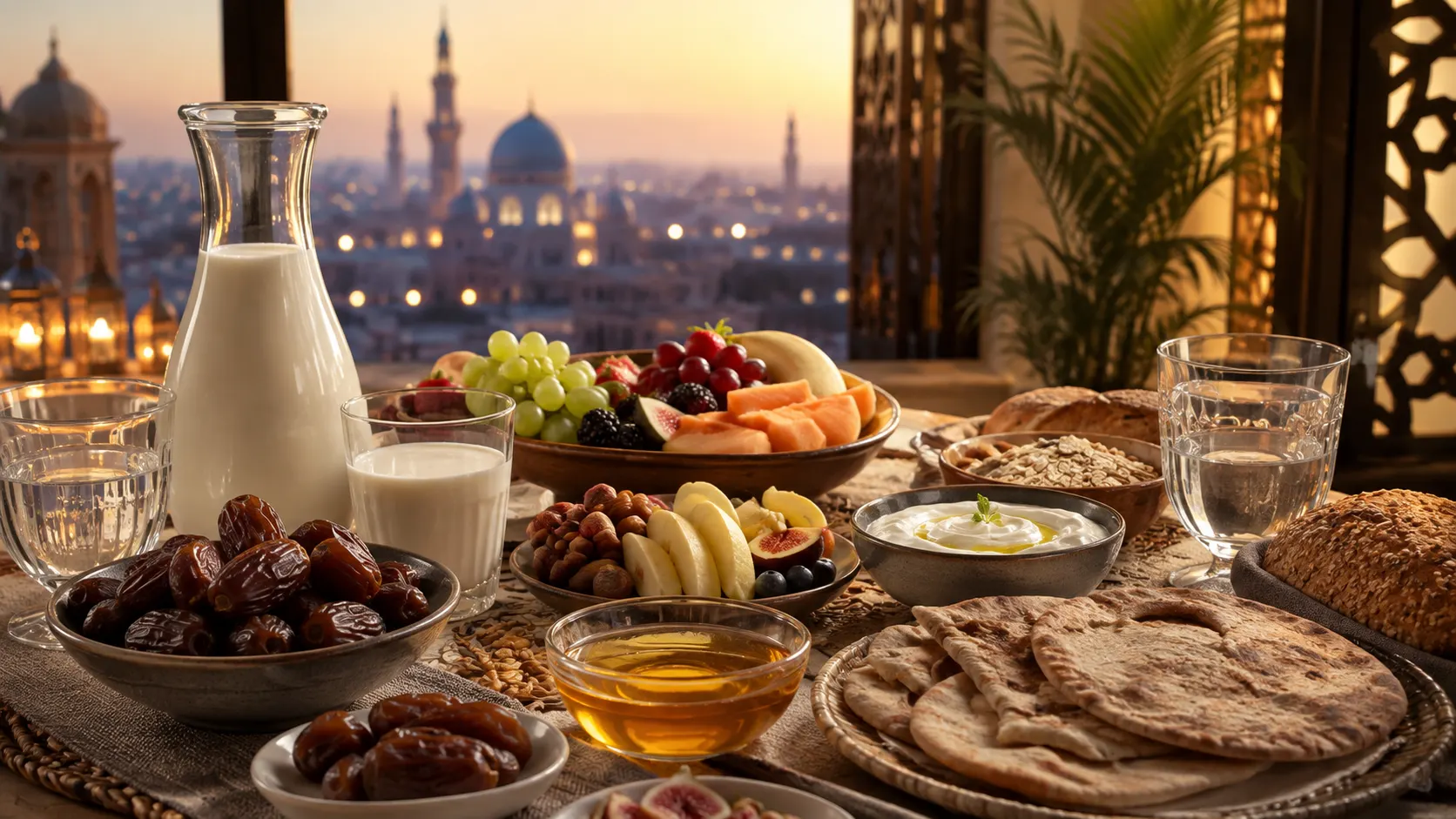
Suhoor — the pre-dawn meal of Ramadan — is far more than a nutritional obligation. It is a moment of intention, of gratitude, of quiet preparation before a long day of worship. What you choose to eat before the Fajr call will shape your energy, your concentration, and your spiritual presence throughout the entire fasting day.
Before the World Wakes
There is a particular quality to the silence just before the Fajr call. The streets are empty. The city has not yet remembered itself. Somewhere in a kitchen, a light comes on — soft, unhurried — and a family moves through the darkness with a quietness that feels almost ceremonial.
Water is poured. Dates are set out on a plate. Someone whispers a prayer. The smell of cardamom drifts from a small pot on the stove. This is suhoor — the pre-dawn meal that opens the day of fasting in Ramadan — and for millions of Muslim families across the Gulf, the Arab world, Morocco and beyond, it carries a weight that no ordinary breakfast can quite match.
It is not merely about eating before a long day without food or water. It is about intention. About gratitude. About beginning with care.
And yet, for many people, suhoor is either skipped entirely or reduced to whatever is quick and available. The alarm sounds late, there is barely time to sit, and the fast begins on an empty stomach or a hurried bowl of something sweet that fades within hours. What follows — the fatigue, the headaches, the difficulty concentrating — is often accepted as simply part of Ramadan, when in truth it is often the consequence of a meal that was too small, too rushed or poorly composed.
This article is an invitation to reconsider suhoor. Not as a nutritional obligation to be optimised, but as one of the most thoughtful acts of self-care you can offer yourself during this month. To eat well at suhoor is to respect the fast. To respect the fast is to honour the month.
Why Suhoor Matters — Far More Than Many Realise
The Prophet Muhammad, peace and blessings be upon him, encouraged Muslims not to skip the pre-dawn meal. In a widely transmitted hadith, he said: “Have suhoor, for indeed there is a blessing in suhoor.” (Reported by al-Bukhari and Muslim)
This blessing — barakah — is understood both spiritually and practically. Scholars across the centuries have noted that suhoor is distinguished from any other meal by the time at which it occurs: in the final portion of the night, close to the call of Fajr, in a moment when the heart is naturally more open, the mind clearer, and the intention purer.
From a nutritional standpoint, the reasoning is equally clear. The human body, during a fast that can last anywhere from twelve to eighteen hours depending on season and geography, relies entirely on what was consumed before dawn. The quality, composition and timing of suhoor will shape energy levels, concentration, mood and physical comfort throughout the entire fasting day.
Skipping suhoor does not make the fast more devout. It simply makes it harder — and often harder on the body in ways that can interfere with prayer, work, study and the very spiritual presence that Ramadan is meant to cultivate.
The timing matters too. Nutritionists and hospital dieticians across the UAE, Saudi Arabia and the broader Gulf region consistently advise eating suhoor as close to the Fajr call as practically possible. The later the meal, the less time the body has spent in a fasted state before the dawn prayer — and the more sustained the energy through the first and most demanding hours of the day.
Beginning with Gratitude and Intention
Before we discuss what to eat, it is worth pausing to consider how to begin.
Many Muslims start suhoor — and indeed each act of eating throughout Ramadan — with Bismillah: in the name of God. This is not a formality. It is a reminder that the meal is a provision, that nourishment is not taken for granted, and that the body being fed is held in trust.
Others take a moment before sitting down to make the intention for the fast — niyyah — quietly, sincerely, in the heart. This intention, though simple in form, orients the entire day. It transforms the physical act of abstaining from food and drink into an act of worship.
There is something worth preserving in this unhurried beginning. In a world of notifications and rushed mornings, the suhoor table offers a brief, luminous counterpoint: a meal taken in near-darkness, in stillness, with family, before the world’s noise begins again. If there is any meal that deserves to be eaten slowly and with awareness, it is this one.
The Foundation of a Balanced Suhoor: Complex Carbohydrates
The single most important nutritional consideration at suhoor is the type of carbohydrate you choose — and this distinction matters more than almost any other decision on the table.
Simple carbohydrates — white bread, sugary cereals, pastries, sweetened drinks — are digested rapidly. They produce a quick rise in blood sugar followed by an equally quick fall. For someone about to fast for the next fourteen to eighteen hours, this pattern is counterproductive: a burst of energy that disappears by mid-morning, leaving fatigue, irritability and hunger in its place.
Complex carbohydrates behave entirely differently. They are digested slowly, releasing glucose into the bloodstream gradually over several hours. This steady release sustains energy, supports concentration and helps the body manage the long stretch between the pre-dawn meal and iftar with far greater comfort.
Oats, Barley and Whole Grains
Oats are among the most practical and well-researched choices for suhoor. They are rich in beta-glucan — a soluble fibre that slows gastric emptying, sustains the feeling of fullness and supports a stable energy level well into the fasting hours. Research published in peer-reviewed nutrition journals has confirmed that beta-glucan from oats and barley may contribute to increased satiety, slower glucose absorption and a positive effect on gut health.
Barley — known in Arabic as sha’ir — has an even older relationship with the Arab world. It was among the staple grains of the Arabian Peninsula for centuries, and there is a particular quiet elegance in choosing it for suhoor during Ramadan: a food both ancient and wise.
Whole wheat bread, bulgur, and quinoa also belong to this group. The key is the word “whole”: the less processed the grain, the more fibre it retains, and the more slowly and gently it nourishes.
Brown Rice, Lentils and the Slower Path
Brown rice and lentils are worth particular mention, especially for families in the Gulf who may prefer warmer, more substantial suhoor meals. A small portion of brown rice with lentils — a combination found in many Arab households in varying forms — provides both slow-release carbohydrates and plant protein, making it a quietly excellent pre-dawn option. It is filling without being heavy, sustaining without being indulgent.
The general principle to carry into every suhoor decision: choose foods that take time to digest, not foods that digest before the fast has properly begun.
Dates and Honey — Two Gifts Carried Across Centuries
No serious article on suhoor can pass without pausing here. Dates and honey are not merely traditional foods. They are two of the most culturally significant, spiritually connected and nutritionally interesting foods in the Islamic culinary world — and both have an authentic place at the suhoor table.
Dates at Suhoor: A Prophetic Tradition with Modern Resonance
Abu Huraira reported that the Prophet, peace and blessings be upon him, said: “The best pre-fasting meal of the believer is dates.” (Reported by Abu Dawood)
Scholars recommend eating an odd number — one, three, or five — following the broader sunnah of preferring odd numbers. But beyond the spiritual dimension, dates deserve to be appreciated for what they are: one of nature’s most concentrated sources of natural sugars, fibre, potassium, magnesium, B vitamins and antioxidants, all contained within a small and entirely portable fruit.
At suhoor, dates serve a precise purpose. They provide an immediate source of natural energy — through their content of glucose, fructose and sucrose — while the fibre they contain moderates the speed at which that energy enters the bloodstream. Unlike a spoonful of refined sugar, which spikes and collapses, the sugars in dates arrive with a gentleness that the body manages well.
Not all dates are equal, of course. A Medjool date from Jordan and a Kholas from the Eastern Province of Saudi Arabia are different experiences entirely — different in texture, sweetness, moisture and complexity. An Ajwa date from Madinah carries a particular significance for many Muslims and a flavour that is drier and more resinous than the lusher varieties. Understanding these differences is part of what turns a simple tradition into a cultivated appreciation.
Two or three dates eaten calmly at suhoor, paired with water, is one of the most complete and time-honoured ways to begin a fasting day. It requires no preparation, no kitchen skill, and no more than a moment of attention. Its simplicity is part of its beauty.
Honey — A Small Spoonful Before the Day Begins
Honey at suhoor is a quieter tradition than dates, but no less meaningful. The Quran describes honey as a healing (shifa’) for people — a verse in Surah An-Nahl (verse 69) that has guided both its spiritual significance and its practical use across the Muslim world for fourteen centuries.
A small spoonful of raw honey at suhoor — stirred into warm water, spread over whole grain bread, or taken simply on its own — contributes natural sugars, trace minerals and enzymes. Its role as a traditional food in the context of a balanced suhoor is well-established across Gulf, Yemeni, Moroccan and Levantine traditions. It should be noted clearly that honey is not a medical treatment, and its consumption should be understood as part of a traditional and balanced approach to eating.
The quality of honey matters here. Raw, unprocessed honey — particularly varieties such as Sidr from Yemen or the Hadramawt region, or mountain honeys from Morocco’s Atlas highlands — retains its natural enzymes, pollen and antioxidant compounds. These are diminished by excessive heat treatment or blending. For suhoor, where only a small amount is used, choosing a genuinely good honey is worthwhile: it is one of those small luxuries that costs little but changes the quality of a moment.
As part of a thoughtful table — alongside whole grains, protein and good hydration — raw Sidr honey belongs with the confidence of centuries behind it.
Protein — The Quiet Sustainer
If complex carbohydrates are the architecture of a good suhoor, protein is its support structure. While carbohydrates manage the pace of energy release, protein extends the feeling of fullness and helps the body maintain muscle tissue during the hours of fasting — particularly important in warmer climates where physical demands remain high even in Ramadan.
Eggs, Labneh and Legumes
Eggs are perhaps the most versatile protein source at suhoor. They are quick to prepare, easy to digest and pair naturally with almost everything else on the table — whole grain bread, vegetables, a drizzle of olive oil. Boiled, scrambled or folded into a simple omelette with herbs and tomatoes, they provide complete protein without heaviness.
Labneh — the strained yoghurt beloved across the Levant and increasingly present on Gulf breakfast tables — is another excellent choice. It is rich in protein and probiotics, and its mild acidity makes it easy on the stomach in the early hours of the morning. Spread on warm bread with a spoonful of olive oil and a pinch of za’atar, it is a breakfast that has sustained generations.
Legumes — lentils, chickpeas, foul medames — deserve a place on the suhoor table that they do not always receive. They combine protein and complex carbohydrates in a single ingredient, digest slowly and provide sustained energy well into the fasting hours. In Moroccan and Egyptian households, a small bowl of foul with cumin and olive oil is a suhoor tradition of real nourishment and cultural depth.
Nuts and Seeds: Small in Volume, Long in Effect
A small handful of almonds, walnuts or pumpkin seeds added to oats, eaten alongside fruit, or simply placed on the table alongside dates contributes healthy fats and additional protein without requiring preparation or significant quantity. Nuts are energy-dense in the best sense: they nourish with efficiency. The body processes them slowly, and their satiety effect extends well beyond the meal itself.
Greek yoghurt with a handful of walnuts and a few dates is, in truth, one of the most complete and elegant suhoor combinations possible. Simple, balanced, deeply traditional in spirit if not always in exact form.
Hydration Before Sunrise — The Most Overlooked Priority
Of all the things that can go wrong at suhoor, inadequate hydration is perhaps the most consequential — and the most quietly overlooked. The body will fast for many hours. Every glass of water not drunk before Fajr is a deficit that the body will carry through the day.
Health authorities across the Gulf consistently recommend drinking water steadily between iftar and suhoor, rather than trying to consume it all at once before the call to prayer. The body absorbs water more effectively when given time. Large quantities consumed too rapidly pass through too quickly to hydrate the cells that need it.
Aim for water as the primary hydration source. Herbal teas — camomile, peppermint, hibiscus — are a gentle and pleasant alternative for those who find plain water difficult in the early hours. Fruits with high water content — cucumber, watermelon, oranges — contribute meaningfully to hydration and are also easy to eat when appetite is limited in the darkness before dawn.
Soups, if the household tradition includes them, are another underappreciated option: warm, hydrating, easy to digest and naturally comforting in the quiet of a pre-dawn kitchen.
What matters above all is that hydration is treated as a priority, not an afterthought. Food can wait a moment. The glass of water should not.
Arabic Coffee at Suhoor — With Care and Measure
Arabic coffee — qahwa — brewed with cardamom and sometimes a whisper of saffron, holds a place in Gulf culture that goes far beyond caffeine. It is an expression of hospitality, of care, of identity. To offer qahwa is to offer welcome. To drink it is to participate in a tradition that is older than most nations in the region.
During Ramadan, qahwa moves with the rhythm of the household: at iftar it marks the end of the fast, at suhoor it is sometimes part of the quiet gathering before the day of worship begins.
There is, however, a practical note worth making. Caffeine has a mild diuretic effect — it encourages the kidneys to process fluid — and consumed at suhoor, when hydration is already the primary concern, it should be approached with moderation. A small cup, unhurried, alongside adequate water, is a reasonable and entirely human choice. A series of cups without sufficient water may contribute to the very thirst it was meant to dispel.
For those who are caffeine-sensitive, or who notice that coffee at suhoor intensifies daytime thirst, herbal alternatives — warm cinnamon water, dried lemon and ginger, unsweetened hibiscus — offer something warming and ceremonial without the dehydrating effect.
The principle is simple: enjoy the traditions that belong to this meal. Adjust them gently when the body asks for it.
Foods That Work Against You at Suhoor
Understanding what to eat is only half the conversation. Understanding what undermines the fast is equally valuable — and the list is shorter and simpler than many people expect.
Excessively salty foods — processed meats, cured cheeses, crisps, instant noodles — stimulate thirst and accelerate fluid loss. Whatever satisfaction they offer in the moment, they leave the body less prepared for the hours of fasting ahead.
Fried and heavy foods — samosas, pastries, fried eggs in excessive oil — are difficult to digest, sit heavily on the stomach and do not provide the slow-release energy that the fasting day demands. They are better appreciated at iftar, when the fast has already been broken.
Sugary foods and refined carbohydrates — sweetened cereals, white bread, pastries, jam-covered toast — produce the energy spike and crash described earlier. They feel satisfying for a short time and then fail the body precisely when it needs sustained support.
Large quantities of any food — even nutritious food, eaten in excess at suhoor, can cause digestive discomfort, bloating and sluggishness. The stomach in the early hours of the morning is not designed for heavy feasting. The Prophet, peace and blessings be upon him, advised moderation in eating at all times — a principle that applies with particular wisdom at suhoor.
None of these are prohibitions. They are simply observations from nutrition, from tradition and from the honest experience of many people who have fasted. Small, composed, thoughtful — that is the spirit of a good suhoor.
Ramadan Is Not a Feast — It Is a Month of Return
There is a tendency, observed in many countries across the Muslim world, for Ramadan to become paradoxically the most calorically demanding month of the year. Iftar tables that grow larger each evening. Suhoor spreads that begin to resemble banquets. The fast, which was intended to teach restraint and gratitude, sometimes becomes the occasion for its opposite.
This is not a judgement. Generosity is one of the defining virtues of Ramadan, and the impulse to feed one’s family abundantly comes from love. But there is a difference between generosity and excess, between sharing and overindulging, between a welcoming table and one that has lost sight of the month’s purpose.
The Prophet, peace and blessings be upon him, is reported to have said that no vessel is worse to fill than the stomach, and that a few mouthfuls sufficient to keep one upright are enough for the believer. This wisdom was not meant to make eating joyless. It was meant to restore the proper proportion between nourishment and intention.
Suhoor is a meal of preparation. Preparation for a day of worship, of patience, of closeness to God. It should be adequate, balanced, calm — and then it should be finished, so that the fast can truly begin.
Nourishing the Soul as Much as the Body
The most important dimension of suhoor is one that no nutritional guide can fully capture.
Ramadan is, at its heart, a month of spiritual return — a return to awareness of God, to gratitude for provision, to compassion for those who lack what you have. The fast is not primarily a dietary practice. It is an act of worship that uses the body as its instrument.
When you sit at the suhoor table in the quiet of the pre-dawn hours — whether alone or with your family, whether in Dubai or Casablanca or London — you are participating in something ancient and shared. Across time zones and centuries, hundreds of millions of people are doing exactly the same thing at almost exactly the same moment: waking before the world, eating in the dark, preparing to fast for the sake of something greater than appetite.
That awareness is itself a form of nourishment. It feeds something the food cannot reach.
Taking a moment at suhoor — to make intention, to say Bismillah, to feel gratitude for the meal in front of you, to think briefly of those who will fast today without a suhoor table, to ask for steadiness in the hours ahead — these are not interruptions to the meal. They are its meaning.
A Gentle Suhoor Table — Practical Inspiration
For those who find it helpful to have a simple framework, here is what a balanced and deeply traditional suhoor might include — not as a prescription, but as a starting point that each family can adapt to its own tastes, traditions and rhythm.
Slow carbohydrate
A bowl of oats cooked gently with water or milk, or two slices of whole grain bread. Alternatively, brown rice with lentils if the family prefers a warmer, more filling option.
Protein
Two eggs, simply prepared. Or a generous spoonful of labneh. Or a small portion of hummus alongside the bread. A handful of almonds or walnuts alongside any of the above.
Traditional foods
Two or three dates — chosen with care, eaten slowly. A small spoonful of raw honey, taken on its own or stirred into warm water.
Fruit or vegetables
Cucumber slices, tomato, a handful of berries — whatever is available and appealing. These contribute both vitamins and water.
Hydration
Two full glasses of water, drunk unhurriedly during the meal. A small cup of herbal tea or, for those who wish it, a single small cup of qahwa alongside plenty of water.
Nothing on this table is complicated. Nothing requires a kitchen equipped beyond the essentials. The value lies not in the complexity of what is prepared but in the care with which it is chosen.
Final Thoughts: The Meal That Belongs to the Dawn
There is a reason the Prophet, peace and blessings be upon him, called suhoor a blessed meal. Not because of its size, or its ingredients, or its nutritional profile — but because of its time, its intention and its spirit.
It is eaten in the final hour of the night, in a moment of transition, when the fast has not yet begun and the day has not yet arrived. It belongs, in a sense, to neither. It occupies that luminous space between rest and worship, between darkness and the call to prayer.
To take that meal seriously — to prepare it with thought, to eat it with gratitude, to begin the fast with a body that is genuinely nourished — is a small act of self-respect and a larger act of devotion.
Ramadan asks many things of the believer. Patience. Presence. Generosity. Restraint. Gratitude. The suhoor table, prepared with care before the world is awake, is where all of those qualities are quietly assembled for the day ahead.
May your fasting be accepted, your suhoor be nourishing, and your Ramadan be filled with peace.
تقبل الله منا ومنكم
Raw Honey for Suhoor — Chosen with Care
A small spoonful of genuine raw honey at suhoor is a tradition carried across centuries. Discover honeys sourced from the Arabian Peninsula and beyond — Sidr, Samar and more — each one selected for its authenticity and its story.
Frequently Asked Questions About Suhoor
Suhoor — also written as sahur or sehri depending on the region — is the pre-dawn meal eaten by Muslims before beginning the daily fast in Ramadan. It is taken before the Fajr (pre-dawn prayer) call, and marks the start of each day’s fast. The word comes from the Arabic root s-h-r, relating to the time just before dawn.
Suhoor is not obligatory — the fast is valid without it. However, it is a strongly encouraged Sunnah of the Prophet Muhammad, peace and blessings be upon him, who described it as a blessed meal and advised believers not to leave it. Many Islamic scholars consider eating suhoor a highly recommended act during Ramadan.
The best suhoor combines slow-release complex carbohydrates (oats, whole grains, lentils), quality protein (eggs, labneh, legumes, nuts), traditional foods (dates, a small amount of honey), hydrating fruits and vegetables, and sufficient water. The goal is a balanced, moderately sized meal that sustains energy gradually through the fasting hours.
Dates belong at both. The Prophet, peace and blessings be upon him, recommended breaking the fast at iftar with dates — but he also specifically named dates as the best pre-fasting meal at suhoor. Two or three dates at suhoor, paired with water, is a practice rooted in both spiritual tradition and sound nutritional reasoning.
A small amount of raw, good-quality honey at suhoor is a valued traditional practice across the Arab world. Honey may contribute natural sugars and trace minerals, and pairs well with whole grain bread, warm water or oats. It should not be used to replace a balanced meal, but as a complement to one. As always, quality matters: raw honey retains more of its natural properties than heavily processed alternatives. Honey is not a substitute for medical advice or treatment.
A small, single cup can be enjoyed without significant concern for most people — especially if taken alongside adequate water. Caffeine has a mild diuretic effect, however, and drinking several cups at suhoor without sufficient hydration may increase daytime thirst. Those who are sensitive to caffeine may find herbal alternatives more comfortable for the pre-dawn meal.
Foods that work against the fast include excessively salty items (which increase thirst), fried and heavy foods (which sit heavily on the stomach and provide little sustained energy), refined carbohydrates and sugary foods (which cause an energy spike and rapid crash), and very large quantities of food in general. A moderate, composed meal is always more effective than an excessive one.
Aim for at least two full glasses of water during the suhoor meal itself — slowly, not all at once immediately before the fast begins. Ideally, water intake should be spread steadily between iftar and suhoor throughout the evening and night rather than concentrated at either end alone. The World Health Organization’s general daily water recommendation of around 2 litres remains relevant to Ramadan, distributed across the non-fasting hours.
Suhoor must end before the Fajr call to prayer. It is recommended — both spiritually and nutritionally — to eat as close to the Fajr time as possible, rather than waking in the middle of the night. Eating later means the body enters the fast with a more recent, still-available source of energy.
Children who are fasting can generally eat from the same balanced suhoor table as adults, adjusted for portion size and preference. Children who are not yet fasting — or who fast only partially — have different nutritional needs and should be encouraged to eat a full, balanced breakfast appropriate to their age. Ramadan is a time of gradual introduction for young children, not nutritional restriction.