
They did not need to travel alone for their journeys to matter.
The woman whose name became a road
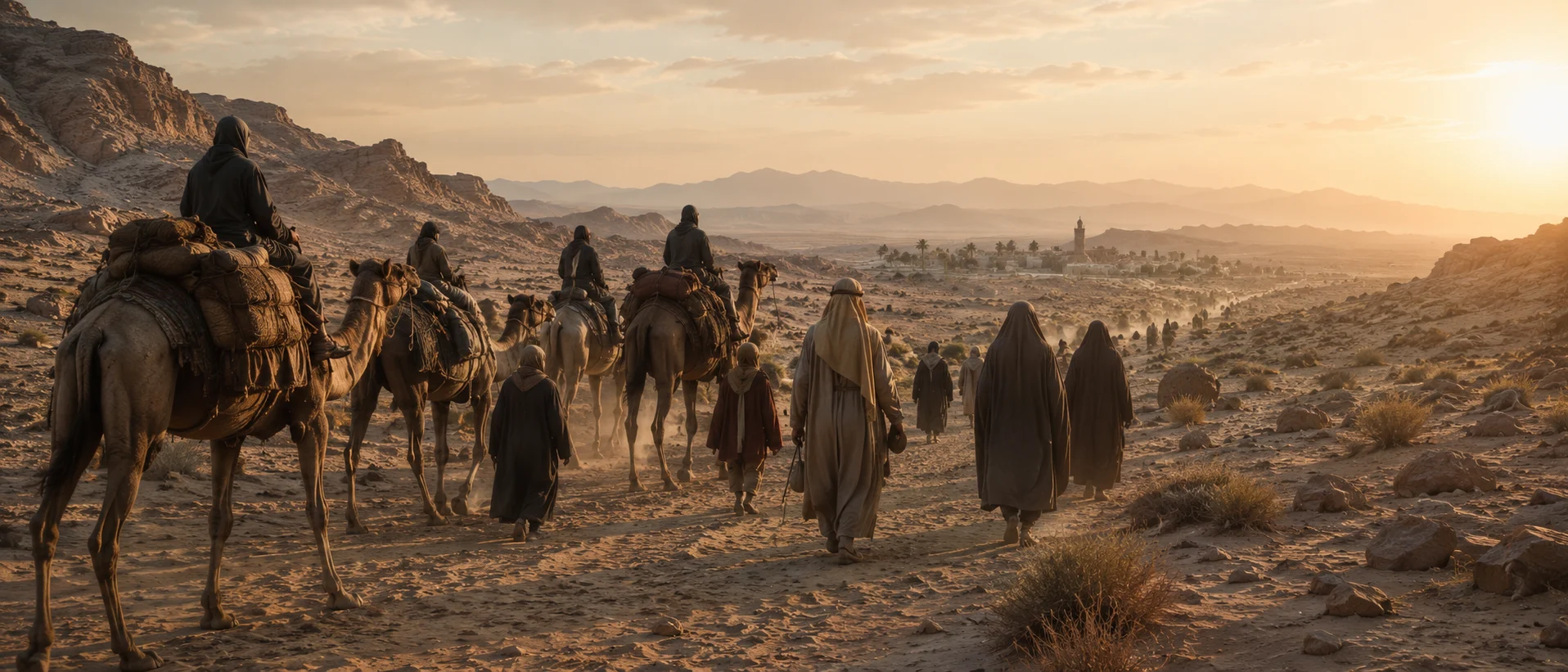
Long before airports, highways and high-speed trains made Makkah reachable in hours, a road from Iraq crossed roughly 1,300 kilometres of difficult country toward the Hijaz. Wells, pools, reservoirs, caravan stations and places of prayer helped make that road possible. Today it is remembered as Darb Zubaydah, the Zubaydah Trail.
The name belongs to Zubaydah bint Ja’far, wife of the Abbasid caliph Harun al-Rashid and a woman of extraordinary wealth and influence. UNESCO describes the road as one of the great historical Hajj routes and links her name to charitable works at the stations along it. Her importance is not that she became a romantic symbol of a woman wandering the desert alone. Her importance is much more substantial: she helped make an immense journey safer and more possible for other people.
That is where I want this story to begin. Not with a modern idea of the ‘female traveller’, but with the real ways women moved through the Muslim world, the families and caravans around them, the risks they faced, the knowledge they carried and the roads they helped build.
Zubaydah was not an exception because she travelled alone
Modern travel writing often loves the image of the solitary adventurer. It is a powerful image because our world has passports, airports, police, phones, hotels, mapped roads and instant communication. The pre-modern road was something else. Even men often travelled in caravans because distance, theft, weather, illness and lack of water made isolation dangerous.
For women, accompaniment by family, husband, mahram or trusted company was therefore not an embarrassing detail to remove from the story. It was part of the actual structure of travel. A woman could cross enormous distances without being alone for a single stage of the journey. That does not make her less of a traveller.
They did not need to travel alone for their journeys to matter.
What Zubaydah actually left behind
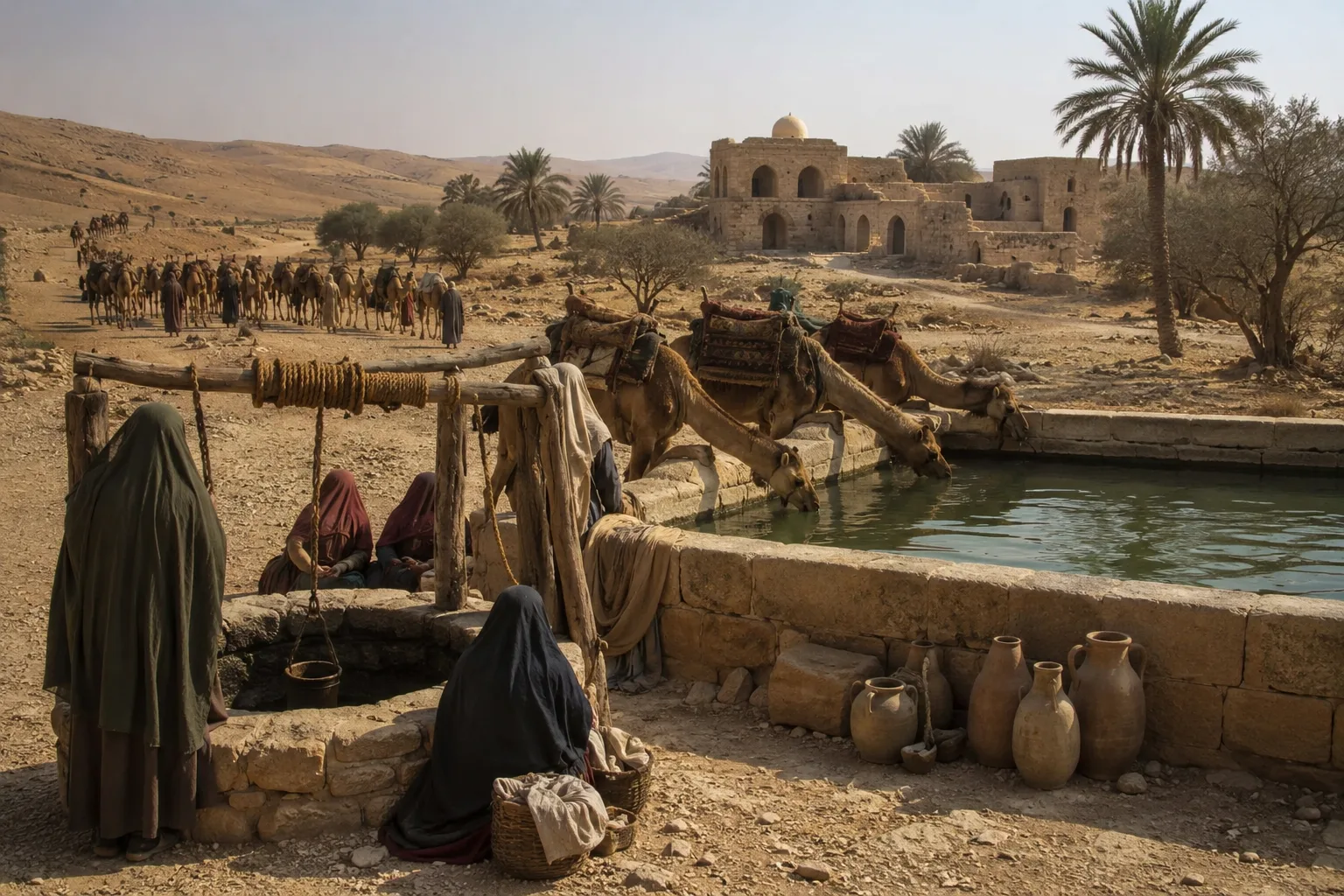
The most impressive part of Zubaydah’s legacy is water. Darb Zubaydah was not simply a path scratched across the desert. It contained specialised infrastructure: wells, reservoirs, pools, dams, canals, caravanserais and mosques. A pilgrim might never know the name of the person who financed a water structure, yet that water could decide whether the next stage of the journey was possible.
Her story therefore changes the question. Instead of asking only which women travelled, we can ask which women shaped travel itself. Patronage, charity and public works were forms of movement too. Zubaydah’s money travelled ahead of pilgrims who would come years after her.
A woman can leave her mark on a road without needing her footprints on every kilometre.
The Hajj put women on the great roads of Islam
Women participated in Hajj from the earliest Islamic period. Cambridge scholarship on women and Hajj notes that female participation persisted throughout Islamic history despite the physical and legal challenges surrounding long-distance pilgrimage. Hajj was obligatory for women as well as men when the conditions of capability were met.
This meant that women from different regions entered the same enormous movement toward Makkah. Some travelled with husbands or close male relatives, some with wider family groups, and jurists discussed circumstances in which trustworthy company could satisfy the conditions of safety for obligatory Hajj.
The pilgrimage road was therefore never a male road with an occasional woman on it. Women belonged to its history.
The caravan was protection before it was romance
Today the word caravan can sound beautiful. Camels moving beneath a red sunset. Bells. Tents. Poetry. But the caravan existed partly because the road was dangerous. Travelling together meant shared water, guides, animals, information and protection.
A lone person could become lost, robbed, injured or stranded. A large group could organise guards, manage supplies and help someone who became sick. For a woman, the presence of family and trusted company added another layer of protection in a world where help could be days away.
We should remember this before turning the past into a debate using only the assumptions of modern travel.
A woman going to Makkah carried more than luggage
Like male pilgrims, women carried food, clothing, money, medicines available to them, water containers and the practical needs of a long route. But the social reality of travel could add additional burdens: privacy, health, pregnancy in some cases, care for children and dependence on a group whose pace she could not always control.
Women also carried prayers entrusted to them by people who stayed home. A mother, sister, neighbour or friend might ask to be remembered in Makkah. One woman’s body travelled while an entire family’s hopes travelled with her.
This is one of the reasons pilgrimage memoirs written by women are so valuable when they survive. They record details that male travel accounts might not notice.
Women left travel memoirs too
Research on Iranian women pilgrims has identified travel memoirs written by women who journeyed to Makkah and to sacred sites in Iraq over the last several centuries. Some came from elite families and therefore had resources unavailable to ordinary travellers, but their accounts preserve the spiritual satisfaction of pilgrimage alongside the particular difficulties women experienced on the road.
These memoirs matter because most women who travelled left no book. History remembers whoever had the means, literacy, leisure and manuscript survival to record a journey. Silence in the archive does not mean absence on the road.
How many women crossed the same deserts as famous male travellers and simply never left us a Rihla?
The road did not erase social class
A wealthy woman could travel with servants, guards, animals and provisions that a poorer pilgrim could never afford. A princess’s Hajj was not the same physical experience as the pilgrimage of a woman who had saved for years. The Kaaba gathered them at the same rites, but the road to reach it could expose enormous inequalities.
Zubaydah herself belonged to the Abbasid elite. That position gave her the resources to sponsor infrastructure. Her example is powerful precisely when we keep this context. She could do what ordinary women could not, and she used part of that capacity in ways that served people beyond her household.
Women travelled for knowledge
Pilgrimage was not the only reason women moved. Islamic scholarly culture placed great value on chains of transmission, teachers and hearing texts directly. Men famously travelled in search of hadith, but women also became respected transmitters and teachers.
Karima al-Marwaziyya is a striking example. Born near Merv in Central Asia, she later settled in Makkah and became one of the most respected transmitters of Sahih al-Bukhari. Cambridge scholarship describes her as renowned for her knowledge of transmission chains and as a teacher whose authority attracted students.
Her story reminds us that movement could take a woman not toward adventure for its own sake, but toward a centre of learning where people would later travel to learn from her.
Karima’s journey ended with students coming to her
Once established in Makkah, Karima became a destination. This reversal is beautiful. A woman who had herself moved across a vast geographical world became someone to whom scholars came for knowledge.
Travel therefore has two directions. Sometimes we remember the person who crosses the map. Sometimes the more important story is that, after arriving, she becomes a point on other people’s maps.
Knowledge can turn a traveller into a destination.
Family travel was still travel
Women moved because families moved. Marriage could take a woman to another city. Political households relocated. Merchants and scholars travelled with wives and children. Pilgrimage groups crossed regions together. A woman might never write ‘I am an explorer’, yet the geography of her life could extend across countries.
This matters because our modern categories can make ordinary historical movement invisible. If a woman travelled with her husband from one scholarly centre to another, we may describe the man’s career and reduce her to ‘his wife’. Yet she crossed the same road, endured the same climate and built a life in the new city too.
Being accompanied does not remove distance from a journey.
Women of ruling households moved through politics
Royal and elite women travelled for marriage, court politics, pilgrimage and family obligations. Their movement often involved large entourages and formal protection. We should not confuse this with ordinary travel, but neither should we dismiss it.
A political marriage could connect dynasties across regions. A princess might leave the city of her childhood permanently. A queen or noblewoman performing Hajj might cross territory with a large household. These journeys could alter alliances, patronage and cultural exchange even when the woman was never ‘alone’ in the modern sense.
Protection was normal because danger was normal
This is perhaps the point that needs the least ideology and the most common sense. Long-distance travel was dangerous. Roads were not continuously policed. Communication was slow. Medical help could be unavailable. A broken leg, fever, attack, lost animal or empty water skin could become a crisis.
Men also benefited from company, guides and organised caravans. For women, the social expectation of travelling with a husband, mahram, family or safe company added protection within this already dangerous environment.
To say this is not to say every historical rule can be reduced only to physical danger. Religious law has its own texts and reasoning. It is simply to recognise that the material world in which those rulings were lived was very different from a two-hour flight between major airports.
The road had spaces for women because women were on it
Caravan camps, pilgrimage stations and urban lodging had to account for families, women and children because they were real users of the route. Privacy, water access and household organisation mattered.
Historical travel infrastructure is often described in architectural terms: reservoir, station, mosque, caravanserai. But architecture exists for bodies. When women travelled, these spaces shaped their ability to rest, wash, pray and continue.
Zubaydah’s water works become even more meaningful when we imagine not an abstract pilgrim but an exhausted mother, an elderly woman, a child and a family waiting for water.
Hajj could be the longest journey of a woman’s life
For many people in pre-modern societies, Hajj was the greatest geographical journey they would ever undertake. A woman could live most of her life within a relatively small region and then cross thousands of kilometres toward Makkah.
That journey exposed her to accents, foods, clothing and customs she had never encountered. The Muslim world became physically visible. The ummah stopped being an idea heard in sermons and became people walking beside her.
Travel changed knowledge even when the purpose of travel was worship.
The famous male traveller saw women travelling too
Ibn Battuta’s world was full of moving people, and women were part of that movement even though the Rihla is remembered through a male narrator. Historical scholarship has specifically examined what his account reveals about women’s travel in the Islamic world.
This is another lesson in how archives work. Sometimes women’s journeys survive because a man noticed them. Sometimes they survive in legal texts discussing their conditions. Sometimes in biographies of scholars. Sometimes in Hajj memoirs written by women themselves.
We have to reconstruct the road from many kinds of evidence.
The woman who travelled without writing
I am perhaps most interested in the woman whose name we will never know. She left a village, joined a caravan with her family, crossed land she had never seen, reached Makkah, performed Hajj and returned. Nobody copied her words because she wrote none. No chronicle called her remarkable.
But she travelled.
History does not become less real because nobody wrote it down.
The journey could also mean loss
Not every traveller returned. Disease, childbirth, accident, violence and exhaustion were realities of pre-modern movement. A woman could leave with her family and be buried far from the place where she was born.
Remembering this prevents us from turning historical travel into costume drama. The beauty of the caravan road came with fear. Protection mattered because loss was possible.
From camel caravan to steamship
Over the nineteenth and twentieth centuries, transport began to change women’s experience of pilgrimage as it changed men’s. Steamships shortened maritime routes. Railways and motor vehicles reduced some overland travel. Organised transport and modern states changed security.
The journey remained demanding, but distance slowly became less absolute. A woman could reach the Hijaz from far away without spending months exposed to the same road conditions as her ancestors.
Then the airplane changes the meaning of distance
Air travel transformed pilgrimage again. A woman who once might have needed a caravan, multiple stages and weeks of travel could cross continents in a day. Airports introduced controlled entry points, scheduled departures, identification systems and communication with family.
This does not eliminate every danger, and modern travel creates problems of its own. But the material reality of the journey is radically different from the world in which a traveller could disappear from family news for months.
What did not change
The intention to reach Makkah did not change. The prayer of a family watching someone leave did not disappear. The need for safety did not disappear. The financial burden did not disappear. And the fact that travel places a person outside ordinary routines did not disappear.
Technology changed the road more quickly than it changed the human heart.
The religious framework matters too
At the end of an article about Muslim women travelling, it would be strange to discuss only security and ignore the religious framework in which many of these women understood their journeys.
Authentic hadith reports establish rules concerning a woman’s travel and the presence of a husband or mahram. In one well-known report, a man told the Prophet ﷺ that he had been assigned to an expedition while his wife had gone for Hajj; the Prophet ﷺ instructed him to perform Hajj with his wife. The report is found in al-Bukhari and Muslim.
But the jurists did not all apply the texts identically
It is important not to turn a historical article into a simplified fatwa. Sunni jurists differed over whether the husband or mahram is an absolute condition for a woman’s obligatory Hajj when safe company is available.
Hanafi and Hanbali positions are generally stricter on the requirement of a husband or mahram. Maliki and Shafi’i jurists recognised permissions in circumstances of trustworthy or safe company for the obligatory pilgrimage, with details differing among authorities. Contemporary fatwa institutions also differ in how they apply these principles to modern secure transport.
So the honest sentence is not ‘Islamic scholars always said one identical thing’. The honest sentence is that accompaniment, safety and responsibility were central questions, and jurists discussed how those principles applied.
Protection was not the opposite of movement
This brings us back to the historical road. A woman travelling with her husband, mahram, family or caravan was not a woman who ‘did not travel’. She still crossed deserts. She still boarded ships. She still left home. She still faced fatigue, fear and uncertainty.
Protection did not erase the journey. It made the journey more possible.
And in a world where even men avoided crossing vast dangerous regions alone, the idea of organised accompaniment was hardly strange.
Do not turn medieval women into modern influencers
We do not need to invent a medieval ‘solo female traveller’ to make Muslim women’s history interesting. Their real lives are enough.
Zubaydah financed water on a road to Makkah. Karima moved from the region of Merv and became an authority teaching hadith in Makkah. Female pilgrims crossed the same difficult routes as men within the social and religious structures of their time. Elite women wrote memoirs. Ordinary women travelled without leaving books.
Reality is richer than the slogan.
Meskaoui
“We remember the men who wrote about the road. Perhaps it is time we also remembered the women who walked it beside them.”
— Meskaoui
The road remembers Zubaydah
More than a thousand years later, Zubaydah’s name is still attached to a pilgrimage road. That is an extraordinary ending for a woman whose greatest travel story is not that she escaped everyone around her, but that she used what she possessed to help other people cross a dangerous landscape.
Her legacy changes how I think about travel. Sometimes courage is leaving. Sometimes courage is accompanying. Sometimes it is protecting. And sometimes it is putting water on a road for a stranger who will pass long after you are gone.
Those women did not need to travel alone for their journeys to matter. They needed only to have been there. And they were.
Travel could begin with marriage
For many women, the most important journey of life was not labelled travel at all. Marriage could move a woman from one city to another, sometimes across a frontier, into a household whose accent, food and customs differed from those of her childhood. Historians may record the marriage as a political or family event, but the woman herself had to inhabit the geography that followed.
This kind of movement matters because the history of travel is not only the history of people who chose the road for curiosity. Sometimes the road came because family life required it.
Travel could begin with widowhood or responsibility
A widow, mother or older woman might also move because family responsibilities changed. She might accompany children, return to relatives, join a household elsewhere or travel for pilgrimage after years in one place. These journeys rarely become famous because they do not fit the heroic template of exploration.
Yet ordinary movement is often where social history lives.
Travelling with children changed everything
A mother on a caravan road was not simply managing herself. Food, rest, illness, fear and pace had to account for children too. A delayed stage was different when a child had fever. A water stop was different when several people depended on one adult’s attention.
This is another reason family travel should not be dismissed as easier merely because a woman was accompanied. Accompaniment increased protection, but family responsibility could increase the weight of the journey.
Women could be patrons without being rulers
Zubaydah’s scale was exceptional, but charitable patronage was not limited to imperial women. Across Islamic societies, women endowed property, supported mosques, schools, fountains and charitable works through waqf and other forms of giving. A woman did not need to govern a state for her money to shape public life.
This matters in an article about travel because roads depend on institutions. Water, lodging and places of worship exist because somebody decided strangers were worth serving.
The road created female networks too
Women travelling in family groups or pilgrimage caravans could meet other women from regions far beyond their own. Shared lodging, waiting, prayer and domestic routines created spaces where information moved: family news, remedies, recipes, religious knowledge and practical advice.
These exchanges are difficult to document because they often left no formal text. But lack of a manuscript should not make us imagine silence.
Women learned the world through other women
A traveller did not need a map to discover difference. She could hear it in another woman’s accent, see it in clothing, taste it in food and learn it in the way a household organised prayer, hospitality or childcare.
The road taught geography through people.
Safety was not only about men protecting women
Protection in a caravan was collective. Men guarded, guides navigated, women cared for children and sick relatives, older travellers shared experience, and everyone depended on water and discipline. A husband or mahram had a particular religious and social responsibility, but the caravan itself was a wider system of mutual dependence.
This is important because protection should not be reduced to a cartoon in which one strong person saves one weak person. Pre-modern travel made everybody vulnerable in different ways.
Why the legal discussion became so important
Because Hajj is an obligation when a person is capable, jurists had to define what capability meant for women in a world where travel could be genuinely dangerous. Was a mahram part of that capability? Could trustworthy company be sufficient? What counted as security?
The disagreement among schools makes more sense when we see the practical road behind the legal words. They were not debating an abstract airport lounge. They were debating journeys that could last weeks or months.
Modern safety changed the facts but not the need for serious judgement
Airports, passports, scheduled flights, public transport and instant communication changed the practical environment dramatically. Some contemporary scholars therefore place greater weight on whether the route and destination are secure, while others continue to emphasise the classical mahram requirement.
MESKI is not a fatwa institution, so this article does not choose for the reader. It records the history honestly and points readers to qualified religious authorities for personal rulings.
What I want the reader to remember
I do not want the lesson to be that women in the past were secretly living modern solo-travel lives. I want the opposite: understand their world well enough that we no longer need to distort it to find them interesting.
They travelled within families, caravans, scholarly networks and religious rules. They faced real danger. Some wrote. Most did not. Some had wealth. Others had little. Some crossed a continent. Some crossed a region and never returned home.
They were travellers because they moved through the world, not because they matched our vocabulary.
Women, Hajj and Historical Travel FAQ
She was an Abbasid princess and the wife of Caliph Harun al-Rashid, remembered especially for patronage of water and pilgrimage infrastructure on the road from Iraq to Makkah.
Darb Zubaydah is the historical Hajj route from Kufa toward Makkah, with stations, wells, reservoirs and other infrastructure associated with Abbasid patronage.
Yes. Women travelled for Hajj, family movement, marriage, court life and knowledge, usually within the social and security structures of their time.
Yes. Women’s participation in Hajj has existed since the earliest Islamic period and continued throughout Islamic history.
No. Long journeys were commonly organised around families, husbands, mahrams, caravans and trustworthy groups because travel itself was dangerous.
An eleventh-century hadith scholar born near Merv who later settled in Makkah and became a renowned transmitter of Sahih al-Bukhari.
Classical Sunni jurists differed. Hanafi and Hanbali positions are generally stricter, while Maliki and Shafi’i authorities recognised permissions for obligatory Hajj with trustworthy or safe company in certain circumstances.
An authentic report in al-Bukhari and Muslim relates that the Prophet ﷺ instructed a man assigned to an expedition to go and perform Hajj with his wife.
Continue the Journey
If this story brought you here, continue the journey through related stories from The House of Meski.