
Six jars, five countries, one majlis and a bee who has had enough of human geography.
Six jars, no passports
Six jars were waiting on the majlis table. No labels. No flags. No gold lids announcing premium. No little map of Arabia printed on the box. Just six jars of honey, a dallah of Arabic coffee, a plate of dates and one question that sounded much easier than it really was.
Which honey came from where? Yemen? Oman? Saudi Arabia? The Emirates? Qatar? I poured myself a small cup of coffee. Let’s play.
The first honey was dark. “Yemen,” I said. A bee landed on the edge of the table. I ignored her. The second was lighter. “Oman, perhaps.” The bee walked toward the dates. The third looked dense and amber. “Emirati Sidr honey. Maybe Hatta.” She stopped. The fourth had been purchased in Doha. “Qatari honey?” At that point, the bee turned around.
I know what you’re thinking. Bees do not speak. Usually. This one apparently had had enough. “You humans are making this very complicated.” I put down my finjan. “Excuse me?” “Emirati honey. Yemeni honey. Omani honey. Qatar honey. Saudi honey. Sidr honey. Premium Sidr honey. Gold Sidr honey…” She moved closer to the first jar. “I was only looking for flowers.” Fair point.
A Bee Does Not Carry a Passport
Imagine a bee flying through Hatta. She does not wake up thinking: Today I shall produce authentic Emirati honey. She leaves the hive. She searches. She follows scent, colour, nectar and opportunity.
A flowering Sidr tree does not show her an Emirati passport. A Samar tree does not explain customs regulations. A Ghaf does not ask whether the honey will eventually be sold in Dubai, Abu Dhabi or Doha. The bee works within a landscape. And that landscape is the beginning of origin.
Search for honey Dubai, and you will find honey from many countries. Search for Emirati honey, and you should be talking about honey actually harvested in the Emirates. Search for Yemeni Sidr honey UAE, and you are talking about Yemeni honey available in the UAE. These are not the same thing.
So here is the first rule of our game: Emirati honey in Qatar is not Qatari honey. Yemeni Sidr sold in Dubai does not become Dubai honey. Our bee stared at me. “That took you this long to understand?” Apparently.
ROUND TWO: Hatta
We followed her first to the mountains. Not Yemen. Not Oman. Hatta. This is one of the things I love about the Emirates. Say Dubai to someone who has never travelled beyond the obvious places and the images arrive immediately: Burj Khalifa, Sheikh Zayed Road, Jumeirah, Marina, Palm Jumeirah.
Drive toward Hatta and the vocabulary changes. Mountain. Rock. Wadi. Farm. Tree. Bee. Hatta gives us a very different way of understanding Dubai honey. Because there is a major difference between honey sold in Dubai and honey harvested within the Emirate of Dubai. Hatta can give the second expression real meaning.
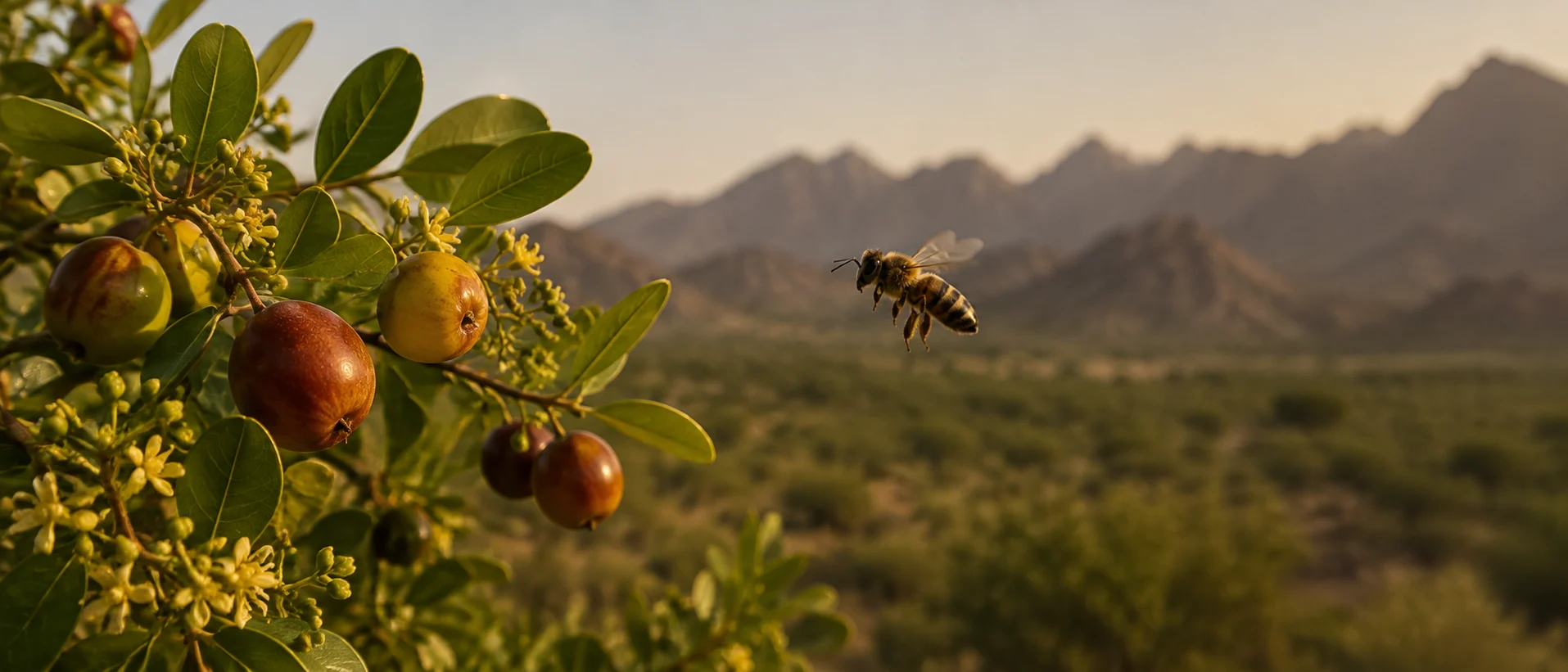
Here bees forage within a mountain environment where Sidr and other flowering plants form part of the landscape. And suddenly Emirati Sidr honey is no longer simply a product name. It has somewhere to stand.
Our bee disappeared into a Sidr tree. She returned. “So,” I asked, “you’re an Emirati bee?” “I am a bee.” “Yes, but you’re in Hatta.” “Then write Hatta if it makes you happy.” I laughed. “Emirati Sidr honey from Hatta.” She looked exhausted already. “Are we going to do this all day?” We were.
Sidr Is Not a Country
This may be the most important trick in the entire game. I place a jar in front of you. The label says SIDR HONEY. Where is it from? Yemen? Maybe. Oman? Possible. UAE? Absolutely possible. Saudi Arabia? Again, possible. Elsewhere? Yes.
The word Sidr does not provide a passport. Sidr refers to trees within the Ziziphus group whose flowers can provide nectar for bees. Different species, environments and local naming traditions complicate the story further.
This is why treating Sidr as though it automatically means Yemen is a mistake. Yemeni Sidr became internationally famous, and with good reason. But fame does not give one country ownership of a flowering tree.
The bee returned. “Sidr again?” “Yes.” “Where?” “Here.” “No. Which country?” She looked at me. “You really like countries.” We do. Perhaps too much. But there is also a reason.
The Bee Doesn’t Care About the Passport. We Should Care About the Terroir.
This became our compromise. The bee was right about borders. I was right about origin. She doesn’t care whether a mountain is called Yemeni, Omani or Emirati. But rainfall matters. Temperature matters. Altitude matters. Soil matters. Available flora matters. The flowering season matters. The beekeeper matters. Hive placement matters. Harvesting matters. Storage matters.
And all of these things exist somewhere. So perhaps the better sentence is: The bee does not care about the passport. We should care about the terroir.
An Emirati Sidr honey from Hatta and a Yemeni Sidr honey from Do’an may share a famous floral name. That does not make them identical. And neither needs to defeat the other. Different landscapes can produce different expressions.
This is where our little charade stopped being only a joke.
ROUND THREE: The Bee Goes to Yemen
Our bee crossed the imaginary map on the majlis table. Yemen. If Sidr honey has a legendary home in the Arabian imagination, Yemen is impossible to avoid. Do’an in Hadramout is especially associated with celebrated Yemeni Sidr honey, often called Do’ani Sidr honey.
Valleys, dry landscapes, seasonal flowering and generations of beekeeping created a reputation that travelled far beyond Yemen. Today you can find Yemen honey in Dubai. You can find Yemeni Sidr honey in the UAE. You can find Yemeni honey in Saudi Arabia and Qatar. But the jar’s journey does not rewrite the harvest.
And somewhere in Yemen, our travelling bee met another bee. “Where are you from?” she asked. “Here.” “Apparently humans call you a Yemeni Sidr bee.” The Yemeni bee stopped working. “A what?” “A Yemeni Sidr bee.” “Why?” “Because you’re in Yemen.” The other bee looked toward the flowering trees. “There is Sidr over there.” “I know.” “Then why are we talking?” “Humans.” “Ah.” Apparently that explained everything.
Our bee continued: “In Hatta they called me an Emirati Sidr bee.” The Yemeni bee stared at her. “Did the flowers ask?” “No.” “The hive?” “No.” “The queen?” “No.” “Humans are strange.” “Very.” “Is the Sidr still flowering?” “Yes.” “Then come.” And they both flew away. For the bees, the argument was over. There were flowers.
Yemeni Honey Does Not Become Emirati Honey at Dubai Airport
Back at the majlis, another jar appeared. It had travelled from Yemen to Dubai. “What have we got?” I asked. “Flowers,” said the bee. “Please cooperate.” She sighed. “Yemeni honey.” “Excellent.” “In Dubai.” “Excellent.” “So…” I waited. “So what?” “Is it now Dubai honey?” “No.” She looked almost proud. “You’re learning.”
This sounds ridiculously obvious when written like this. Yet online terminology often blurs precisely this distinction. Yemeni honey Dubai can mean Yemeni honey available or sold in Dubai. Yemeni Sidr honey UAE means Yemeni Sidr being sought, purchased or discussed in the UAE market. Emirati honey, however, should indicate honey originating from the Emirates.
Location of sale and location of harvest are different pieces of information. The same applies everywhere else in our game.
ROUND FOUR: Oman
The next jar took us across the border toward Oman. Mountains again. But not the same mountains. Climate changes. Altitude changes. Vegetation changes. Human practices change. Nizwa and the Hajar Mountains belong naturally in the story of Omani honey, alongside other regions and floral sources.
Sidr is important. So is Samar. And Oman has other honey traditions linked to its varied environments. I opened the jar. “Sidr again,” I said. The bee landed beside it. “Same honey?” “No.” She froze. “What?” “I said no.” “Say it again.” “Omani Sidr and Yemeni Sidr aren’t automatically the same honey.”
She flew around my head once. “Finally. You are learning.” “But they’re both Sidr.” “And?” “Different origin.” “And?” “Different environment.” “And?” “Potentially different sensory characteristics, harvest conditions and practices.” She landed. “I’m proud of you.” This was becoming humiliating.
Omani Honey in Dubai Is Still Omani Honey
Now let us move the jar. Nizwa to Dubai. What happened? Commercially, quite a lot. Geographically, the honey travelled. Botanically? Nothing. Omani Sidr honey sold in Dubai remains Omani Sidr honey. Omani honey in the UAE remains Omani honey.
And an Emirati customer buying it has not transformed its origin. This distinction becomes particularly useful in Gulf markets because products circulate constantly between neighbouring countries. Families travel. Merchants trade. Gifts cross borders. People move for work.
A Yemeni family living in Abu Dhabi may seek honey from Yemen. An Omani living in Dubai may know the flavour of a honey from home. An Emirati may love Yemeni Do’ani Sidr. A Qatari family may serve Omani honey. None of this creates a contradiction. It creates a regional food culture.
ROUND FIVE: Samar Enters the Game
Our bee thought we were finally finished with Sidr. Then I produced another jar. “Samar.” She looked relieved. “Finally.” Samar honey has an important place across parts of Arabia and should not be treated merely as Sidr’s less famous cousin.
The trees, flowering periods and environments are different. And again, geography crosses our neat marketing boxes. You encounter Samar honey in Oman, Samar honey in the UAE, and Samar traditions elsewhere in the Arabian Peninsula.
The bee looked at me suspiciously. “Are humans going to argue about this one too?” “Probably.” “Why?” “Some words rank better on Google.” “Google again.” “Yes.” “What exactly is Google?” I hesitated. “Another creature we’re trying to feed.” She stared at me for several seconds. “Does it pollinate anything?” “Not exactly.” “Then I don’t understand your species.” Fair enough.
ROUND SIX: Saudi Arabia Is Too Large for One Jar
Then Saudi Arabia entered the game. And immediately another problem appeared. Saudi Arabia is enormous. Reducing Saudi honey to a single flavour or landscape makes little sense.
Mountains, valleys, desert environments and regional climates vary considerably across the Kingdom. Different areas support different plants and beekeeping traditions. Sidr appears again. So does Samar. Other floral sources enter according to region.
I held up another jar. “Saudi Sidr honey.” “Flowers.” “Saudi Samar honey.” “More flowers.” “Premium Saudi honey.” She stared at me. “Are you going to let me work?” “But people search for Saudi honey.” “Then tell them where the flowers were.”
That stopped me. Because once again the bee had reduced pages of marketing language to the correct question: Where were the flowers? Not where was the luxury box made, where did you buy it, or which airport did the jar pass through. Where did the bees forage?
Saudi Honey in the Emirates
Saudi honey also travels. So someone may search Saudi honey UAE, Saudi Sidr honey Dubai or Saudi Arabian honey Emirates. There is nothing strange about these expressions once we understand them as origin plus market.
The mistake comes when market and origin collapse into each other. The bee had developed a system. Whenever I showed her a jar, she asked only: “Where were the flowers?” Yemen. “Yemeni honey.” Oman. “Omani honey.” Hatta. “Emirati honey.” Saudi Arabia. “Saudi honey.”
Bought in Dubai? She didn’t care. Gifted in Doha? She didn’t care. Gold added afterward? She cared even less.
ROUND SEVEN: Gold Honey
Now we reached something particularly close to MESKI. Gold. I placed a jar containing Sidr honey with edible gold on the table. The bee walked around it. “What happened?” “Gold.” “Why?” “Luxury.” “Did I collect it?” “No.” “Did the tree produce it?” “No.” “Did the beekeeper harvest it from a flower?” “No.” “Then why are you asking me?” Again, she had a point.
Gold honey describes something added to the experience or presentation. It does not tell you the botanical or geographical origin of the underlying honey. You can have gold Sidr honey. You can have Yemeni Sidr honey with gold. You can have Emirati Sidr honey with gold.
But gold does not turn poor honey into excellent honey. At MESKI, when we use gold, silver or saffron in particular collections, I prefer thinking of them as additions to a honey whose origin should already be worth explaining. Decoration should celebrate the product. It should never be asked to invent the product’s story.
The Dubai Table Gets Completely Out of Control
By now the majlis table was full. Yemeni Sidr. Omani Sidr. Emirati Sidr. Saudi honey. Samar. Gold honey. Then someone started writing labels.
Yemeni Sidr Honey Dubai. Omani Sidr Honey UAE. Emirati Honey Dubai. Emirates Sidr Honey. Saudi Honey Emirates. Gold Sidr Honey UAE. Authentic Yemen Honey Dubai. Raw Omani Honey UAE.
The bee stared at the table. Then at me. Then back at the table. “You humans have managed to turn flowers into geography homework.”
But there is something useful hidden inside this madness. These combinations represent real questions. Someone in Dubai wants Yemeni honey. Someone in Abu Dhabi wants Omani Sidr. Someone searches specifically for Emirati honey because they want something harvested locally. Someone wants a luxury gold Sidr honey gift. Someone wants to understand whether the Sidr honey they saw in Doha actually came from Qatar. These are different intentions. Good information should help distinguish them.
ROUND EIGHT: Doha Sets the Trap
We arrived at the easiest trap of all. A beautiful jar was purchased in Doha. “Qatari honey,” I announced. The bee nearly fell off the dallah. “Where were the flowers?” “The Emirates.” “Then?” “Emirati honey.” “Where did you buy it?” “Qatar.” “So?” “Emirati honey in Qatar.” She nodded. “Good.”
I tried another. “Yemeni Sidr sold in Doha.” “Where were the flowers?” “Yemen.” “So?” “Yemeni Sidr honey.” “And Qatar?” “The market.” “Finally.”
This gives us another sentence worth remembering: A shop gives honey an address. It does not give honey an origin. Qatar has its own beekeeping and local agricultural story, despite its challenging climate. That deserves to be explored on its own terms.
Can Qatar Produce Honey?
Yes, bees and beekeeping exist in Qatar. But this is where honesty becomes more interesting than marketing. Qatar’s arid climate creates very different conditions from the valleys of Yemen or mountain environments of Oman and Hatta.
So instead of asking whether Qatar can produce something exactly like Yemeni Sidr, I prefer: What can bees actually find in Qatar? What flowers? What seasons? What agricultural areas? What conditions? What yields? What does genuinely local honey tell us about Qatar itself?
The bee approved. “Now you’re asking about flowers.” “I knew you’d like that.”
ROUND NINE: Remove the Labels Again
We returned to our original six jars. This time I removed not only the labels but the boxes. No flags. No prices. No origin claims. No gold. No medals. No words like royal, premium or rare. Just honey.
“Now identify them,” I challenged. The bee laughed. “You first.” Dark honey. Could it be Yemen? Perhaps. Could a dark honey come from somewhere else? Of course. Thick texture. Yemeni Sidr? Possibly. Proof? No. Strong aroma. Omani? Maybe. Proof? Still no. Expensive? Dubai? Absolutely not.
And this is another important lesson. You cannot reliably determine geographical origin from colour alone. Nor price. Nor thickness. Nor a photograph. Sensory experience can tell us many useful things about honey. It can help us compare. It can reveal preferences. But it should not become a magic passport detector.
The bee walked across the six lids. “Who won?” “Nobody.” “Excellent.”
Traceability Wins the Game
So how do we know? We trace. Producer. Beekeeper. Region. Harvest. Floral claim. Batch information where available. Documentation. Testing when appropriate.
A serious seller should be capable of explaining more than: This is the best Sidr honey. Best according to whom? From where? Harvested when? Why is the floral origin claimed? Who handled it? How was it stored?
Our charade began with guessing. It ends with the opposite lesson: don’t guess when information can be traced.
Best Honey Dubai Is the Final Trap
The bee was almost ready to leave when I asked the question Google loves. “So which one is the best honey?” She ignored me. “Best honey in Dubai?” Nothing. “Best Sidr honey UAE?” She cleaned one antenna. “Best Yemeni Sidr?” Silence. “Best Omani honey?” She started toward the window.
“Come on. People want an answer.” She turned. “Best for what?” Now she was becoming annoying. But again, correct.
Best flavour? Best traceability? Best value? Best gift? Best local Emirati honey? Best Yemeni Sidr available in Dubai? Best honey for someone who prefers intense flavours? Best for someone who prefers something milder? The word best hides the question that should come after it.
Hatta Does Not Need to Defeat Yemen
This is perhaps what I most wanted our bee to teach us. If Hatta produces a beautiful Emirati Sidr honey, it does not require Yemen to lose. If Yemen produces extraordinary Do’ani Sidr, Oman does not become irrelevant. If Oman produces remarkable Sidr or Samar, Saudi Arabia does not disappear.
If Saudi beekeepers work in their own landscapes, Qatar does not need to imitate them. And if Qatar develops honey within its difficult environment, we should judge it by what it genuinely is.
The obsession with declaring one country the winner can make us miss the most interesting part: difference. Different terrain. Different seasons. Different flora. Different beekeepers. Different traditions. Different tables. That is richness.
One Majlis, Many Arabias
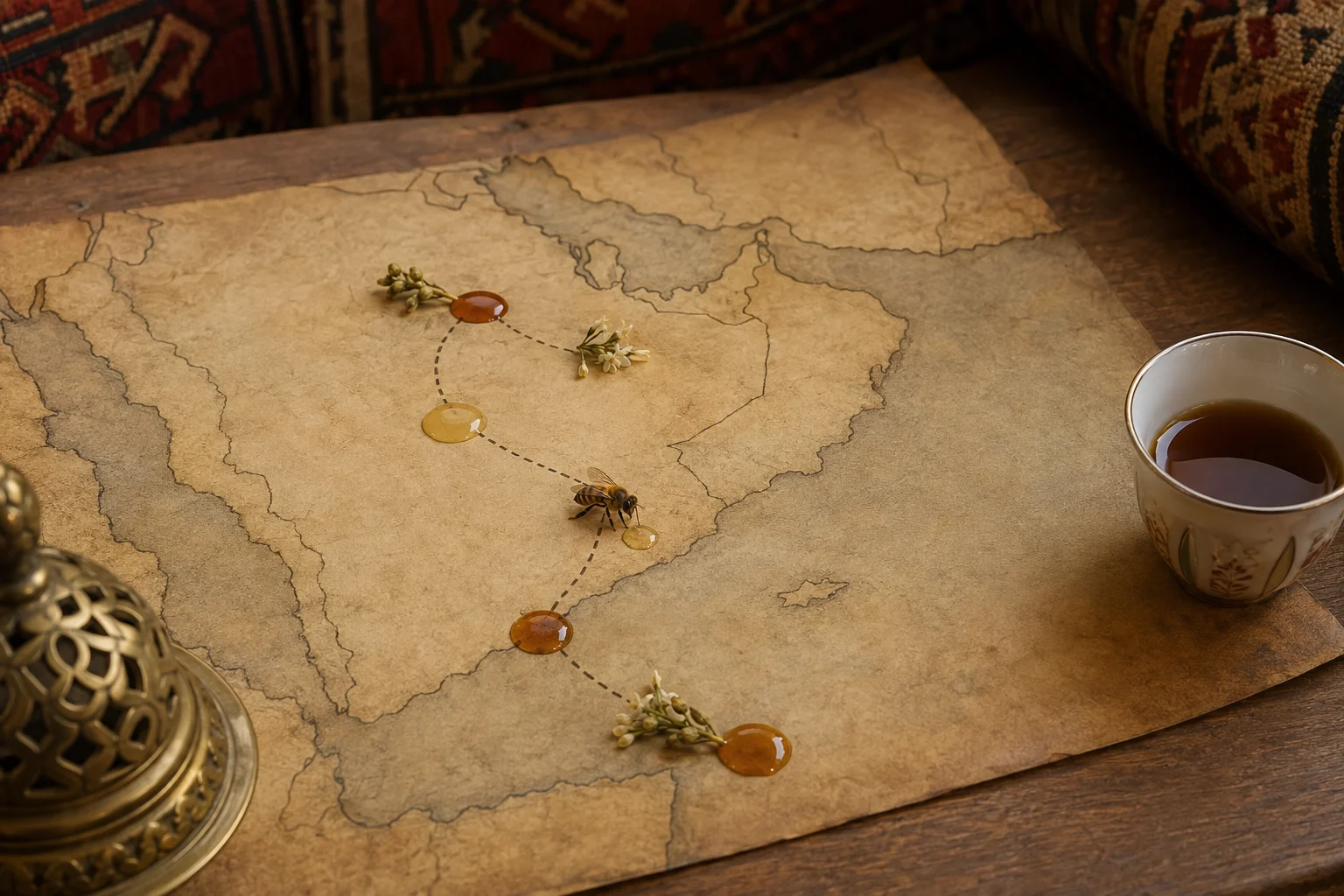
The coffee was still warm. Dates remained on the plate. Six jars stood between us. And suddenly the table looked less like a competition and more like a map. Yemen. Oman. Saudi Arabia. The Emirates. Qatar. Different routes converging around one majlis.
Arabic coffee appears across these countries, but not always with exactly the same roast or spice balance. Dates appear everywhere, but varieties and preferences change. Sidr crosses borders. Samar crosses borders. Hospitality crosses borders. Language crosses borders. Yet sameness never completely arrives.
And perhaps that’s precisely what makes the Gulf interesting. Shared traditions do not erase local character. They make the differences easier to notice.
Our Bee Changes Her Mind
She had spent the entire journey laughing at us. Yemeni honey. Emirati honey. Omani honey. Saudi honey. Qatari honey. She thought the whole human obsession with names was ridiculous.
Then somewhere near the end of our journey, she became quiet. We were looking toward the mountains. “Maybe I was wrong about you humans,” she said. “About what?” “The names.” I smiled. “You finally understand Yemeni Sidr honey?” “No.” “Emirati Sidr?” “No.” “Omani honey?” “No.” “Then what?”
She looked toward the landscape. “I understand why you want to remember where the flowers were.” And there it was. The whole article in one sentence. Not nationalism. Not marketing. Not one country defeating another. Memory of place.
Because when we say Hatta, we should be remembering mountains and flowering trees. When we say Do’an, we should remember a valley and generations of beekeeping. When we say Oman, the Hajar Mountains, Nizwa and other landscapes enter the story. When we say Saudi honey, the immense variety of Saudi geography should prevent us from imagining one uniform jar. When we say Qatar honey, we should ask what bees can genuinely find within Qatar’s particular environment. Origin is valuable because landscape is valuable.
The Bee Meets Her Yemeni Friend One Last Time
Before leaving, she returned to Yemen. Her friend was working. “I understand the humans a little better now.” The Yemeni bee looked suspicious. “Why?” “They don’t only name the honey.” “They don’t?” “They name places because they are afraid of forgetting them.”
The other bee stopped. “Do flowers care if they are forgotten?” “No.” “Do we?” “Probably not.” “Then?” Our bee thought about it. “Humans do.” The Yemeni bee returned to the flowers. “Strange creatures.” “Very.”
A moment passed. “Are you coming?” “Where?” “The Sidr is flowering.” And that was the end of their philosophical discussion.
What Should You Actually Look For When Buying Gulf Honey?
After all our travelling, jokes and arguments, the practical answer is surprisingly simple. If you’re looking for Emirati honey in Dubai, ask where in the UAE it was harvested. If you’re looking for Hatta Sidr honey, ask whether the honey genuinely comes from Hatta.
If you’re buying Yemeni Sidr honey in the UAE, distinguish Yemen as the origin and the UAE as the market. If you’re looking for Omani honey in Dubai, ask for the Omani region and floral source where available. If you’re buying Saudi honey in the Emirates, the same principle applies.
If you see Sidr honey Qatar, determine whether that means Sidr produced in Qatar or Sidr imported and sold there. And if you see gold honey, ask about the honey before admiring the gold. Origin first. Decoration afterward.
A Word About Raw, Authentic and Premium
Terms such as raw honey, authentic honey, premium honey and luxury honey are used constantly online. They can communicate something useful. They can also communicate almost nothing.
Authentic Yemeni Sidr honey should be supported by credible origin and traceability. Premium Emirati honey should have a reason for being called premium beyond typography. Luxury Sidr honey may describe presentation, rarity, selection or ingredients, but luxury itself does not identify floral origin.
And raw deserves clarity about handling rather than becoming a magical adjective attached to every expensive jar. The bee nodded. “Better.” “Thank you.” “I still prefer flowers.” We know.
Why We Put Gold in Honey Anyway
She had not forgotten the gold. “So explain it.” “Explain what?” “Why humans put gold in honey.” “Because sometimes food is also a gift.” She waited. “Sometimes a celebration.” Still waiting. “Sometimes beauty matters.”
She looked toward the golden reflection inside the jar. “Does it make people smile?” “Sometimes.” “Then say that.” So I will. There is nothing wrong with making something beautiful. There is nothing wrong with a gold Sidr honey gift, an elegant box or a table prepared for somebody we care about.
At MESKI, we enjoy that world too. But beauty becomes more meaningful when it rests on something genuine. A beautiful jar containing honey whose origin we can explain interests me more than a spectacular jar containing a mystery. The gold can make the eye smile. The honey still has to tell the story.
The Final Round
Six jars. Five countries. One very tired bee. I poured the last coffee. “Ready?” “No.” “Final question.” She moved toward the open window. “Which one is the best honey?” Silence. “Finally you have nothing to say?” She lifted into the air. Then turned once.
“I already told you.” “What?” “I look for flowers.” “And?” “You humans look for winners.” Then she disappeared.
I looked at the jars again. Yemen did not need to defeat Oman. Oman did not need to defeat the Emirates. Emirati honey did not need to defeat Saudi honey. Qatar did not need to claim a honey simply because the jar was sitting in Doha. And Hatta did not need to become Yemen to make beautiful Sidr honey.
Different land. Different flowers. Different seasons. Different hands. Different memories. That is not competition. That is richness. And perhaps our confused little bee had understood the Gulf better than all of us.
Meskaoui
“The richest table is not the one with the winning jar. It is the one where every jar still has a story to tell.”
— Meskaoui
And after all that…
Our bee had crossed Hatta, Yemen, Oman, Saudi Arabia and Qatar. She had argued with us about passports, watched humans turn flowers into geography homework, learned why we care about terroir, and listened to us debate Sidr, Samar, Emirati honey, Yemeni honey, Omani honey, Saudi honey, Qatari honey and gold honey.
Then morning came.
A human opened one of the jars, spread the honey over warm bread and sat down with coffee.
The bee looked at the breakfast table from the window.
“All that travelling, all those countries, all those arguments…”
She shook her head.
“And in the end, our honey becomes breakfast for humans.”
Hahaha. Fair enough.
Gulf Honey FAQ
Not necessarily. Emirati honey should refer to honey harvested in the UAE. Dubai honey can also be used loosely for honey sold in Dubai, so check the actual harvest origin.
Yes. Genuine Sidr honey harvested in Hatta is Emirati Sidr honey and, more specifically, Hatta Sidr honey.
No. Yemeni Sidr honey sold in Dubai remains Yemeni honey. Dubai is the market; Yemen is the harvest origin.
Yes. Yemeni honey, including Yemeni Sidr and Do’ani Sidr, is sold in the UAE. Traceability and seller reliability matter.
No. Both may be Sidr honey, but they come from different geographical environments and should not be treated as identical.
No. Sidr honey is also produced in Oman, the UAE, Saudi Arabia and other regions where suitable Ziziphus trees grow.
Samar honey is produced from nectar associated with Samar trees and is important in parts of the Arabian Peninsula, including Oman and the UAE.
Usually Yemeni Sidr honey available in the UAE. Yemen remains the origin; UAE describes the market.
Normally Omani-origin honey available in Dubai. The place of sale does not change the harvest origin.
Yes. Emirati honey in Qatar remains Emirati honey if it was harvested in the UAE.
Not automatically. Doha sells local and imported honey. Qatari honey should refer to honey actually produced in Qatar.
Yes, beekeeping exists in Qatar. Genuine local honey should be evaluated according to Qatar’s own flora, climate and season.
Saudi Sidr honey is Sidr honey produced in Saudi Arabia. Regional origin within the Kingdom can also be important.
No. Gold is an addition. The underlying honey still has its own floral and geographical origin.
There is no universal winner. Look at origin, traceability, floral source, storage, seller knowledge and personal taste.
There is no objective answer for every jar or every palate. Compare traceable individual honeys rather than declaring an entire country the winner.
Do not rely on colour, price or thickness alone. Look for producer, geographical origin, harvest details, batch information and credible documentation.
Flora, climate, rainfall, altitude, soil, flowering periods, hive placement, harvest timing, beekeeping practices and storage can all affect honey.
Start with the bee’s favourite question: where were the flowers? Then ask who produced it, where it was harvested and how the origin is documented.
Continue the Journey
If this story brought you here, continue the journey through related stories from The House of Meski.