
A beach can lead to a souk. A souk can lead to Sidr. Sidr can lead all the way to Hatta.
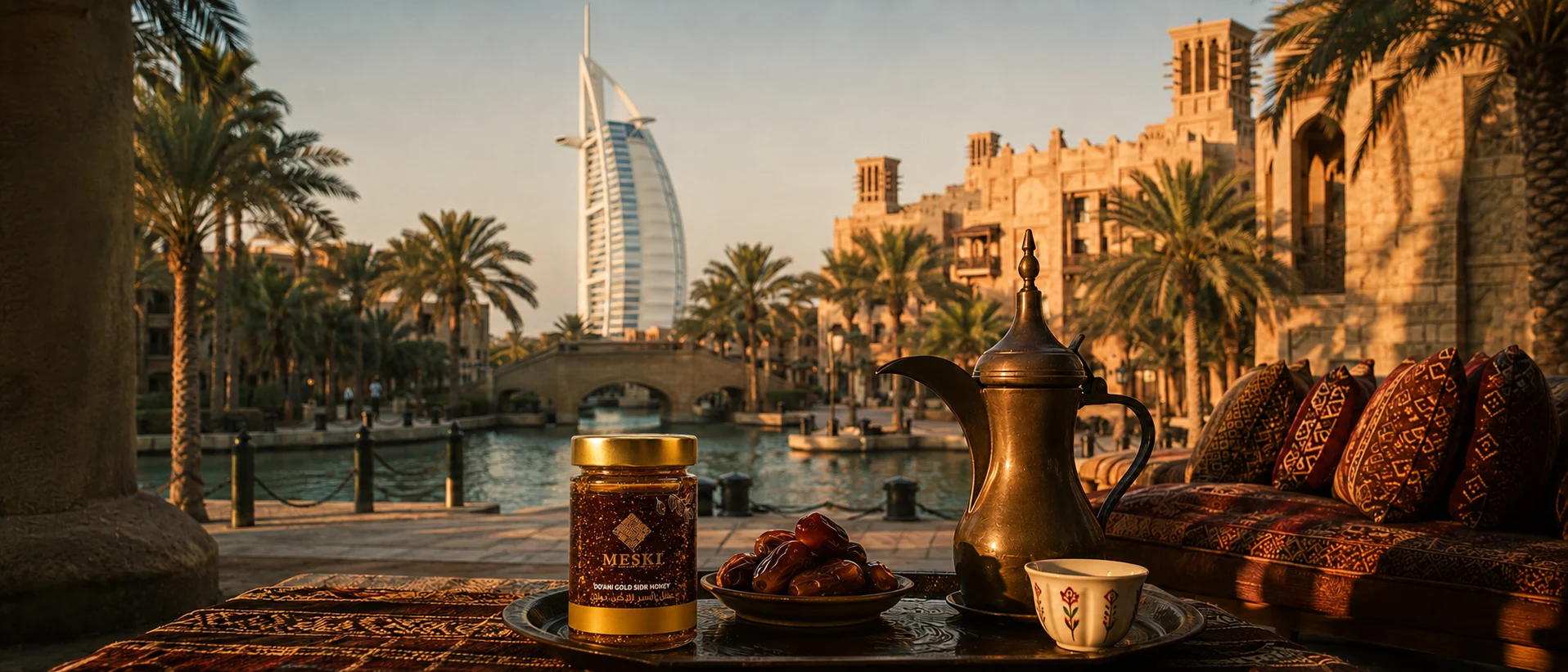
Jumeirah is not a honey district. That is exactly why this article matters.
Jumeirah is known for beaches, villas, cafés, restaurants, hotels, boutiques and some of the most recognisable views in Dubai. Visit Dubai describes it as a neighbourhood of beaches, shopping and food. Nobody opens a map and says: this is Dubai’s honey quarter.
And yet search for Jumeirah honey, honey Jumeirah, Sidr honey Jumeirah, Emirati honey Jumeirah or Jumeirah honey Dubai and honey appears naturally in the conversation. It appears in souks, breakfast tables, gift shops, cafés, family homes and the wider culture of Dubai hospitality.
That is the point of this article. Honey does not need its own street to belong to a place.
From the beach to the majlis
Jumeirah can be read in several ways. One visitor sees a beach. Another sees Burj Al Arab. Someone else comes for Madinat Jumeirah. A resident may think of villas, schools, mosques, cafés and roads travelled every day.
I like the quieter reading. Leave the postcard for a moment and imagine a morning table: Arabic coffee, dates, bread, perhaps cheese, olive oil and a small bowl of honey. Suddenly Jumeirah is not only a place to visit. It becomes part of an Emirati breakfast story.
This is where honey Jumeirah starts to make sense without forcing it.
Can You Find Emirati Honey in Jumeirah?
Yes, but the important question is what Emirati honey means. Honey sold in Jumeirah is not automatically Emirati honey. A jar may come from Yemen, Oman, Saudi Arabia, Morocco or elsewhere and simply be sold in Dubai.
Emirati honey should refer to honey actually produced in the UAE. That may include Sidr, Samar or other local floral origins depending on region and harvest.
So someone searching Emirati honey Jumeirah may be looking for local UAE honey available in Jumeirah, not merely any honey on a Jumeirah shelf.
Emirati Honey, Emirates Honey or UAE Honey: What Do We Actually Mean?
People search in different ways. Emirati honey, Emirates honey, UAE honey, honey UAE, honey Emirates, Emiratie honey, Emirati Sidr, Emirates Sidr honey. Search language is rarely tidy.
Most of these searches are trying to solve the same problem: find honey connected to the United Arab Emirates.
But connection can mean two things. Produced in the UAE, or simply sold in the UAE. Good SEO should explain the difference instead of hiding it.
Honey in Jumeirah, Honey Dubai and Sidr Honey UAE
Jumeirah belongs to Dubai, Dubai belongs to the UAE, and consumers often combine all three in search. That creates queries such as honey Jumeirah Dubai, Sidr honey Jumeirah, Dubai honey UAE, Emirati honey Dubai and UAE Sidr honey.
The words overlap because geography overlaps. But the honey’s origin still needs its own answer.
A Yemeni Sidr sold in Jumeirah remains Yemeni Sidr. A Hatta Sidr sold in Jumeirah is genuinely Emirati Sidr.
Sidr Honey in Jumeirah: Yemen, Hatta and the UAE Are Not the Same Thing
Sidr is one of the most powerful honey words in Gulf search. But Sidr is not a country. Yemen produces famous Sidr honey. Oman produces Sidr. The UAE produces Sidr. Saudi Arabia produces Sidr.
So a person searching Sidr honey Jumeirah may find several origins under the same floral name.
That is why the label after Sidr matters: Yemeni Sidr, Omani Sidr, Emirati Sidr, Hatta Sidr, Saudi Sidr. Same famous word, different landscapes.
Yemeni Sidr Honey in Dubai Is Still Yemeni Honey
Dubai is one of the Gulf’s strongest markets for Yemeni honey. That creates searches such as Yemeni honey Dubai, Yemen honey Dubai, Yemeni Sidr Dubai, Yemen Sidr UAE and Sidr honey Jumeirah.
But market does not become origin. A jar from Yemen does not change nationality when it crosses Sheikh Zayed Road.
This sounds obvious, yet the distinction helps Google and readers understand the subject more accurately.
Hatta Sidr: The Emirati Sidr Honey From the Mountains
Hatta changes the image of Dubai. Around 130 kilometres south-east of central Dubai, the mountain town introduces farms, bees, wadis and a completely different environment from Jumeirah’s coast.
Visit Dubai highlights Hatta Honey Bee Garden and local beekeeping as part of the area’s identity. That makes Hatta one of the most natural bridges between Dubai geography and Emirati honey.
When Hatta Sidr reaches Jumeirah, the journey is local: mountain Dubai to coastal Dubai.
From Hatta to Jumeirah: How Emirati Sidr Reaches Dubai
Think about the route. The bees forage in a mountain environment. The honey is harvested and packed. Then it moves toward central Dubai, where residents and visitors encounter it in shops, markets and gifts.
That movement gives us a useful phrase: Emirati honey in Jumeirah. Here the origin and the market are both true.
Hatta is where the honey story begins. Jumeirah is one place where the story can be discovered.
Hatta Honey, Hatta Sidr and UAE Mountain Honey
Searches do not always use technical botanical language. People type Hatta honey, Hatta Sidr, UAE mountain honey, Emirati mountain honey, Sidr honey Hatta or Dubai mountain honey.
Some phrases are more precise than others, but they all show the same curiosity: what kind of honey can come from the UAE’s mountain landscapes?
That is a question worth answering because Dubai is usually imagined as a city before it is imagined as an ecosystem.
Sidr, Jujube or Jujube Tree Honey: Why the Names Change
Sidr and jujube frequently appear in the same conversation because Sidr trees belong to the Ziziphus group. Online, consumers may search Sidr honey, jujube honey, jujube tree honey, jujube honey Dubai, Emirati jujube honey or UAE jujube honey.
That does not mean every Ziziphus tree is identical or every honey is interchangeable. Species, local names and terroir matter.
But from an SEO perspective, jujube is an essential bridge because many people know the fruit or tree name before they know the Arabic word Sidr.
Sidr, Sdr and the way people really type
People do not always spell Sidr correctly. Some searches drop a vowel and become sdr honey, sdr honey Dubai, sdr UAE or Emirati sdr.
I would never write an entire article badly just to catch a typo. But acknowledging the variant once is enough to tell search engines that the conversation belongs to the same topic.
Language is messy. Search is even messier.
Jujube Honey Dubai Is Not a Different Universe
Someone searching jujube honey Dubai may be looking for the same broad honey family another person calls Sidr honey Dubai.
That makes jujube honey one of the useful side doors into the Sidr conversation.
From there, a reader can learn the difference between tree name, local name, floral source and geographical origin.
Samar and Ghaf: Jumeirah Is Not Only About Sidr
If every UAE honey article talks only about Sidr, we create another distortion. Samar honey has an important place in the Arabian Peninsula, including the UAE. Ghaf is deeply associated with Emirati landscapes and identity, and honey connected to Ghaf appears in the local honey conversation.
So Jumeirah honey culture can include more than Sidr. Emirati Samar honey, UAE Samar honey, Ghaf honey UAE and Emirati Ghaf honey all belong to the wider map.
The local honey story is richer when one famous word does not occupy every shelf.
Emirati Samar Honey
Samar produces a very different conversation from Sidr. The tree, flowering period and flavour profile differ, and consumers who know Gulf honey often distinguish the two clearly.
Searches such as Samar honey Dubai, Emirati Samar honey, UAE Samar honey and honey Samar Emirates may be smaller than Sidr terms, but small roads can still bring visitors into a larger site.
That is precisely why a broad editorial ecosystem matters.
Ghaf Honey From the UAE
The Ghaf is the national tree of the UAE and one of the plants most strongly associated with desert resilience in the country.
Honey linked to Ghaf therefore carries a very different cultural story from imported Yemeni Sidr or mountain Hatta Sidr.
Someone searching Ghaf honey Dubai or Emirati Ghaf honey may begin with curiosity about a tree and end up learning about UAE honey.
Old Jumeirah Before the Hotels
Modern Jumeirah is inseparable from famous hotels, beaches and luxury. But Dubai itself began as a fishing and pearling settlement, and the coastal culture of the emirate predates the modern skyline.
Old coastal life was built around sea, trade, family, mosques, neighbourhood ties and hospitality. Jumeirah’s modern identity should not make us forget that the Dubai coast had a life before resort architecture.
This matters because honey, coffee and dates belong more naturally to a story of receiving guests than to a story of luxury retail.
Jumeirah Beach, Burj Al Arab and the Dubai Visitors Know
We do not need to reject modern Jumeirah to prove we understand culture. Burj Al Arab, beaches, restaurants and hotels are part of the real city too.
A visitor may arrive because of a famous view and then discover something less expected: Arabic coffee, dates, oud, honey, local gifts or an Emirati breakfast.
Tourism becomes interesting when the postcard opens a door instead of closing the story.
Souk Madinat Jumeirah: Where Tradition Meets Modern Dubai
Souk Madinat Jumeirah deliberately recreates the atmosphere of a traditional Middle Eastern marketplace within a modern resort setting. Its official directory includes honey retail among the souk’s offerings.
That makes the link between Jumeirah and honey completely natural. The souk is not a historic honey market from old Dubai; it is a contemporary space using traditional architecture and retail culture.
That distinction matters. We can enjoy the atmosphere without pretending it is an untouched nineteenth-century bazaar.
Sidr at the Souk
At a souk in Jumeirah, Sidr can sit beside saffron, oud, perfume, dates, spices and gifts. That is exactly how Gulf luxury works: products speak to each other culturally even when they come from different countries.
A Yemeni Sidr jar may sit beside Emirati products. An Omani honey may be sold a few metres from a UAE perfume. The market brings origins together.
The job of the buyer is to enjoy the mixture without confusing where each product actually came from.
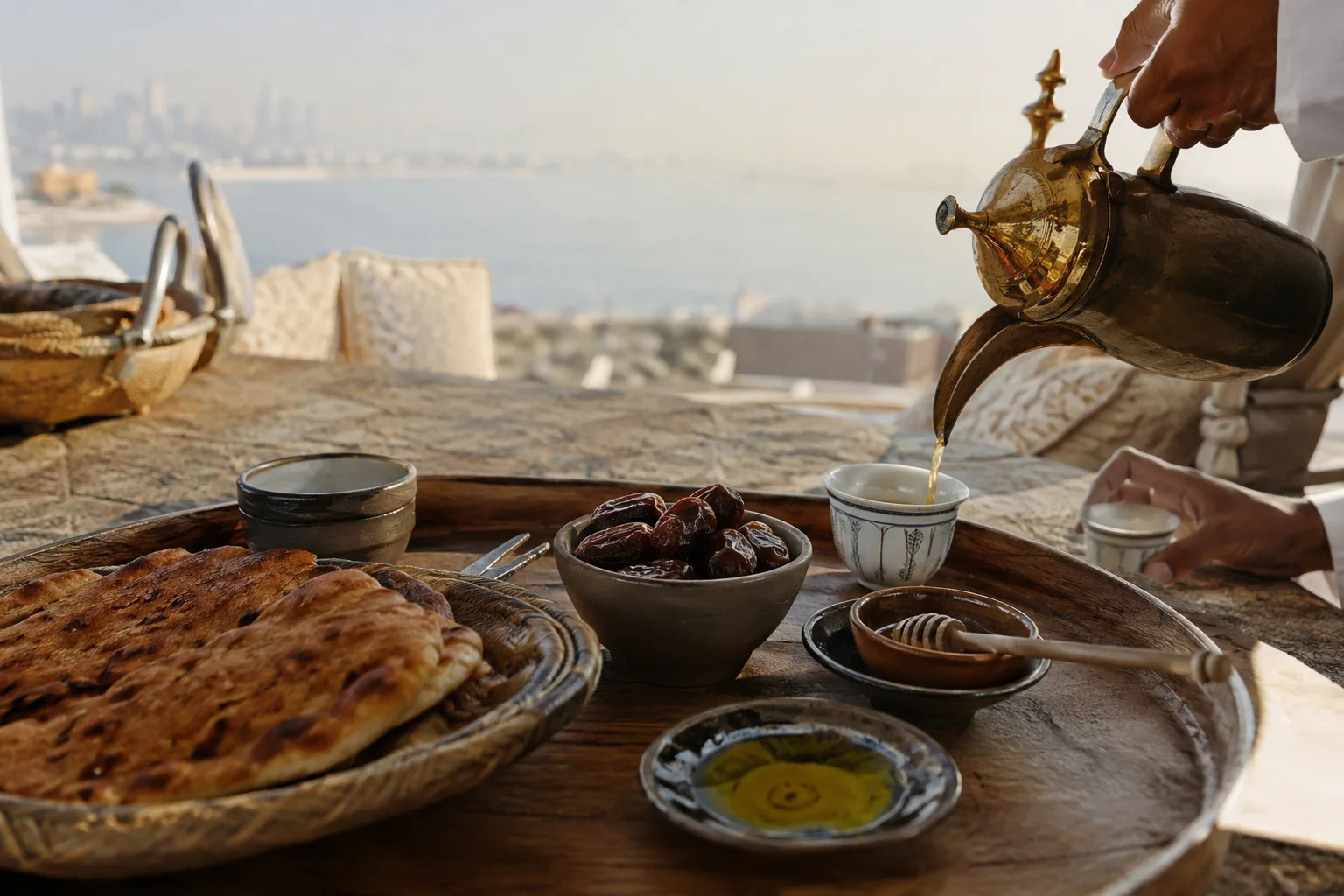
Honey, Dates and Arabic Coffee at the Emirati Table
This is the part of Jumeirah I prefer. Leave the shelf and return to the table.
Arabic coffee arrives in a small cup. Dates come first or sit nearby. Bread can be torn by hand. Honey does not need a luxury box here; a spoon is enough.
The value is not the price of the table. It is that somebody offered you a place at it.
Arabic Coffee, Emirati Dates and Sidr Honey
Coffee, dates and honey form one of the easiest bridges between Gulf food culture and honey search.
A tourist who searches Arabic coffee Dubai may discover dates. Someone researching dates may discover Sidr. Someone searching Sidr honey Jumeirah may discover Hatta, Samar and Ghaf.
This is how soft cultural SEO feeds hard commercial SEO without turning every article into a shop window.
An Emirati Breakfast in Dubai
What is an Emirati breakfast? It can include breads, eggs, cheeses, dates, sweet dishes, legumes, coffee and many family variations. There is no single plate that represents every Emirati home.
Honey can appear naturally among these foods, especially with bread or as part of a broader hospitality table.
So Emirati breakfast Jumeirah, breakfast Dubai honey and Arabic breakfast Dubai are not absurd combinations. They belong to a real food context.
Jumeirah Breakfast: Luxury Hotel or Family Table?
Jumeirah offers both worlds. A hotel breakfast may be immaculate, international and expensive. A family table can be simpler and infinitely more meaningful to the person sitting there.
I enjoy both, but I do not confuse price with hospitality.
Sometimes the most memorable honey is the one somebody placed in front of you without trying to sell it.
Ramadan in Jumeirah: Dates, Coffee, Honey and Hospitality
Ramadan changes the rhythm of Dubai. Jumeirah’s hotels, restaurants, mosques, homes and evening spaces all feel that change in different ways.
Dates become even more visible at iftar. Arabic coffee returns again and again. Honey may appear in desserts, breakfasts, suhoor tables or gifts.
This creates natural long-tail searches: Ramadan honey Dubai, Ramadan gifts Jumeirah, dates Jumeirah, Sidr honey Ramadan UAE, Emirati honey gifts and Dubai Ramadan honey.
Ramadan Gifts in Jumeirah
Gift culture is one of the strongest bridges between honey and Jumeirah. Perfume, oud, dates, sweets, coffee and honey all work well as Ramadan or Eid gifts.
Luxury packaging can fit the neighbourhood, but the product still needs a story.
An expensive box does not turn imported honey into Emirati honey.
Jumeirah, Gifts and Luxury Honey
Jumeirah naturally attracts searches around luxury. Luxury honey Jumeirah, honey gift Dubai, premium Sidr Dubai, gold honey Dubai and Sidr gift UAE all sit close to the neighbourhood’s commercial image.
This is where MESKI can speak confidently without pretending that luxury is the only value.
Some people want gold. Some want a simple raw jar. Both can love honey.
Gold Honey Dubai: Decoration Is Not Origin
Gold honey can be beautiful, but gold tells you nothing about where the bees foraged.
A Yemeni Sidr with gold remains Yemeni Sidr. An Emirati Sidr with gold remains Emirati Sidr.
Decoration and origin should never be allowed to replace each other.
Where Jumeirah Fits Into Dubai’s Honey Culture
Jumeirah is not the production centre of Dubai honey. Its role is closer to a meeting point: residents, tourists, souks, hotels, restaurants and retail all bring different honeys into one neighbourhood.
Hatta brings a local production story. Deira brings trading history. Jumeirah brings hospitality, tourism and premium retail.
Together they create a broader Dubai honey ecosystem.
Best Honey in Dubai Does Not Mean One Honey
People love the phrase best honey Dubai. Google loves it too. But best for what?
Best local Emirati honey? Best Yemeni Sidr in Dubai? Best Hatta Sidr? Best Samar? Best gift? Best value? Best raw honey? Best luxury honey?
The word best becomes useful only after the question becomes specific.
Dubai Honey vs Emirati Honey
Dubai honey is one of those phrases that can mean several things. It may mean honey produced in Dubai, honey sold in Dubai or simply honey someone wants to buy while visiting Dubai.
Emirati honey should be narrower: honey produced in the UAE.
So every Emirati honey can be sold in Dubai, but not every honey sold in Dubai is Emirati.
Where UAE Honey Actually Comes From
The UAE is not one ecosystem. Mountain areas, desert environments, farms, oases and coastal zones differ.
Hatta gives Dubai a mountain beekeeping story. Other emirates contribute their own landscapes and floral sources.
This geographical diversity is why UAE honey should never be reduced to a generic country label.
Jumeirah Honey, Jumeirah Sidr, Honey Jumeirah: Why All Three Matter
These phrases may look repetitive to a writer, but searchers do not think like editors. One types Jumeirah honey. Another types honey Jumeirah. Another types Jumeirah Sidr. Google must decide whether the same page can answer all three.
A strong article should make that decision easy without sounding ridiculous to a human reader.
That is the balance: lexical density for search, narrative depth for people.
Emirat, Emirates, Emirati, Emiratie, UAE
The same country appears under several words. Emirate refers to one member of the federation. Emirates refers to the federation in common language. Emirati describes something or someone from the UAE. Some users type Emiratie, Emirats or other variations influenced by French spelling. Others simply type UAE.
A site that speaks only one perfect version leaves search territory unused.
So this article deliberately recognises Emirates honey, Emirati honey, UAE honey, Emirats honey and even Emiratie honey as part of the search landscape while keeping the editorial language clean.
Miel, Honey and the French-English Bridge
Dubai search is multilingual. A French-speaking traveller may search miel Dubai, miel de jujubier Dubai or miel des Emirats before switching to Sidr honey Jumeirah or Emirati honey.
That is why one small multilingual bridge can be useful: miel de jujubier, jujube honey, Sidr honey.
The product did not change. Only the searcher’s language did.
A tourist can enter through Jumeirah and leave through Hatta
This is what I like most about broad editorial SEO. A person arrives because they searched Jumeirah. They read about the souk, then Sidr, then Hatta, then Emirati honey. Suddenly a beach search has become a mountain story.
Another visitor enters through Ramadan and reaches dates, coffee and honey. Another begins with jujube tree and reaches the UAE.
Every good article is a door. It does not need to be the same door.
A reader can finish in the shop without being pushed
I do not want every paragraph to say buy honey. That would destroy the reason to read MESKI.
If the reader becomes curious about Hatta Sidr, Yemeni Sidr, Samar or Ghaf, the shop is there. The article has done its job by making the curiosity real.
Hospitality first. Commerce can wait its turn.
Meskaoui
“Jumeirah may bring you for the beach, the souk or the view. If you leave knowing that Dubai also has mountains, bees, Sidr, Samar and a table waiting for coffee, then perhaps you discovered more than you came for.”
— Meskaoui
One neighbourhood, many doors
Jumeirah is not a honey district. Good.
It does not need to be.
It can be a beach, a breakfast, a souk, a Ramadan evening, a luxury hotel, an old coastal memory, a jar of Sidr from Yemen, or Emirati honey that travelled from Hatta.
That is exactly why the word Jumeirah can lead so many different people into the same wider story of Dubai and the UAE.
Jumeirah, Dubai and Honey FAQ
Honey is sold through supermarkets, souks, specialist food retailers and gift shops in and around Jumeirah. Souk Madinat Jumeirah officially lists honey retail among its offerings.
Yes. Sidr honey is widely available in Dubai, including Jumeirah retail environments, but check whether the origin is Yemen, UAE, Oman, Saudi Arabia or elsewhere.
Not necessarily. Emirati honey should be produced in the UAE; imported honey can be sold in Jumeirah without becoming Emirati.
Sidr honey produced in Hatta, the mountain area of Dubai, is a form of Emirati Sidr honey.
Yes. Hatta is part of the Emirate of Dubai, around 130 km south-east of central Dubai.
Sidr belongs to the Ziziphus group, often discussed as jujube in English. Exact species and local origin still matter.
It is a common shortened or misspelled form of Sidr honey in online searches.
Honey genuinely produced in the United Arab Emirates.
Usually another search phrase for UAE or Emirati honey, though sellers may also use it loosely for honey sold in the Emirates.
No. It remains Yemeni honey; Dubai is the market.
Honey produced from Samar nectar in suitable UAE regions and other parts of Arabia.
Honey linked to nectar from Ghaf trees, a plant strongly associated with the UAE.
There is no single answer. It depends on whether you want Emirati local honey, Yemeni Sidr, Hatta Sidr, Samar, Ghaf, value, traceability or gifting.
Yes. Jujube honey and Sidr honey are common search terms in Dubai, though buyers should check the precise origin and floral claim.
Yes. The official Souk Madinat Jumeirah directory lists honey retail.
Sidr, Samar and other honeys can all be served with breads, dates or breakfast foods alongside Arabic coffee; preference is personal.
Yes. Honey, dates, coffee, sweets, oud and perfume are common categories for Ramadan and Eid gifting.
The phrase can mean honey produced in Dubai, honey sold in Dubai, or simply honey someone wants to buy while in Dubai.
Usually a misspelled or multilingual variation of Emirati honey in search queries.
Sidr honey actually produced in the United Arab Emirates, including harvests associated with areas such as Hatta.
Continue the Journey
If this story brought you here, continue the journey through related stories from The House of Meski.