
Dubai is both a place where honey is produced and a marketplace where the honeys of Arabia meet. The important thing is knowing which is which.
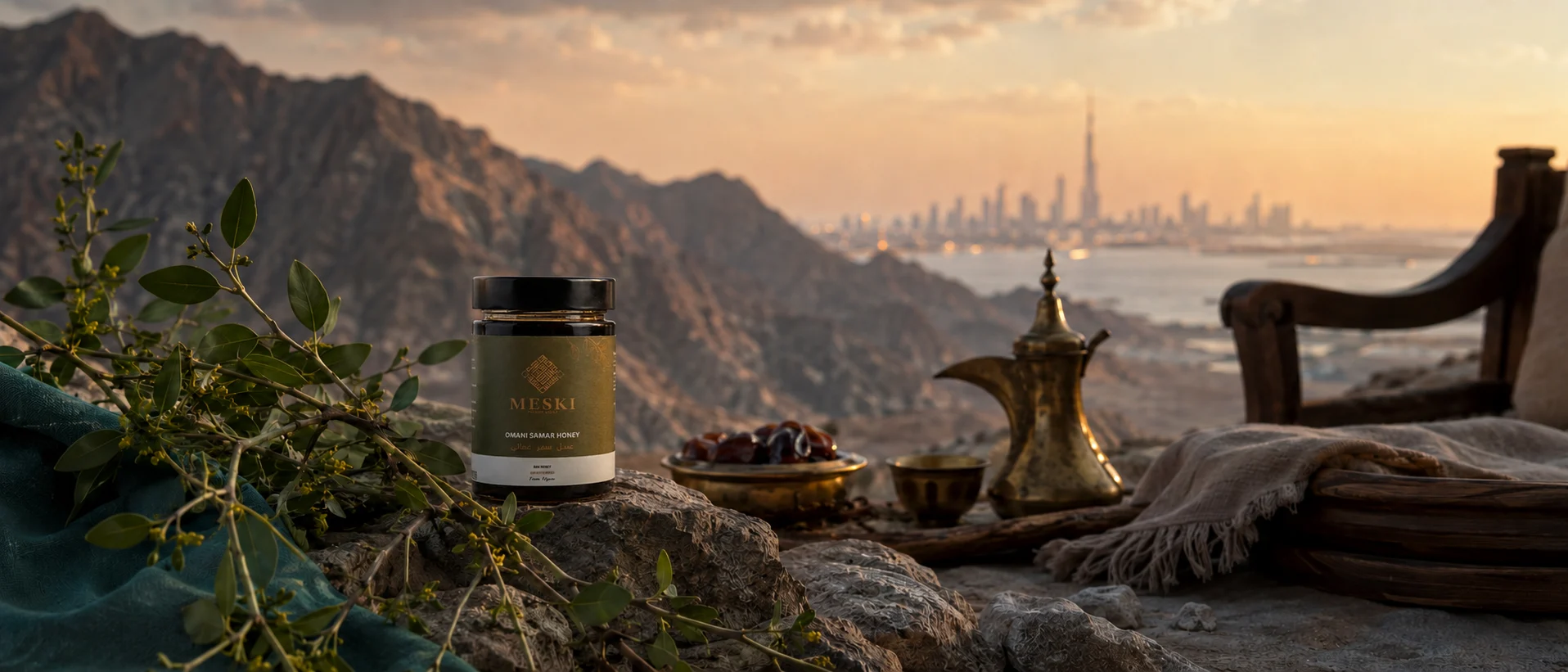
Search for honey in Dubai and almost immediately you enter a world of Sidr, raw honey, Yemeni honey, Hatta honey, luxury gift boxes, dark jars, golden jars and claims of purity.
The problem is not that Dubai has too little choice. It has almost too much.
So I want to begin with geography. Dubai can be the place where you buy the honey, the place where you receive it, and sometimes the place where it was actually harvested. Those are three different things. Once we separate them, choosing honey becomes much easier.
There Is More Than One Meaning Behind ‘Dubai Honey’
When someone searches Dubai honey or honey Dubai, they may mean several different things. They may want honey produced inside the Emirate of Dubai. They may want to buy Sidr honey while staying in Dubai. They may be looking for a gift. They may want Yemeni honey delivered to Jumeirah. Or they may simply be trying to understand which honey is worth buying.
Those intentions should not be collapsed into one claim. Honey sold in Dubai is not automatically honey from Dubai. The city is a marketplace for Emirati, Yemeni, Omani and many other origins.
A useful guide therefore begins by separating place of purchase from place of harvest.
Hatta: Where Dubai Honey Can Actually Begin
Hatta gives the phrase Dubai honey a literal meaning. Part of the Emirate of Dubai, Hatta sits in the Hajar Mountains and has an established beekeeping industry. Sidr, Samar, Ghaf and other floral sources are part of the local beekeeping landscape.
Hatta Honey, one of the best-known local producers, describes its Sidr as monofloral honey harvested from Sidr nectar, with the Sidr season running from October to November. Its product range also includes Samar, Ghaf, mangrove and wildflower honeys.
For a buyer, this matters because Hatta Sidr honey is not merely a Dubai-branded product. It can be connected to a specific mountain area, flowering source and harvest season.
Sidr Honey Dubai: One Search, Several Origins
Sidr honey Dubai is one of the phrases most likely to create confusion. Sidr describes honey associated with nectar from Sidr trees, but it does not tell you the country by itself.
In Dubai you can encounter Emirati Sidr, Yemeni Sidr, Omani Sidr and Sidr from other regions. Each should retain its own identity. A Yemeni jar does not become Dubai Sidr because it is sold in Dubai. An Omani jar does not become Emirati because it was delivered to Jumeirah.
The first question when buying Sidr honey in Dubai should therefore be simple: where was this honey harvested?
Emirati Sidr and Hatta’s Mountain Character
Emirati Sidr deserves to be tasted on its own terms rather than as an imitation of Yemeni Sidr. Hatta’s mountain environment, local flowering, weather and harvest conditions give the honey its own identity.
Local producers describe Hatta Sidr as dense, smooth and golden, with a rich sweet profile. Like all natural honey, colour and texture can evolve with time and storage.
The important point is not to turn tasting notes into absolute rules. Natural harvests vary. Origin, batch and traceability tell us more than a single adjective.
Yemeni Sidr in Dubai
Yemeni Sidr has a strong reputation across the Gulf, particularly honey associated with Hadramout and Do’an. Dubai’s trading culture makes Yemeni honey widely sought after by residents and visitors.
That popularity also creates a reason for caution. A prestigious geographic name should be supported by credible sourcing and traceability. The darker jar or higher price is not automatically the more authentic one.
For MESKI, Yemeni Sidr belongs in Dubai because Dubai is where many people discover, compare and gift it. But the story must always lead back to Yemen.
Omani Honey in Dubai
Oman adds another important family of honeys to the Dubai market. Sidr and Samar are well known, while frankincense or Luban-related honey traditions create a different conversation around Dhofar and Omani landscapes.
An Omani Sidr bought in Dubai should be presented as Omani. This sounds obvious, yet vague Arabian branding often erases the differences that make regional honey interesting.
A good Dubai honey shop or specialist should help the customer understand those differences rather than hide them.
Samar, Ghaf and Mangrove: Dubai Honey Is Not Only Sidr
Sidr dominates search behaviour, but it should not dominate our understanding of Emirati honey. Samar honey can have a deeper, sometimes caramel-like character. Ghaf is tied to one of the UAE’s most symbolic native trees. Mangrove honey introduces the coastal ecosystem into a story many people assume belongs only to desert and mountains.
Hatta Honey currently sells Sidr, Samar, Ghaf, mangrove and wildflower honey, which shows how broad the local category can be.
For someone searching best honey Dubai, the best answer may therefore depend on taste rather than prestige. Sidr is not automatically the right jar for every person.
“A shop tells you where you bought the honey. The bees tell you where its story began.”Meskaoui
Jumeirah Honey: A Location Search, Not a New Origin
A person staying in Jumeirah may type Jumeirah honey, honey Jumeirah Dubai or Sidr honey Jumeirah because they want something nearby or delivered to their hotel or home.
That is a useful local signal, but it should never create a fictional origin. Jumeirah is the buyer’s location. The honey may come from Hatta, Yemen, Oman or somewhere else entirely.
Good local SEO should answer where the customer is without lying about where the bees were.
Downtown Dubai and Honey Near Burj Khalifa
The same principle applies around Downtown Dubai. A visitor can reasonably search honey near Burj Khalifa, Dubai honey gift Downtown or Sidr honey delivery Downtown Dubai.
The practical questions are delivery, packaging, origin and whether the product can travel. For tourists, a compact gift may be easier than a large hamper. For hotel delivery, recipient details and timing matter.
The geographic phrase tells us where the person wants the honey. It does not tell us where the honey came from.
Deira, the Creek and Dubai’s Trading Memory
Dubai’s relationship with regional products is older than its modern shopping districts. Deira and the Creek remind us that the city grew through trade, movement and exchange.
Honey fits naturally into that history because it travels. Yemeni, Omani and other regional products have long moved through Gulf markets, even if today’s logistics look very different.
When I think about honey in Dubai, I therefore think about two stories at once: local production in places such as Hatta, and Dubai’s role as a meeting point for products from across Arabia.
Raw Honey Dubai: What Does Raw Actually Tell You?
Raw honey is another popular search phrase. Consumers often use it to mean honey that has not been heavily heated or industrially processed. But the word alone does not answer every quality question.
Ask about handling, storage, origin and traceability. Natural honey can crystallise. It can vary in colour. Thick honey is not automatically raw, and liquid honey is not automatically processed.
A trustworthy seller should be able to explain what they mean by raw rather than relying on the word as decoration.
How to Read a Jar Before You Buy
Start with the label. Look for the stated country or region of origin. Identify the floral source if one is claimed. Check the net weight, batch information and storage guidance. For premium honey, ask what traceability or analysis is available.
Then taste when possible. Aroma, sweetness, acidity, texture and aftertaste are more useful than chasing a mythical universal Sidr profile.
Finally, compare like with like. A 250 gram rare-origin gift jar and a one-kilogram everyday local honey are not competing for exactly the same purpose.
Price: Why Dubai Honey Can Range So Widely
Honey prices in Dubai vary because the products themselves vary. Origin, harvest yield, floral source, scarcity, testing, packaging, import costs and brand positioning can all affect the final price.
Hatta Honey currently lists its one-kilogram Sidr at AED 262.50, while gift formats and other honey types carry different prices. That provides a useful local reference point, not a universal definition of what Sidr should cost.
A high price can be justified. It can also be marketing. Price is evidence of price, not evidence of authenticity.
Honey Gifts Dubai: When the Jar Becomes a Present
Honey works particularly well as a Dubai gift because it can connect food, hospitality and place. A Hatta Sidr gift tells a local mountain story. A Yemeni Sidr gift tells another Arabian story. A mixed collection can invite comparison.
Luxury presentation, saffron, edible gold or silver can add ceremony for weddings, Ramadan, Eid, corporate gifts or VIP occasions. But decoration should come after the quality of the honey.
The best honey gift Dubai is the one whose story remains true after the ribbon is removed.
Can You Take Honey Home From Dubai?
For travellers, honey can be an attractive edible souvenir, but baggage and customs rules depend on destination, container size and airline arrangements. Travellers should check current rules for their route rather than assuming.
Packaging matters. A properly sealed jar, protective box and clear label make travel easier. Small tasting collections can be practical for gifts.
This is another reason not to confuse luxury with size. The gift that arrives safely is more luxurious than the one that leaks into a suitcase.
How I Would Choose Honey in Dubai
If I wanted a local Emirati story, I would look closely at Hatta and other clearly identified UAE harvests. If I wanted the classic prestige associated with Yemeni Sidr, I would focus on provenance and traceability. If I wanted to explore Oman, I would compare Sidr, Samar and other Omani traditions.
If I were buying for a gift, I would ask who is receiving it before choosing the origin. Someone who loves strong flavours may enjoy a different honey from someone who prefers something gentle.
And if I were standing in Jumeirah or Downtown searching on my phone, I would remember one thing: the nearest jar is not necessarily the most local honey.
“Dubai brings many origins to one table. Good honey should never lose its homeland on the way.”Meskaoui
Dubai Is the Marketplace, the Honey Still Needs a Homeland
Dubai is exceptionally good at bringing the world together. That is one of its strengths. Honey should benefit from that openness without losing geography.
Hatta should remain Hatta. Yemen should remain Yemen. Oman should remain Oman. A buyer should be able to move from one jar to another and understand that each represents a different flowering season, landscape and chain of people.
That is the Dubai honey guide I want MESKI to build: not a list of claims, but a map.
Honey Delivery in Dubai: Convenience Without Losing Provenance
Online ordering has changed how people buy honey in Dubai. A customer can be in Jumeirah, Business Bay, Downtown, Dubai Marina or another district and order without visiting a shop. That convenience is useful, particularly for gifts.
But online shopping removes the chance to ask questions face to face. Product pages therefore need to work harder: origin, weight, floral source, storage, delivery conditions and photographs should be clear.
Fast delivery is a service feature. It is not a quality certificate. The honey still needs to stand on its own.
Why One Giant ‘Best Honey’ Ranking Is Misleading
People naturally search best honey in Dubai, but honey does not have one universal winner. The best jar for a strong Sidr lover may not suit someone who wants a mild breakfast honey. The best corporate gift may not be the best everyday jar.
Instead of ranking every origin from one to ten, I prefer questions: Do you want local UAE provenance? A famous Yemeni Sidr? An Omani discovery? A tasting gift? A honey for daily use?
Once the purpose is clear, the category becomes much easier to navigate.
The Role of Laboratory Testing
For premium honey, laboratory analysis can add useful evidence. Moisture, HMF, diastase, pollen and other parameters can help describe quality, freshness or botanical and geographic context depending on the method used.
Testing should not be turned into magic. One number rarely proves an entire story. Good traceability combines documentation, sourcing, batch identity and appropriate analysis.
This is especially important in a market where words such as pure, raw and premium appear everywhere.
From Flower to Jar: Why Season Matters
Honey is agricultural before it is commercial. A flowering season can be strong or weak. Rainfall, temperature, wind, forage availability and the condition of bee colonies all influence what reaches the jar.
For Hatta Sidr, local producers identify the main harvest period around October and November. That does not mean every jar from every year will taste identical. Natural variation is part of genuine honey.
When a seller can tell you the harvest period and batch, the conversation becomes more useful than generic claims such as premium or number one.
Crystallisation Is Not a Verdict
One of the most persistent honey misunderstandings is that crystallisation means a jar is fake or spoiled. In reality, crystallisation is a natural physical process influenced by the balance of sugars, temperature, floral source and time.
Some honeys remain liquid for long periods, while others crystallise more readily. A consumer buying raw honey in Dubai should therefore avoid using one visual characteristic as a purity test.
The same caution applies to colour and viscosity. Honey is not authenticated by a social-media trick. Serious evaluation starts with provenance, traceability and appropriate analysis.
Buying Honey for Everyday Use Versus Gifting
Everyday honey and gift honey can be the same quality while being presented very differently. A family buying a kilogram for breakfast may care most about flavour, origin and value. A person sending a VIP gift may need smaller jars, stronger presentation and a story that can be understood immediately.
This difference explains why comparing price per kilogram across every product can be misleading. Packaging and occasion affect the final price even when the honey itself is related.
For MESKI, the challenge is to keep the product honest in both situations. The gift box should add ceremony without pretending the jar inside came from somewhere it did not.
Honey in Dubai for Restaurants and Hospitality
Honey also appears beyond retail. Hotels, breakfast tables, cafés, restaurants and private hospitality use honey in very different ways, from small portions to premium tasting experiences.
A chef may care about flavour consistency and culinary use. A hotel may care about presentation and guest experience. A private host may care about the story behind a jar served with bread, cheese or dessert.
This broader hospitality context is another reason Dubai honey is not one market. The same city contains daily consumption, tourism, gifting, gastronomy and collectors looking for rare origins.
One City, Many Honey Questions
That is ultimately why a single Dubai honey guide needs breadth. The person searching may be a resident buying breakfast honey, a tourist in Jumeirah, a company preparing gifts, a Sidr enthusiast comparing Yemen and Hatta, or someone who has never tasted Samar or Ghaf.
They do not all need the same jar. They do need the same honesty: clear origin, useful information and enough context to make their own choice.
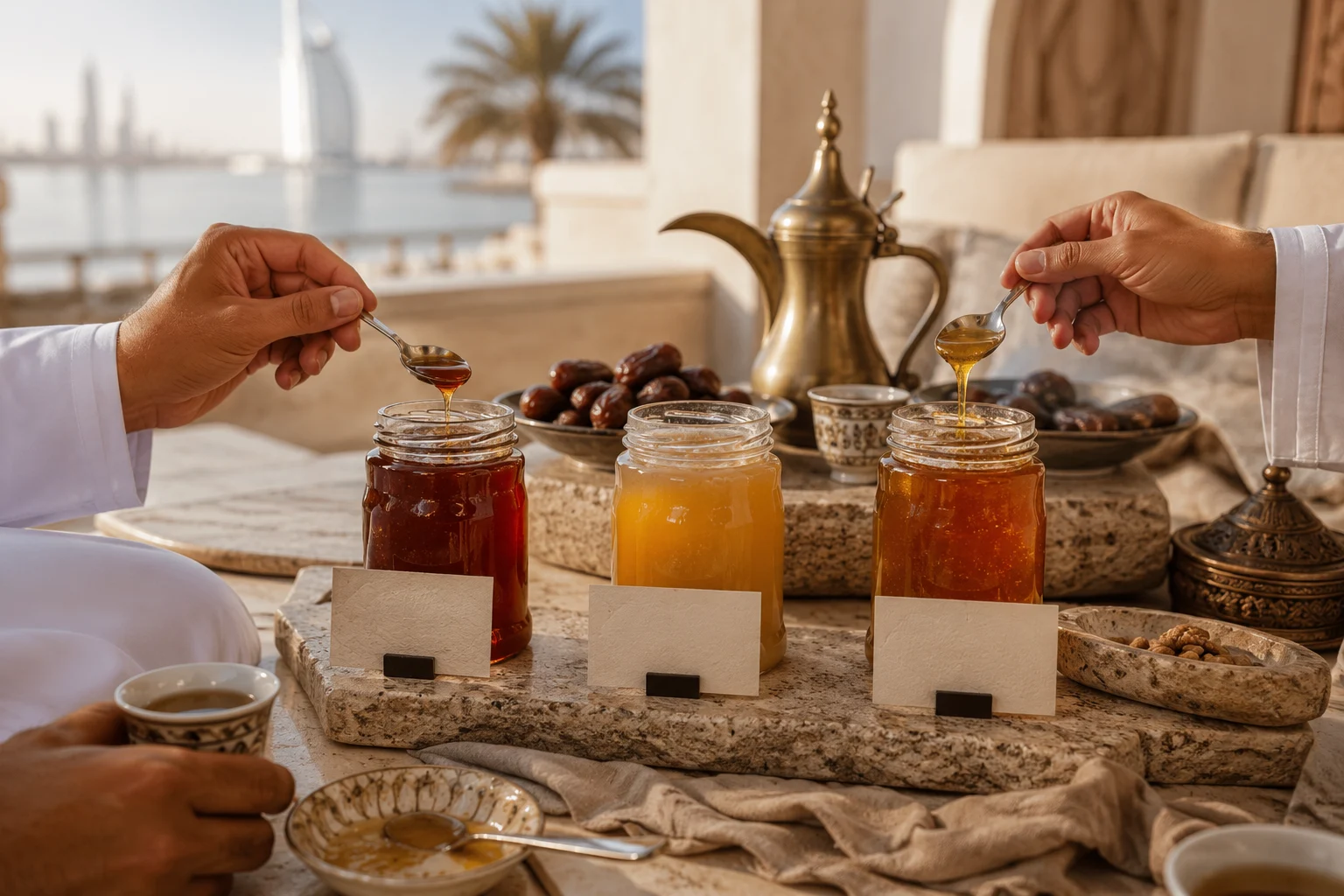
Honey, Sidr and buying honey in Dubai
The phrase can mean honey produced in the Emirate of Dubai, such as Hatta honey, or simply honey sold in Dubai. Always check the actual harvest origin.
Hatta, in the Hajar Mountains and within the Emirate of Dubai, has established beekeeping and local Sidr, Samar and other honey production.
Sidr honey is sold by local producers, specialist honey retailers and online sellers across Dubai. Compare origin, traceability, product information and delivery rather than relying only on the word Sidr.
Yes. They come from different regions and harvest environments. Both can be high quality, but they should be evaluated as distinct origins.
Yes, depending on retailer and delivery coverage. A jar delivered in Jumeirah remains Yemeni honey if that is its true harvest origin.
Emirati beekeeping also includes Samar, Ghaf, mangrove and wildflower honeys, among others.
It generally refers to honey that has not been heavily heated or industrially processed, but sellers should explain their handling practices. Raw alone does not prove origin or authenticity.
Prices vary widely by origin, weight, harvest, brand and packaging. As one current local reference, Hatta Honey lists a 1 kg Sidr product at AED 262.50.
Yes, especially when the origin is clear. Hatta honey can offer a local Emirati story, while Yemeni and Omani honeys can represent wider Arabian traditions.
Check origin, floral source, batch or traceability information, storage, seller credibility and any available analysis. Do not judge authenticity by price, colour or thickness alone.
Continue the Journey
If this story brought you here, continue the journey through related stories from The House of Meski.