
40 Questions Answered
A definitive guide to Gulf hospitality — covering qahwa etiquette, date varieties, honey pairings, the dallah, the majlis, and the living tradition that connects them all.
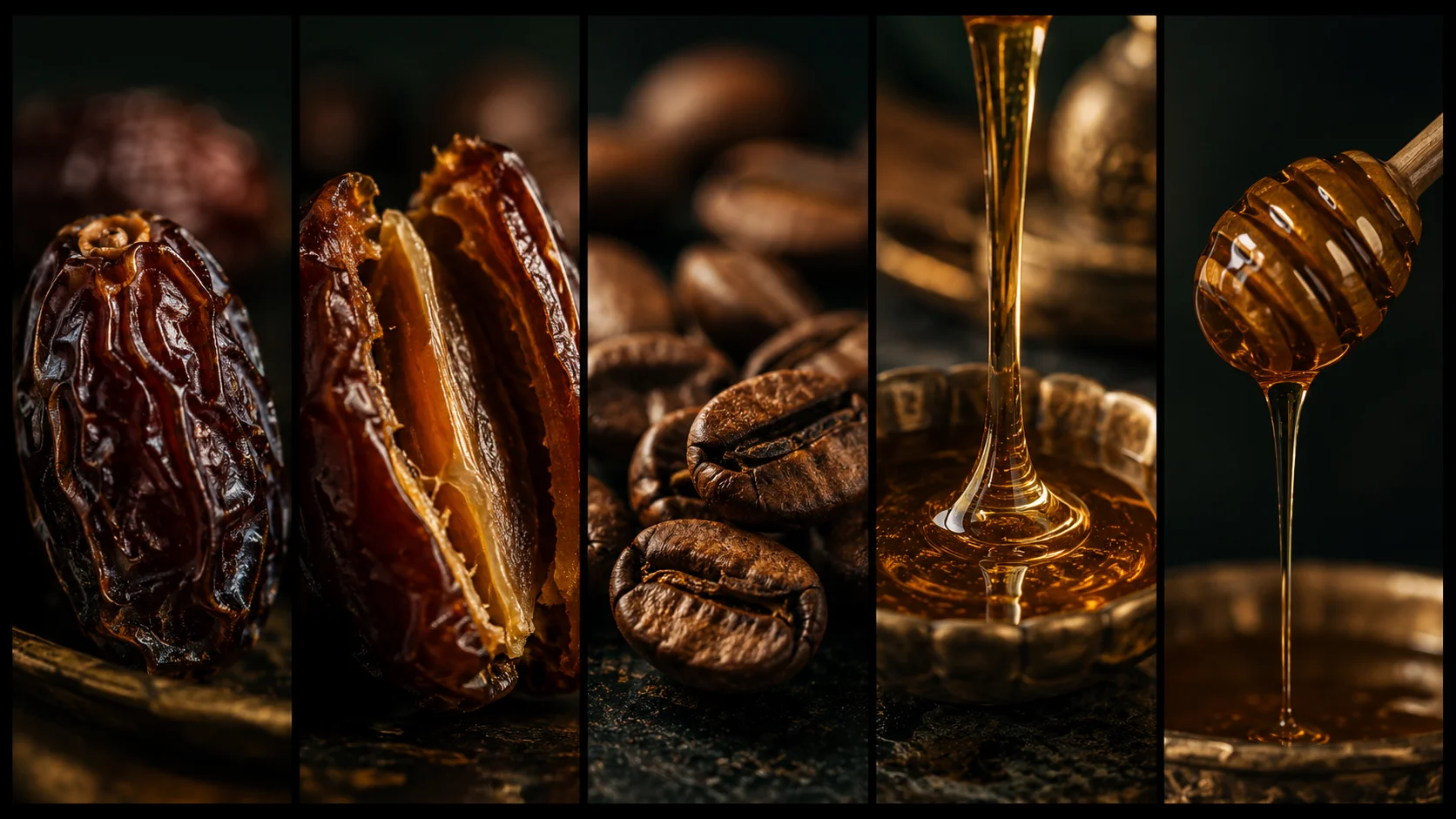
The dallah arrives before anything else is said. The finjan is filled no higher than a third. Beside it, dates. To one side, a small jar of honey. Three elements, one gesture — and forty questions that deserve a straight answer.
Why do Arabic coffee, dates and honey belong together?
Arabic coffee (qahwa) is lightly spiced and served without sugar. Dates provide the natural sweetness that balances its bitterness. Honey adds a third register — floral, dense, slower — and has long been regarded across the Arabian Peninsula as a mark of genuine generosity. Together they form not a menu but a gesture: each element has a role, each reflects a value, and none requires explanation in the cultures where they originate.
Chapter 1 — The Meaning of the Hospitality Gesture
1. Why are Arabic coffee and dates served together?
The pairing exists because Arabic coffee is deliberately unsweetened, and dates provide the sweetness that balances it. Qahwa — the Gulf term for Arabic coffee — is brewed from lightly roasted beans, spiced with cardamom and sometimes saffron, and served without sugar. Dates, naturally rich in glucose and fructose, soften the bitterness of each sip and allow the spiced aroma to linger more pleasantly.
But the pairing is more than sensory logic. Both the coffee and the date carry symbolic weight. Dates have been a staple of the Arabian Peninsula for thousands of years, offering sustenance in a harsh environment where little else grew reliably. Coffee, arriving later through trade routes from Yemen and Ethiopia, quickly became the primary ritual of welcome. Serving both together became a way of offering everything the house had to give. The tradition was recognised by UNESCO in 2015 as part of the intangible cultural heritage of humanity — submitted jointly by the UAE, Saudi Arabia, Qatar and Oman.
2. What does offering coffee communicate to a guest?
Offering coffee signals that a guest is received with respect, not merely tolerated. Across the Gulf, coffee is closely associated with the values of generosity (karam), honour and peaceful intent. Important social events — marriage negotiations, business discussions, conflict resolution — have historically taken place over coffee in the majlis. Accepting a cup is accepting hospitality. Declining a first cup, unless one explains a health reason, is considered a social misstep.
There are more nuanced signals embedded in how the coffee is served. A cup filled to a third communicates welcome and the expectation of continued conversation. Historically, some Bedouin traditions held that a cup filled to the brim indicated the guest should drink and leave. These conventions are not universally observed in the same way today, but the underlying principle — that the amount poured carries meaning — has not disappeared.
3. Do coffee and dates carry the same meaning throughout the Gulf?
The core meaning — generosity, welcome, respect — is shared, but practices differ meaningfully between countries and even between regions within the same country.
In the UAE, the tradition is closely associated with Emirati national identity. The dallah appears on the UAE’s one-dirham coin — a detail that speaks to how central coffee hospitality has become to national self-expression. In Qatar, coffee carries particular significance in expressing Qatari generosity, remaining prominent in official gatherings and public spaces such as Souq Waqif in Doha. In Saudi Arabia, roast levels and spice blends vary between regions. Omani coffee may include dried limes (loomi) alongside cardamom. Yemen, widely considered the historical origin of coffee cultivation, produces distinct regional brews that differ from Gulf-style preparations. The tradition belongs to the whole region — but it is not a single tradition.
4. Is the coffee ritual formal or part of everyday life?
Both. The ritual scales naturally between contexts. A formal majlis — receiving dignitaries, hosting a marriage delegation, conducting a tribal dispute resolution — follows more elaborate conventions. In everyday family life, the same gestures appear in quieter form. A mother pours for whoever arrives. A colleague keeps a thermos of spiced coffee at the office. The etiquette remains — right hand, small cup, attentiveness to refill — but without ceremony around it. The ritual is not performed. It is simply lived.
5. Why is the finjan only partly filled?
The cup is filled to approximately one third — traditionally called sabbat al-hashma, the “pour of respect” — so that the coffee stays hot and can be refreshed continuously. A small quantity cools more slowly per sip and invites the host to return and refill, sustaining both the warmth of the drink and the warmth of the conversation. There is also a spatial logic: a small pour prevents spilling when the cup is received with one hand. And within the tradition’s more layered symbolism, how much is poured has historically communicated how welcome the guest is expected to feel.
6. Why are several cups sometimes offered?
Custom in many Gulf traditions holds that a guest should drink between one and three cups. An old Arabic proverb describes the meaning of each: the first cup is for the host (who confirms quality), the second is for the guest (an expression of hospitality), and the third is for pleasure. In practice, many hosts refill continuously until the guest shakes the cup. The expectation of at least one cup remains firm — refusing entirely without explanation can be taken as a signal that something is wrong between you.
7. Why is the right hand used?
Using the right hand to give and receive food and drink is a deeply rooted convention across the Arab world and in Islamic practice, connected to notions of cleanliness and honour. The server holds the dallah in the left hand and the finjan in the right — offering the cup from the more honoured side. Guests receive the cup with their right hand and return it the same way. This convention applies across the meal, not only to coffee.
8. What is the role of the host — or the gahwaji — during service?
The person pouring coffee — the gahwaji — holds a specific role that combines attentiveness, deference and quiet authority. In formal settings, this role traditionally falls to the youngest male member of the family. He stands throughout the service, holds the dallah in his left hand and the finjan in his right, and moves clockwise through the gathering, beginning with the most senior or most honoured guest. He remains present and watchful, ready to refill any extended cup. The role is a practice in humility: the gahwaji does not sit until everyone has been served. The UAE’s Department of Culture and Tourism in Abu Dhabi has described this passing of knowledge from elder to younger as one of the living transmissions the UNESCO inscription was intended to protect.
Chapter 2 — Arabic Coffee Explained
9. What exactly is Arabic coffee?
Arabic coffee — known as qahwa (قهوة) in the Gulf — is a brewed coffee made from lightly roasted Coffea arabica beans, typically infused with cardamom and sometimes saffron, cloves or rose water, and served without sugar in small handleless cups.
It differs from Western coffee styles not only in preparation but in purpose. It is not a morning stimulant consumed quickly. It is a social medium: slow to prepare, served in small quantities, meant to be drunk across a conversation rather than before one. The UNESCO inscription from 2015 describes it as “a symbol of generosity” — which tells you more about the drink’s function than any technical description could.
10. Why is Gulf Arabic coffee often yellow or golden?
The golden colour comes from two sources: a very light roast that leaves the beans pale, and the presence of saffron, which gives the brew its characteristic warm yellow hue.
Gulf-style qahwa uses beans roasted to the lightest possible level — sometimes almost at the green stage, sometimes to what coffee specialists call a very light or “blonde” roast. At this level, little of the dark pigmentation associated with darker preparations has developed. Saffron, historically traded across the Arabian Peninsula through Persian and Indian Ocean routes, deepens this amber into gold. Cardamom adds its grey-green tones and unmistakable aroma. The colour reflects the quality of the spices used and the care taken with the roast.
11. Is Arabic coffee the same as Turkish coffee?
No. The two are distinct in roast, preparation, appearance, texture and cultural purpose.
| Aspect | Arabic Coffee (Qahwa) | Turkish Coffee |
|---|---|---|
| Roast level | Very light — sometimes near-green | Medium to dark |
| Colour in the cup | Golden to amber, often yellow | Dark brown, nearly black |
| Preparation vessel | Dallah (long-spouted pot) | Cezve or ibrik (small open pot) |
| Spices | Cardamom, saffron, cloves, rose water | Usually none; sometimes cardamom in Levantine styles |
| Sugar | Rarely, if ever — served without | Often added during brewing |
| Serving vessel | Finjan — small, handleless | Small demitasse with handle and saucer |
| Grounds in the cup | Strained or settled — typically minimal | Grounds settle at the bottom; not filtered |
| Typical accompaniment | Dates, honey, sometimes halwa | Water, Turkish delight (lokum) |
| Cultural context | Hospitality ritual; majlis; ceremony | Social gathering; coffeehouse culture; fortune reading |
12. Does Arabic coffee always contain cardamom?
Cardamom is the single most consistent ingredient across Gulf-style Arabic coffee, but it is not universally required. Some preparations use cardamom and nothing else. Others layer it with saffron, cloves, cinnamon or rose water depending on the region, the household and the occasion. In the Hejaz region of Saudi Arabia, saffron is common. In Oman, dried limes occasionally appear. The cardamom, however, is the baseline — the spice most associated with qahwa wherever you encounter it.
13. Why are saffron, cloves or rose water sometimes added?
Each ingredient adds a distinct dimension to the cup, and their presence often reflects regional identity, family tradition or the occasion being celebrated. Saffron adds a golden colour, a faint floral sweetness and a visual elegance that marks the occasion as worthy of special ingredients. Cloves add warmth and a slightly resinous depth. Rose water introduces a delicate floral note that softens the bitterness. For weddings, Eid gatherings or the welcome of an important guest, all of these might appear together. For a daily cup, cardamom alone is sufficient.
14. Is Arabic coffee supposed to be bitter?
Qahwa is mild rather than bitter compared to espresso or dark-roasted Western coffee. The very light roast means that the beans have not yet developed the strong bitter compounds associated with darker preparations. What you encounter instead is a gentle earthiness, the aromatic warmth of cardamom, and — when saffron is present — a faint sweetness from the spice itself. That said, qahwa is served without sugar, and those unfamiliar with it may experience the cardamom as intense at first. The dates served alongside it resolve this mild astringency immediately, which is why the pairing feels so natural once you experience it together.
15. What are a dallah and a finjan?
The dallah (دلة) is the traditional long-spouted coffee pot used throughout the Arabian Peninsula to brew and serve qahwa. The finjan (فنجان) is the small, handleless cup from which it is drunk.
The dallah is among the most recognisable objects in Gulf material culture. Made historically from brass, copper or silver, its elongated spout is designed for pouring in a slow, controlled stream. Its form has been so closely associated with Emirati identity that it appears on the UAE’s one-dirham coin. The finjan is designed for smallness: no handle means both hands can warm around it, or it can be held with the tips of three fingers. The thinness of its rim sharpens the sensory experience of each sip.
16. Which beans and roasting styles are used?
Gulf-style qahwa uses Coffea arabica beans, roasted to a very light level — sometimes barely past the green stage, sometimes to a pale golden tan. This is far lighter than a “light roast” in specialty coffee terms. The result is a bean that retains much of its original character: grassy, mildly earthy, lower in caffeine than a dark roast of the same bean. In some traditional households, the beans are shown to guests before roasting — a gesture of transparency that is itself part of the ritual. The roast becomes darker as one moves geographically northward through the Arabian Peninsula.
17. Who traditionally receives the first cup?
The first cup is served to the eldest or most honoured guest in the room. The server moves clockwise through the gathering, proceeding from the person of highest status downward. This order encodes respect visibly, making clear to every person in the room how the host views the gathering. In some older Gulf traditions, the first cup of a fresh brew was tasted by the host himself, to confirm its quality before offering it to any guest.
18. Why does a guest shake the finjan?
Gently shaking the finjan from side to side signals that the guest has had enough and does not wish to be refilled. Because the server will continue to refill the cup of any guest who simply holds it out or says nothing, the shake is the recognised signal for “thank you — I am done.” The gesture is efficient precisely because it requires no words. In a room where multiple conversations may be happening, a small wrist movement communicates clearly across a distance. It is one of those small social inventions that reflects a great deal of collective intelligence about how to manage generosity gracefully — on both sides of the cup.
Chapter 3 — Dates at the Gulf Table
19. Why are dates the traditional companion to coffee?
Dates are paired with Arabic coffee because their natural sweetness balances the bitterness of the unsugared brew, and because both have been staples of Arabian life for centuries. The date palm (Phoenix dactylifera) has grown across the Arabian Peninsula for at least five thousand years. Its natural sugars — principally glucose and fructose — provide an immediate sensory counterpoint to the astringency of coffee. You do not decide to eat a date with your qahwa any more than you decide to pour water with your meal. It is simply what is done, and it works.
20. Which date varieties pair best with Arabic coffee?
Soft, naturally sweet varieties with a caramel or buttery quality pair best with the mild spice of qahwa. The sweetness should complement the cardamom without overwhelming it, and the texture should dissolve gently between sips rather than demanding prolonged chewing. Khalas and Sukkari are the two varieties most consistently associated with Arabic coffee pairing across the Gulf. Ajwa, darker and more complex, pairs beautifully when the coffee is lightly spiced. Medjool, though widely available and internationally recognised, is meatier and more assertive — a generous choice but not the most traditionally refined pairing for a formal serving.
21. Are Khalas dates good with qahwa?
Yes — Khalas is arguably the most celebrated variety for this pairing within Emirati culture. Grown primarily in the UAE and in the Eastern Province of Saudi Arabia, Khalas dates are medium-sized, with a reddish-golden skin and a moist, tender flesh that carries a distinctive buttery caramel flavour. They are soft enough to dissolve between sips of coffee, rich enough to satisfy, and restrained enough not to compete with the cardamom. Khalas is available at different stages: fresh rutab (semi-ripe, with a soft wet interior) and fully dried tamr (the stage most often served with coffee). The rutab stage of Khalas, particularly when chilled, is considered a seasonal delicacy in the UAE.
22. What is the difference between Khalas, Sukkari, Ajwa and Medjool?
| Variety | Origin | Texture | Flavour | With Arabic coffee |
|---|---|---|---|---|
| Khalas | UAE, Eastern Saudi Arabia | Soft, moist, slightly chewy | Buttery caramel, toffee notes | Excellent — the traditional Gulf pairing |
| Sukkari | Qassim region, Saudi Arabia | Very soft, melt-in-mouth | Honey-sweet, pure, barely complex | Excellent — melts easily between sips |
| Ajwa | Madinah, Saudi Arabia | Semi-dry, dense, chewy | Mildly sweet, earthy, hint of prune | Good — works well with lightly spiced qahwa |
| Medjool | Tafilalt, Morocco; now grown across multiple regions | Large, plump, soft-chewy | Rich caramel, vanilla hints | Acceptable — flavourful but slightly heavy for the ritual |
23. Are fresh dates served with coffee?
Yes, particularly during the harvest season. Fresh dates at the rutab stage — semi-ripe, with a soft, sweet, slightly wet interior — are seasonal and highly prized. In the UAE, the harvest season runs roughly from July through September, and during this window rutab Khalas and other local varieties appear on hospitality trays alongside qahwa. Their texture and sweetness at this stage differ noticeably from the fully dried tamr form. Both are correct for coffee service; the choice depends on what the season and the farm provide.
24. Should dates be soft, semi-dry or firm?
For pairing with Arabic coffee, soft and moist dates are generally preferred. They dissolve between sips without requiring concentration, and their sugars are released quickly enough to counterbalance the bitterness of each refill. Sukkari, Khalas and fresh Medjool represent this softer register well. Semi-dry varieties such as Ajwa add more chew and complexity, which can be welcome when the coffee is very mild. Firm or fully dried varieties are less commonly served with coffee in formal Gulf contexts, though they appear in everyday situations where the primary goal is nourishment rather than hospitality ritual.
25. Are all dates sold in Dubai and Doha locally grown?
No. A significant proportion of dates available in Dubai and Doha — including some sold in premium packaging — are imported. The UAE does grow dates on a notable scale: the country has more than forty million date palms and produces around 150 varieties. However, the high demand from both residents and tourists means that imports from Saudi Arabia, Oman and elsewhere fill a considerable portion of the market. Qatar grows dates domestically — the country hosts an annual Local Dates Festival celebrating its own production — but also imports from neighbouring countries. When the origin of a date matters to you, ask specifically. For genuinely local produce, Emirati farm-direct sources from Al Ain (part of a UNESCO World Heritage Site) or certified Qatari sources provide a clearer connection to the land.
26. How should dates be presented to guests?
Presentation matters — not because it is decorative but because it communicates care. Dates should arrive on a tray or dish that allows guests to take one without reaching across others. Two or three varieties side by side give guests a choice and create a small sensory conversation. Dates should be at room temperature; cold dates from the refrigerator lose some of their softness and aroma. If pits remain, this should be clear so that guests are not caught off guard. The tray should arrive before or alongside the coffee, not after it — the sequence is part of the gesture.
27. Should dates be opened and checked before serving?
Yes. Soft varieties such as Sukkari and Khalas can occasionally harbour small insects, particularly if sourced directly from farms and not commercially processed. While this is rare with properly stored, market-quality dates, a brief visual check before serving is standard practice in households that care about their hospitality. It is also worth checking semi-dried varieties for any crystallised sugar patches that may indicate the date has dried unevenly. A date served to a guest should not require explanation.
28. How should dates be stored in Gulf heat?
Soft and semi-soft dates should be refrigerated in the Gulf climate, ideally in an airtight container. The combination of humidity and heat that characterises summer in Dubai and Doha is the enemy of date quality: moisture causes fermentation, and heat accelerates the breakdown of texture and flavour. Refrigerated, soft varieties like fresh Khalas or Sukkari will keep for weeks to months depending on their moisture content. Firmer, drier varieties tolerate ambient temperatures more readily, but even these benefit from an airtight container away from direct sunlight. Freezing is possible for longer storage — dates freeze well and can be brought to room temperature before serving without significant loss of quality.
Chapter 4 — Honey and the Hospitality Table
29. What place does honey have in Gulf hospitality?
Honey carries a long tradition of prestige across the Arabian Peninsula, and its presence on a hospitality table communicates generosity at a level beyond the everyday. Premium honey — particularly wild Sidr honey from Yemen and Oman — has historically been considered a gift appropriate for heads of state, tribal leaders and distinguished guests. It is mentioned in the Quran and in prophetic traditions, and this cultural esteem continues to shape how honey is offered and perceived in Gulf homes and majlises today. Where dates represent the sweetness of the land, honey represents its abundance and care.
30. Is honey traditionally added directly to Arabic coffee?
Not typically. Arabic coffee is almost always served without any sweetener. Adding honey to the cup would alter both the flavour of the coffee and the clarity of its spice character, and would contradict the established etiquette of serving qahwa unsweetened. Honey belongs on the table, not in the cup. In practice, some guests choose to dip a date into honey before a sip of coffee, creating a layered sequence of sweetness, earthiness and spice. This is a personal gesture rather than a formal practice — neither required nor discouraged.
31. Which honey pairs best with dates?
Sidr honey is the most celebrated pairing with Gulf dates, both for its flavour profile and its cultural resonance. Sidr honey — produced from the nectar of the Sidr tree (Ziziphus spina-christi), found primarily in Yemen and parts of Oman — has a rich, dense, fruity sweetness with a long finish. Placed against the caramel sweetness of a Khalas date, it adds depth without repetition. The two sweetnesses are different enough to complement rather than duplicate each other. Lighter honeys create a softer combination that suits guests who prefer subtlety. Darker, more intense honeys such as Samar honey can be paired with firm dates or enjoyed alongside the coffee itself as a standalone element.
32. What is the difference between Sidr and Samar honey?
Sidr and Samar are two distinct Arabian honeys from different botanical sources, with notably different flavour profiles, colours and textures.
Sidr honey is produced from the blossoms of the Sidr tree (Ziziphus spina-christi), found in the valleys of Yemen and Oman. It tends to be golden to dark amber in colour, dense in texture, and rich with a fruity, slightly tangy sweetness that lingers. Yemeni Sidr honey — particularly from regions such as Wadi Hadramawt and Wadi Do’an — is regarded as among the finest honeys in the world, prized for its flavour and its scarcity. The same species grows elsewhere, but the specific conditions of Yemeni valleys produce a notably denser honey with lower moisture content.
Samar honey comes from the Samar tree, a species of Acacia that grows in highland regions of Yemen. It is generally darker than Sidr, with a deeper, more complex profile — sometimes described as smoky, caramel-like or reminiscent of maple syrup. Its higher mineral content makes it a preferred choice for daily use among those who value honey for wellbeing reasons. In colour, texture and flavour, Samar sits further from conventional sweetness and closer to something more mineral and robust.
From the Sidr tree (Ziziphus spina-christi)
Golden to dark amber. Dense, fruity sweetness with a long finish. Prized across Yemen and Oman.
From the Samar tree (Acacia species)
Darker, more mineral, with a robust caramel profile. Preferred for daily use and deeper pairings.
33. Does darker honey always taste stronger?
Generally yes — but the relationship is not simple, and exceptions exist. Darker honey tends to carry more minerals, more polyphenols and more of the complex compounds from the flower source. However, colour alone is not a reliable guide to quality or flavour intensity. Some pale honeys deliver a beautifully refined floral sweetness while remaining entirely liquid and clear. Colour reflects the botanical source and the processing conditions, not necessarily the quality of the beekeeper or the authenticity of the product. When evaluating honey, taste remains more informative than colour.
34. Does authentic honey crystallise?
Yes. Crystallisation is a natural and expected property of raw, unprocessed honey — it is a sign of purity, not a defect. Honey is a supersaturated solution of sugars, primarily glucose and fructose. Over time, glucose molecules separate from the liquid and form crystals — a process that is entirely natural and that commercial honey producers typically prevent by heating and filtering the honey before sale. Raw honey — honey extracted from the comb with minimal processing, strained but not pasteurised — will crystallise, typically within weeks to months of harvest. Crystallised honey can be gently warmed in a warm water bath to restore its liquid state without damaging its properties. If your Sidr honey has never crystallised after years in the jar, it may be worth asking why.
A note on health claims
Honey is traditionally valued across many cultures and contains natural compounds including enzymes, pollen and antioxidants. It should not replace professional medical advice. Any wellbeing benefits described in this article refer to traditional use and cultural appreciation, not medical claims.
35. Is expensive honey necessarily better?
Not always — but price is not meaningless either. The cost of premium Arabian honey reflects real factors: the scarcity of certain botanical sources, the labour-intensive nature of traditional hive management in mountainous terrain, the limited annual yield from wild or unirrigated trees, and the expertise required to harvest without compromising the honey’s quality. A jar of authentic wild Yemeni Sidr honey is expensive because very little of it exists, and the process of producing it has not changed significantly in centuries. When buying premium honey, ask: Where was it harvested? From which flower? By whom? If these questions cannot be answered, the price alone tells you nothing useful.
36. What does raw honey really mean?
Raw honey is honey extracted from the comb and strained — but not heated, not pasteurised and not ultra-filtered. In its raw state, honey retains natural enzymes, pollen particles, trace amounts of propolis and beeswax, and the full range of compounds present in the hive. These are what give each honey its botanical fingerprint. The term “raw” is not legally regulated in the same way in all countries, which means some products labelled as such may have undergone more processing than the word implies. Signs of genuinely raw honey include: a tendency to crystallise over time, an opaque or cloudy appearance when fresh, colour variation between batches, and a flavour that changes subtly from one harvest to the next.
37. How should honey be served beside coffee and dates?
A small jar or dish with a wooden dipper is the simplest and most elegant presentation. Honey does not need to be warmed or prepared; it should arrive at room temperature. A dipper allows guests to lift a portion cleanly without touching the honey with their fingers. The honey should sit at the edge of the tray, distinct from the dates, inviting exploration rather than instruction. Guests who wish to combine honey with a date, or to taste the honey alone, can do so. Those who prefer not to are not obligated. The host’s role is to provide the three elements — coffee, dates, honey — and then to withdraw from supervision.
38. Can honey, coffee and dates form a balanced tasting experience?
Yes, and the balance is both sensory and cultural. Tasted in sequence — a sip of cardamom coffee, a bite of soft Khalas or Sukkari date, then a small amount of Sidr honey either alone or on the same date — the three create a layered experience that moves from warm and aromatic to sweet and caramel, then to something floral and dense. Each element provides contrast. None of them competes in the same register. This is not a tasting menu that needs a sommelier. It is simply what happens when three excellent things from the same region are placed together with enough understanding of their individual qualities to allow them to interact freely. The majlis has been doing this for centuries without calling it a pairing. That is probably why it still works.
Chapter 5 — Serving, Buying and Gifting
39. How can Arabic coffee, dates and honey become a meaningful gift?
The combination becomes meaningful when it reflects genuine knowledge of what it contains rather than simply what it looks like in a box. A gift that includes ground spiced qahwa (with cardamom, perhaps a thread of saffron), a selection of properly identified date varieties and a small jar of traceable honey — with a note explaining what each element is and where it comes from — gives the recipient something beyond a product. It gives them a story and an invitation to explore. That is the difference between a hospitality gift and a luxury item that happens to be wrapped well.
Occasions that carry particular resonance for this kind of gift include Ramadan (when dates and coffee feature prominently at iftar), Eid (when giving is a religious and social act), and occasions of welcome such as housewarming or business beginnings. In Qatari and Emirati custom, the gesture of bringing coffee, dates and honey to a new household is understood immediately — it is a blessing on the table, not just a present.
40. What should a premium Gulf hospitality gift contain?
A thoughtful Gulf hospitality gift should contain at minimum: a clearly identified date variety of known origin, a honey of traceable botanical source, and — where possible — a qahwa blend with its spices named and explained.
Origin clarity
Every element should come with enough information for the recipient to understand what they have received. A date labelled only “premium dates” is not a premium gift.
Presentation proportionate to the occasion
The packaging should feel appropriate — neither so elaborate that it overwhelms the contents, nor so plain that it fails to signal care.
Something to read
A short note explaining the tradition, the variety or the honey source transforms a gift into a conversation. In the spirit of the majlis, sharing knowledge is part of the hospitality itself.
A box containing Khalas or Sukkari dates, a jar of raw Sidr honey with its harvest origin noted, and a small quantity of freshly spiced qahwa blend with cardamom and saffron represents the Gulf hospitality table in miniature. It is a complete gift. It needs no additional explanation — but it deserves one.
“The cup is small because what it carries is not.”
— The House of Meski
There is a tendency, in writing about Arab hospitality, to describe it as lavish — to emphasise the scale of the table, the quantity of food, the wealth of the offering. But the most enduring expression of Emirati and Qatari hospitality is actually quite small: a cup that holds barely three sips, a fruit that fits in the palm of one hand, a spoonful of honey set quietly to one side.
What makes the gesture remarkable is not its size but its sequence. The coffee arrives first, before anything is asked of the guest. The dates are already there. The honey waits. Nothing is withheld, but nothing is forced. The host’s attention is offered along with everything else — and that, in the end, is the thing that cannot be boxed or shipped. It simply has to be experienced, one small cup at a time.
بارك الله فيكم
Frequently Asked Questions
Gulf-style qahwa is intentionally served without sugar so that its spice character — particularly cardamom and saffron — can be appreciated clearly. The sweetness comes from the dates served alongside it, which balance the mild bitterness of the brew naturally.
Qahwa uses very lightly roasted Coffea arabica beans, spiced with cardamom and sometimes saffron, brewed in a long-spouted pot called a dallah, and served in small handleless cups called finjan. Unlike Western coffee, it is served without sugar and is understood primarily as a social ritual rather than a stimulant.
Khalas and Sukkari are the most celebrated varieties for this pairing. Both are soft, naturally sweet and mild enough to complement the spiced flavour of qahwa without competing with it. Ajwa dates also pair well when the coffee is lightly spiced.
Sidr honey is produced from the blossoms of the Sidr tree (Ziziphus spina-christi), found primarily in the valleys of Yemen and Oman. It is prized for its dense, fruity sweetness, its low moisture content, its limited annual yield, and its deep cultural significance across the Arabian Peninsula, where it is mentioned in both the Quran and prophetic traditions.
Gently shake the finjan from side to side. This is the recognised signal in Gulf hospitality that you have had enough and do not wish to be refilled. Without this gesture, the host will continue to pour.
Crystallisation is a natural and expected property of raw, unprocessed honey. It is a sign of purity, not a defect. Commercial honeys are typically heated to prevent crystallisation, but this process removes many of the natural enzymes and compounds that give raw honey its character. Crystallised honey can be gently warmed in a warm water bath to restore its liquid state.
Bring the Gulf Hospitality Table to Life
Sidr and Samar honeys from Yemen, Oman and the UAE — selected for origin, botanical traceability and the generosity they represent at any table.