
What it truly is, how it is made, why every jar is different — and what separates knowledge from myth.
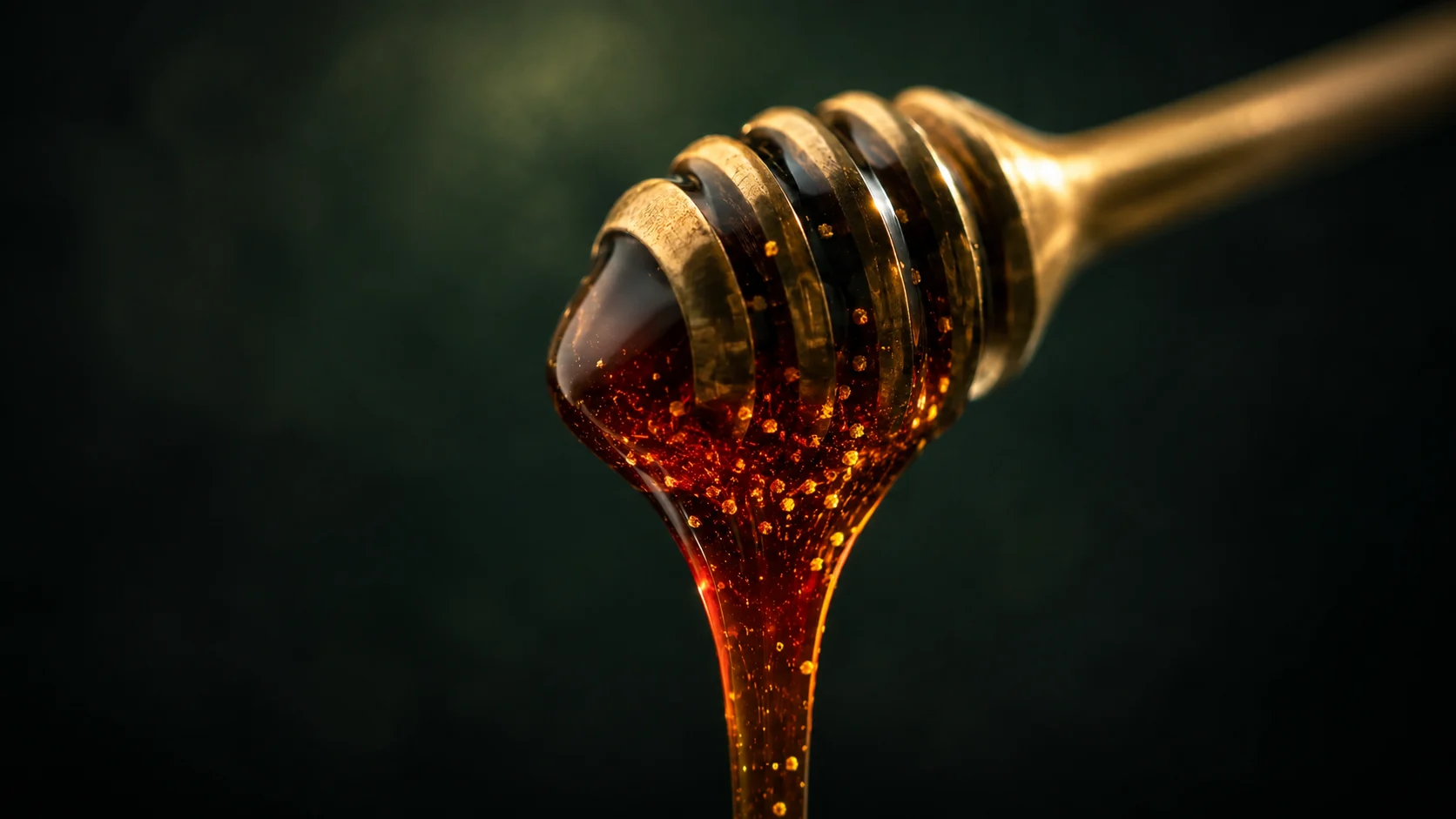
Raw honey is honey that has not been pasteurised or ultra-filtered after extraction. It retains its natural enzymes, pollen, propolis traces and aromatic compounds built entirely by the bees. The difference between raw and commercial honey is not the flowers, not the bees, not the country of origin — it is what happens after the honey leaves the hive.
What Is Raw Honey?
There is no single official international definition of raw honey that applies universally. The Codex Alimentarius — the international food standards body established by the FAO and the WHO — defines honey broadly, but does not legislate a specific “raw” category. This means the word is sometimes used loosely, and understanding what it means in practice is worth the effort.
In beekeeping and food science, raw honey is generally understood to mean honey that:
- has not been heated above the natural temperature of the hive — approximately 35 to 40°C (95 to 104°F);
- has not been pasteurised (a process that typically involves temperatures of 60 to 80°C);
- has not been ultra-filtered, which would remove pollen and fine particles;
- has not had water, syrups, sugar or other additives introduced.
What raw honey does contain — and what makes it a genuinely different substance from supermarket honey — is its full original chemistry: living enzymes, traces of pollen, gluconic acid, residual propolis, and an aromatic profile shaped entirely by the flowers the bees visited. None of these require any particular marketing claim. They are simply the result of doing very little after extraction.
The Arabic tradition understood this intuitively long before modern food science arrived. In Surah An-Naḥl — the sixteenth chapter of the Qur’an, named after the honey bee — the description of what issues from the bee is rendered as شِفَاءٌ لِلنَّاسِ, often translated as “a healing for people” (An-Nahl, 16:69). Whether approached as a religious statement, a cultural observation, or simply an ancient people’s careful attention to what was in front of them, the recognition of honey’s distinct character runs deep across the Arab world and well beyond it. It was never merely sweetness. It was always something to be understood.
How Raw Honey Is Produced
From Nectar to Comb
A honey bee visits between fifty and a hundred flowers on a single foraging trip, collecting nectar in a specialised stomach called the honey stomach or crop. Back at the hive, she passes the nectar to a house bee through a process of regurgitation. During this transfer, enzymes from the bee’s hypopharyngeal glands are introduced into the nectar. Three are particularly significant:
Invertase
Begins breaking sucrose into glucose and fructose, the two primary sugars of honey.
Diastase (Amylase)
Breaks down starches. Diastase activity is used by food standards authorities as a standard quality marker for honey freshness and gentle handling.
Glucose Oxidase
Produces hydrogen peroxide — the source of much of honey’s antimicrobial character. This enzyme loses significant activity above 45°C.
This enzymatic conversion continues inside the hive as the liquid moves through many workers. Meanwhile, bees fan the nectar vigorously with their wings to evaporate water. Fresh nectar contains roughly 80% water. Honey, when sealed by the bees under beeswax cappings, contains approximately 17 to 18%. That reduction is not incidental. It is what makes honey shelf-stable and resistant to fermentation.
Extraction and the Question of Heat
In modern beekeeping, most honey is extracted by placing uncapped frames in a centrifuge that spins the honey outward by force. The honey collects at the bottom, is drawn off through a valve, and then strained through a mesh — not to filter out pollen, but to remove larger particles: wax fragments, the occasional bee leg, hive debris.
This process, done gently and at ambient temperature, preserves everything the bee added. No heat is applied. No chemistry is changed. The honey that comes off the extractor is, in the most meaningful sense, the same honey that was in the comb.
An older method, still used by some small producers and in certain traditional beekeeping cultures, is the crush-and-strain method: the comb itself is crushed, and the honey drains through cloth by gravity. This produces honey that may carry traces of beeswax and is often more richly aromatic. Neither approach is superior as an absolute. Both, when done carefully, produce genuine raw honey.
What heat actually changes
Once honey is heated beyond hive temperature — particularly to the 60 to 80°C range used in commercial pasteurisation — enzymes begin to degrade. Diastase activity falls measurably. Glucose oxidase loses activity above 45°C, reducing antibacterial capacity. Aromatic compounds volatilise. The honey becomes more uniform and visually appealing — and less of what it originally was.
Why Every Raw Honey Is Different
Floral Source and Terroir
There is a word borrowed from wine culture that applies here with genuine precision: terroir. Every honey carries the landscape it came from.
When bees forage predominantly on one plant species, the resulting honey is called monofloral. When they range across many different plants, it is polyfloral or wildflower honey. Monofloral honeys have recognisable, consistent profiles:
Yemen, Oman, Arabian Peninsula
From the Ziziphus spina-christi tree. Thick, amber and deeply aromatic, with a warm complexity that no other honey duplicates. Among the most prized honeys in the Gulf tradition, where it has been offered as a gift of esteem for generations.
Central Europe, Eastern Europe
From the black locust tree (Robinia pseudoacacia). Exceptionally pale and liquid, very high in fructose, crystallises very slowly. Its clear appearance does not indicate processing — it is simply the natural character of this variety.
New Zealand
From Leptospermum scoparium. Earthy and slightly medicinal. Contains methylglyoxal (MGO), a compound specific to this plant that contributes additional antimicrobial activity beyond the hydrogen peroxide common to all honeys.
Corsica, France
Protected by French and European AOP designation. Produced from the island’s exceptional maquis — a dense, biodiverse scrubland of wild herbs, chestnut, heather and cistus. Each seasonal harvest produces a distinct character.
Each of these is genuinely different in chemistry, not merely in marketing language. The glucose-to-fructose ratio, the phenolic compound profile, the enzyme activity, the water content, the pH — all of these shift depending on the nectar source.
Season, Climate and the Beekeeper’s Hand
Spring honey, collected when early blossoms are opening, is typically lighter in colour and milder in flavour. Summer honey, gathered when a broader range of plants is in bloom, is often darker, richer and more complex. Late-season honeys can carry tannins and resins from the plants the bees visit as flowers become scarcer.
Climate matters too. A dry year reduces nectar flow and concentrates the honey’s character. The beekeeper’s decisions — when to harvest, how to extract, whether to blend or keep harvests separate — shape the final result without ever adding an ingredient. This is craft in its most understated form.
Raw Honey vs Processed Honey
The distinction between raw and processed honey is not about adulteration. It is about processing history. Both may be pure — free of added syrups or artificial ingredients. What differs is what happened between the hive and the jar.
| Property | Raw Honey | Processed Honey |
|---|---|---|
| Enzymes (diastase, invertase, GOx) | Preserved | Reduced or destroyed |
| Pollen | Present | Removed by filtration |
| Antioxidant phenolic compounds | Higher levels | Reduced by heat |
| Crystallisation | Natural and expected | Delayed or prevented |
| Aroma and flavour | Varied, floral-specific | Uniform, lighter |
| Appearance | Cloudy, variable | Clear, consistent |
| HMF level (heat indicator) | Very low when fresh | Higher after heat treatment |
| Shelf life (liquid state) | Shorter before crystallising | Longer liquid shelf life |
The HMF Marker — A Reliable Quality Indicator
Among the tools available for verifying honey quality, one stands out for its precision: hydroxymethylfurfural, or HMF. This compound forms naturally when fructose degrades — accelerated by heat, by acidity, and by time. Fresh raw honey contains very little of it.
Low HMF and high diastase activity together indicate fresh, gently handled honey. High HMF and low diastase indicate heat exposure, extended storage, or both. These are not opinions. They are chemistry. When purchasing premium honey, requesting laboratory analysis results — including HMF and diastase measurements — is the most reliable verification available to any buyer.
How to Store Raw Honey
Raw honey does not require complicated storage. It requires consistent conditions.
Temperature: 18 to 24°C
Room temperature in most homes. Store away from direct light and heat sources such as stoves or windowsills. A pantry shelf or dark kitchen cupboard is exactly right.
Container: glass over plastic
Honey is mildly acidic and can absorb trace compounds from plastic over time. A well-sealed glass jar is the preferred container. The original jar from a trusted producer is generally the best choice.
Do not refrigerate
Refrigeration is unnecessary — honey’s natural chemistry already protects it from microbial growth. More practically, refrigeration accelerates crystallisation significantly and makes the honey difficult to use. There is no safety benefit.
Always use a clean, dry spoon
The single most common way to compromise honey is to introduce moisture. Water promotes fermentation — particularly in raw honey, which retains natural yeasts present in the original nectar.
Common Myths About Raw Honey
Some misconceptions about raw honey are harmless. A few are worth correcting, because they lead buyers toward poor decisions or unrealistic expectations.
Myth: Crystallised honey has gone bad
The opposite is closer to true. Crystallisation is a natural process caused by glucose separating from the supersaturated solution over time. Raw honey crystallises faster precisely because it contains pollen particles and natural seed crystals that encourage glucose to precipitate. To restore it to a liquid state, place the sealed jar in a warm water bath below 43°C and stir gently. Never use a microwave or boiling water — you will simply pasteurise it yourself.
Myth: Raw honey is always cloudy
Not necessarily. Some raw honeys — acacia honey is the clearest example — are naturally very pale and liquid due to their high fructose content and low tendency to crystallise. A clear appearance does not automatically mean a honey has been processed. Context and origin matter.
Myth: Raw honey is medicinal — in the sense of treating diseases
Honey has a long history of use in traditional medicine across many cultures, and modern research does support certain properties — particularly its antimicrobial activity, which is well-documented. The antibacterial character of honey operates through specific mechanisms (hydrogen peroxide, osmotic pressure, low pH, and in some varieties additional plant-derived compounds). These are genuine and measurable. They do not, however, make honey a treatment or cure for specific medical conditions. Honey should not replace medical advice. Honey is a food with genuine biological complexity — and that is already considerable.
Myth: “Pure” and “raw” mean the same thing
They do not. Pure honey means honey without adulterants — no added syrups, no artificial ingredients. A honey can be pure and still be fully pasteurised and ultra-filtered. Raw honey is a statement about processing. A honey can be both, one, or in the worst cases of food fraud, neither.
Myth: Expensive honey is always better
Price in the honey market is determined by many factors: rarity of the floral source, difficulty of access, harvest size, certification process, and brand strength. Some extraordinary raw honeys remain relatively affordable because they come from regions — Morocco’s thyme highlands, Oman’s mountains, the flowering valleys of Turkey — where small producers work with less international visibility. A knowledgeable buyer will look at origin, floral source, HMF levels and enzyme activity before looking at price.
Choosing Raw Honey Wisely — A Practical Guide
Understanding raw honey does not require a laboratory. It requires attention — to colour, to texture, to the way a honey crystallises, to the faint floral note it leaves at the back of the palate. These are not aesthetic details. They are the language of quality, and they are readable once you know what to look for.
Named Origin
Look for a clearly identified floral source and geographic origin. “Pure honey” without further detail tells you nothing about how it was handled or where it came from.
Documented Floral Source
The floral source determines chemistry, texture, crystallisation speed and aroma. Knowing the source is knowing the honey.
Laboratory Analysis When Available
For premium honey above a certain price point, HMF and diastase measurements provide the most reliable verification that the honey has been handled honestly.
Caution with Price Anomalies
Price significantly below market average for a given variety — particularly for Sidr, Do’ani or Manuka — should prompt caution. Adulteration through cheap sugar syrups is a documented reality in global honey markets. Laboratory analysis, particularly stable isotope ratio analysis (IRMS) or NMR testing, is the only conclusive method.
In the Gulf, where Do’ani Sidr honey from the valleys of Hadhramawt and Omani Sidr from the mountain regions of Oman reach tables in Dubai and Doha as some of the most respected foodstuffs in the region, the question has never simply been “is this honey sweet?” It has always been: where does it come from, how was it made, and who made it? Those remain the right questions today.
Final Reflection
A jar of raw honey is a small archive. Inside it: the memory of a specific season, the genetics of specific plants, the labour of tens of thousands of bees, and the judgement of whoever decided when and how to harvest. Nothing was added. Very little was removed. The chemistry that makes it interesting was built by the bees themselves before the beekeeper ever opened the hive.
Honey has been traded, gifted, studied and celebrated for thousands of years — along the same routes that carried frankincense from Dhofar, dates from the oases of Arabia, and saffron from the highlands of Persia. It has always been more than sweetness. It has always been a story worth knowing.
May every tasting become a moment of genuine discovery.
Discover Our Raw Honey Collection
Single-origin raw honeys from the Arabian Peninsula, Oman, the UAE and Corsica — each selected for verifiable origin, honest handling and genuine character.
Frequently Asked Questions About Raw Honey
Raw honey has not been pasteurised or ultra-filtered after extraction. It retains its natural enzymes (including glucose oxidase, diastase and invertase), pollen, propolis traces and aromatic compounds. Regular commercial honey is typically heated to 60–80°C and fine-filtered to produce a clear, shelf-stable product. The heat reduces enzyme activity and eliminates pollen; the filtration removes particles that contribute to crystallisation. The fundamental ingredients — nectar converted by bees — are the same. The processing history is different.
Raw honey contains documented biologically active compounds: enzymes that produce hydrogen peroxide with antimicrobial activity, antioxidant phenolic compounds (flavonoids and phenolic acids), pollen, and gluconic acid. These are measurably reduced or eliminated by commercial processing. Traditional use of honey in medicine across cultures is well-attested. However, honey is not a treatment for any specific disease and should not replace medical advice. It is a food with genuine biological complexity — and that is already considerable.
Crystallisation is entirely natural and a reliable sign that your honey has not been heavily processed. Honey is a supersaturated sugar solution; glucose, being less soluble than fructose, naturally separates and forms crystals over time. Raw honey crystallises faster than processed honey because it contains pollen particles and natural seed crystals that encourage glucose to precipitate. To reliquefy, place the jar in a warm water bath below 43°C and stir gently. Never exceed that temperature — doing so will begin to degrade the enzymes that make raw honey what it is.
Store raw honey at room temperature, between 18 and 24°C, in a sealed glass container away from direct light and heat sources. Do not refrigerate — it is unnecessary for safety and accelerates crystallisation. Always use a clean, dry spoon to avoid introducing moisture. Properly stored raw honey does not spoil; enzyme activity and aroma gradually change over years, but safety is not a concern in a sealed jar.
Adulteration — typically through the addition of cheap sugar syrups — is a real and documented problem in global honey markets. At home, basic tests provide rough guidance but are not conclusive. Laboratory analysis, particularly stable isotope ratio analysis (IRMS) and nuclear magnetic resonance (NMR) testing, is the only reliable method. When buying honey, look for named origin, documented floral source, pollen analysis certificates when available, and established producers with verifiable beekeeping practices. Price significantly below market average for a given variety should prompt caution.
Raw honey is not safe for infants under twelve months of age. Honey — raw or pasteurised — can contain spores of Clostridium botulinum, which are harmless to adults and older children but can cause infant botulism in babies whose gut flora is not yet fully developed. This is a consistent recommendation from paediatric and food safety authorities worldwide. For all other healthy adults, raw honey is safe to consume. Those with specific allergies to bee products, pollen or bee venom should consult a medical professional before consuming raw unfiltered honey.
The floral source determines the sugar profile (the ratio of glucose to fructose), the phenolic compound fingerprint, the enzyme levels, the water content, the pH, the colour, the aroma and the texture of honey. Acacia honey is very pale and liquid because its fructose content is high. Sidr honey is dense and aromatic because the Ziziphus spina-christi nectar is rich in complex compounds. Manuka honey carries methylglyoxal (MGO) unique to its plant. These are chemical differences, not marketing differences. Each monofloral honey is a distinct substance.
The UAE has an active and diverse raw honey market. The Deira Spice Souk in Dubai is a historic point of trade for Yemeni, Omani and Saudi honeys, and has served as a regional transshipment hub for premium Gulf honey for generations. Farmers’ markets in Abu Dhabi and Dubai offer domestic producers, including Emirati mountain honeys. Specialty food shops and curated online stores serving the UAE carry authenticated single-origin raw honeys. When purchasing premium honey above a certain price threshold, always request origin documentation and, when available, pollen analysis reports.