
There is another Dubai beyond glass and coastline. It begins where the road rises into the Hajar Mountains, where old water channels cross the memory of farms, and where bees still follow the flowering trees of Hatta.
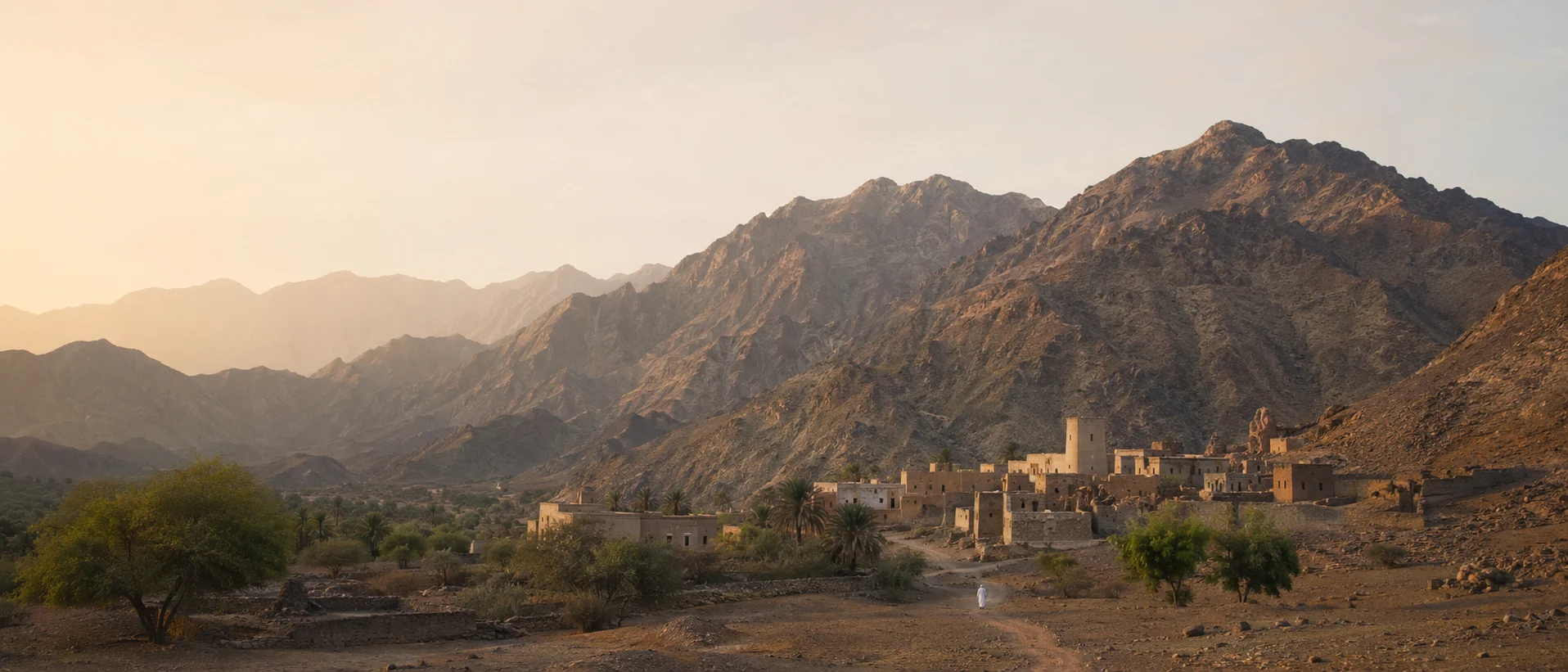
For many visitors, Dubai begins with a skyline. For me, some of the strongest memories begin in the opposite direction.I have been returning to the Emirates for years, and Hatta is one of those places that keeps changing the scale of the country in my head. The towers disappear. The road tightens between rock. Farms, wadis and old stone enter the view. You understand quickly that Dubai is not one landscape and never was.That is why I do not want to tell the story of Hatta as a list of things to do, and I do not want to reduce it to a jar of honey either. Hatta deserves the whole picture: its mountain geography, its old settlements, its falaj, its forts, its hospitality, its trees, its bees, and the Sidr honey that now carries the name of this place far beyond the valley.
Dubai Taught the World to Look Up. Hatta Makes You Look Around.
Downtown Dubai teaches distance vertically. Hatta teaches it horizontally. Around 130 kilometres from central Dubai, the mountain town sits at the foot of the Hajar range, a landscape shared across the eastern edge of the Arabian Peninsula. The approach changes almost everything the first-time visitor expects from the word Dubai. Rock replaces towers. Wadis replace boulevards. Small farms and palm groves interrupt the dry colours of the mountains.
That contrast is useful for search engines, but it is more important for people. Someone may arrive here after searching Hatta Dubai, Hatta things to do or Hatta heritage. Another person may come looking for Hatta honey or Hatta Sidr honey. They are not really separate stories. The honey exists because of the landscape, and the landscape has meaning because people learned how to live inside it.
This is where I want to start. Not with a product. With a place.
“Dubai taught the world to look up. Hatta reminded me to look at what was already there.”Meskaoui
Hatta Before the Weekend Escape
The current image of Hatta is full of kayaking, cycling, mountain lodges and outdoor escapes. That is part of the place today, but it is not where the story begins. UNESCO’s tentative listing for the Hatta Archaeological Landscape describes evidence of human presence reaching back to the Early Bronze Age, with archaeological sites from the Bronze and Iron ages through later Islamic periods. More than twenty sites have been documented across the wider area.
The archaeological landscape matters because it changes the way we read what looks, at first, like a harsh mountain environment. Valleys with seasonal water, protected slopes and small pockets of productive land created opportunities for settlement. Tombs, rock art, stone structures and later hamlets show that Hatta was not simply passed through. People stayed, adapted, cultivated and returned.
Visit Dubai today presents Hatta through its forts, towers and heritage village. Those monuments are easier to photograph than an ancient water strategy, but I think the water strategy explains them better. A community does not build only walls. It builds ways to remain.
The Falaj: A Line of Water Through the Mountains
One detail in the UNESCO record stayed with me: Hatta preserves a traditional falaj irrigation system extending underground for roughly 560 metres from the mountain toward the valley, with studies dating the system back to the first millennium BCE. It is difficult to imagine a better symbol for Hatta.
A falaj is not dramatic from a distance. It does not rise above the skyline. It works quietly, moving water where people need it. In a dry landscape, that means fields, palms, animals and continuity. It also means flowering plants survive where they otherwise might not, and every flowering plant becomes part of the wider ecology that supports insects and bees.
When people search for Hatta history, they often find forts. When they search for Hatta nature, they find dams and mountains. The falaj sits between the two. It is history made practical, and nature made inhabitable.
A Village Built From What the Land Gave
The Hatta Heritage Village contains around 38 traditional structures. The National Cultural Map of the UAE describes buildings made with materials such as clay, stone and palm fronds, alongside a historic mosque more than two centuries old and Hatta Fort, built in 1896. The area was also known as Al-Hajarein, “the two rocks”, a name linked to the surrounding mountains and defensive towers.
I like these details because they show a style of architecture that does not try to erase the environment. The building materials come from the place. Shade is designed, not added later. Courtyards, walls and towers answer questions of heat, security, family life and community.
For a visitor searching Hatta Heritage Village or Hatta fort, this is obviously cultural tourism. For MESKI, it is also part of understanding food and honey. A jar does not begin in a shop. It begins in the same landscape that supplied stone for walls, palm leaves for roofs and flowers for bees.
The Mountains Are Not Empty
The Hajar Mountains can look severe from the road, especially in the harder light of midday. Yet the valleys hold more life than the first impression suggests. Seasonal rain moves through wadis, groundwater is recharged, farms occupy workable pockets, and native vegetation survives in ways that are easy to miss if you drive too quickly.
This is one reason I have always preferred slowing down outside the city. The Emirates become larger when you stop treating everything between two attractions as empty space. A tree beside a wadi may be part of a beekeeper’s season. A terrace may carry the memory of cultivation. A patch of flowering vegetation that looks insignificant to us may be a map for a colony of bees.
That is the background to Emirati honey from Hatta. It is not desert honey in the simplistic sense of bees somehow producing nectar from sand. It is mountain and wadi honey, shaped by flowering trees and the seasonal rhythm of a specific landscape.
Sidr, Samar and Ghaf: Three Names You Hear Again and Again
Anyone who spends time around honey in the UAE soon meets three names: Sidr, Samar and Ghaf. They are often placed side by side on shelves, but the trees, flowering periods and flavour profiles are not identical. Hatta’s honey culture is especially associated with native and adapted vegetation growing around farms, wadis and mountain slopes.
Hatta Sidr honey receives the most attention because Sidr already carries a strong reputation across Yemen, Oman, Saudi Arabia and the Emirates. But I would not let that reputation make the other honeys invisible. Samar can be darker and more intense, with a character many Gulf honey lovers recognise immediately. Ghaf connects the jar to one of the UAE’s most symbolic native trees.
This is also why I avoid saying that one honey is simply “better”. Origin, harvest, beekeeper, storage and personal taste matter. If all we do is rank names, we lose the landscape behind them.
When the Bees Enter the Story
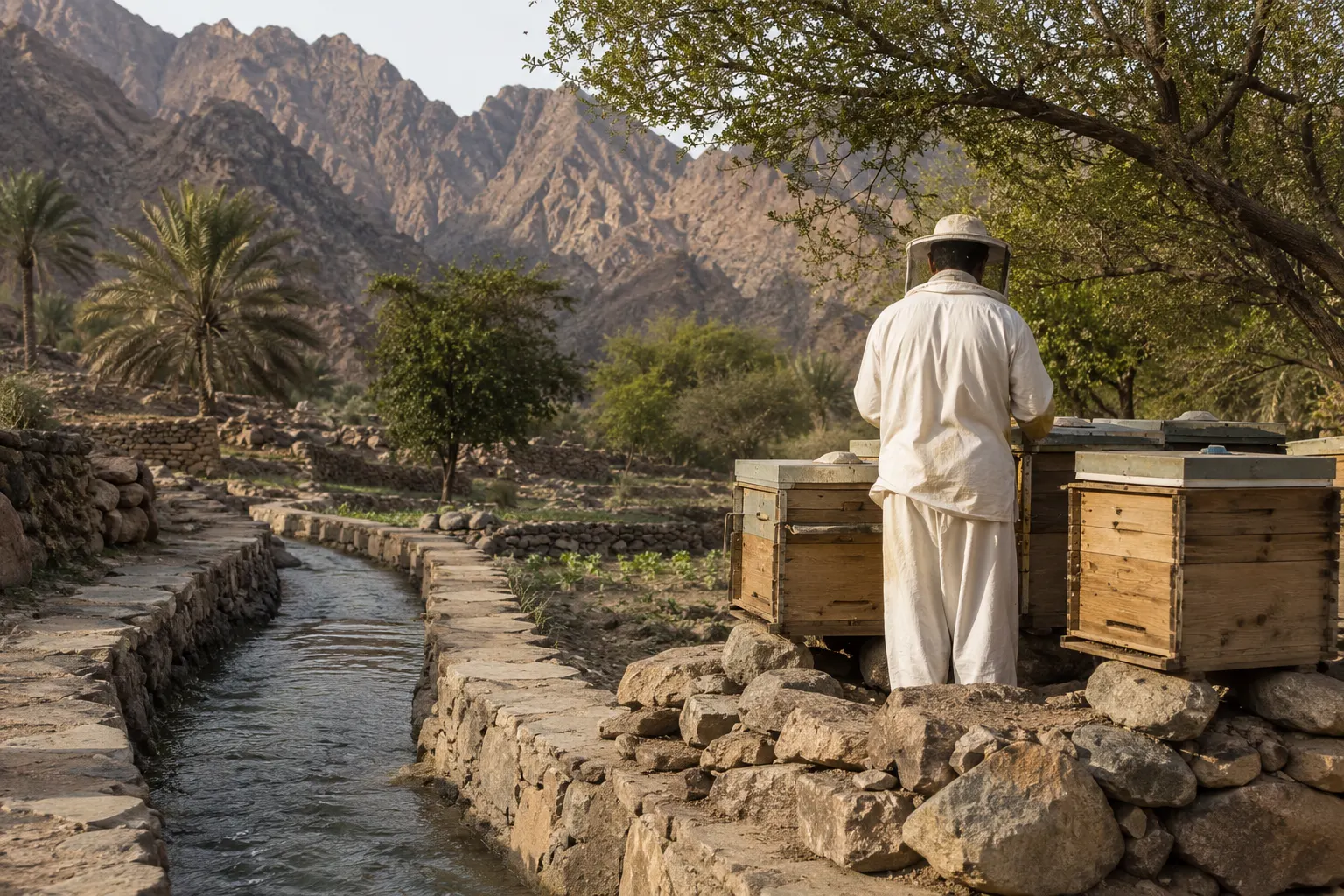
Hatta’s relationship with beekeeping is no longer a hidden local detail. Visit Dubai promotes the Hatta Honey Bee Garden and Discovery Centre, a large educational site devoted to honeybees, hives and the environmental role of pollinators. Dubai Media Office has also described beekeeping and honey production as an important economic activity in Hatta, supported by the area’s natural conditions.
That public visibility matters. Honey in Hatta is not a decorative souvenir attached to tourism after the fact. It belongs to farming, local enterprise and the knowledge of people who understand where to place hives and when the trees are ready.
I return regularly to a beekeeper in Hatta, and each visit reminds me that the useful questions are rarely the glamorous ones. What flower is open now? How was the previous rain? Did the heat arrive early? Are the colonies strong? The jar is the last chapter. The season begins much earlier.
What Makes Hatta Sidr Honey Different?
There is no single flavour sentence that can describe every Hatta Sidr harvest. Honey is agricultural. Rain changes. Heat changes. Flowering density changes. Colonies move through the season differently. Still, there are reasons people search specifically for Sidr honey from Hatta.
The first is provenance. Hatta gives a precise Emirati mountain origin, not simply “UAE” on a label. The second is floral identity. Sidr flowering creates a recognised seasonal harvest. The third is cultural proximity. For residents and visitors in Dubai, Hatta honey offers a local connection to a part of the emirate that feels far removed from the city centre.
That does not make it automatically superior to Do’ani Sidr from Yemen or Sidr from Nizwa in Oman. It makes it different. And difference is what a serious honey collection should preserve.
Hatta Sidr and Yemeni Sidr Are Not the Same Story
This comparison causes confusion because the word Sidr is doing too much work. Two honeys can both be linked to Sidr and still come from completely different terroirs, climates, beekeeping practices and seasons. Yemeni Sidr honey, especially celebrated origins such as Do’an, has its own history and market reputation. Emirati Sidr honey from Hatta carries another geography.
I would never try to prove Hatta by pretending Yemen is lesser, or sell Yemen by pretending the UAE has no serious honey tradition. Both approaches are too easy. A better question is what each jar can tell us honestly: where it was harvested, by whom, in which season, from which dominant floral source, and how it was handled afterward.
For readers comparing Hatta Sidr vs Yemeni Sidr, flavour and texture matter, but provenance comes first. Before asking which one wins, make sure both contestants are actually who they claim to be.
From Hatta to Jumeirah: Place of Harvest Is Not Place of Purchase
This distinction is simple and surprisingly useful. Someone searching Sidr honey Jumeirah, honey in Downtown Dubai or Hatta honey delivery Dubai is usually telling us where they want to buy or receive the jar. They are not necessarily describing where the honey was produced.
A Hatta harvest can be delivered to Jumeirah. Yemeni Sidr can be sold near the Burj Khalifa. Omani honey can sit on a shelf in Deira. Search geography and harvest geography are different things, and good product pages should make that clear.
This also gives us a more honest way to talk about local SEO. We do not need ten cloned pages claiming “Jumeirah honey”, “Dubai Marina honey” and “Burj Khalifa honey” as if every neighbourhood had its own floral origin. One strong article can answer the buying question while protecting the truth of the harvest.
Hatta Honey as a Gift From Dubai
There is another reason Hatta matters commercially: gifting. Visitors often want something connected to the Emirates without buying an object that could have been made anywhere and simply printed with the word Dubai. Honey can answer that need when the origin is real.
A Hatta Sidr honey gift carries a place, a tree, a season and a food tradition. Add a well-made box and it can become a corporate gift, a Ramadan gift, a hotel welcome gift or a personal gift taken home after a journey. The luxury should support the story, not replace it.
This is where gold honey and elaborate presentation can make sense too. Gold does not improve the honey. It changes the ceremony around the gift. For some recipients that ceremony matters. For others, a simple jar with a clear origin will mean more. The important thing is not to confuse decoration with provenance.
“Honey carries the sweetness of a flower. A gift of honey carries the memory of a place.”Meskaoui
Ramadan, Hospitality and the Mountain Table
Ramadan gifting deserves its own full story, but Hatta gives us a useful reminder of why food gifts matter in the Gulf. Hospitality is not an accessory to the region. Coffee, dates, sweets and honey move through homes, majlis and family visits as part of relationships.
Dubai Media Office has highlighted Hatta residents known for opening their majlis to visitors and introducing Emirati culture through hospitality. That makes the connection between Hatta honey gifts and Ramadan less commercial than it first appears. A food gift works because it can be opened, shared and placed on a table.
For a corporate buyer searching Ramadan gifts Dubai or VIP gifts UAE, this cultural layer matters. The best gift is not always the biggest box. Sometimes it is the one that gives the recipient something to ask about.
What to Look for When Buying Hatta Honey
If a jar is sold as Hatta honey, I want the seller to be able to tell me more than the word Hatta. Which honey is it: Sidr, Samar, Ghaf, multifloral? Is Hatta the harvest location or simply the shop location? Is there a harvest period? Is the beekeeper or producer identifiable? How was the honey stored?
For authentic Hatta Sidr honey, transparency is more valuable than theatrical claims. Colour alone cannot prove origin. Thickness alone cannot prove quality. A high price cannot prove rarity. A laboratory result can answer certain quality questions, but even a lab report should be linked to a real batch and read for what it actually measures.
This is the same discipline we use when comparing honey from Yemen, Oman, Morocco or elsewhere. Beautiful stories are welcome. Verifiable details are better.
A Day in Hatta Should Not End at the Dam
The dam is beautiful, and I understand why it dominates photographs. But if you leave Hatta with only the turquoise water in your camera, you have seen one layer. The heritage village, the old irrigation systems, farms, mountain paths and honey culture explain why the place feels different from a resort built in a dramatic setting.
If you are planning a visit, I would give the place time. Walk through the heritage area. Look at how walls meet shade. Notice palms and small cultivated spaces. If the season and opening hours allow, visit the honeybee centre or meet local producers. Then taste honey after you have seen the landscape it comes from.
That order matters to me. Place first, product second. The honey becomes more interesting when the word Hatta is no longer just a keyword.
Hatta Is Part of Dubai, but It Expands What Dubai Means
For SEO, “Hatta Dubai” is a useful phrase. For culture, it is an important reminder. Hatta belongs to the Emirate of Dubai, yet its mountains, old settlements, agriculture and rhythm complicate the international image of Dubai in a productive way.
This is why I keep returning to the seven Emirates as different landscapes rather than one postcard. Abu Dhabi has its islands, desert and oases. Ras Al Khaimah climbs into high mountains. Sharjah carries deep cultural institutions and east-coast geography. Fujairah faces the Gulf of Oman. Hatta gives Dubai a mountain memory.
When a jar of Hatta Sidr honey reaches a table in Jumeirah, Doha, Paris or elsewhere, that is the story I want it to carry. Not “luxury from Dubai” as a slogan. A real place from Dubai.
The Future of Honey in Hatta
Hatta is changing. Development projects, tourism, farms, outdoor attractions and cultural investment continue to reshape the area. Honey sits inside that future because beekeeping can support local enterprise while depending directly on environmental health.
That dependency is worth remembering. Bees need flowering resources. Flowering depends on plants, rain, temperature and land management. A successful honey economy cannot be separated from the landscape that feeds it. If native vegetation disappears or seasons become less predictable, the effect eventually reaches the hive.
This is where heritage and ecology meet. Protecting an old falaj and supporting a beekeeper may look like two unrelated actions. Both are ways of keeping knowledge attached to place.
What I Keep From Hatta
I do not remember Hatta as one viewpoint. I remember changes: the moment the city falls away, the first hard mountain walls, cultivated green against stone, the calm around old buildings, and conversations with people who know the season better than any label does.
That is why this page carries many search words but only one real subject. Hatta history, Hatta heritage, Hatta Dubai, Hajar Mountains, Hatta Sidr honey, Emirati honey and Hatta gifts are all doors into the same place.
You can arrive through any of them. I only hope that once you enter, you stay long enough to see more than the keyword that brought you here.
Hatta, Sidr Honey and Dubai’s Mountain Heritage
Yes. Hatta is part of the Emirate of Dubai, located in the Hajar Mountains away from the main urban area of Dubai.
Hatta is known for its mountain landscape, heritage village, forts and towers, dam, outdoor activities, farms and a growing reputation for beekeeping and local honey.
Hatta Sidr honey is honey harvested in the Hatta area during a Sidr flowering season, with Sidr as the dominant floral source claimed by the producer. The harvest origin should be clearly identified.
No. Both may be associated with Sidr, but Hatta honey is Emirati in origin while Yemeni Sidr comes from Yemen. Terroir, season, beekeeper and flavour can differ.
Hatta honey may be sold by producers in Hatta and delivered or retailed elsewhere in Dubai. When buying in Jumeirah, Downtown or another district, check that Hatta is the stated harvest origin, not merely the place of sale.
Sidr, Samar and Ghaf are among the best-known trees connected with Emirati honey. Local and seasonal floral sources can vary by site and year.
The falaj represents a long tradition of moving and managing scarce water for settlement and agriculture. UNESCO documentation notes a Hatta falaj extending roughly 560 metres underground and dating back to the first millennium BCE.
Yes. The Hatta Honey Bee Garden and Discovery Centre is promoted by Visit Dubai as an educational attraction focused on bees, honey and pollination.
Yes. A clearly sourced Hatta honey can work as a local Emirati food gift. For corporate or Ramadan gifting, presentation can be premium, but the provenance of the honey should remain clear.
No. Price can reflect rarity, packaging, retail costs and branding as well as the honey itself. Origin, harvest information, handling and traceability are better starting points for judging a jar.
Continue the Journey
If this story brought you here, continue the journey through related stories from The House of Meski.