
A definitive expert guide to origin traceability, lab certification, and trusted sellers — so every purchase is one you can stand behind.
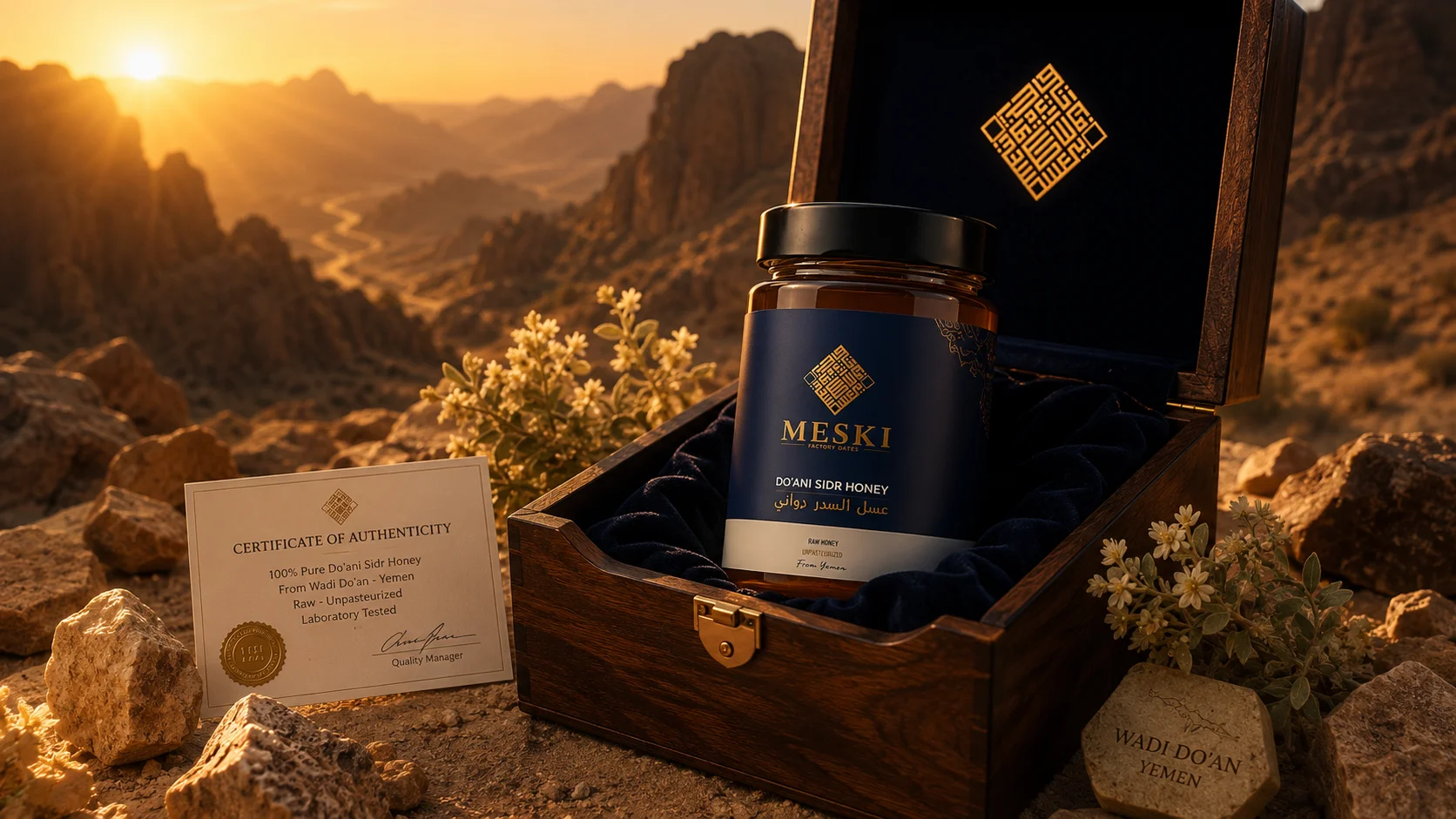
In the markets of the Arab world, Yemeni Sidr honey has long occupied a category entirely its own. Not simply a sweetener — it is a cultural inheritance, a measure of trust between beekeeper and buyer, and one of the most scrutinised luxury food products traded across the Gulf today. In the UAE, the question is rarely whether to buy Sidr honey, but how to buy it right.
Why Authentic Yemeni Sidr Honey Commands Such Reverence
The Sidr tree — known botanically as Ziziphus spina-christi and revered across Islamic tradition as the Lote tree — flowers in the remote valleys of Yemen’s Hadhramaut and Shabwa regions during a brief winter window. The bees that forage exclusively on its blossoms produce a monofloral honey of remarkable depth: dense in texture, complex in aroma, ranging in colour from deep amber to rich caramel, with a characteristic warmth that lingers long after the first taste.
What makes authentic Yemeni Sidr honey rare is not marketing — it is geography, seasonality, and constraint. The harvest occurs only twice a year, in yields determined entirely by rainfall, altitude, and the unpredictable rhythms of highland ecology. Verified Yemeni Sidr from the finest valleys regularly trades between AED 400 and AED 1,100 per kilogram at the retail level in the UAE. A price significantly below this range should, without exception, prompt careful scrutiny.
Why Choosing the Right Seller Is Everything
The premium honey market in the UAE is not immune to the same pressures that affect luxury goods globally: counterfeiting, adulteration, and ambiguous labelling. The very attributes that make Sidr honey valuable — its high price, its mystique, its loyal following — also make it a target for imitation.
What is commonly sold under the name “Sidr honey” can range from genuine, traceable monofloral Hadhramaut honey to blended products from cultivated Sidr trees in other regions, or honey cut with sugar syrups. The differences are not always visible to the untrained eye. A credible seller does not simply sell honey — they narrate its origin. They know which valley, which beekeeper, which harvest season. They have documentation. They welcome questions.
Buyer’s Warning
Vague claims of “Yemeni origin” with no regional specificity are insufficient for a product at this price point. Always request documentation before purchasing.
What to Look for Before You Buy Online
Two criteria stand above all others when evaluating a genuine Sidr honey online purchase: origin transparency and batch traceability.
Origin Transparency and Traceability
A trustworthy seller will tell you not just “Yemen” but the specific region — Wadi Doan, Shabwa, Hadhramaut — and ideally the name or cooperative of the beekeeper. Genuine Yemeni Sidr pollen analysis should show greater than 60% Ziziphus pollen content to qualify as a true monofloral Sidr honey — confirmable only through melissopalynological laboratory testing. Any seller unable to reference this data is operating without the transparency a discerning buyer deserves.
Harvest Season and Batch Information
Primary season honey — gathered at the height of the Sidr bloom — is regarded as the most concentrated in character. Sellers who distinguish between seasons and communicate batch dates demonstrate a level of rigour that generic honey merchants cannot match. Look for lot numbers, harvest year, and country of origin clearly indicated on the label. Absence of this information is itself a signal.
The Unmistakable Signs of a Trusted Honey Seller
Beyond the product itself, the seller’s conduct tells you everything. Here is what genuine professionalism looks like in the premium honey UAE trade:
Direct Sourcing Relationships
The seller works directly with beekeepers or regional cooperatives — not through anonymous intermediary chains. Meski’s Yemeni Do’ani Sidr Honey is sourced through exactly this kind of verified direct relationship.
Third-Party Laboratory Certification
Independent lab reports are made available to buyers — not merely cited in passing. This is the non-negotiable foundation of buyer confidence in the premium segment.
Honest Communication About Limitations
A reputable seller acknowledges seasonal variability, limited stock, and natural batch differences. Uniformly perfect claims across every jar are a warning sign, not a reassurance.
UAE-Registered Business Presence
A legitimate honey seller will have a verifiable commercial presence, an importation licence, and compliance with UAE food safety standards set by the Emirates Authority for Standardisation and Metrology (ESMA).
Questions Every Discerning Buyer Should Ask
Before completing any online purchase of raw Sidr honey in the UAE, ask these questions directly:
| Question | What a Good Answer Looks Like | Red Flag |
|---|---|---|
| Specific harvest region and season? | Immediate, precise: “Wadi Doan, primary season 2025” | “Yemen” with no further detail |
| Lab reports available? | PDF provided on request: pollen, moisture, HMF, diastase | “We guarantee quality” with no documents |
| Has honey been heated or filtered? | “Extracted, lightly strained, jarred — nothing more” | Mentions pasteurisation or ultra-filtration |
| Return/verification policy? | Clear, fair, written policy provided | Evasive or absent |
| Temperature-controlled UAE delivery? | Insulated packaging confirmed for summer months | No mention of temperature logistics |
Laboratory Testing and Product Traceability — The Non-Negotiables
In the premium segment, laboratory certification is not optional — it is the foundation of buyer confidence. The tests that matter most for authentic Sidr honey are:
Melissopalynology
Identifies the botanical origin by examining pollen content. The definitive method for confirming monofloral Sidr status — requires greater than 60% Ziziphus pollen.
Hydration Check
Raw Sidr honey should measure below 20% water content. Higher moisture indicates premature extraction or adulteration.
Heat Exposure Marker
Hydroxymethylfurfural rises sharply when honey is heated or stored incorrectly. Low HMF confirms neither pasteurisation nor transit degradation.
Enzyme Integrity
Naturally present in raw honey; its presence confirms the honey has not been subjected to excessive heat treatment.
Pesticide & Antibiotic
Particularly relevant for honey sourced from regions where agricultural inputs vary. A clean report is a baseline requirement.
At Meski Dates Factory, every batch of Yemeni Sidr honey is accompanied by verifiable documentation. Traceability is not a bureaucratic formality — it is the most tangible expression of respect for the buyer.
Packaging, Storage, and Delivery: Details That Reveal Everything
The container is not merely aesthetic — it is a preservation decision. Authentic raw honey should be packaged in dark or amber glass jars, which protect from UV light degradation. Plastic containers are not considered appropriate for premium honey at this price point.
Regarding storage: raw Sidr honey should be kept away from direct sunlight, at room temperature (ideally between 18°C and 24°C). Refrigeration is not necessary and can accelerate crystallisation. A shelf life of two years, properly stored, is standard for quality raw Sidr honey.
For UAE buyers, delivery logistics matter critically. During summer, when temperatures regularly exceed 40°C, premium honey must be shipped with appropriate insulation. A seller who ships without temperature consideration is compromising the product they claim to stand behind.
Comparing Quality, Not Price
One of the most common errors made by first-time buyers of premium honey in the UAE is to treat price as the primary variable. Price matters — products priced implausibly low should raise immediate concern — but price alone tells you nothing about what is in the jar.
Think of it the way a collector approaches fine olive oil, aged balsamic, or single-estate coffee: the price is a consequence of quality, not a guarantee of it. The more useful comparison is qualitative:
Origin Documentation
Does the seller provide verifiable regional sourcing — valley, beekeeper, cooperative — not just a country of origin?
Pollen Analysis Available
Is a third-party melissopalynological report accessible? This is the single most important quality signal.
Raw Extraction Confirmed
Has the honey been extracted, lightly strained, and jarred — with no heat treatment applied at any stage?
Packaging Integrity
Dark glass jar, airtight seal, clear labelling of origin, harvest date, and batch number — all present and legible.
Why Transparency Is the Highest Form of Luxury
In a market where mystique can be manufactured and claims are easy to make, genuine transparency is genuinely rare — and therefore genuinely valuable. A seller who shows you the laboratory report, names the beekeeper, identifies the valley, specifies the harvest year, and stands fully behind every jar is not merely selling honey. They are offering accountability.
This is, ultimately, what distinguishes a luxury purchase from an expensive one. Luxury, properly understood, means that someone, somewhere, has taken extraordinary care — and is willing to prove it.
At Meski Dates Factory, this standard is operational. Our Yemeni Do’ani Sidr Honey and our Luxury Sidr Honey Gift Box — Gold 23K, Silver Oman & Saffron Yemen are sourced with direct relationships, documented at every stage, and presented in packaging that reflects the rarity of what they contain. We invite every buyer to ask us anything.
Explore Meski’s Verified Sidr Honey Collection
Every jar carries its origin story, its laboratory documentation, and our unconditional commitment to authenticity — delivered across the UAE.
Frequently Asked Questions
Authentic Yemeni Sidr honey can be purchased online through verified UAE-based sellers who provide full origin documentation, third-party laboratory reports, and transparent sourcing from specific Yemeni valleys such as Wadi Doan (Hadhramaut) or Shabwa. Meski Dates Factory, based in Sharjah, offers traceable, certified Yemeni Sidr honey with direct delivery across the UAE.
Genuine Sidr honey can be verified through melissopalynological (pollen) analysis — which should confirm greater than 60% Ziziphus pollen content — alongside moisture content below 20%, low HMF levels, and diastase enzyme activity. Sensory indicators such as a deep amber colour, dense viscosity, and a rich, warm aroma are supporting signals, but laboratory testing remains the only definitive method.
At minimum: pollen analysis (melissopalynology), moisture content measurement, HMF level testing, diastase activity confirmation, and pesticide/antibiotic residue screening. These tests, conducted by an accredited independent laboratory, constitute the baseline of buyer protection for any premium honey purchase.
Yes — and it should be understood as a mark of quality, not a defect. Crystallisation is a natural process by which glucose molecules in raw, unprocessed honey form a crystalline structure over time. Honey that never crystallises has typically been heated or ultra-filtered — processes that compromise the honey’s character. To return crystallised honey to liquid form, place the sealed jar in warm water no hotter than 40°C; never microwave or boil.