
Medjool plain, Sukkari with Arabic coffee, Ajwa with almonds, Sagai with sesame, and one famous Errachidia date I strangely like less than everyone else.
I grew up with dates before I ever thought of them as a product category. They were simply part of the house. Morocco gave me the first taste, travel gave me more varieties, and somehow I ended up with a date for almost every mood. The only real problem is when there are none left at home. Then I feel almost orphaned.
Dates Were Never a Health Food in My House
I did not grow up eating dates because somebody told me they were good for me.
I ate them because they were there.
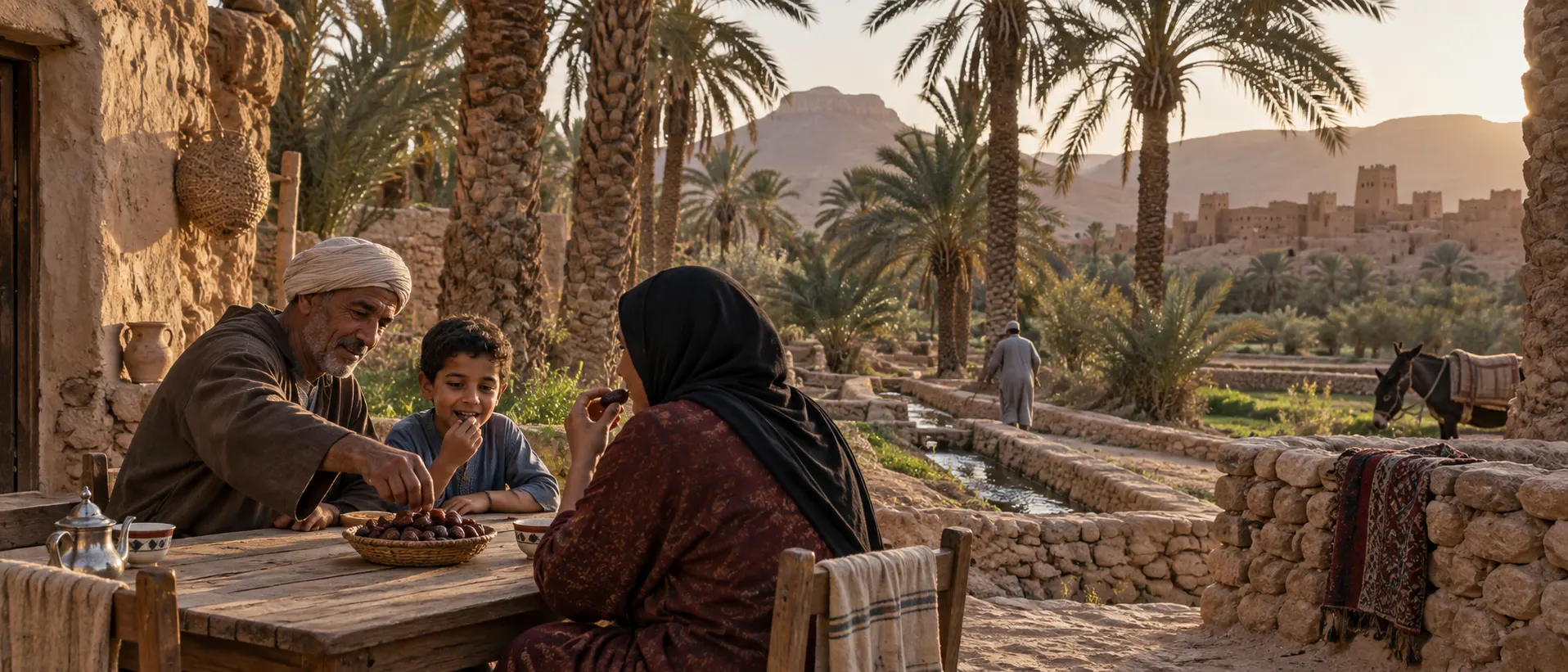
They belonged to the house, to family, to the oasis, to Ramadan, to visitors, to coffee, to the little moment when you open a box and immediately take one before you have even decided whether you are hungry.
That is probably why I struggle with articles that introduce dates as if humanity discovered them yesterday through a nutrition label.
Before calories, minerals and antioxidants, there was simply the fruit.
When there are no dates in my house, I feel almost orphaned. It sounds dramatic, but people who grew up with one food always understand exactly what I mean.
Meskaoui
My Starting Point Is Meski
For me, the story begins in Morocco, around the oasis world of Meski and the wider Tafilalet.
Palm trees were not exotic scenery. Dates were not something brought into the house for a themed dinner. They belonged to the landscape I knew and to the taste I grew up with.
FAO describes the Tafilalet as Morocco’s principal date palm area, with remarkable varietal diversity. The same region is also the historical home of Mejhoul, better known internationally as Medjool.
That geography is part of why the name MESKI was never only a brand idea for us. If you want the deeper story, our MESKI origin story begins in that same oasis memory.
Medjool From Morocco: This One Is Home
I can eat many dates in many ways, but if you give me a good Moroccan Medjool and tell me I must eat it completely plain, I am happy.
No filling. No chocolate. No decoration.
Just the date.
Maybe I am biased. Actually, I know I am biased.
FAO traces Medjool to Morocco’s Tafilalet area, where it was already an important export date centuries ago.
So yes, when I say Moroccan Medjool is my base, there is a little patriotism in the bite.
And I am perfectly comfortable admitting it.
The Funny Part: Boufeggous Is Not One of My Favourites
Here is where taste becomes personal.
Around Errachidia, Boufeggous is not an obscure date. It is one of the important local varieties, and official Moroccan documentation even protects Dates Boufeggous with a geographical indication covering Errachidia and other oasis provinces.
Recent FAO material on Tafilalet also identifies Boufeggous and Mejhoul among the dominant varieties.
And yet, strangely, Boufeggous is one of the dates I reach for the least.
People around me can ask for it enthusiastically and I am the one looking for something else.
That is exactly why I do not believe in universal rankings.
A famous date is not automatically your date.
I Love Dates According to the Moment
I do not have one ranking that works all day.
A date changes depending on what is beside it.
Sometimes I want something soft and rich on its own.
Sometimes I want a firmer date with nuts.
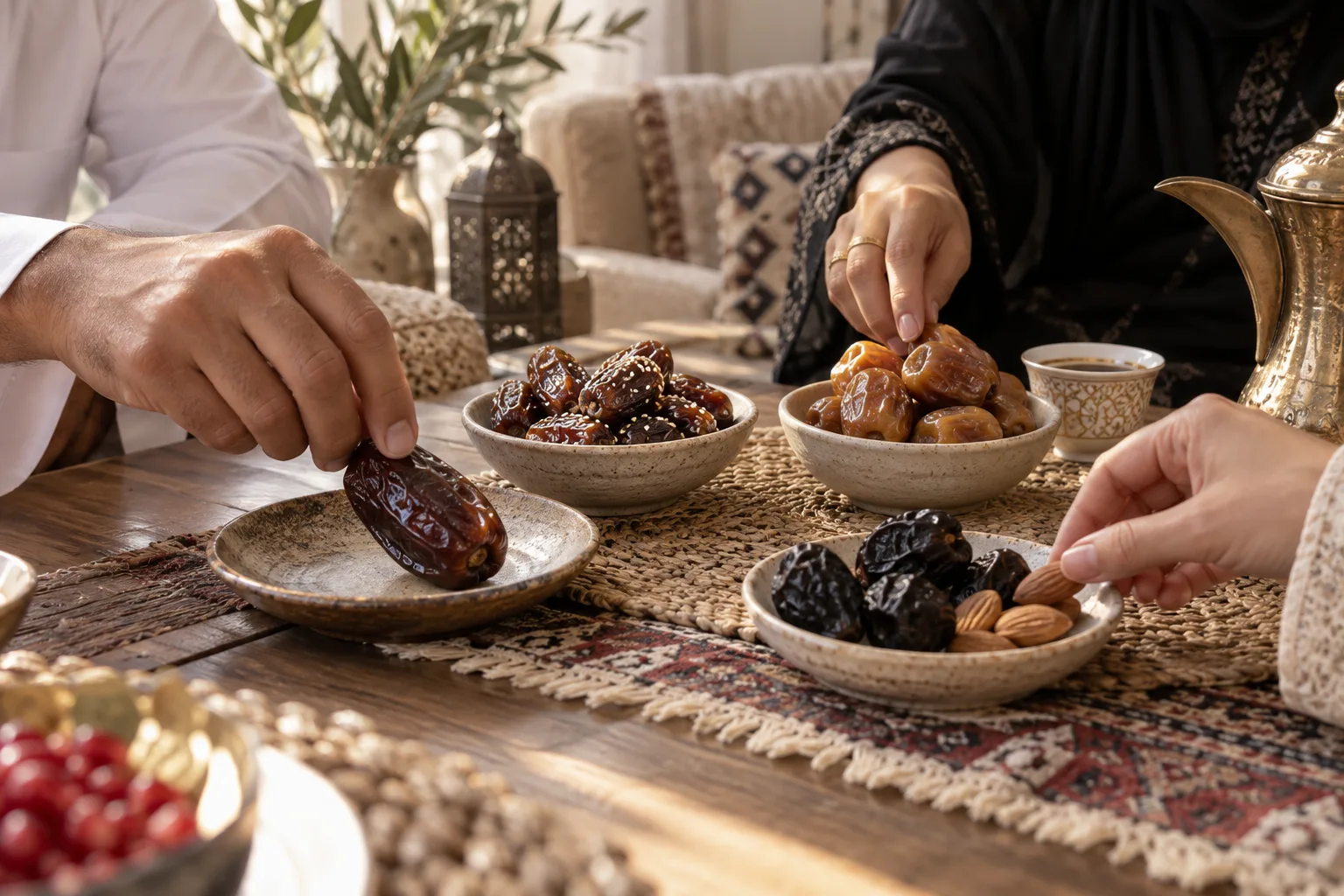
Sometimes the date is there to follow Arabic coffee.
Sometimes it becomes almost a dessert.
The same person can prefer four different varieties for four different moments without contradicting himself.
Sagai: Give It Sesame and I Am Interested
Sagai is one of those Saudi dates I like when there is something around it.
I enjoy it with sesame, or in preparations where its texture can meet another flavour.
Saudi sources place Sagai among the Kingdom’s recognised local varieties, especially around Riyadh.
For me, it is not the date I need to leave completely alone.
It becomes more interesting when somebody gives it a little company.
Sukkari and Arabic Coffee Just Understand Each Other
Sukkari is different.
Give me Arabic coffee and Sukkari and I already understand the table.
It has that sweetness that works with a lighter, aromatic coffee, especially the kind perfumed with cardamom.
I like the contrast: small finjan, fragrant coffee, sweet date.
It is simple, but simplicity is often where hospitality becomes convincing.
That connection is exactly why dates belong naturally beside our stories about Arabian hospitality and Arabic coffee.
Ajwa With Almonds
Ajwa has another personality for me.
I like it with almonds.
The dark date and the clean crunch of the nut work well together without needing to turn the whole thing into a confectionery project.
Ajwa is strongly associated with Madinah and carries an important religious and cultural place in Muslim life.
I respect that history, but when I am eating it, my opinion remains extremely practical.
Put an almond inside and leave me alone for five minutes.
From Morocco to Saudi Arabia, Oman, Yemen and Al Ain
The more I travelled, the more I noticed the same fruit changing character without losing its place at the table.
In Saudi Arabia, the number of varieties is enormous. Official Saudi sources list hundreds of cultivars and names such as Sukkari, Khalas, Ajwa and Sagai immediately carry regional associations.
In Oman, varieties such as Fardh and Khalas belong to another date landscape.
In the UAE, Al Ain’s oases are part of a UNESCO World Heritage cultural landscape. The oasis, desert and mountain meet there in a system shaped by water management and old agricultural knowledge.
And Yemen belongs to the same wider date palm heritage recognised by UNESCO across the Arab region.
I do not need every country to produce the same date. What interests me is that the palm keeps changing accent while remaining understood everywhere.
Dates Make More Sense in an Oasis
A supermarket box can make dates look like small brown objects arranged in rows.
An oasis corrects that misunderstanding.
The palm is vertical life in a dry place.
Water must be found, shared and managed.
Shade allows other crops to live underneath or nearby.
Harvest follows season and skill.
UNESCO’s date palm heritage listing speaks not only about the fruit but about cultivation knowledge, crafts, social practices, poetry and the use of palm parts across generations.
That is why I never see dates as just a snack.
The Date Is Also a Social Signal
Put dates on a table and something changes.
They say a guest can eat immediately.
They work before a meal, beside coffee, during Ramadan, after prayer, inside a gift box, in a car during a journey, or quietly at home when nobody is visiting.
You do not need cutlery.
You do not need a speech.
A date is one of the easiest forms of hospitality in the region.
Natural First, Filled When It Makes Sense
My preference is usually simple.
I like dates natural.
But I am not against fillings. I just want the filling to have a reason.
Sesame can work. Almonds can work. Nuts can work. Sometimes a little contrast makes the fruit more interesting.
What I do not want is to lose the date under ten other flavours.
If the first thing I taste is everything except the fruit, then we have probably gone too far.
There Are Dates I Love, Dates I Like, and Dates I Respect From a Distance
I like almost all dates with a few exceptions.
That does not mean I pretend every variety gives me the same pleasure.
There are dates I buy because I know exactly when I want them.
There are dates I enjoy when someone serves them.
And there are dates that other people love much more than I do.
Boufeggous is the perfect example.
It is part of my own region’s date culture, it is important, people ask for it, and still it is not among my first choices.
Food would be boring if heritage required identical taste.
Heritage tells me where a fruit comes from. My tongue is still allowed to have an opinion.
Meskaoui
Why I Will Never Make a Top 10 Dates Ranking
I could write one.
It would probably perform well.
Number one Medjool. Number two Sukkari. Number three Ajwa. Put a crown emoji somewhere and everybody goes home.
But that is not how I eat.
If I am drinking Arabic coffee, my answer changes.
If I want one date alone, my answer changes.
If there are almonds, my answer changes.
If I am remembering Morocco, the answer changes again.
The better question is not which date is best.
It is which date do you want now?
Sources and Cultural Notes
FAO documents the Tafilalet as Morocco’s principal traditional date palm area and records major varietal diversity there, including the importance of Mejhoul and Boufeggous.
FAO’s date palm reference also traces Medjool to Morocco’s Tafilalet area.
Moroccan geographical indication documentation formally recognises Dates Boufeggous and includes Errachidia within its protected production area.
UNESCO recognises date palm knowledge, skills, traditions and practices across countries including Morocco, the UAE, Oman, Saudi Arabia and Yemen, while Al Ain’s oasis landscapes are also inscribed as World Heritage.
Saudi official sources identify Sagai, Sukkari and Ajwa among major local varieties and associate them with Riyadh, Qassim and Madinah respectively.
Everything about which date I prefer, what I pair it with, my feelings about an empty date box, and my unusual lack of enthusiasm for Boufeggous is simply my own taste.
The Fruit I Grew Up With
I have tasted dates in different countries, in different shapes, at different prices and with different presentations.
But in my head they still begin in the same place.
An oasis.
A palm.
A box somewhere in the house.
A hand reaching inside without asking permission.
And if one day there are no dates left at home, I will probably still look at the empty shelf with the same ridiculous feeling.
Orphaned.
Until somebody brings another box.
Questions People Ask
A good Moroccan Medjool is my first choice when I want the date completely natural.
Sukkari is one of my favourite pairings with light aromatic Arabic coffee.
I enjoy Sagai especially with sesame or in a simple preparation where another texture complements the date.
With almonds. I like the contrast between the dark soft date and the nut.
I respect the variety and its importance around Errachidia, but strangely it is one of the dates I personally like least.
FAO traces Medjool to Morocco’s Tafilalet area, where it was historically an important export variety.
Across oasis societies they connect agriculture, hospitality, craft, seasonal knowledge and social traditions.
No. My preference changes according to whether I eat the date alone, with nuts or beside coffee.
Yes when the filling supports the fruit rather than hiding it. I usually prefer simple combinations.
Continue Through the Oasis
Dates open naturally into the wider MESKI stories of oasis life, hospitality, Arabic coffee and the landscapes that gave the house its name.