
From my grandmother’s spiced Moroccan coffee to Hanoi egg coffee, Gulf cardamom and a Sudanese ginger kick, travel taught me to look for flavour instead of strength.
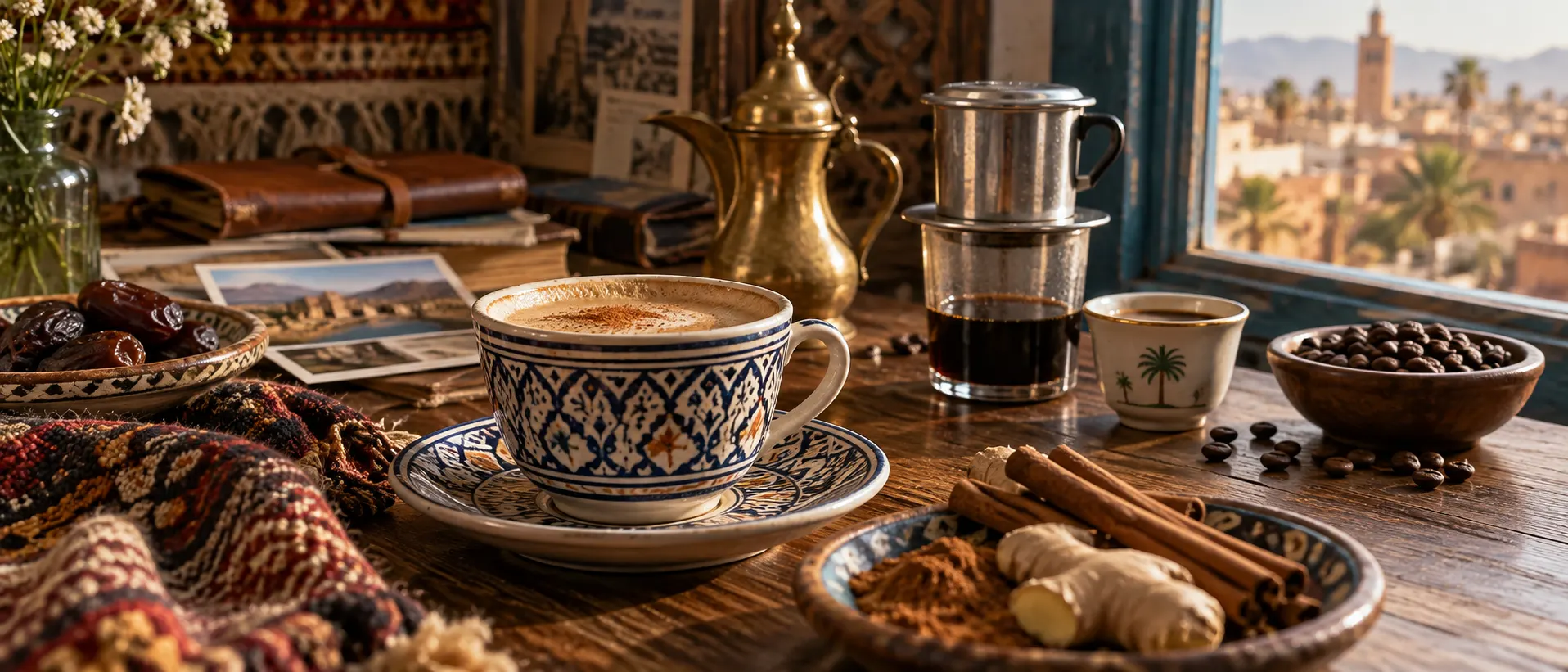
I am not a coffee addict. I used to drink it every day, but now I would rather wait for a cup that has something to say. I grew up with café au lait and my grandmother’s spiced Moroccan coffee. Then travel slowly changed my taste. Vietnam taught me patience, Arabic coffee taught me that black coffee could be light and aromatic, Ethiopia gave me flavour, Sudan gave me ginger, and Yemen has left me with a question I still want to answer.
I Am Not a Coffee Addict
I should probably start with a confession. I am not one of those people who cannot speak before the first coffee of the morning.
There was a time when I drank coffee every day. I grew up with café au lait, so coffee was always around me. But today I can go without it.
What changed is that I became more selective.
I do not need coffee every day. I need the right coffee at the right moment.
And travel taught me that the word coffee can hide completely different experiences.
My First Coffee Memory Is Moroccan
My earliest coffee memory is not an espresso machine.
It is milk, coffee and the smell of spices.
My grandmother made a Moroccan coffee with spices, the kind of smell that fills the room before the cup even reaches you. That memory is probably one hundred percent MESKI without us having known the name yet.
Coffee was not something I analysed. It belonged to home.
Maybe that is why I still look for aroma before strength.
France Taught Me That Espresso Is a Booster
I live around a coffee culture where the espresso is everywhere.
After lunch. At the counter. On a terrace. In a tiny cup that looks almost empty before you touch it.
I know there are excellent French cafés and excellent roasters. But personally, many of the everyday espressos I meet are too bitter for my taste.
So for me, espresso has a very practical category.
Booster.
One sip, eyes open, mission completed.
I Still Have One Question for Espresso People
And I genuinely need somebody to explain this to me.
An espresso is one sip. Maybe two if you are extremely disciplined.
So how do some people sit in a café for two hours with the same espresso and, somehow, there is still coffee left in the cup at the end?
I am not criticising. I am impressed.
That is a level of patience and portion control I have never mastered.
Italy Is Different for Me
Italian coffee culture is easier for me to enjoy because I like the variety around it.
Espresso, yes, but also cappuccino and all the more comforting versions that let milk soften the coffee without making it disappear.
I admit I have a weakness for cappuccino.
And if the name ends in cino, there is a good chance I will at least want to try it.
Frappuccino included. I know, not exactly a lesson in classical Italian coffee heritage, but pleasure does not always need a passport.
Then Ethiopia Taught Me That Black Coffee Could Have Flavour
Ethiopian coffee helped change something in my taste.
I began to understand that black coffee did not have to mean one thing: dark, bitter, aggressive.
It could be aromatic, fruity, floral or spicy depending on the bean, roast and preparation.
UNESCO describes coffee as central to daily and social life in Ethiopia, with a preparation culture built around roasting, grinding, the jebena and time spent together.
I did not suddenly become a coffee expert.
I simply discovered that I preferred flavour to force.
The Gulf Changed My Relationship With Coffee Without Milk
Arabic coffee was another important step for me.
Before that, if there was no milk, I usually was not very interested.
Then I discovered a lighter cup, often perfumed with cardamom and sometimes other spices depending on the place and family.
I liked that I could drink it without milk and still feel aroma rather than just bitterness.
UNESCO recognises Arabic coffee as a symbol of generosity across the UAE, Saudi Arabia, Oman, Qatar and Jordan, with the serving ritual itself carrying as much meaning as the drink.
That is why it belongs naturally beside our article What Was Served When a Stranger Arrived?. The cup is small, but the social world around it is large.
I Learned to Choose Coffee According to Mood
This was probably the real turning point.
I stopped asking whether I liked coffee.
That question was too simple.
I started asking which coffee I wanted today.
Something creamy. Something aromatic. Something light. Something strong. Something cold. Something that takes five minutes. Something that disappears in one gulp when I need to wake up.
Coffee became a direction, not a rule.
Vietnam Was Different Because I Went Looking for Coffee on Purpose
Before travelling to Vietnam, I already knew the country had a serious coffee reputation.
So when I reached Hanoi, I did not wait for coffee to find me.
I went looking for it.
I walked through streets and small lanes trying local cafés, because I wanted the coffee people actually drank, not just the easiest version in a hotel.
That search became one of the nicest food memories of the trip.
Egg Coffee in Hanoi: I Was Not Disappointed
I had heard about Vietnamese egg coffee before arriving.
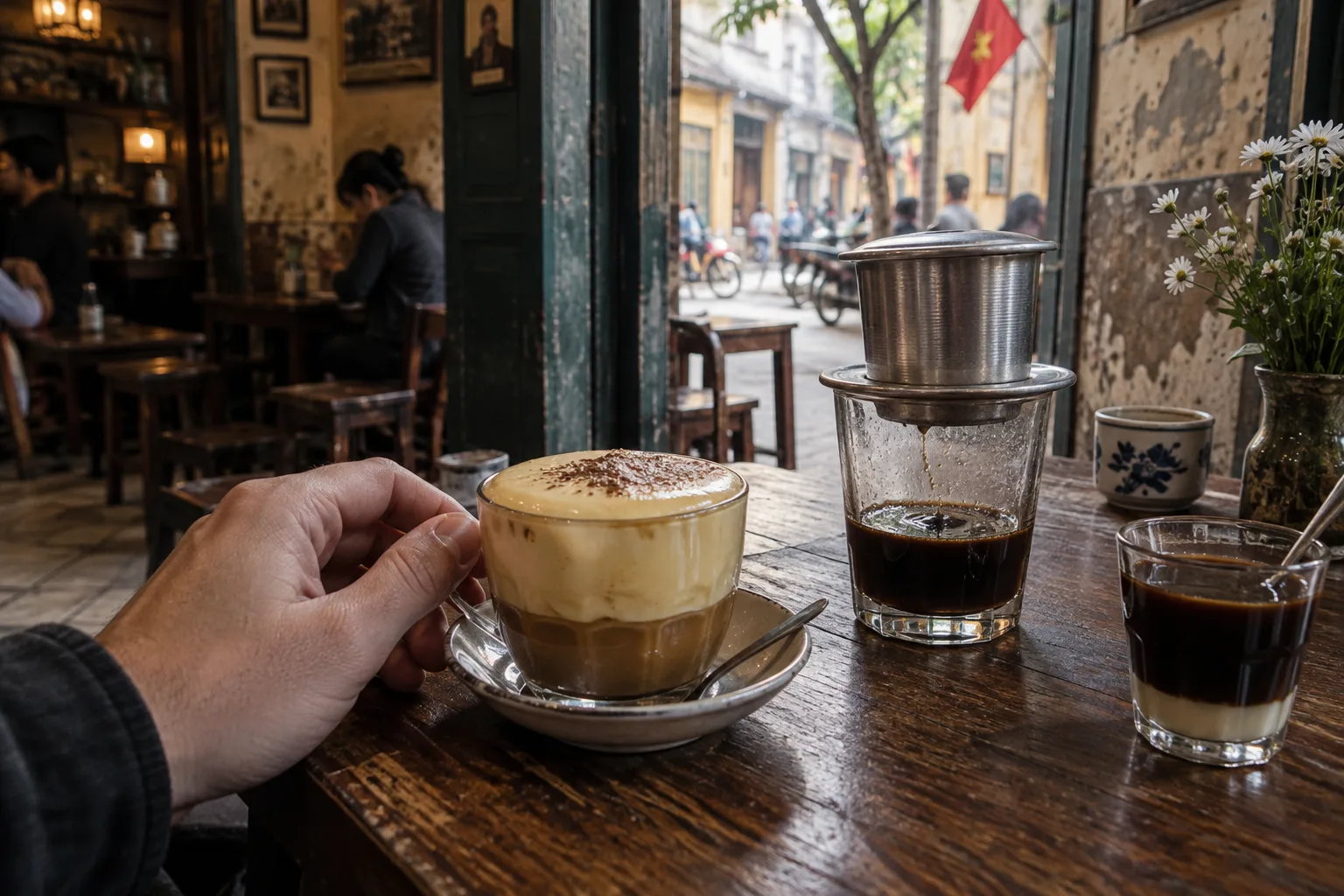
Vietnam Tourism describes Hanoi egg coffee as a local specialty built from coffee, egg yolk and condensed milk, with a rich creamy layer that turns the drink into something halfway between coffee and dessert.
Reading that is one thing.
Drinking it in a small local café in Hanoi is another.
Honestly, I was not disappointed.
It was delicious.
Rich, surprising and completely different from the espresso logic of drink it fast and move on.
Condensed Milk, Coconut and the Pleasure of Drinking Slowly
Then came Vietnamese coffee with condensed milk.
Then iced coconut coffee.
Those are the cups I can actually sit with.
They have enough texture, sweetness and flavour that you can wait, talk, look around and drink slowly.
Vietnam Tourism also highlights coconut coffee as one of the country’s modern coffee specialties.
With a drink like that, two hours at a café finally makes sense to me.
Give me an espresso and I am finished before the waiter turns around. Give me coconut coffee and now we can have a conversation.
The Phin Was a Small Revelation
What fascinated me as much as the taste was the method.
The Vietnamese phin filter was different from what I had used before.
Coffee sits above the cup and drips slowly.
You wait.
You watch.
The drink is being made in front of you at the same speed you are supposed to enjoy it.
In France, espresso taught me efficiency.
In Vietnam, coffee taught me patience.
I Also Discovered Flavoured Beans
In Vietnam I also came across coffee beans sold with added aromas such as coconut, caramel and other flavours.
I am not claiming that every Vietnamese coffee is flavoured or that this defines the country’s traditional coffee culture.
It was simply part of what I personally encountered while exploring shops and cafés.
And yes, I liked some of them.
Enough that before leaving Vietnam, I stocked up on coffee to bring home.
Sudanese Coffee Came With Ginger and Woke Me Up Properly
Another coffee I really enjoy is a Sudanese coffee I have tasted prepared with ginger.
No milk. No sugar.
That one is a proper booster.
It is strong, aromatic and the ginger gives it a little bite that wakes up the mouth as much as the caffeine wakes up the head.
That cup made me laugh because it is almost the opposite of my usual comfort coffee, yet I like it.
Apparently I do not dislike strong coffee. I dislike strong coffee when it has nothing else to say.
Turkish Coffee Is Not My Lane, and That Is Fine
I am leaving Turkish coffee mostly outside this article on purpose.
It is not the style I naturally reach for.
That does not make it bad and I do not want to judge a coffee tradition that other people genuinely love.
Not every taste has to become my taste.
One of the nicest things travel teaches you is to recognise the difference between I do not like this and this has no value.
Yemen Is Still an Unfinished Cup for Me
Yemeni coffee is different because right now I know more about its history than I know about my own preference for its cup.
After writing Before Mocha Was a Flavour, It Was a Port, I understand Al-Makha differently. FAO describes Yemen as one of the world’s oldest coffee-producing countries, with Arabica cultivated in terraced highlands and processed through long-standing dry methods.
I know the story is extraordinary.
I know the name Mocha travelled far beyond Yemen.
But I still need to drink more Yemeni coffee before I pretend to tell you exactly where it sits in my personal ranking.
For now, Yemen remains a question mark I am very happy to keep exploring.
The Old Coffee Roads Now End in Very Modern Places
This is the connection I love most.
Coffee that once travelled through mountain villages, Red Sea ports and caravan networks now belongs to a world of polished cafés, hotel lounges and luxury terraces.
I am not saying the cup in a specific hotel came from Yemen unless I know it did.
I am saying something broader.
The coffee traditions that crossed Arabia are still moving through Jumeirah, Sheikh Zayed Road, Abu Dhabi, Doha and Riyadh, even when the surroundings are marble, glass and gold instead of a mountain terrace or an old port.
It is one reason our Sheikh Zayed Road story and our coffee stories can sit inside the same journal. Roads change. The desire to meet over a cup does not.
My Occasional Little Pleasure: Ethiopian Coffee, Camel Ghee and Jujube Honey
I have one coffee recipe I make rarely, but when I make it, it feels like a small personal luxury.
I start with about half a spoon of camel ghee in a small saucepan. I add a little turmeric, a little cinnamon and a little ginger, then let the spices toast gently in the ghee for a short moment so the aromas come out.
Then I add water and ground Ethiopian coffee and let it cook gently for around five minutes.
After that I add a little thick, creamy oat milk and leave it for another two minutes.
I filter the coffee into the cup, then stir in a spoonful of jujube honey.
That is it.
No complicated machine. No café menu.
Just a cup I make from time to time when I want something warm, aromatic and completely mine. And yes, when I say jujube honey, I know exactly where the temptation comes from. Yemeni Do’ani Sidr Honey is never very far from this kitchen.
What Travel Actually Changed
Travel did not turn me into somebody who needs coffee all day.
It did something more interesting.
It broke the idea that coffee has one correct taste.
My grandmother’s spiced coffee, a French espresso, an Italian cappuccino, Ethiopian coffee, a Gulf finjan, Hanoi egg coffee, Vietnamese coconut coffee and Sudanese coffee with ginger do not need to compete for one trophy.
They belong to different moods and different memories.
I learned my direction by tasting the differences.
Sources and Cultural Notes
For Vietnamese coffee, I used Vietnam Tourism’s guide to Vietnamese coffee, particularly for the documented context of Hanoi egg coffee and coconut coffee.
For Arabic coffee and its etiquette, see UNESCO’s Arabic coffee heritage entry.
For Ethiopia, UNESCO’s feature on Ethiopian coffee culture gives the social and ceremonial context. For Yemen, FAO documents the country’s coffee heritage, terraced cultivation and connection to Mocha.
Everything about what I liked, disliked, bought, drank in Hanoi, remember from my grandmother or make in my own saucepan is personal experience. I am not trying to turn taste into a universal rule.
I Do Not Need More Coffee. I Need More Stories
I still do not call myself a coffee addict.
But now I understand why people can spend years exploring one small bean.
Coffee changes when the land changes. It changes when the roast changes. It changes when the cup reaches another culture.
And sometimes I do not remember the coffee separately from the place at all.
I remember my grandmother.
I remember Hanoi.
I remember the first time cardamom made black coffee feel light enough for me.
And somewhere ahead, Yemen is still waiting for me to understand its cup better.
That is enough reason to keep tasting.
Questions People Ask
Not anymore. I used to drink coffee every day, but now I prefer choosing a coffee for the moment rather than drinking it by habit.
I tend to enjoy coffees with aroma, fruit, spice or another clear character. Bitterness alone does not interest me much.
Egg coffee in a small Hanoi café was one of the strongest memories, along with condensed-milk coffee, coconut coffee and learning to use the phin filter.
Some are excellent, but many everyday espressos taste too bitter for me. I usually treat espresso as a quick booster.
Its lighter body and aromatic spices helped me enjoy coffee without milk, while the hospitality ritual gives the cup another dimension.
I am fascinated by its history, but I still want to taste more examples before deciding where it sits among my personal favourites.
It is not the style I naturally choose, so I prefer not to judge a tradition that others appreciate deeply.
Camel ghee, turmeric, cinnamon, ginger, water, ground Ethiopian coffee, thick oat milk and a spoonful of jujube honey after filtering.
That I do not need one favourite coffee. Different preparations suit different places, moods and memories.
Follow the Coffee Roads
This personal journey connects naturally to the older history of Mocha, the majlis culture around Arabic coffee and the roads where these traditions still move today.