
India, Pakistan, Afghanistan, Thailand, China, Japan and Korea change the colours, flavours and questions of the same Dubai evening.
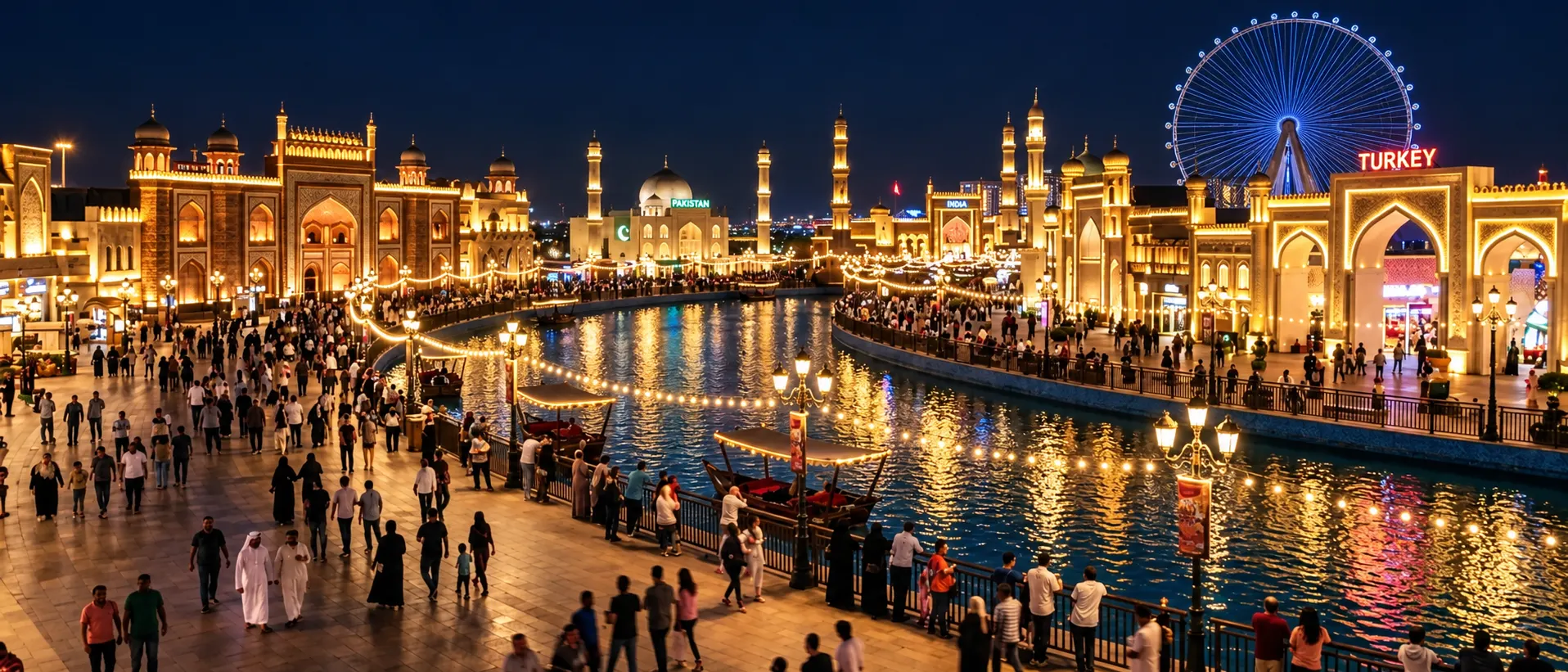
Walk a few minutes beyond the Arab pavilions and the evening changes quickly. Spices become tea, textiles change, music changes, street food changes, architecture changes. The most useful lesson is immediate: Asia is not one culture, and the faster Global Village lets us cross it, the more carefully we should notice the differences.
Asia Is Not the Next Pavilion. It Is Half the World.
After the Arab pavilions, it is tempting to say, “Now we go to Asia,” as if Asia were one culture waiting behind the next gate. It is not. India is not Japan. Afghanistan is not Thailand. Pakistan is not Korea. China is not Sri Lanka.
That obvious fact becomes useful at Global Village because the transitions are fast. In a few minutes, architecture, music, tea, spices, fabrics, sweets and street food can change completely. The compressed distance makes contrast visible.
Part II is less about collecting countries and more about noticing how quickly our assumptions fail.
India: Too Large to Fit, Useful Enough to Start a Conversation
The India pavilion presents palatial and temple-inspired architecture, music, dance, regional food, handicrafts, spices, tea, perfumes and textiles.
Of course India cannot fit inside one pavilion. That should almost be the first lesson. A country with enormous linguistic, religious, regional and culinary diversity will always be simplified when turned into one façade.
Smell the cardamom. Look at embroidery. Taste something. Then ask which part of India it comes from. That last question changes the whole experience.
Pakistan: Textiles, Food and the Question of Region
The Pakistan pavilion leans into Mughal, colonial and vernacular references, with a marketplace, regional food, textiles, leather and handicrafts. Again, the word Pakistani is only the first layer.
A shawl has a region. A spice mixture has a regional kitchen behind it. A sweet carries a city, family or celebration.
MESKI already has a small connection to Pakistan through our Pakistani Sidr Honey entry in the Honey Atlas. That does not turn the pavilion into a honey story. It simply reminds us that Sidr itself crosses borders farther than many Gulf buyers assume.
Afghanistan: A Country Often Reduced to Headlines
Afghanistan may be one of the most valuable stops precisely because many people know the country mainly through news.
The official pavilion description points toward historic architecture, carpets, wood and copper carving, pottery, spices, sweets, nuts and dry fruits. Those things do not erase the country’s difficulties. They restore dimensions that headlines often remove: craft, taste, skill, beauty and ordinary exchange.
A handful of nuts can sound trivial beside geopolitics. Yet food and craft are often how people remember continuity when politics makes everything look temporary.
Sri Lanka and Bangladesh: One Pavilion, Two Identities
A shared pavilion creates another useful question: how do two countries share a space without becoming one story?
Sri Lankan batik and Bangladeshi jute products sit beside hoppers, curries, biryani and roshogolla, with music and dance from both traditions.
When two cultures are presented together, ask which object belongs where. The answer is often more interesting than the display.
Thailand: When Food Becomes the Fastest Teacher
Thailand is one of those places where food can dominate memory. The pavilion combines Thai-inspired architecture with street food, costume, music and dance.
Sweet, sour, chilli, coconut, herbs and texture allow the palate to notice geography quickly. Food is not a complete cultural lesson, but one taste can make somebody curious about a country they had never considered visiting.
China: Tea, Craft and the Scale Problem Again
China creates the same problem as India on an even larger scale: how do you represent a civilisation and a country of that size in one pavilion?
The official page uses red pillars, dragons and pagoda-style forms, with dragon dance, Guzheng music, herbal teas and handicrafts. Those symbols are recognisable, perhaps too recognisable, which is why I would use them as entry points rather than conclusions.
If you taste a herbal tea, ask what it is. If you see a craft, ask where the style comes from. The more specific the question, the less the country becomes a stereotype.
Japan: The Pavilion Is Not Japan, and That Is Fine
Japan is an excellent place to repeat our rule: the pavilion is not the country.
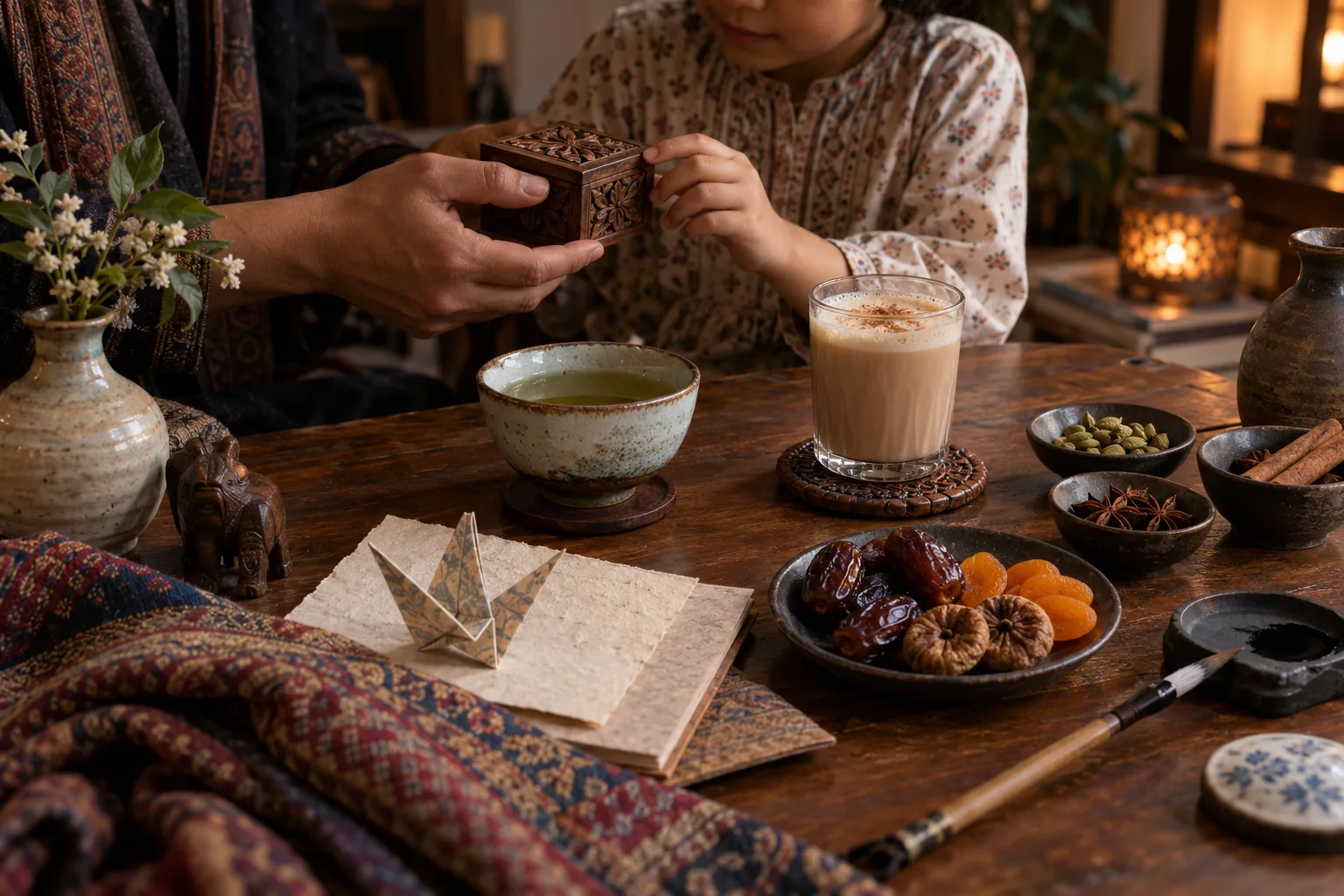
The official experience brings together a Torii gate, pagoda forms, Mount Fuji imagery, tea, calligraphy, kimonos, origami, snacks and pop-cultural references.
I would not go there to say I have discovered Japan. I would go to find one thing I did not know. Perhaps a tea, a craft technique, a word or a question about why a form is used. If one small detail survives the night, the pavilion has done enough.
Korea: Tradition Standing Beside Pop Culture
Korea makes the old-and-new contrast especially visible. Palace-inspired architecture and traditional dress can sit a few metres from K-beauty and K-pop merchandise.
Some people may see that as inconsistency. I think it is a useful picture of culture: countries do not stop having traditions because younger generations create new ones.
The question is not which Korea is real. Both can be real. The better question is how they speak to each other.
Tea Changes as We Walk East
In Part I, coffee, dates, mint tea and frankincense were recurring markers. In Asia, tea begins to change the map.
Indian tea culture, Chinese herbal teas, Japanese green tea and many regional preparations remind us that the same act—offering a hot drink—can carry different ingredients, rituals and meanings.
This is also why I resist making honey the hero of every pavilion. MESKI sells honey, yes, but forcing honey into Japan, Korea or Thailand would make the article worse. Sometimes the honest thread is tea. Sometimes it is fabric. Sometimes it is dance. Culture should lead; the product can follow when it genuinely belongs.
Where Honey Does Reappear
Honey traditions exist across Asia, but not every Global Village pavilion presents honey as a defining product. That distinction matters.
At MESKI, we are interested in origins such as Pakistani Sidr and in wider Asian honey traditions, yet the purpose of this walk is not to turn every country into a honey-selling opportunity.
If the subject interests you, the World of Sidr Honey explains how the Sidr story moves beyond Yemen and the Gulf. The pavilion walk should remain a cultural walk.
The Family Test: Did the Children Ask a Better Question?
For me, a successful family visit is not measured by how many pavilions we completed.
It is measured by the questions that come home with us. Why do people eat with chopsticks? Why are some teas green? Why are Afghan carpets famous? Why does Korean traditional clothing look different from Japanese clothing?
You do not need to answer everything on the spot. Saying “I don’t know, let’s look it up later” may be the most honest cultural lesson of the evening.
Shopping Without Turning Culture Into Merchandise
Global Village is a marketplace. Buying is part of the experience, and there is nothing wrong with that.
But use the same rule we use in a souq: ask what you are buying. Is the object made in the country represented by the pavilion? Is it handcrafted or mass-produced? Is the food genuinely connected to a regional tradition or simply themed for tourists?
A souvenir does not have to be museum-grade to make you happy. It just deserves an honest story. Our article on traditional gifts worth bringing home from Qatar follows the same principle: origin first, meaning second, price after that.
Global Village Works Best When You Leave Something Unfinished
The temptation is to cover everything. Pavilions, food, shows, rides, photos, shopping. That turns the evening into a race.
I prefer leaving with unfinished business. One pavilion I want to revisit. One tea I want to understand. One country I suddenly want to read about. One food the children keep talking about in the car.
That incompleteness is useful because real culture is inexhaustible. You should not be able to finish a country in thirty minutes.
Part II Verdict: The Faster the Walk, the More Slowly We Should Judge
Global Village compresses distance. It should not compress our judgment.
Walk from India to Pakistan, Afghanistan, Thailand, China, Japan and Korea. Enjoy how quickly the colours change. Then resist the urge to think those colours are the culture itself.
Taste, listen, ask, compare. If you cannot travel now, let this be an introduction. If you can travel later, let the pavilion become a note in your mind rather than a substitute.
Season 31 is scheduled for October 2026 to May 2027. The exact mix of pavilions, shops and shows evolves, so confirm the current programme before visiting.
And if you leave Global Village wanting to see one of these countries for real, that may be the best return on the ticket.
Questions People Ask About Global Village
Recent official pages include India, Pakistan, Afghanistan, China, Japan, Korea, Thailand and the shared Sri Lanka & Bangladesh pavilion. The exact seasonal mix can change.
It presents architecture, food, crafts and performances inspired by the countries represented, but every pavilion is a compressed commercial interpretation.
No. It can introduce tea, craft, visual references and popular culture, but it is a prompt for curiosity rather than a substitute for travel.
Use food, dress, music, tea, crafts and architecture to start questions. Children often remember sensory differences long after factual explanations.
Honey traditions exist across Asia, but not every pavilion presents honey as a central product. It is better to follow the culture honestly than force honey into every stop.
There is no ideal number. A slower visit to fewer pavilions often creates better conversations than trying to complete the whole park in one evening.
The official site states October 2026 to May 2027. Check current pavilion and show listings because details can change by season.
Continue the Journey
Asia cannot be finished in one evening. Keep following the countries, ingredients and honey origins that caught your attention.