
Arabian Lifestyle · History & Memory
The Gulf Before Oil
Was Not Empty
Oil changed the Gulf. It did not create it. Long before towers, highways and airports, people here were already crossing seas, following caravan routes, diving for pearls, tending oases and trading with worlds far beyond the horizon.
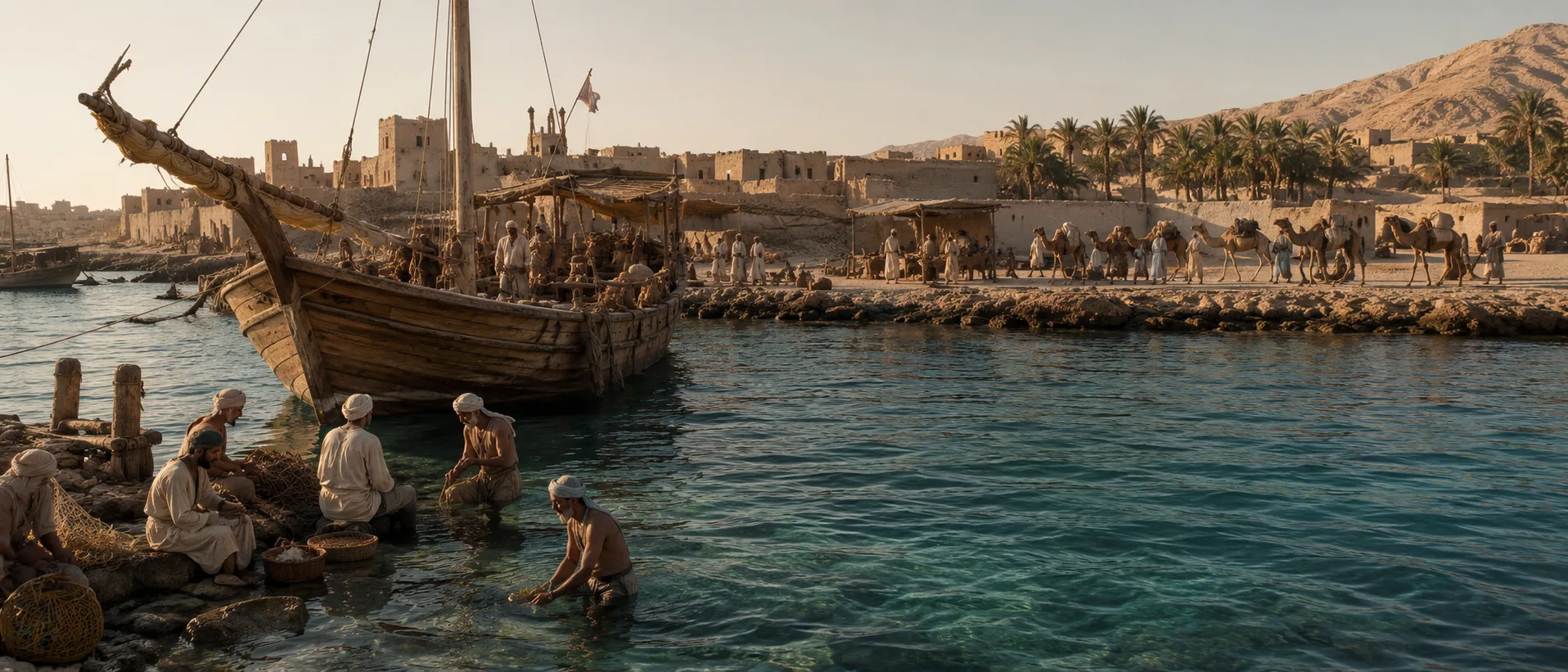
There is a sentence I hear too often when people speak about the Gulf:
Before oil, there was nothing.
I understand what people usually mean. They are comparing skylines, roads, airports, ports, hospitals, universities and the speed of modern development.
But the sentence is wrong.
Before oil, there were lives.
There were economies.
There were dangerous professions, seasonal rhythms, family systems, ports, markets, farms, boats, wells and routes that connected Arabia to India, East Africa, Persia and the Mediterranean world.
Oil changed the scale of everything.
It did not begin the story.
“Modern wealth can transform a country. It should never make us forget the kinds of wealth that existed before money arrived in abundance.”
Meskaoui
The Sea Was Already a Highway
When I look at the Gulf today, it is easy to think first of aviation. Dubai, Doha, Abu Dhabi and the great regional airports have made the Gulf one of the most connected places on earth.
But connection is not new here.
For centuries, the sea carried people, goods and knowledge between the Arabian Peninsula, India, Persia and East Africa. Wooden vessels moved along the coasts and across the Indian Ocean. Ports rose because geography gave them something valuable: a place between worlds.
That is why the story of the Gulf cannot be reduced to desert isolation. The desert was real. So was the sea. And the sea opened outward.
Qatar and the World Beneath the Water
In Qatar, pearling was not a decorative memory. It was work, risk and livelihood.
Visit Qatar describes generations of men leaving on difficult seasonal expeditions aboard wooden dhows, diving with simple equipment into the Gulf in search of natural pearls. The trade connected Qatar to India, Persia, the Ottoman world and later buyers much farther away.
The glamour came at the end, when a pearl reached a jeweller.
Before that came heat, salt, debt, uncertainty and lungs pushed to their limits.
That distinction matters. Heritage becomes shallow when we remember only the beautiful object and forget the human effort that produced it.
Dubai Was Trading Before It Was Shining
Dubai’s modern image is so powerful that it can hide the older logic of the city.
Before the skyline, Dubai was already a place of fishing, pearling and maritime commerce. Deira and the Creek were not historical decorations. They were part of the machinery of everyday economic life.
Visit Dubai records the growth of pearling and maritime business in the late nineteenth century and the arrival of traders from abroad long before oil was discovered in Dubai in 1966.
This is one reason I enjoy walking through old Dubai so much. The lanes, the creek, the small shops and the trading atmosphere are not an imitation of the past built after the fact. They sit on top of an older commercial instinct.
Oman Looked Far Beyond Arabia
Oman makes the idea of an isolated pre-oil Gulf especially difficult to defend.
Its maritime history stretches across the Indian Ocean. Omani ports and sailors participated in networks linking Arabia with East Africa, India and beyond. The story of Sayyida Salme, born in Zanzibar into the house of Sultan Said bin Sultan, is itself evidence of how broad that Omani world once was.
The same is true on land.
Frankincense from Dhofar moved through a network of production zones, caravan stations and ports. UNESCO’s Land of Frankincense includes Wadi Dawkah, Shisr, Khor Rori and Al-Baleed, places that together show how a resin collected in southern Oman entered trade systems of the ancient and medieval world.
A small tear of resin could travel farther than many people ever would.
Saudi Arabia Was Crossed by Routes, Not Emptiness
On the western side of the Peninsula, caravan and maritime routes carried incense, spices, textiles and precious materials.
Visit Saudi traces the long history of the incense route and the sea routes that linked Red Sea ports with wider commercial networks. Places grew around movement. Caravans needed water, food, security and markets. Ports needed warehouses, merchants, craftsmen and people able to speak across cultures.
Trade does more than move objects.
It moves words, recipes, techniques, clothing, stories and habits.
That is one reason the food of Arabia can feel deeply local while also carrying echoes from India, East Africa, Persia and the Levant.
And Inland, Life Followed Water
The sea should not make us forget the interior.
Across Arabia, where water could be found and managed, communities cultivated dates, grains and other crops. Oases were not romantic green spots placed in the desert for travellers to photograph. They were systems of survival.
A palm grove meant shade, fruit, fibre and agriculture beneath the canopy. A well could determine where a family lived. Irrigation knowledge could be the difference between abundance and loss.
This is something I understand personally from Meski. Water changes the meaning of land. When you grow up around an oasis, a palm is never only a palm and a well is never only a hole in the ground.
That is why I resist histories that look only at rulers, oil concessions and modern construction. Everyday infrastructure existed long before concrete.
The Old Gulf Was Not One Gulf
Another mistake is to flatten the region into a single story.
Qatar’s relationship with pearling was not identical to Oman’s oceanic history. Dubai’s Creek economy was not the same as the caravan routes of western Arabia. Mountain communities, coastal settlements, Bedouin groups and oasis towns lived according to different geographies.
Even when people shared coffee, dates, Islam, Arabic language or similar forms of hospitality, the details changed.
That difference is not a problem to solve. It is the richness of the region.
Then Oil Arrived, and Time Accelerated
None of this requires us to minimise what oil did.
Oil revenues transformed infrastructure, health, education, housing, transport and the ability of Gulf states to build at an extraordinary pace. Entire cities changed within the memory of living generations.
That transformation deserves to be studied on its own terms.
But there is a difference between saying, “Oil transformed the Gulf,” and saying, “Oil created the Gulf.”
The first is history.
The second erases history.
Why This Matters Now
I do not write about the past because I want the Gulf to return to it.
I enjoy the modern Gulf too. The roads, the malls, the airports, the restaurants, the ease of movement, the mixture of people from everywhere.
But modernity becomes more meaningful when we know what stood underneath it.
An abra across Dubai Creek becomes more than a cheap boat ride.
A pearl in Doha becomes more than jewellery.
Frankincense in Oman becomes more than a pleasant smell.
A spice market in Jeddah becomes more than a colourful photograph.
Each object opens a door.
And behind that door is a Gulf that was never empty.
The Gulf Before Oil
Livelihoods varied by place and included pearling, fishing, maritime trade, caravan commerce, agriculture, date cultivation, animal husbandry, crafts and local markets. Coastal, oasis, mountain and desert communities did not all live the same way.
Yes. Pearling was an important source of income in several Gulf communities, especially Qatar and parts of what are now the UAE and Bahrain. The work was seasonal, dangerous and connected to international trade.
Yes. Arabian ports and caravan routes connected the Peninsula with India, East Africa, Persia, the Mediterranean and wider Asian trade networks. Goods moved together with ideas, foods, technologies and cultural influences.