
Arabian Lifestyle · Saudi Arabia
The Traditional Markets of Riyadh and Jeddah:
What the Mall Cannot Replace
Souq Al Zal and Historic Al-Balad are not relics of one generic past. They carry two different Saudi stories of commerce, movement and memory.
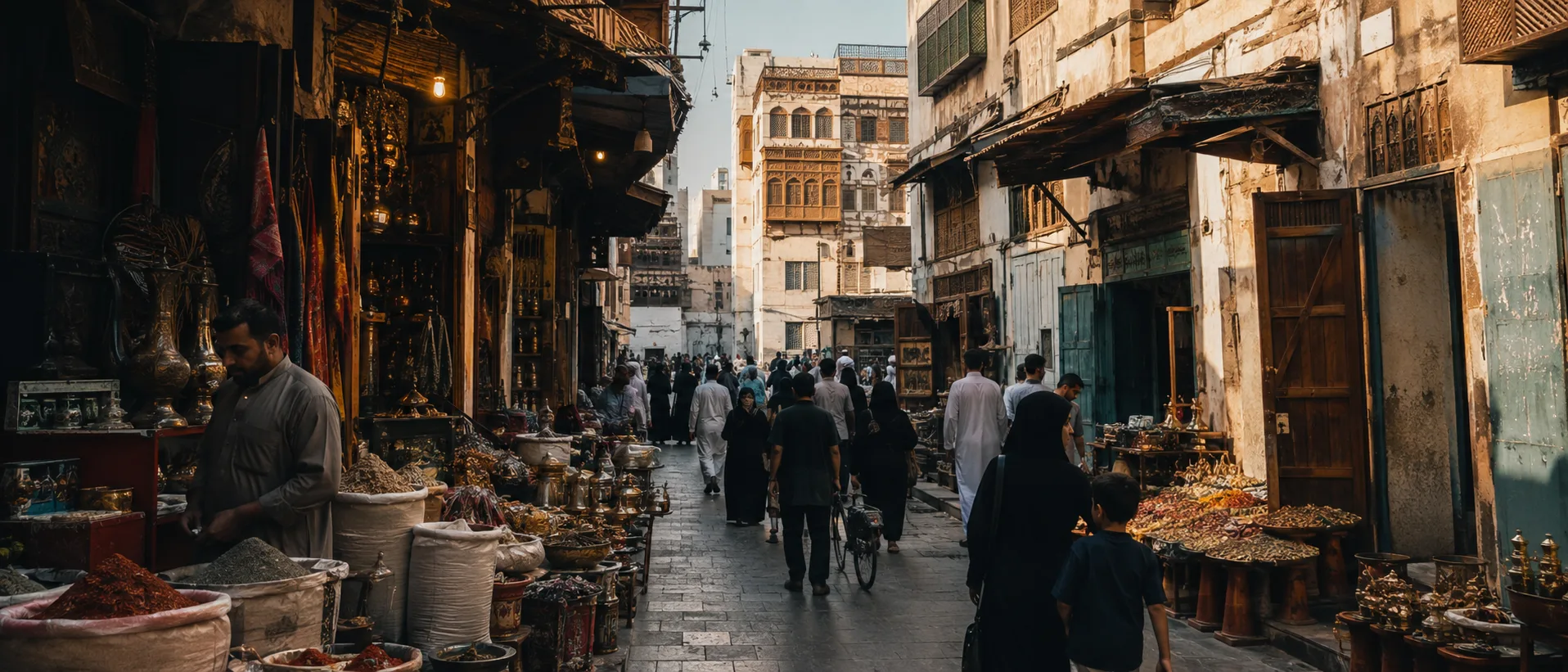
A mall can give you comfort, choice, air-conditioning, restaurants and almost every international brand you can name.
A traditional market gives you something else.
It gives you accumulation.
Objects that have passed through hands. Shops that specialise in one thing. Smells that do not stop at the edge of a store. Streets shaped before anyone had to design a customer journey.
Riyadh and Jeddah both have old markets, but they do not tell the same story.
Riyadh: Souq Al Zal and the Memory of the Inland City
Visit Saudi describes Souq Al Zal as Riyadh’s oldest market. It sits close to the historic heart of the capital and is associated with antiques, carpets, traditional goods, perfumes, spices and the sound of auctions.
The name itself is often connected with floor coverings and carpets, but the interest of the souq goes beyond one product category. It is the density of old objects and specialised knowledge that matters.
In a place like this, asking a seller a question can be more valuable than reading ten labels. What region is this from? How old is it? What material? Is it handmade? What makes one piece better than another?
Traditional markets reward curiosity because the merchandise often needs explanation.
Jeddah: The Market Belongs to a Port Story
Jeddah is different because its old city grew in conversation with the Red Sea.
UNESCO describes Historic Jeddah as a major port on Indian Ocean trade routes from the seventh century and as a gateway for pilgrims travelling to Makkah by sea. Goods, people, languages and ideas arrived through the same urban fabric.
The souqs of Al-Balad therefore make sense as part of a trading city rather than as decorative additions to a heritage district.
UNESCO still describes Historic Jeddah as a living commercial environment, with traditional souqs, small cafés, popular restaurants and street-food vendors. That word living matters to me.
Souq Al Alawi, Souq Al Nada and the Pleasure of Narrow Streets
Visit Saudi itineraries continue to point visitors toward Al Alawi market in Historic Jeddah, while Souq Al Nada remains another recognised market inside the old city.
But I would avoid treating the experience as a race between named attractions.
The value of Al-Balad comes from moving through the whole urban fabric: roshan-covered façades, old houses, mosques, food, small commerce and streets that still carry the scale of an older city.
Sometimes the market is not one building. It is the way an entire district behaves.
What Can You Actually Look For?
In Riyadh, traditional carpets, antiques, incense, perfume, spices and heritage objects naturally attract attention. In Jeddah, the Red Sea trading history makes the mix feel broader and more cosmopolitan.
The important warning is the same in both cities: old-looking is not the same as old, and traditional-looking is not proof of local manufacture.
If you are buying an antique or expensive craft, ask for provenance. If you are buying a simple object because you like it, enjoy it without inventing a history it does not have.
A Market Preserves Skills That a Price Tag Cannot Explain
The strongest traditional markets are not valuable only because of their architecture.
They preserve ways of judging material. How a carpet is woven. How incense is selected. How a metal object was worked. How a spice should smell. How an old piece is repaired rather than thrown away.
Those skills survive through conversation and repetition.
That is why a market can disappear even when the buildings remain. If the specialised knowledge leaves, the façades alone cannot replace it.
Why I Do Not Put the Mall and Souq in Competition
I enjoy Gulf malls too. They serve another purpose.
Families meet there. People eat, walk, cool down, watch films, buy what they need and spend time together. Modern commerce is also part of contemporary Saudi life.
The traditional souq is not better because it is older. It is irreplaceable because it carries a different kind of information.
The question is not whether Riyadh or Jeddah should choose between old and new.
It is whether both forms can remain legible.
Two Cities, Two Market Memories
Souq Al Zal speaks to Riyadh’s old commercial core and the material culture of an inland capital.
Historic Jeddah speaks to a Red Sea port where trade and pilgrimage brought people together from Africa, Asia and the wider Middle East.
Put them under the single label traditional market and you miss the best part.
A market is not only where a city sells things.
It is where you can sometimes see how the city learned to become itself.
Questions People Ask
Visit Saudi describes Souq Al Zal as Riyadh’s oldest market. It is known for traditional goods, antiques, carpets, perfumes, spices and auction culture.
Historic Al-Balad contains long-established commercial streets and souqs. Visit Saudi highlights markets such as Souq Al Nada and Al Alawi within the wider historic district.
UNESCO recognises it as a historic Red Sea port and gateway to Makkah whose trade and pilgrimage roles helped create a multicultural urban and commercial culture.
No. Their character varies, but UNESCO specifically describes Historic Jeddah as a living urban environment with ongoing retail, cafés, restaurants and traditional souq activity.