
Arabian Lifestyle · Saudi Coffee
Saudi Coffee:
Meaning, Etiquette and the Pleasure of Finding Your Own Blend
A small finjan can carry agriculture, regional identity and hospitality. Then I go home, mix my own beans, forget the recipe and begin again.
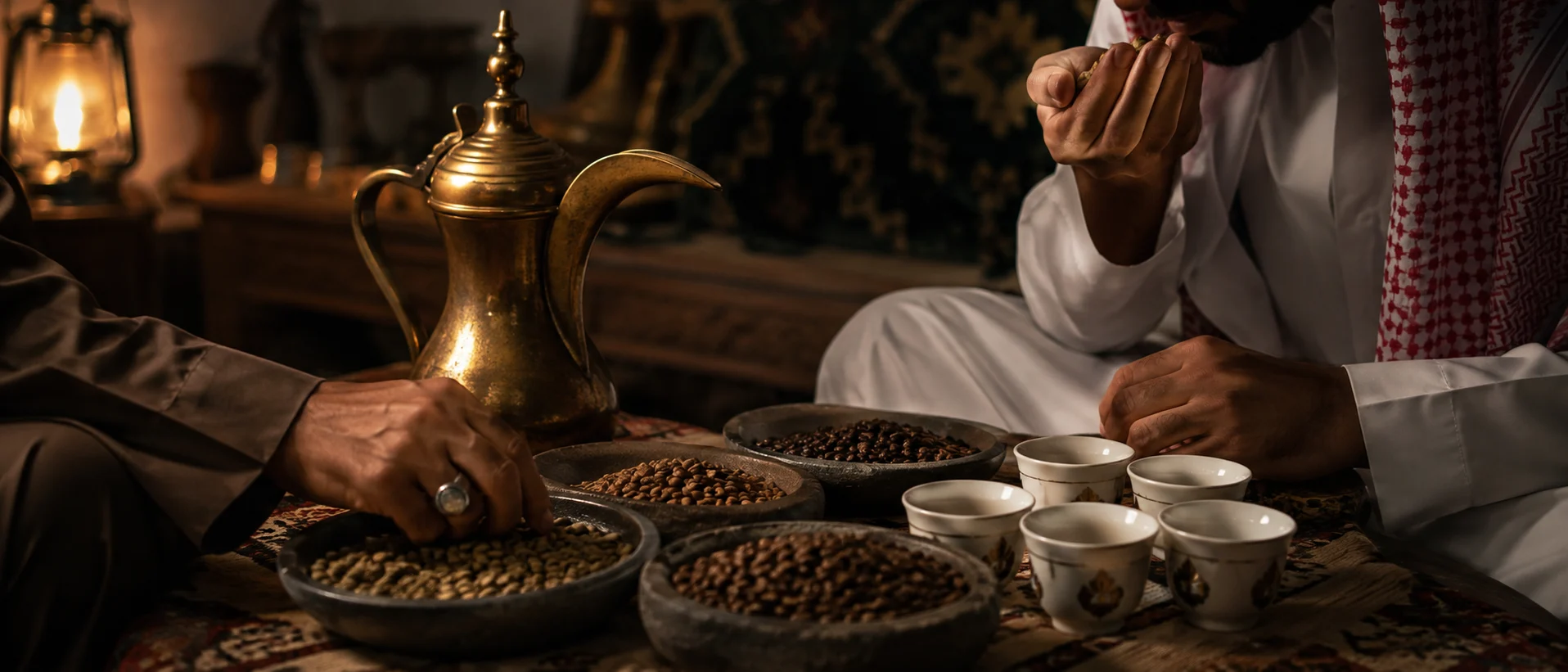
I have a bad habit with coffee.
I mix origins.
I taste. I change the percentage. I add a little more of one bean, less of another, roast or grind differently, and sometimes I create a cup I genuinely love.
Then I realise I did not write anything down.
I have forgotten the percentage. Sometimes I am not even completely sure which origins I combined.
So I start again.
It is frustrating for about thirty seconds. Then it becomes fun, because the next cup can surprise me again.
Before My Experiments, There Is a Tradition Much Older Than Them
My home blending is personal. It is not a traditional Saudi recipe, and I would never present it as one.
Saudi coffee has its own deep cultural meanings, methods and regional differences. Saudi Arabia’s Ministry of Culture has highlighted coffee as a symbol of generosity, hospitality and cultural identity, with preparation varying across the Kingdom’s thirteen regions.
That diversity is important. There is no single cup that can represent every Saudi household, region or occasion.
Coffee Is Served as a Relationship
UNESCO’s inscription of Arabic coffee as a symbol of generosity includes Saudi Arabia, the UAE, Oman, Qatar and Jordan. The practice is described not simply as a drink but as a daily social ritual tied to hospitality.
There are recognised gestures. Older people and guests are served first. Coffee is poured with the right hand. A guest may gently shake the finjan to indicate that they have finished.
The cup is small because hospitality is not measured by one enormous serving. Attention continues through repeated pours.
The person serving watches the guest. That is part of the ritual.
Khawlani Coffee Adds the Story of the Land
Saudi coffee is not only about imported beans being transformed through local preparation.
In the mountainous southwest, Khawlani coffee has been cultivated for generations. UNESCO inscribed the knowledge and practices related to cultivating Khawlani coffee beans in 2022.
The nomination describes hand harvesting, drying, traditional processing and more than three hundred years of knowledge passed through communities. It also notes that serving guests coffee grown on one’s own farm is considered a sign of honour and respect.
That changes the meaning of the cup again. The drink can carry agriculture, family knowledge and hospitality at the same time.
Why Saudi Coffee Does Not Taste the Same Everywhere
The Ministry of Culture emphasises that preparation changes across Saudi Arabia’s regions. Roast colour, spice, strength and serving habits can differ.
Cardamom is strongly associated with Arabic coffee, while saffron, cloves and other aromatics may also appear depending on region and household. UNESCO’s documentation of Arabic coffee shows ingredients such as cardamom, saffron, cloves and rose water within the wider tradition.
This is why I prefer saying Saudi coffee traditions rather than pretending there is one immutable formula.
Tradition can be precise without being uniform.
Then I Go Home and Complicate Everything
This is where my own curiosity begins.
I like buying different coffee origins and combining them. Sometimes I want more body. Sometimes more fragrance. Sometimes I am trying to keep one origin present without letting it dominate.
And yes, I have made blends I loved and then completely failed to reproduce because I forgot what I had done.
So I make another.
There is something pleasant in that failure. A recipe I lost forces me to pay attention again rather than turning taste into a fixed formula.
“Some of my best cups of coffee exist only in memory, because I forgot to write down what I put in them.”
Meskaoui
Personal Blending and Traditional Coffee Are Not Opposites
I do not think respecting a tradition means being forbidden from experimenting in your own kitchen.
The important thing is to name the difference.
If I prepare a recognised Saudi style, I should respect the method and context I am learning from. If I combine beans from different origins because I am curious, that is my own blend.
Confusion begins when personal invention is marketed as ancient authenticity.
Curiosity is better when it remains honest.
How to Taste Saudi Coffee With More Attention
Do not begin only by asking whether you like it.
Notice the roast. The colour. The aroma before the first sip. Which spice reaches you first? How sweet or dry does the cup feel? What is served beside it? Dates? Sweets? Nothing?
Then notice the service itself.
Who pours? In what order? How small is the cup? How quickly is it refilled? Those details tell you why coffee belongs to hospitality rather than only caffeine.
The Cup Is Small. The Culture Around It Is Not
Coffee can be agriculture, trade, roasting, spice, hospitality, memory and personal taste at once.
That is why I never get bored of it.
Even when I forget the recipe.
Questions People Ask
Saudi coffee refers to coffee traditions across Saudi Arabia, where preparation, roast, spices and serving customs vary by region. It is strongly associated with hospitality and generosity.
Khawlani coffee is cultivated in southwestern Saudi Arabia. UNESCO inscribed the knowledge and practices related to its cultivation on the Representative List of Intangible Cultural Heritage in 2022.
UNESCO documents practices including serving older people and guests first, pouring with the right hand and shaking the cup to signal that no more coffee is wanted. Household and regional customs can vary.
No. His blending experiments are a personal hobby described separately from documented Saudi coffee traditions.