
Arabian Lifestyle · Scent & Memory
The Smell of Arabia
Oud, Bakhoor, Frankincense and Memory
Some places stay in the mind as an image. Others return first as a smell.
I can leave a perfume shop and still carry it with me hours later.
The scent sits on the sleeve.
On the wrist.
Sometimes in the car.
Then another day, far from the shop, I smell something similar and suddenly I am back there.
This is one of the things I love about fragrance in the Gulf.
It does not always stay inside a bottle.
It enters rooms, clothes, gatherings and memory.
“A photograph waits for us to look at it. A scent can bring a place back before we have time to prepare.”
Meskaoui
First, They Are Not the Same Thing
Oud, bakhoor and frankincense are often placed together in travel writing because all three belong to the fragrant world of the region.
But they should not be confused.
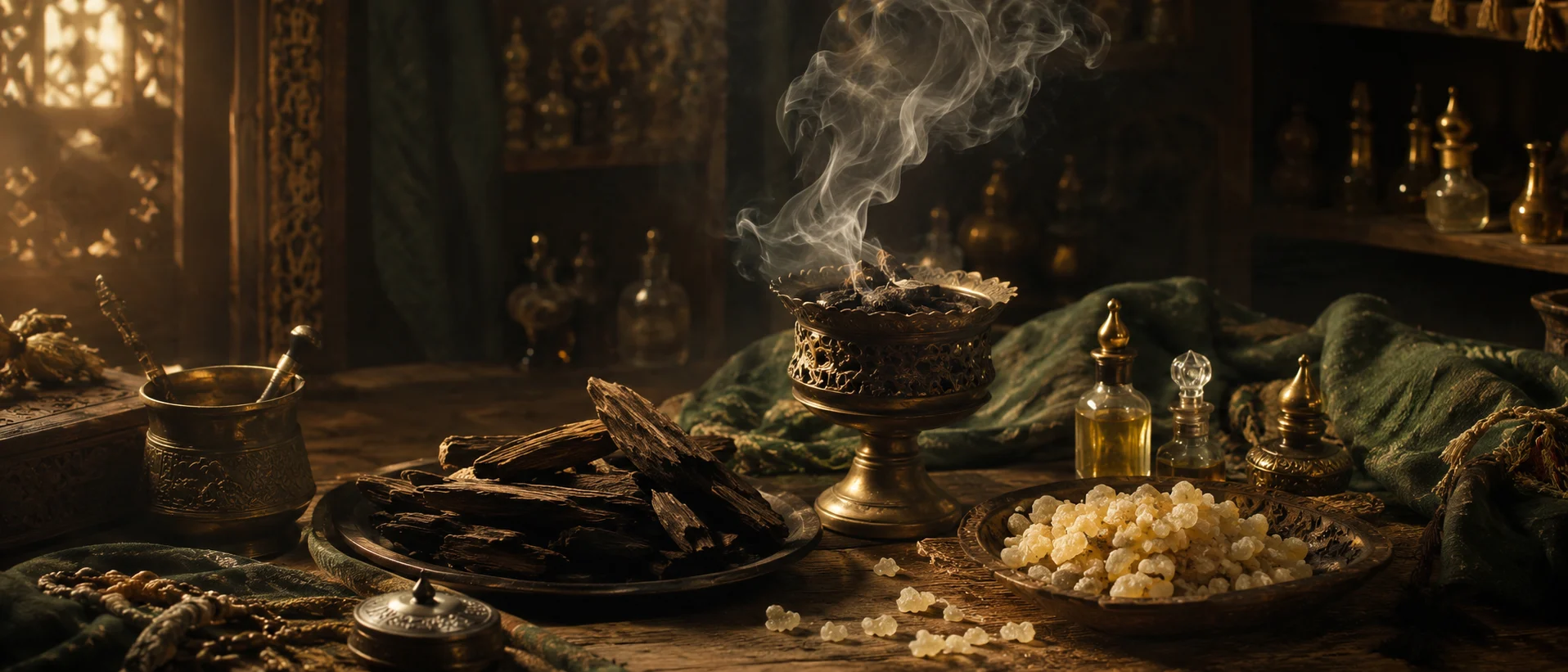
Oud comes from resin-rich agarwood, associated with trees of the Aquilaria genus. It may be burned as wood or transformed into oils and perfumes.
Bakhoor is a broader incense preparation, commonly made from scented wood chips or powders blended or infused with perfume materials such as oud, musk, rose, sandalwood, resins and spices.
Frankincense is a different resin entirely, strongly associated with Boswellia trees and, in Arabia, especially with Dhofar in southern Oman.
The smells can meet in the same world without having the same origin.
Why Oud Feels So Personal
I enjoy perfume shops where the conversation starts before the sale.
You explain what you like. Something woody. Something warm. Maybe less sweet. Maybe darker. Maybe a note that stays close to the skin instead of announcing itself across the room.
Then the testing begins.
This is where perfume becomes interesting to me. The same oud can feel completely different once it meets rose, amber, musk or other materials.
A fragrance can be traditional in vocabulary and entirely personal in proportion.
Bakhoor Makes a Room Smell Occupied
Bakhoor is different because its natural territory is not only the body.
It belongs to space.
Visit Qatar describes it as part of hospitality and daily ritual, used to scent homes, clothing and gatherings. A mabkhara carrying smouldering bakhoor may be passed among guests so the fragrance catches on fabric and hair.
This is the kind of detail that changes the meaning of scent.
The smell is no longer only “what perfume are you wearing?”
It becomes “someone prepared this room before you arrived.”
Frankincense Belongs to Another Geography
Then Oman changes the story again.
In Dhofar, frankincense is not merely an ingredient imported into a perfume culture. It grows from the land itself.
UNESCO’s Land of Frankincense links the trees of Wadi Dawkah with caravan and port sites including Shisr, Khor Rori and Al-Baleed. Together they show how the resin was produced and moved through trade systems for centuries.
That gives Omani frankincense a particular depth for me.
You can hold a small piece of resin in your hand and know that this humble material once justified routes, ports, negotiations and long-distance trade.
A Souq Teaches the Nose Differently
Modern perfume boutiques are beautiful, but I still enjoy wandering through older commercial districts.
In places like Deira, fragrance competes with everything else around it.
Spice shops. Food. Heat. Fabric. Street air. Smoke. Cardboard boxes. Tea.
Then you step into a perfume shop and the sensory world changes again.
I like that movement because the fragrance remains connected to a place instead of being isolated inside a perfect luxury environment.
The Same Scent Does Not Mean the Same Thing Everywhere
It is tempting to speak of “Arab perfume culture” as one uniform tradition.
That is too simple.
Oud and bakhoor are widely appreciated across the Gulf, but households have their own preferences. Countries have different commercial traditions. Families use scent differently. The relationship between frankincense and daily life is especially distinctive in Oman because of Dhofar’s production history.
Even one person changes over time.
A fragrance you found too strong five years ago can suddenly feel comforting.
Perfume Is Also a Way of Remembering People
This may be the strongest part.
We often remember people through what they wore.
A father’s cologne.
A grandmother’s room.
The smell of clean clothes after bakhoor.
Incense during a gathering.
A perfume someone used so consistently that years later a stranger can walk past wearing something similar and disturb your whole afternoon.
Memory is not always polite enough to ask permission.
Why I Would Bring Scent Home
When people ask what to buy in the Gulf, perfume often appears on the list.
It deserves to.
But I would not choose it only because oud is expensive or because a bottle looks luxurious.
I would choose something that reminds me of where I smelled it.
A small bottle can do what a large souvenir sometimes cannot.
Open it months later and the journey starts again.
Oud, Bakhoor and Frankincense
No. Oud refers to fragrant resin-rich agarwood and products made from it. Bakhoor is an incense preparation that may contain oud but can also include other woods, oils, resins, spices and floral materials.
No. Frankincense is a resin from Boswellia trees. Oud comes from resinous agarwood associated with Aquilaria trees. Their botanical origins and scent profiles are different.
Dhofar in southern Oman has a long history of frankincense production and trade. UNESCO’s Land of Frankincense preserves both natural and archaeological sites connected to that history.