
Before one Arabian capital became dominant, another oasis city stood in real competition. Ha’il ruled routes, welcomed caravans and shaped the politics of northern Arabia.
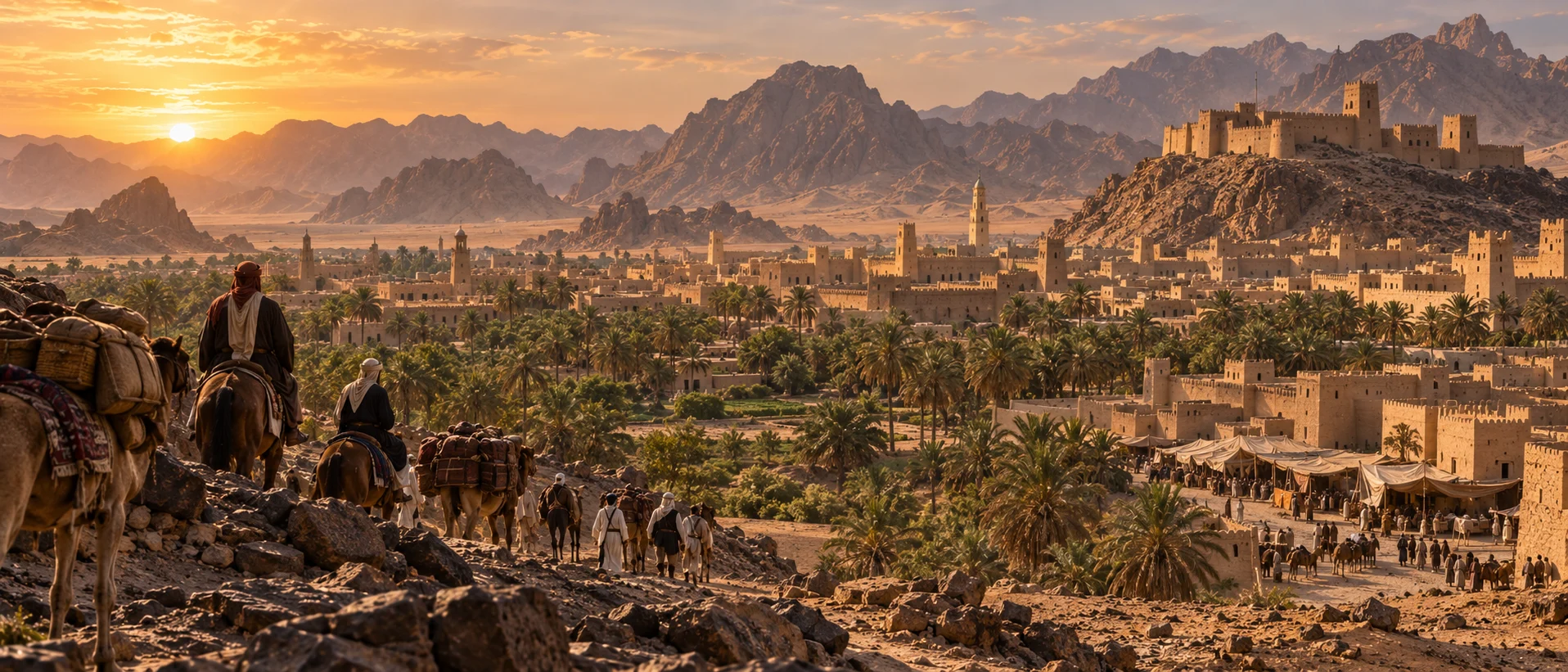
The more I explore Arabia, the more I realise how many powerful places disappeared from mainstream memory without truly disappearing from the land. Ha’il is one of them. Long before most people reduced Arabian history to one inevitable capital, Ha’il stood as the seat of Jabal Shammar, an emirate that rivalled Riyadh and shaped the routes, politics and hospitality of northern Arabia.
Before Ha’il Was a Regional Capital, It Was an Oasis of Passage
Ha’il makes sense only if we begin with geography.
It sits between mountain ridges and the sands of northern Arabia, looking both toward the Nafud and toward the roads that linked Iraq and Syria to the Arabian interior and, farther on, the Hijaz.
Long before it became the seat of the Al Rashid rulers, the region mattered because movement passed through it: caravans, pilgrims, merchants, herds and news.
That is why Ha’il’s history feels larger than its skyline.
It is not only a city story. It is a story of routes.
The Landscape Already Carried a Deep History
The UNESCO inscription for the Rock Art in the Hail Region reminds us that human movement through this landscape is far older than the nineteenth century.
Jubbah and Shuwaymis preserve rock art and inscriptions that testify to thousands of years of passage, water, hunting, settlement and adaptation in this part of Arabia.
That does not make the Emirate of Jabal Shammar ancient in a direct political sense.
But it does place Ha’il inside one of Arabia’s old corridors of life, long before Riyadh and long before modern Saudi borders.
When a later emirate rose here, it did not rise on empty ground.
Who Were the People of Jabal Shammar?
The name Jabal Shammar refers both to the mountain region around Ha’il and to the wider political emirate ruled from there in the nineteenth and early twentieth centuries.
The people and tribal landscape were never simple, but the region became strongly associated with the Shammar confederation and, politically, with the Al Rashid dynasty of Ha’il.
This matters because the emirate was not merely a provincial town administration.
For decades it was a real Arabian power, with military reach, political ambition and the ability to challenge the Al Saud project centred in Riyadh.
Why Ha’il Could Rival Riyadh
We sometimes read Arabian history backwards, as if Riyadh had always been destined to dominate Najd.
It was not.
In the nineteenth century the struggle for central and northern Arabia was open, and Ha’il had several advantages: a strategic oasis position, caravan connections, strong tribal alliances and rulers who understood both hospitality and hard politics.
Ha’il could provision travellers, host delegations, tax movement and project force.
A place that commands routes can sometimes rival a place that commands only its immediate hinterland.
The Rise of the Al Rashid
The Emirate of Jabal Shammar emerged in the 1830s under Abdullah bin Ali Al Rashid, and Ha’il became its centre.
From there the Al Rashid family expanded influence across a large part of northern and central Arabia.
In later decades their power grew enough for Ha’il to become one of the most important political seats on the peninsula outside the Hijaz.
From Meski’s perspective, what interests me most is not simply dynasty.
It is the feeling that an inland oasis became a court, a market and a strategic crossroads all at once.
Power in Arabia Was Also About Hospitality
This may sound surprising if we imagine politics only as war.
But in a caravan world, hospitality was part of power.
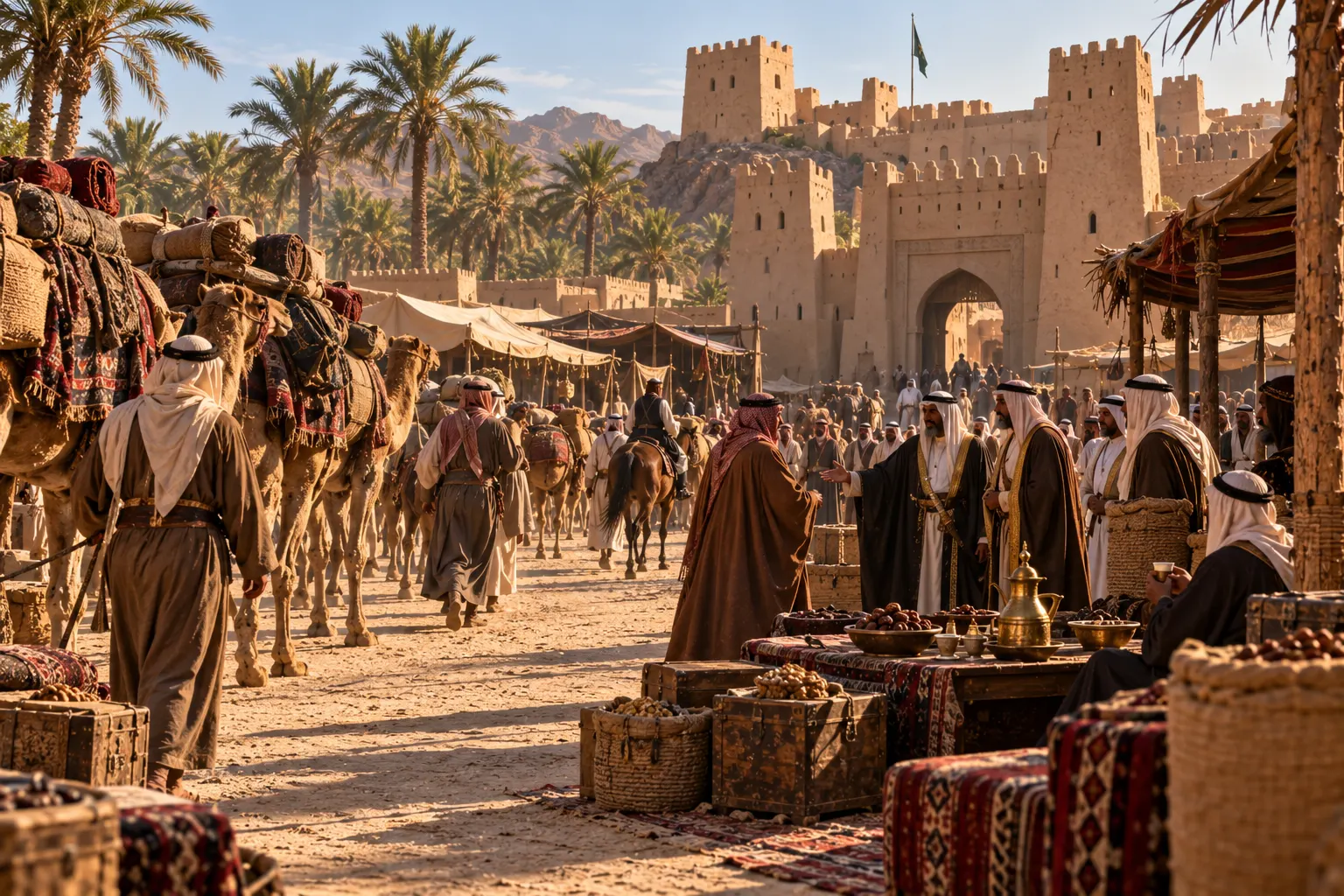
A city known for receiving guests, feeding travellers, sheltering merchants and treating emissaries properly gained reputation as well as allies.
That is why our article What Was Served When a Stranger Arrived? speaks so naturally to Ha’il too.
Coffee, bread, dates, meat, shelter and conversation were not decorative gestures. They were tools of civilised authority.
Ha’il and the Pilgrim Roads
Ha’il was also tied to the movement of pilgrims crossing northern Arabia toward the holy cities.
Not every hajj caravan followed the same path at every time, and the history of the great routes is complex, but the region’s strategic relevance was inseparable from movement toward the Hijaz.
Readers who enjoyed our Road to Makkah piece will recognise the same logic here.
Before highways, the politics of the Arabian interior were shaped by who could make difficult journeys possible.
The Court of Ha’il Was Not Provincial
Descriptions of Rashidi Ha’il by travellers often carry a tone of surprise.
They expected a remote desert seat and found a place of order, horses, armed retainers, guests, negotiation and ceremony.
The emirate’s rulers cultivated an image of authority that belonged to a serious court, not a dusty outpost.
Ha’il was famous for horses, for martial strength and for a political culture that combined desert severity with the obligations of reception.
That is one reason the city lingers in memory even when modern narratives move quickly from Najd to Riyadh.
The Rivalry With the Al Saud
The phrase rivalled Riyadh is not a metaphor.
For decades the Rashidi emirate and the Al Saud cause stood against one another in the struggle for dominance in Najd and beyond.
After Ibn Saud retook Riyadh in 1902, the contest did not disappear overnight.
Ha’il remained a major centre of resistance and political weight until Ibn Saud finally incorporated the emirate in 1921.
So if we want to understand Saudi unification, we have to admit that the story had another powerful capital for a very long time.
Ha’il Was More Than a Military Opponent
Reducing Jabal Shammar to ‘the people who lost to Riyadh’ would be unfair.
It had its own urban life, caravan economy, agricultural base and distinctive prestige.
Ha’il was a place where merchants passed, grain and livestock circulated, and mountain-oasis life produced a recognisable rhythm.
Even conflict itself depended on logistics, routes and food.
No emirate fights or hosts without wells, palms, storage, markets and trust.
A’arif Fort and the Overlook of Authority
Today, when people think of historic Ha’il, places like A’arif Fort help visualise the older city.
The fort’s commanding height captures something essential about the political imagination of the place.
To look over Ha’il was to look over an oasis that mattered.
Authority in such a setting was never abstract.
It watched roads, guarded approaches and understood that movement was wealth.
The Mountains Gave the Emirate Its Name
Jabal Shammar was not called that by accident.
The mountains around Ha’il are part of the city’s identity, shaping climate, orientation and memory.
An oasis city ringed by striking terrain always acquires a stronger sense of enclosure and defence.
That setting gave Ha’il drama.
Unlike Riyadh’s flatter urban image, Ha’il feels framed by stone and route at the same time.
What Survives After a Political Capital Falls
The Emirate of Jabal Shammar ended politically in 1921, but places do not vanish when dynasties do.
The memory survives in forts, routes, poetry, hospitality, horses and in the fact that many Saudis still recognise Ha’il as a city with strong character rather than a footnote.
The Rashidi state disappeared, yet its emotional geography remained.
Sometimes the most interesting historical capitals are not the ones that won forever, but the ones that remind us history could have gone another way.
Why This Story Matters to Meski
I like stories that rescue a landscape from a single narrative.
People hear Arabia and think of capitals already fixed, frontiers already decided and roads already drawn.
But before modern highways and modern states, cities competed through wells, caravans, alliances and welcome.
Ha’il fits beautifully into that world.
It belongs with our wider Meski line of articles about roads, ports, hospitality and the forgotten places that helped shape what came later.
Suggested Links Inside the Arabian Story
If you want to continue through that wider world, move next to Road to Makkah for the long difficulty of pilgrimage, then to The Day an Airplane Landed in the Desert for a later turning point in Arabian mobility, and finally to What Was Served When a Stranger Arrived? for the etiquette that made these journeys more human.
Meski makes most sense, I think, when all these roads begin speaking to each other.
When Ha’il Rivalled Riyadh
Ha’il deserves to be remembered not as a side note to Riyadh, but as a city that once stood in real competition with it.
It guarded routes, received travellers, cultivated authority and gave northern Arabia a political centre of its own.
For a time, the future of the region did not point in only one direction.
That is exactly why the Emirate of Jabal Shammar remains so fascinating.
It reminds us that history is fuller when we remember the capitals that did not become the final capital.
Questions People Ask
A nineteenth- and early twentieth-century Arabian emirate ruled by the Al Rashid dynasty from Ha’il.
Because it stood at a strategic oasis crossroads and became the political centre of a powerful rival to the Al Saud state in Riyadh.
Yes. For decades the Rashidi emirate of Ha’il and the Al Saud cause competed for dominance in Najd and northern Arabia.
It emerged in the 1830s under Abdullah bin Ali Al Rashid.
The emirate was incorporated by Ibn Saud in 1921.
No. It was also an oasis city of hospitality, markets, caravan movement and regional prestige.
Its strategic location tied it to routes and movement across northern Arabia toward the Hijaz.
Historic landmarks include A’arif Fort and the wider Hail region, which is also known for UNESCO-listed rock art sites.
Because it fits Meski’s wider heritage line about roads, hospitality, forgotten capitals and the worlds that existed before modern highways and states.
Continue Through Arabia’s Roads and Houses of Welcome
Ha’il belongs to a larger Meski map: pilgrims, forts, guests, roads and the long story of how Arabia connected distant people before modern travel changed everything.