
Dubai offers an extraordinary selection of honey from the UAE, Yemen, Oman, Morocco, Europe and beyond. The real challenge is not finding an expensive jar—it is recognising honey whose quality, origin and character genuinely justify its presentation.
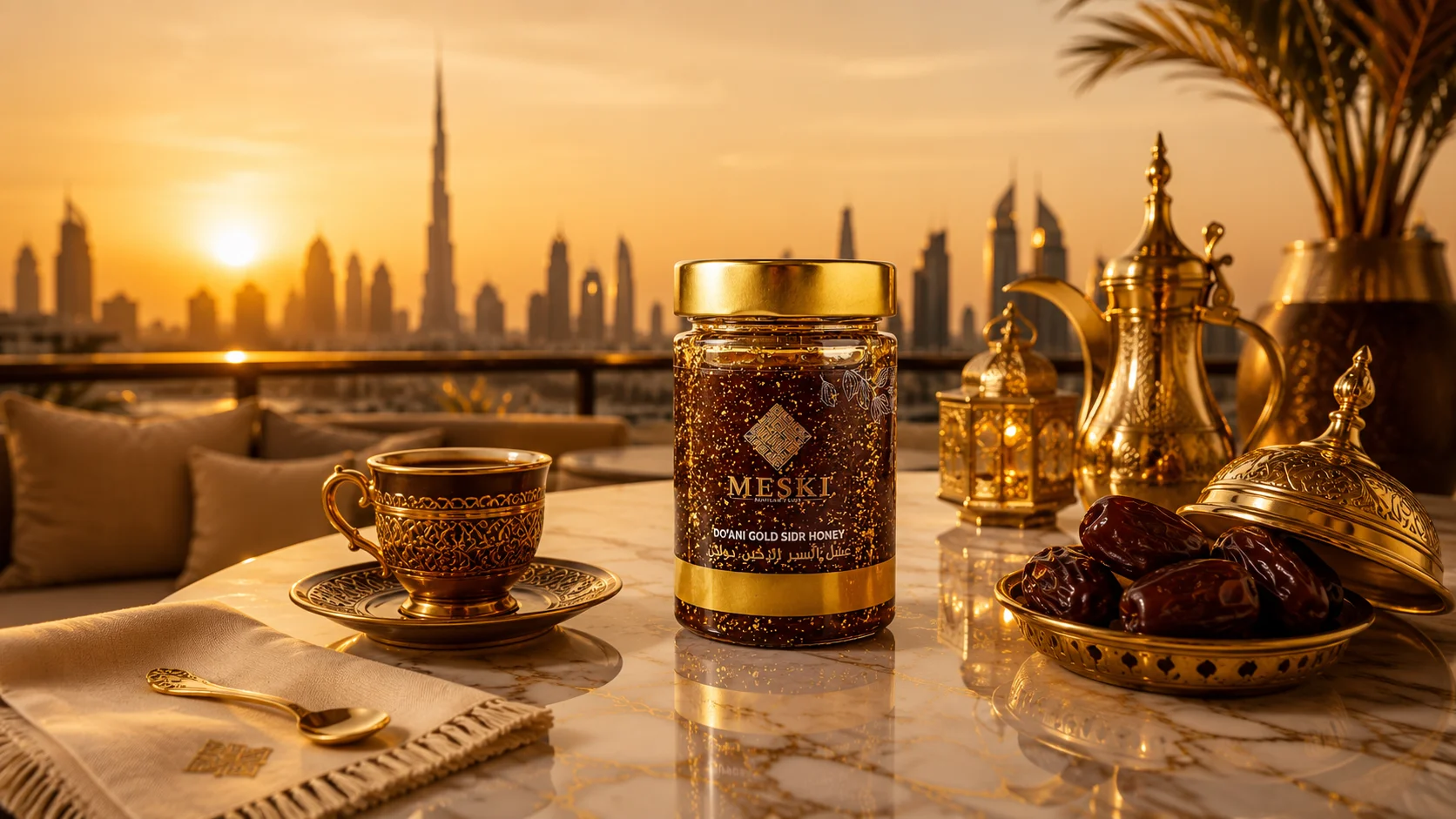
Search for the “best honey in Dubai” and you will encounter rare Sidr harvests, dark Samar honey, local Emirati varieties, raw honey, infused creations and elaborate gift collections. Prices can range from everyday grocery levels to the territory of fine food and luxury gifting.
Yet the word best has no universal answer. A delicate breakfast honey is not judged in the same way as a powerful Do’ani Sidr, a mineral Samar or a prestige gift infused with edible gold. The best choice is the one that combines authentic origin, suitable sensory character, careful handling, clear information and a trustworthy seller.
This guide explains how Dubai and UAE buyers can assess premium honey without relying on folklore, packaging alone or exaggerated health promises.
Inside this guide
What Does “Best Honey in Dubai” Actually Mean?
The most expensive honey is not automatically the finest, and the most famous origin does not guarantee excellence. Honey is an agricultural product whose character changes with flowering conditions, climate, rainfall, colony health, harvest timing, filtration, heat exposure and storage.
A serious evaluation begins with five questions: Where was the honey harvested? Which flora was available? Who produced or selected it? How was it handled? What evidence supports the claims on the label?
A useful principle:
buy honey for its verified quality and character—not merely because one country or one floral name is presented as automatically superior.
Authentic origin
A precise region and harvest story are more meaningful than a vague national flag on the packaging.
Sensory integrity
Aroma, texture, finish and balance should correspond to the honey’s style and botanical environment.
Traceability
The seller should be able to explain sourcing, batch identity, harvest period and storage conditions.
Which Honeys Should You Discover in Dubai?
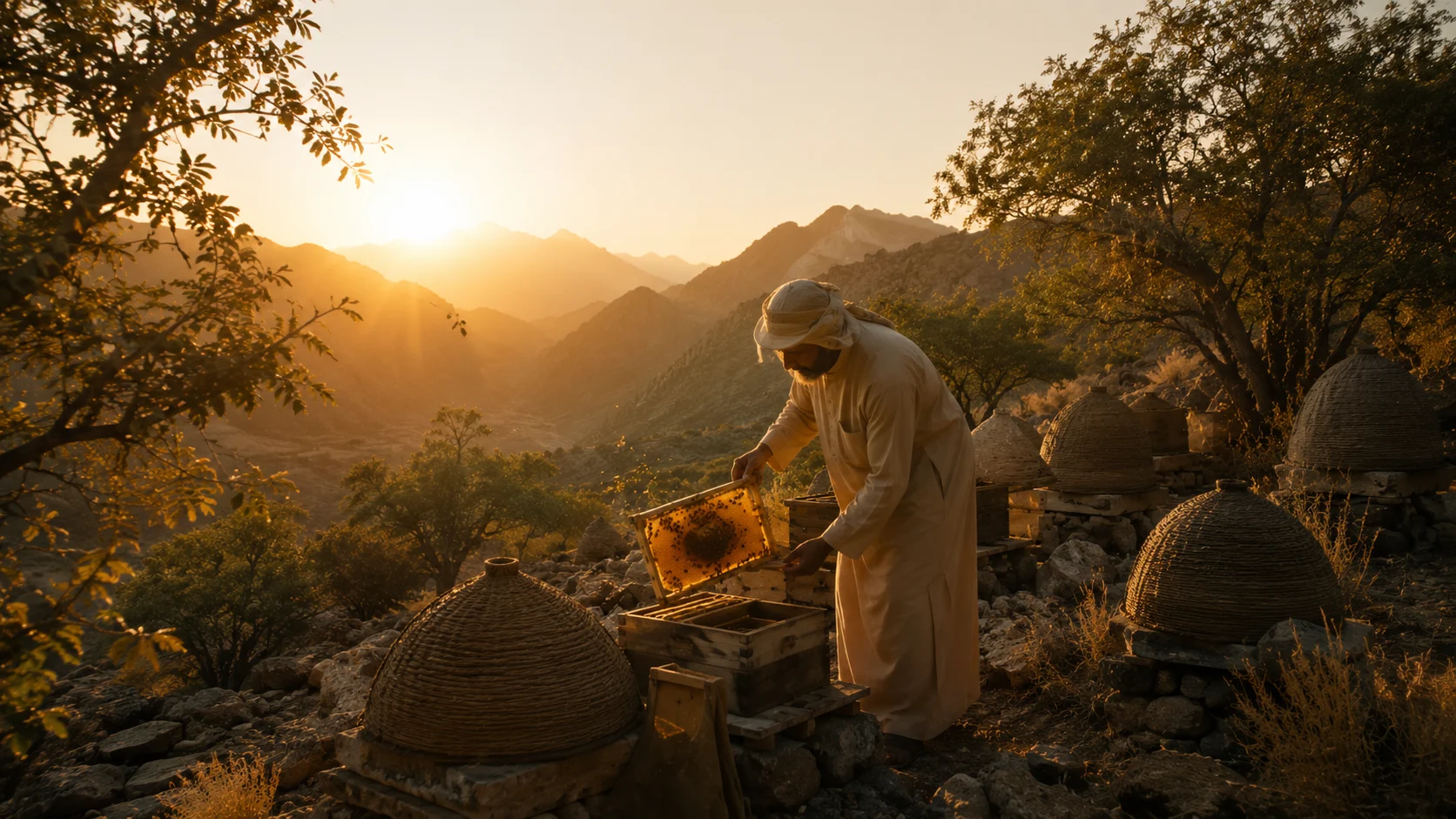
Dubai’s international market makes it possible to explore both Arabian honeys and distinctive harvests from other regions. Each should be judged on its own merits.
Sidr Honey
Often full-bodied, aromatic and persistent. Premium examples may come from Yemen, Oman, the UAE, Saudi Arabia or other neighbouring areas where Sidr trees grow.
Samar Honey
Frequently darker and more intense, with warm, roasted, woody or caramel-like impressions depending on origin.
Ghaf Honey
A locally meaningful UAE desert honey associated with the Ghaf flowering season. Availability and floral predominance can vary by harvest.
International Terroirs
Moroccan, Corsican, alpine, forest and other regional honeys can add acidity, bitterness, floral delicacy or mineral depth to a collection.
Seven Signs of a Premium Honey
Clear origin
Look for a region, valley, mountain area or recognised production zone rather than a vague statement.
Transparent composition
Pure honey should not hide syrups, flavours or unnecessary additives. Infused products should state every added ingredient.
Batch traceability
Batch numbers, harvest details and supplier records create accountability when questions arise.
Responsible handling
Excessive heating may alter aroma and naturally occurring characteristics. Ask how the honey was processed.
Coherent sensory profile
The aroma and flavour should feel natural, layered and free from burnt, fermented or artificial notes.
Compliant label
In Dubai, food products offered for sale are expected to meet UAE and Gulf requirements for registration and label information.
Evidence without theatre
Laboratory reports can support quality, but a certificate should be readable, relevant to the batch and explained honestly.
What Can Honey Laboratory Analysis Confirm?
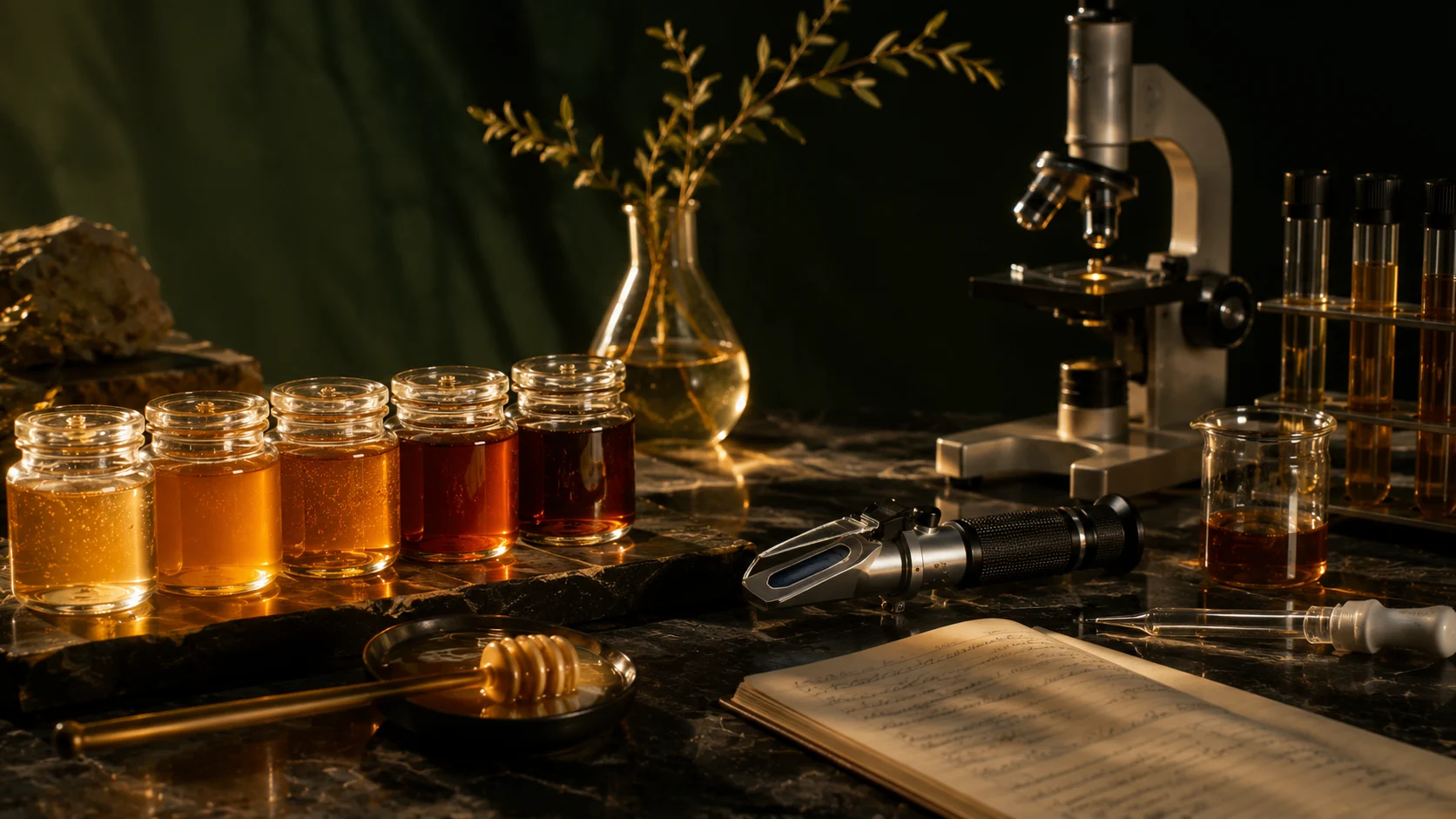
Laboratory testing is valuable because honey authenticity cannot be established reliably through home tricks. The flame test, water test, thumb test and assumptions based on crystallisation are not sufficient.
Depending on the laboratory and analytical programme, testing may examine moisture, electrical conductivity, sugar profile, hydroxymethylfurfural, enzyme activity, acidity, pollen, residues or markers associated with adulteration. No single number tells the whole story.
Dubai Municipality’s National Fingerprint Project for Emirati Honey is particularly significant because it seeks to build a scientific database using laboratory analysis and botanical and geographical differentiation. This reflects a broader movement toward evidence, traceability and protection of local honey reputation.
| Check | What it may indicate | Important limitation |
|---|---|---|
| Moisture | Harvest maturity and fermentation risk | Acceptable levels vary with standards and honey type |
| HMF | Possible heat exposure or ageing | Must be interpreted with storage history and applicable limits |
| Diastase or enzymes | Freshness and heat sensitivity | Natural levels differ between floral origins |
| Sugar profile | Composition and possible anomalies | Advanced adulteration may require more specialised techniques |
| Pollen analysis | Botanical and geographical clues | Filtering and regional pollen behaviour can complicate interpretation |
Choose the Best Honey for Your Taste and Occasion
A honey can be excellent and still be wrong for a particular person. Some buyers prefer a light floral sweetness; others want a dense texture and a long, almost resinous finish.
The finest honey is not simply sweet. It has a beginning, a texture, an aromatic centre and a finish that remains after the spoon has left the palate.
For breakfast
Choose a smooth, balanced honey that complements bread, yoghurt, cheese or fruit without overwhelming them.
For tasting
Select a distinctive single-origin honey with a recognisable aroma, texture and persistent finish.
For gifting
Prioritise provenance, presentation, recipient preferences and a story worthy of the occasion.
Why Does Premium Honey Cost More in Dubai?
Price can reflect rarity, difficult harvest locations, short flowering periods, small production volumes, transport, laboratory analysis, specialist selection, premium packaging and retailer costs. It can also reflect branding alone. The buyer’s task is to distinguish genuine value from decoration.
A higher price becomes more credible when the seller can explain the harvest, origin, batch, handling and sensory profile. A luxury box may enhance the gift, but it should never compensate for uncertain honey.
Common Mistakes When Buying Honey in Dubai
Do not rely on one sign alone.
Thickness, darkness, price, crystallisation and a famous country name cannot independently prove authenticity.
- Assuming all Yemeni Sidr is automatically superior to Sidr from Oman or the UAE.
- Believing raw honey must always remain liquid.
- Choosing the darkest jar because dark colour is assumed to mean stronger benefits.
- Accepting medical promises that are not supported by suitable evidence.
- Buying a gift set without checking net weight, ingredients and origin of every jar.
- Confusing an attractive laboratory logo with a batch-specific analytical report.
How MESKI Selects Premium Honey
MESKI approaches honey first as a consumer and then as a house of selection. Our philosophy was shaped by experiences of purchasing products whose presentation did not always correspond to the quality or origin expected.
We therefore focus on origin, supplier relationships, traceability, sensory character, responsible handling and laboratory analysis where relevant. We do not believe that one country guarantees excellence, or that a prestigious name can replace verification.
Frequently Asked Questions
There is no single best honey for everyone. A strong choice combines authentic origin, traceability, sound handling, a clean sensory profile and suitability for the buyer’s taste or occasion.
No. Country of origin alone does not guarantee quality. Harvest maturity, exact terroir, beekeeper practice, storage and batch integrity are more informative than nationality alone.
Premium honey is available from specialist honey houses, reputable online stores, selected gourmet retailers, local producer events and seasonal initiatives such as the Hatta Honey Festival.
Check the label, origin, batch information, seller transparency and analytical evidence where available. Home tests cannot reliably establish authenticity.
No. Crystallisation is a natural process influenced by sugar composition, temperature and time. Both authentic and adulterated products may crystallise, so it is not a standalone authenticity test.
Price may reflect limited flowering, remote harvest zones, demand, small batches, transport, testing and presentation. Buyers should verify which of these factors genuinely apply.
Less intensive processing may preserve aroma and heat-sensitive characteristics, but “raw” is not a universal guarantee of purity, safety or medical benefit.
Choose a honey with a meaningful origin, refined presentation and a flavour suited to the recipient. A well-curated Sidr or regional collection often offers more depth than a decorative box with unclear contents.
Selected Sources and Further Reading
- Dubai Municipality — National Fingerprint Project for Emirati Honey
- Dubai Municipality — Hatta Honey Festival and laboratory testing
- Dubai Municipality — Food product registration and label evaluation
- UAE Legislation — Federal Law Concerning Food Safety
- UAE Legislation — Executive Regulations concerning food safety and misleading presentation