
Iftar at Sunset: How to Elevate Your Feast Table with Premium Dates and Authentic Gulf Flavours
Where centuries-old Gulf tradition meets the finest premium dates, raw honey, and rare flavours — composing a blessed moment into an unforgettable sensory experience.
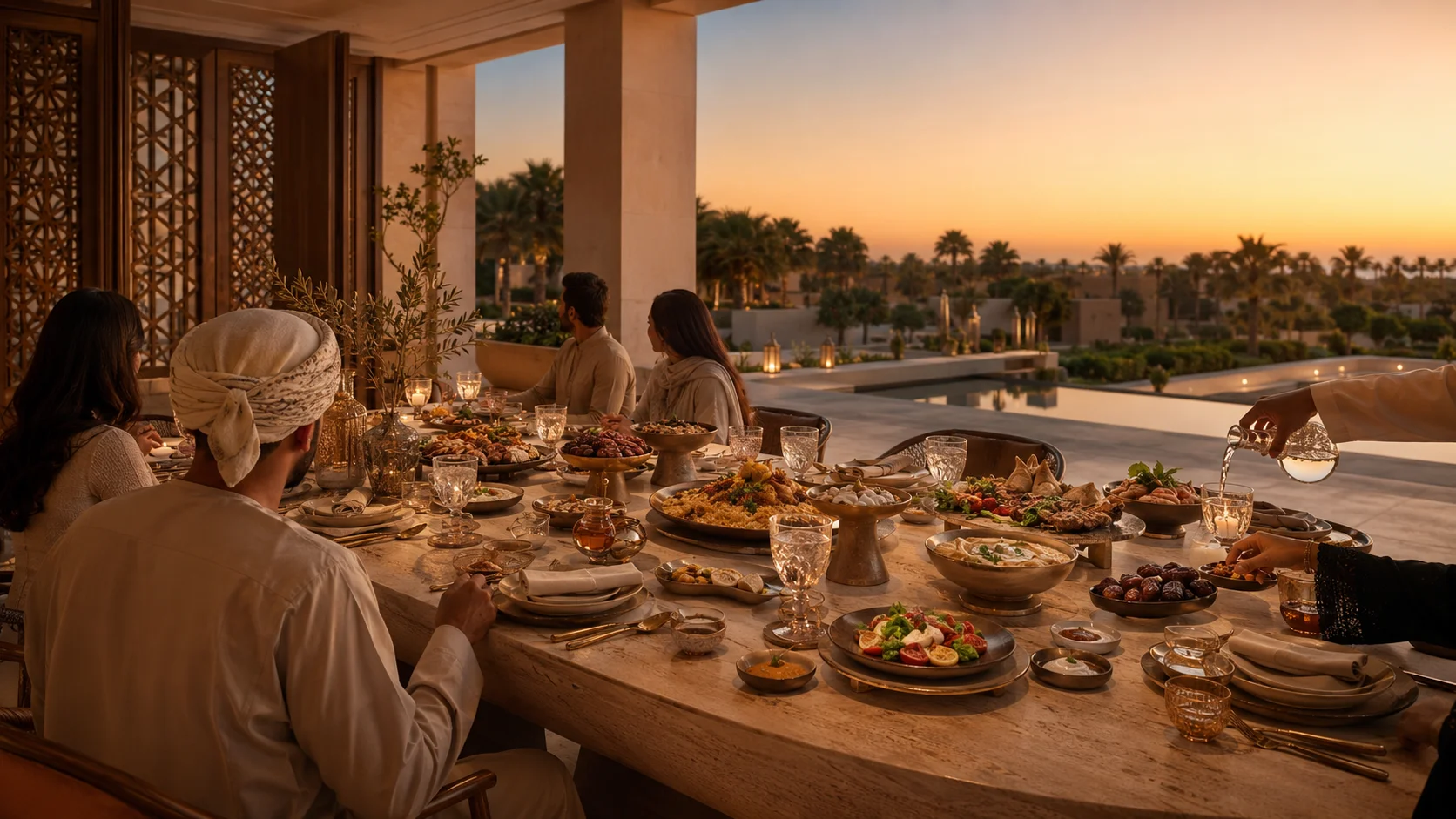
There is a moment — brief, luminous, almost suspended in time — when the last breath of the call to prayer dissolves into the warm Gulf air and the fast is broken. The Iftar table, gathered around by family and honoured guests, is never merely a meal. It is a covenant. A renewal. And in every corner of the Arabian Peninsula, from the mountains of Oman to the palm-lined avenues of Sharjah, the way that table is set speaks volumes about the soul of those who prepared it. This guide is an invitation to compose that table with the intention, beauty, and authenticity it has always deserved.
The Sacred Moment of Iftar — A Ritual Beyond the Meal
Ramadan is the month that slows time down. During the long hours of fasting, the anticipation of Iftar becomes a form of meditation in itself — a daily reminder that gratitude is not merely spoken, but tasted. Across fourteen centuries of Islamic tradition, the breaking of the fast has been observed with the same foundational simplicity: a date, a sip of water, a whispered prayer.
What has changed across generations is not the essence but the expression. Today’s Iftar table, especially in the Gulf’s great households, is a canvas that reflects heritage, abundance, and care. It is where the most precious ingredients find their rightful place — not to impress, but to honour.
Why the First Bite Matters: Dates as the Soul of Iftar
The tradition of breaking the fast with dates is rooted in prophetic practice (Sunnah) and is observed by Muslims worldwide. But beyond its spiritual significance, this custom carries remarkable nutritional wisdom. After hours of fasting, the body’s blood sugar levels are naturally low. Dates — naturally rich in simple sugars, potassium, and fibre — offer one of the most gentle and effective ways to reawaken the digestive system without overwhelming it.
Nutritional tradition across the Gulf has long recognised what modern food science confirms: the natural sugars in dates support a measured, balanced response when breaking a prolonged fast — making the date not merely a ritual food, but the wisest first food the table can offer.
A Timeless Sunnah
Breaking the fast with an odd number of dates — traditionally three — is a practice observed across the Muslim world for over fourteen centuries. At Meski Dates Factory, we source each variety to honour this moment with the quality it deserves.
Curating the Perfect Iftar Table — Principles of Gulf Hospitality
Gulf hospitality — karam — is not about opulence for its own sake. It is about making every guest feel that no effort was spared in their honour. The Iftar table, in this tradition, follows a philosophy of generous intention expressed through quality, not necessarily quantity.
The Art of Abundance Without Excess
The finest Iftar spreads are those that feel effortlessly plentiful — varied in flavour and texture, yet coherent in spirit. Begin with a foundation of dates in two or three varieties, presented in their most beautiful form: in carved wooden bowls, on silver trays lined with dried rose petals, or arranged alongside strands of saffron and cardamom pods. Add a small vessel of raw honey — its golden depth a visual and sensory counterpoint to the richness of the dates. Beside these, warm Arabic bread, a dish of olive oil, and a scattering of roasted nuts complete the opening chapter of the feast.
Colours, Textures, and Vessels — The Aesthetic of the Feast
Gulf aesthetic tradition favours warmth: amber, gold, terracotta, deep brown, ivory. These are the tones of the date palm, the desert at dusk, the honeycomb. When choosing vessels for your Iftar table, look to natural materials — hand-thrown ceramic bowls, copper or brass trays, woven palm-leaf baskets (khoos) that connect the table to the land from which its offerings grew. The visual coherence of the spread is itself a form of welcome.
Premium Dates — Choosing with Intention
Not all dates are created equal. The Gulf’s date-growing tradition spans thousands of years and hundreds of named varieties — each with its own terroir, harvest window, and flavour profile. For the Iftar table, the selection of date varieties is not a trivial decision. It is an act of curation rooted in centuries of collective wisdom.
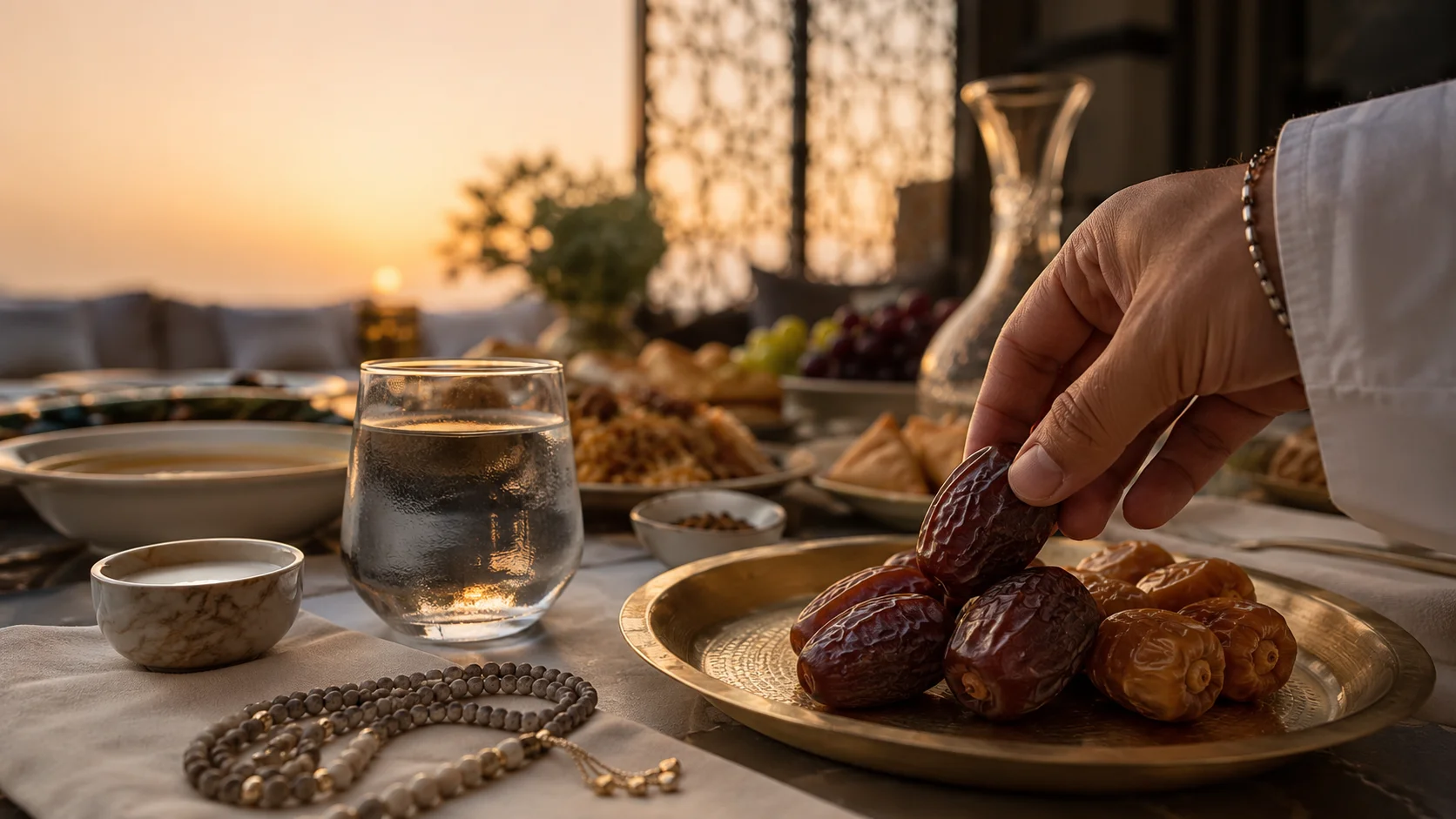
Understanding Date Varieties for the Iftar Table
The King of Dates
Prized for its large size, caramel-soft flesh, and deep toffee-like sweetness. The date most associated with ceremonial abundance — offered first to the most honoured guest.
The Coffee Companion
Native to Saudi Arabia and the eastern Gulf. Distinguished by butterscotch sweetness and a lingering finish — exceptional alongside strong Arabic coffee (qahwa).
The Sugar Date of Qassim
Pale gold in colour, with a dry, crumbly texture and an intensely sweet, almost crystalline quality. Its delicacy demands careful handling — hallmarks of a date that rewards the attentive buyer.
The Date of Medina
Dark, small, and revered. The Ajwa date holds a place of profound spiritual significance for many Muslim families and is frequently included on the Iftar table as an act of devotion as much as pleasure.
How Texture and Sweetness Guide Your Selection
For a premium Iftar table, consider offering at least two varieties that contrast in texture and sweetness: one soft and caramel-rich (Medjool or Kholas), one with a drier or more refined sweetness (Sukkari or Ajwa). This gives your guests a journey rather than a single note — an act of consideration that defines true Gulf hospitality.
When sourcing premium dates, look for fruit that has been harvested and stored under controlled conditions, free of added syrups or artificial preservatives. The date’s natural lustre, intact skin, and firm-yet-yielding flesh are the hallmarks of quality that no cosmetic treatment can replicate.
Honey as the Golden Thread — From the Prophet’s Tradition to Your Table
In the Arab world, honey has never been a mere sweetener. It is a symbol of purity, abundance, and care — mentioned in the Quran, celebrated in poetry, and exchanged as a mark of the highest esteem. On the Iftar table, a jar of fine raw honey occupies a place of honour that no other condiment can claim.
The finest honeys for the Iftar table come from regions where the nectars are as ancient as the traditions themselves. Yemeni Do’ani Sidr honey, harvested from the Ziziphus tree in the valleys of Hadhramaut and Wadi Dawan, is renowned across the Gulf for its intensity, complexity, and rarity. Omani Sidr, drawn from the same botanical lineage but shaped by the distinct terroir of Dhofar and the Hajar mountains, carries its own singular character — lighter in colour, with a floral softness that complements dates with extraordinary grace.
Pairing Raw Honey with Dates: A Time-Honoured Ritual
The combination of dates and honey at Iftar is not merely traditional — it is sensory poetry. The gentle caramel depth of a Medjool or Kholas date, dipped lightly into raw Sidr honey, produces a flavour layering that is simultaneously rich and clean, sweet and complex. The honey’s floral or woody notes — depending on variety — lift the date’s inherent sweetness into a different register entirely.
For those who wish to offer something truly memorable at their Iftar table, a small vessel of honey infused with 23-karat gold flakes transforms this ritual into an act of exceptional generosity — one that guests will remember long after the blessed month has passed. The gold carries no flavour of its own; its role is purely symbolic and aesthetic, elevating the gesture to something that speaks of rarity and care.
At Meski Dates Factory, based in Sharjah, the selection of raw Sidr honeys from Yemen, Oman, and the Emirates is curated with precisely this moment in mind: the golden hour of Iftar, the guest of honour across from you, and the desire to offer something that is genuinely rare.
Select Your Honey
Choose a single-origin raw Sidr honey — Yemeni Do’ani for intensity and depth, Omani Sidr for floral elegance, or Emirati Sidr for a local tribute to Gulf terroir.
Prepare the Vessel
Serve honey in a small ceramic or copper bowl. Allow it to reach room temperature before Iftar — cold honey loses its aromatic complexity.
Pair Deliberately
Place the honey vessel between your date selections. Offer a small wooden dipper or silver spoon. The gesture of invitation is part of the ritual.
Elevate for Occasions
For distinguished guests or gifting, present the Do’ani Sidr Honey Infused with 23-Carat Gold — a gesture that speaks before any word is exchanged.
Beyond Dates and Honey — Completing Your Authentic Gulf Spread
The Iftar table is a symphony, and dates and honey are its opening movement. What follows depends on regional tradition, family custom, and the season — but certain elements are constants across the Gulf that lend every table its grounding authenticity.
Warm Beverages, Bread, and Savoury Accents
| Element | Role on the Table | Quality Signal |
|---|---|---|
| Arabic coffee (qahwa) | Essential companion to dates; beverage of welcome | Cardamom-forward, saffron-tinted, freshly brewed |
| Laban | Cooling, tangy — soothes after fasting | Full-fat, lightly salted, chilled |
| Premium olive oil | Served with warm bread; honours guests through quality | Single-estate, cold-pressed, grassy finish |
| Harees / Thareed | Heartier second chapter; regional and familial identity | Slow-cooked, aromatic, generously spiced |
| Rose water | Flavours sweets; connects table to perfume tradition | Distilled, not synthetic — fragrant and delicate |
The Iftar Table as a Gift — Curated Sets for Sharing the Blessing
In Gulf culture, the gift of food is never incidental. To send a hamper of premium dates and honey to a neighbour, a colleague, or a business associate during Ramadan is among the most meaningful gestures one can make — a tangible expression of baraka, of wishing abundance upon another.
The craft of the gift lies in its curation: varieties that complement one another, packaging that reflects the care behind the selection, and the knowledge that every element inside has been sourced with integrity. A box containing a selection of Medjool and Kholas dates alongside a jar of Yemeni Sidr honey and a bottle of premium olive oil does not require elaborate explanation. Its contents speak fluently, in a language that every Gulf household understands.
Provenance You Can Trust
Every honey in the Meski collection is sourced directly from verified apiaries in Yemen, Oman, and the UAE — raw, unfiltered, and traceable to its origin valley.
Crafted for the Occasion
Meski’s Ramadan gift collections are conceived for the pause before the sunset prayer — the table set with love, the jar opened for the first time in the amber light of Iftar.
Heritage in Every Detail
From the Sharjah factory to your table, each selection reflects over a decade of expertise in curating the Gulf’s finest natural foods — dates, honey, and olive oil as they were meant to be.
Compose Your Iftar Table with Meski
Discover our curated Ramadan honey collections — from rare Yemeni Do’ani Sidr to gold-infused Emirati honey — sourced with integrity and presented with the care the moment deserves.
A Final Word on the Spirit of the Table
The finest Iftar table is not the one with the most elaborate dishes or the rarest ingredients. It is the one at which every guest feels that their presence has transformed an ordinary evening into something sacred. Ingredients matter — their quality, their provenance, their authenticity — because they carry the intention of the person who chose them. But it is that intention itself, the niyyah, that makes a table truly memorable.
Choose your dates with care. Seek your honey from sources you trust. Set your table as you would prepare for a beloved guest — because in Ramadan, every guest who sits at your Iftar table is, in a very real sense, a blessing.
Explore Meski Dates Factory‘s curated selection of premium raw Sidr honeys and Ramadan gift collections at meskidatesfactory.com — and compose an Iftar table worthy of the moment.
Your Questions About the Perfect Iftar Table, Answered
The most traditional and widely appreciated dates for Iftar are Medjool (soft, caramel-rich, ceremonial), Kholas (butterscotch sweetness, ideal with Arabic coffee), Sukkari (crystalline, pale gold, delicately sweet), and Ajwa (dark, spiritually significant, from Medina). For a premium Iftar table, offering two contrasting varieties — one soft and rich, one drier and refined — creates a more memorable and considered experience for your guests.
Raw Sidr honey is universally regarded as the finest honey for the Iftar table across the Gulf. Yemeni Do’ani Sidr — from the Hadhramaut valleys — offers exceptional depth and complexity. Omani Sidr, from the Hajar mountains and Dhofar region, is prized for its floral elegance. Both pair beautifully with dates. For a truly exceptional gesture, Sidr honey infused with 23-carat gold elevates the ritual into an act of rare generosity.
A traditional Gulf Iftar table is built on layers: begin with two to three varieties of premium dates arranged in natural-material vessels (ceramic, copper, or woven khoos baskets), add a small vessel of raw honey, warm Arabic bread, and a dish of cold-pressed olive oil. Serve Arabic coffee (qahwa) alongside. The aesthetic should favour warm tones — amber, gold, terracotta — and the overall composition should feel generous in spirit, coherent in presentation, and deeply intentional in every element chosen.
The finest Ramadan gift hampers in the Gulf combine provenance, rarity, and presentation. Look for curated sets that include single-origin raw Sidr honey (Yemeni, Omani, or Emirati), presented in premium packaging that reflects the care of curation. Meski Dates Factory’s Ramadan gift collections — including the Royal Sidr Collection and the Luxury Gift Box with Gold 23K and Silver — are specifically designed for this purpose, combining traceable sourcing with the aesthetic quality that Gulf gifting culture demands.