
A souk built for modern Dubai, canals, restaurants, hotels and a view that keeps finding the Burj Al Arab.
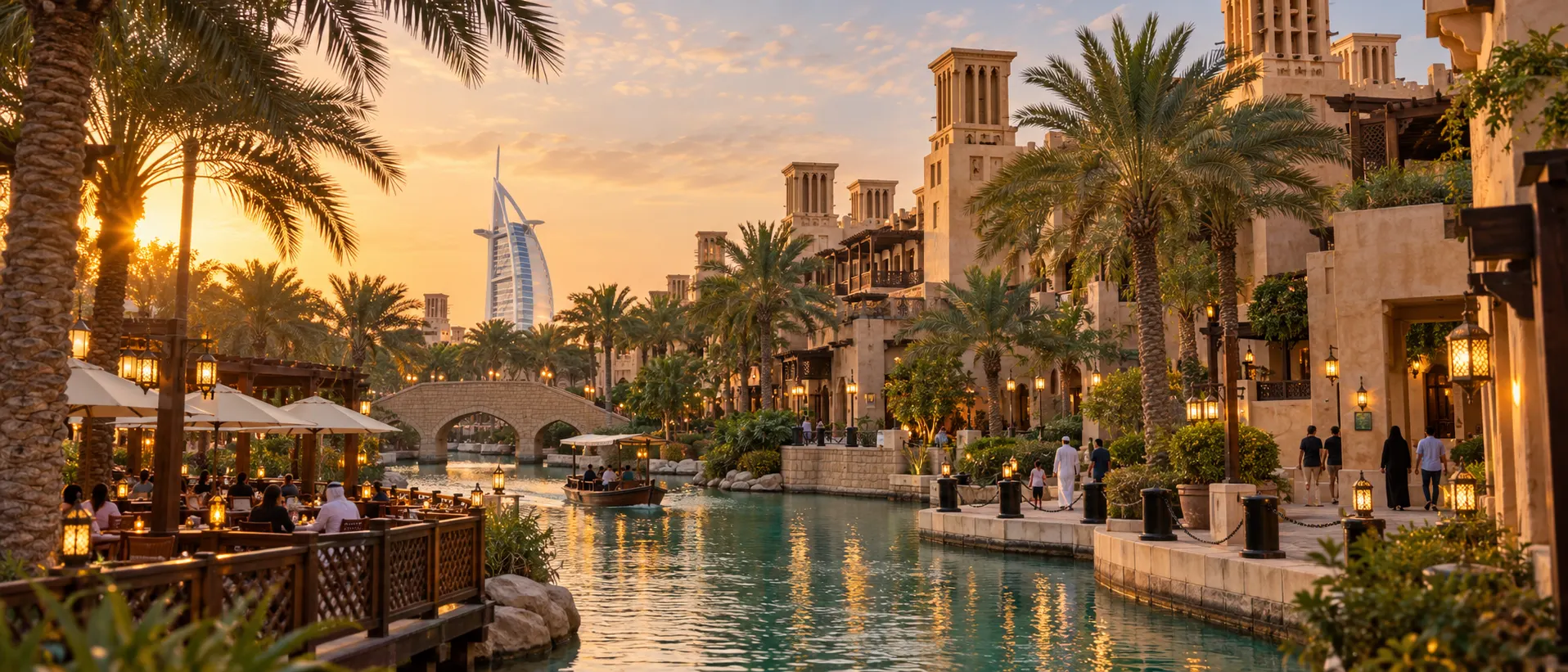
In Part I, I followed Jumeirah Road because I like the way the neighbourhood moves between villas, cafés, beaches and visible wealth without making me feel that one world has to exclude the other. Madinat Jumeirah is where that idea becomes more deliberate. It is modern, designed and unapologetically luxurious, yet it borrows the language of the old souk so confidently that I still find myself wanting to stop, walk and stay longer than planned.
Arriving at Madinat Instead of Rushing Past It
There is a moment on the Jumeirah road when the landscape begins to tell you that you are approaching something larger. The Burj Al Arab becomes more present. Hotel entrances appear. Landscaping becomes more theatrical. The road is still Dubai, but the scale of hospitality changes.
My instinct is not to treat Madinat Jumeirah as a box to tick after photographing the Burj Al Arab. I prefer to stop. Park the car, leave the road behind for a while and enter the souk on foot. The pace changes immediately.
This is important because Madinat is not an old market that survived untouched for centuries. It is a modern development inspired by traditional Arabian architecture. Pretending otherwise would make the place less interesting, not more. Its value is precisely in the question it raises: what happens when Dubai takes the visual language of the old souk and rebuilds it for contemporary hospitality?
The answer is not a museum. It is a living commercial space with restaurants, shops, hotels, waterways, terraces and people arriving for very different reasons. Some come to shop. Some come to eat. Some want the Burj Al Arab view. Some simply want to walk somewhere that feels different from a mall.
A Souk That Knows It Is Modern
Souk Madinat Jumeirah uses wind-tower forms, carved arches, wood, shaded passages and lanterns to evoke an Arabian marketplace. The official description itself presents the place as inspired by traditional souks, and that honesty matters. There is no need to pretend the walls have been standing for three hundred years.
I enjoy it because the design understands something that many modern developments forget: people like to wander. A traditional souk rarely reveals itself in one straight corridor. You turn, hesitate, smell perfume, notice a shop, hear plates from a restaurant and realise that you have lost the shortest route to wherever you thought you were going. Madinat borrows some of that psychology.
Of course, the experience is cleaner, more controlled and far more luxurious than a working old market. There is valet parking, polished hospitality, international dining and a resort surrounding it. This is not Deira, and it should not be judged by whether it can imitate Deira perfectly.
For me, the interesting part is that it offers a traditional visual vocabulary without requiring the visitor to abandon the comforts of modern Dubai. This is exactly what I meant in Part I when I joked about traditional bling-bling. Here, the joke becomes architecture.
Why It Does Not Feel Like Downtown
Downtown Dubai and Madinat Jumeirah are both built around spectacle, but the spectacle works differently. Downtown pulls the eye upward. Burj Khalifa dominates scale, Dubai Mall concentrates movement, and the city feels vertical and energetic.
Madinat works more horizontally. Water, courtyards, bridges, shaded passages and low-rise forms encourage the eye to travel sideways. Even when the Burj Al Arab rises nearby, the immediate environment remains closer to human scale.
That difference changes how luxury feels. In Downtown, luxury often appears as height, glass, branded towers and monumental interiors. At Madinat, it is filtered through wood, stone, water, arches, gardens and the language of hospitality. Neither is more real than the other. They are simply different Dubai dialects.
This is why I can enjoy Madinat even when I am not in the mood for obvious luxury. I do not need to book the most expensive hotel or restaurant to appreciate the atmosphere. I can walk, look at the shops, drink something, sit near the water and let the place work at a smaller scale.
The Burj Al Arab Is Always Somewhere in the Story
It is almost impossible to write about this part of Jumeirah without the Burj Al Arab appearing. The building has become one of Dubai’s most recognisable symbols, and around Madinat it behaves less like a single attraction than a visual compass.
You catch it between buildings. It appears across water. A restaurant terrace frames it perfectly. Then you turn a corner and it disappears. This repeated reveal is part of why the area photographs so well, but I think the view is better when it is not the only reason you came.
The Burj Al Arab represents one form of Dubai luxury: extraordinary, international, unmistakably designed to impress. Madinat beside it represents another. It takes the same appetite for spectacle and wraps it in references to older regional architecture.
Together they create a useful picture of modern Dubai. The city does not only import global luxury. It also keeps asking how luxury can be translated into a Gulf visual language.
The Hotels Around the Souk Are Part of the Landscape
Madinat Jumeirah is surrounded by major Jumeirah hotels, including Mina Al Salam, Al Qasr, Al Naseem and Dar Al Masyaf, with Jumeirah Beach Hotel and Burj Al Arab nearby. More recently, Marsa Al Arab has added another layer to this coastal cluster. You can discuss this entire area as hospitality architecture without turning the article into a ranking of five-star properties.
I prefer to see the hotels as part of the landscape. Al Qasr uses palatial references. Mina Al Salam sits close to the waterways and souk. Al Naseem takes a more contemporary direction. Dar Al Masyaf breaks the resort into lower-scale summer-house style spaces. Each interprets Gulf luxury differently.
For a visitor, this means you can experience some of the atmosphere without staying in every property. Restaurants, public-facing areas and the souk create points of contact. The hotels shape the surroundings even when you are only walking through for an evening.
This is another reason Madinat rarely feels like a single attraction. It is a small hospitality district, almost a designed town, with enough internal movement that you can spend hours there without repeating the same view.
Water Changes Everything
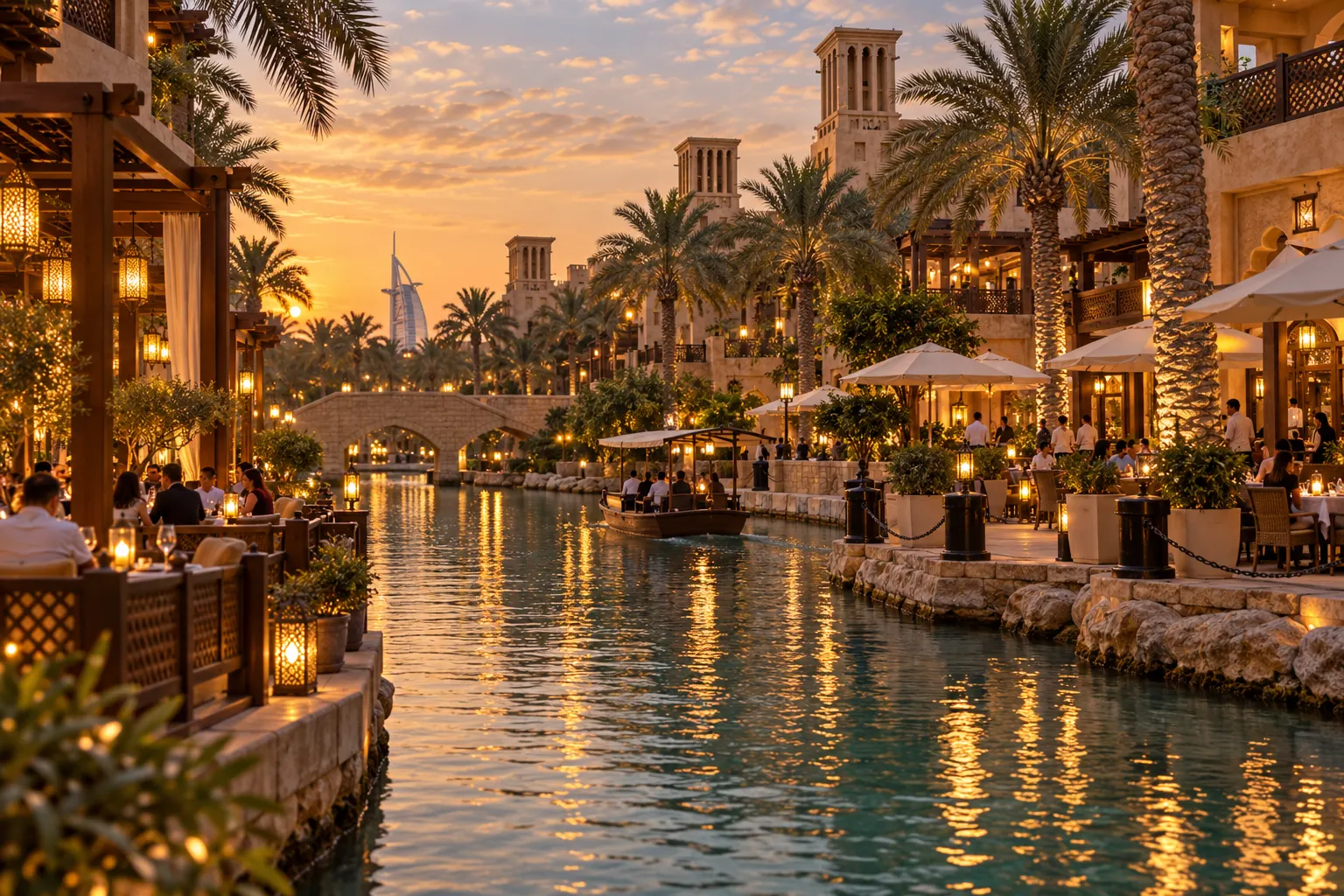
The waterways are one of the smartest parts of Madinat Jumeirah. They soften the architecture, create reflections and allow traditional abra-style boats to move through the resort. Again, this is not an ancient creek that happened to survive inside a hotel development. It is designed. But design can still create an atmosphere worth enjoying.
Water slows people down. A bridge becomes a place to stop. A restaurant table becomes more appealing because it faces a canal. Lights at night double themselves in the reflections. The sound of a boat passing is gentler than the sound of traffic outside.
This matters in Dubai because so much of the city is experienced through movement: car, taxi, metro, escalator, elevator. Madinat asks you to walk. Even the abra rides within the resort turn transport into part of the experience.
If Part I of Jumeirah was about the road, Part II is about what happens when you finally leave the car.
Restaurants: Do Not Choose Only for the Photograph
Madinat Jumeirah has enough restaurants and cafés that the temptation is to choose according to the most spectacular view. I understand that. A table facing the waterways or the Burj Al Arab can make dinner feel like an event before the food arrives.
But I would use the same rule here that I use on Jumeirah Road: curiosity first. The resort and souk bring together cuisines from the Gulf, the Levant, Asia, Europe and elsewhere. Some venues are formal, others easier. The best choice depends on the evening you want, not on a universal ranking.
If you are with family, perhaps the pleasure is simply finding a table where everyone can stay comfortable. If you are receiving a client, the setting may matter more. If you are showing Dubai to someone for the first time, a terrace with the right view can be worth the cliché. There is no need to be allergic to beautiful things simply because other people photograph them too.
The point is to eat, talk and stay. A restaurant becomes memorable when the conversation survives the photograph.
Shopping, Oud, Spices and the Instinct to Bring Something Home
A souk, even a modern one, activates an old instinct: we want to carry something away. Perfume, oud, incense, spices, jewellery, textiles, decorative objects and gifts all make sense in a place built around wandering and discovery.
I have always found this interesting. We do not buy souvenirs because we suddenly need another object. We buy them because we want to compress a place into something small enough to carry home. The object becomes a memory trigger.
That is also why food gifts are so powerful. Honey, dates, coffee, tea, sweets and spices disappear eventually, but while they last they can reproduce a taste or a moment. A jar opened weeks later can bring back a dinner, a trip or the person who gave it.
Madinat Jumeirah makes this especially visible because shopping sits beside hospitality. You eat, walk, smell oud, pass a gift shop, look at the water and begin thinking about someone who would enjoy a piece of the experience.
The Majlis Idea Still Sits Under the Luxury
One of the reasons this environment feels culturally familiar despite its modern construction is that Gulf hospitality has always valued the space between people. A majlis is not luxurious because of marble, fabric or price. Its real function is to receive, sit, talk, serve and make room for another person.
Luxury hotels often reproduce that social logic in a different register. Lobbies become meeting places. Lounges serve coffee and dates. Families gather in semi-private spaces. Business conversations happen over small cups. A visitor is offered something before the serious discussion begins.
This does not make a hotel lobby a traditional majlis, and I would never claim they are the same. But the habit of receiving people has survived the move into modern hospitality. The furniture changed. The scale changed. The coffee service became more polished. The instinct remained recognisable.
That continuity is more interesting to me than pretending modern Dubai has either preserved tradition perfectly or destroyed it completely. Most of the time, culture survives by changing form.
Luxury Gifts in Jumeirah: Gold Is Optional
This is where honey naturally enters the story for MESKI. Jumeirah is a place of hotels, residences, private invitations, business dinners and celebrations. Gifts can range from something modest to something intentionally spectacular.
A simple jar of raw Sidr can be a thoughtful gift. A pairing of Emirati and Omani honey can become a conversation about origin. A larger collection can suit a family. And yes, if the occasion calls for it, honey can be presented with saffron, silver or gold inside a luxury box.
But I do not want to confuse packaging with meaning. Gold does not automatically make a gift better. It makes it different. Sometimes a guest will appreciate the story of a rare honey more than the shine around it. Sometimes presentation is part of the ceremony, especially for a VIP, corporate guest, wedding or important family occasion.
That is why Jumeirah is a good place to think about gifting. The neighbourhood itself makes room for both ends of the spectrum. You can drink a simple coffee after the beach or sit down in one of Dubai’s most luxurious hotels. The gesture depends on the moment.
Traditional Bling-Bling, and Why I Mean It Affectionately
I used the phrase traditional bling-bling as a joke, but I mean it affectionately. Dubai is not shy about luxury. Jumeirah does not need us to pretend otherwise. There are expensive hotels, cars, restaurants, villas and experiences everywhere around this stretch of coast.
What I appreciate is the effort, successful in some places more than others, to make that luxury speak in a local or regional visual language. Arches instead of only glass boxes. Courtyards instead of only lobbies. Waterways, lanterns, wood, majlis-inspired seating, oud and coffee beside international brands.
Could someone argue that this is commercialised tradition? Of course. Sometimes it is. But commercialisation does not automatically erase every cultural reference. The better question is whether the reference creates curiosity and whether the visitor understands that a designed souk is not the same thing as a historical one.
If Madinat makes someone enjoy an Arabian architectural detail and then encourages them to visit the Creek, Al Fahidi, Deira or another genuinely historic place, I see no problem. Curiosity can begin in polished places too.
Stay Until the Light Changes
My favourite advice for Madinat Jumeirah is the simplest: do not rush. If you arrive in late afternoon, stay until evening. The architecture changes with the light. The water becomes darker. Lanterns and restaurant terraces begin to glow. The Burj Al Arab shifts from a bright landmark into a silhouette and then into an illuminated one.
This is when the place becomes less about shopping and more about atmosphere. Families stay for dinner. Visitors stop taking photographs every thirty seconds. The temperature becomes easier in the cooler months. You start noticing sounds rather than only views.
Have coffee. Walk again. If a restaurant looks good, stop. If you are not hungry, continue. Take the long way back to the car. A place designed for wandering should be allowed to make you wander.
Jumeirah is better when you do not try to win against the clock.
What Jumeirah Taught Me About Dubai Luxury
I do not think Dubai has one definition of luxury. Sheikh Zayed Road expresses it through scale and ambition. Downtown expresses it through height and concentration. Palm Jumeirah turns it into engineered geography. Jumeirah often expresses it through hospitality, coast, privacy and a selective borrowing from tradition.
That is why I can move from a quiet residential stretch in Jumeirah 2 to a very polished evening at Madinat without feeling as though I have entered a completely unrelated city. The levels of wealth change, but some visual and social signals continue.
For me, this is the real reason Jumeirah deserves more than one article. Part I was the road, the villas, the beach and the freedom to stop. Part II is the moment that same road reaches a place where Dubai has consciously packaged tradition and luxury together.
I do not need to decide whether that mixture is pure tradition or pure modernity. It is neither. It is Jumeirah, and perhaps that is enough.
Madinat Jumeirah: Practical Questions
No. Souk Madinat Jumeirah is a modern marketplace inspired by traditional Arabian souks. Its architecture uses wind-tower forms, carved details, shaded passages and waterways, but it should not be confused with a centuries-old working market.
Yes. Souk Madinat Jumeirah, restaurants, cafés and other public-facing areas can be visited without being a hotel guest. Individual venues may have their own booking or access policies.
Yes. Many points around Madinat Jumeirah offer views of the Burj Al Arab, especially from waterways, bridges and selected restaurant terraces.
Yes. Traditional-style abra boats operate on the resort waterways. They are part of the modern Madinat experience and should not be confused with the historic Creek abra network in old Dubai.
It can be. Families can walk through the souk, eat at restaurants and enjoy the waterways and views. As with any large hospitality destination, the best venue depends on the age of the children, timing and the atmosphere you want.
MESKI currently delivers across Dubai under its UAE shipping policy. For hotel deliveries, VIP gifts or a specific event date, confirm the recipient details and timing before ordering.
Continue the Journey
If this story brought you here, continue through related stories from The House of Meski.