
Culture & Traditions · Oman & Dhofar
Omani Frankincense:
Why It Became One of Arabia’s Great Treasures
A small resin from a resilient tree once moved through caravan stations and ports to distant worlds. In Oman, its story is still in the air.
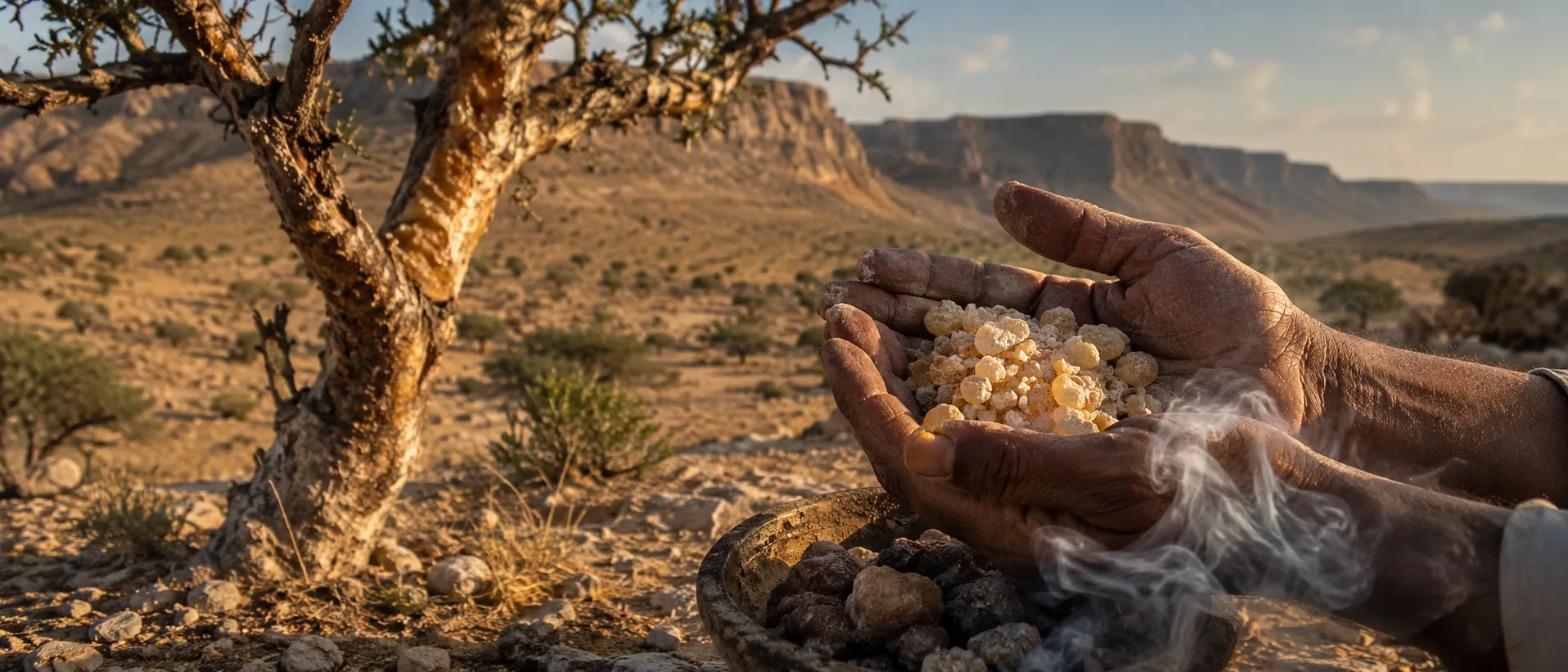
Frankincense does not look like something that should have changed trade routes.
A few pale pieces of resin can sit in the palm of a hand. They are light. Quiet. Almost unimpressive before heat touches them.
Then the smoke rises.
In southern Oman, that small resin belongs to a history large enough to connect wadis, desert caravans, ports and distant markets. UNESCO calls the archaeological landscape around Wadi Dawkah, Shisr, Khor Rori and Al-Baleed the Land of Frankincense.
The name is not poetic decoration. It describes an economy that once made scent a serious form of wealth.
The Story Begins With a Tree That Survives Heat
Wadi Dawkah in Dhofar preserves stands of Boswellia sacra, the frankincense tree from which aromatic resin is collected. UNESCO identifies the wadi as an outstanding example of the tree’s natural growth and notes that frankincense is still harvested there today.
The contrast is part of the fascination. The landscape can appear severe. The tree does not look extravagant. Yet its resin became a luxury commodity known far beyond southern Arabia.
This is one reason I am drawn to frankincense. Value is not always visible before knowledge arrives.
“Sometimes a country’s history can fit in the palm of your hand.”
Meskaoui
Dhofar Was Not the End of the Route. It Was the Beginning
Frankincense produced in the coastal hinterland had to move. That movement created a chain between landscape and world.
UNESCO’s Land of Frankincense includes Wadi Dawkah, the caravan oasis of Shisr, and the ports of Khor Rori and Al-Baleed. Together they show production, inland movement and maritime distribution across many centuries.
Khor Rori served as a natural harbour east of present-day Salalah. Al-Baleed later became another important port. Shisr stood inland near the edge of the Empty Quarter and functioned as an oasis station on caravan routes.
A piece of resin therefore carried more than scent. It carried the work of harvesters, caravan routes, water stops, merchants, sailors and ports.
Why Was Frankincense So Valuable?
In the ancient and medieval worlds, aromatic resins were used in religious practice, elite households, perfumery and trade. Demand existed far from the trees that produced them.
That distance mattered. Frankincense could be transported in relatively compact form, preserved its aromatic value and entered networks that linked southern Arabia with the Mediterranean, East Africa, India and other trading zones.
UNESCO describes frankincense as one of the important luxury commodities of the ancient world. That language helps correct a modern misunderstanding. Incense may now look like a small household purchase. Historically, it could belong to major commercial systems.
The Most Beautiful Part Is That It Did Not Become Only Archaeology
Frankincense is not trapped inside an ancient trade map.
Walk through an Omani souq and you can still find resin, burners, perfumes and other aromatic products. Experience Oman lists frankincense among the goods found in traditional markets such as Muttrah Souq.
That continuity interests me more than a simple claim that something is old.
A tradition remains alive when it still enters homes, clothes, gatherings and ordinary habits. It does not need to remain identical to its ancient form. It needs to remain understood.
Buying Frankincense in Oman: Ask Before You Judge by Colour
Visitors quickly discover that frankincense is sold in different appearances, sizes, colours and price levels. Market names and grading systems are not always standardised from one seller to another.
I would therefore avoid pretending that one visual trick can authenticate every resin. Ask where it comes from. Ask what grade the seller uses and what that grade means in that shop. Smell it when burned if possible.
The most expensive resin is not automatically the right choice for every use. Some buyers want a clean aromatic burn. Others want perfumery material or simply something meaningful to take home.
And I would be especially careful with health claims. Frankincense has a long history of traditional use, but a souq purchase should not be marketed as a medicine simply because the resin is ancient or natural.
Muttrah Makes the History Easier to Feel
I have already written about how Muscat impressed me by preserving a visible link between past and present. Frankincense fits naturally into that feeling.
In Muttrah, you can move from harbour to souq, pass old commercial lanes and smell incense in a city that remains connected to the sea.
The historical frankincense ports of Dhofar are far to the south, but the sensation makes sense: Oman has long looked both inland and outward.
That is why the story of frankincense is not only a Salalah story. It is part of a larger Omani relationship with trade, movement and scent.
A Treasure Does Not Have to Shine
Gold announces value immediately.
Frankincense asks for fire first.
I like that.
You place something small on heat. It softens. Smoke begins to rise. A room changes. For a few minutes, history becomes less abstract because the same material that moved through old ports is present in the air around you.
That is a different kind of treasure.
Questions People Ask
The best-known historical production zone is Dhofar in southern Oman. UNESCO’s Land of Frankincense includes Wadi Dawkah, where Boswellia sacra grows and resin is still harvested.
It is a UNESCO World Heritage property made up of Wadi Dawkah, Shisr/Wubar, Khor Rori and Al-Baleed. Together the sites illustrate the production and trade of frankincense over many centuries.
Yes. Experience Oman lists frankincense among the traditional products sold in Muttrah Souq, along with spices, silverware, clothing and other Omani goods.
This article does not make medical claims. Frankincense has historical and traditional uses, but a retail resin should not be treated as a medical product without appropriate evidence and professional guidance.