
A journey through Sidr valleys, Samar blossoms and desert trees adapted to scarcity.

The Arabian Peninsula produces honeys shaped by short flowering seasons, mountain wadis, desert heat and the patient work of beekeepers. Their true rarity begins in the landscape, not in the packaging.
What Makes an Arabian Honey Truly Rare?
Rarity may come from a short nectar flow, isolated mature trees, difficult hive access or a very small annual harvest.
A premium claim should still be supported by precise origin, mature harvesting, careful handling and credible documentation.
Rarity is not a quality grade
A scarce honey can still be poorly harvested, overheated or badly stored.
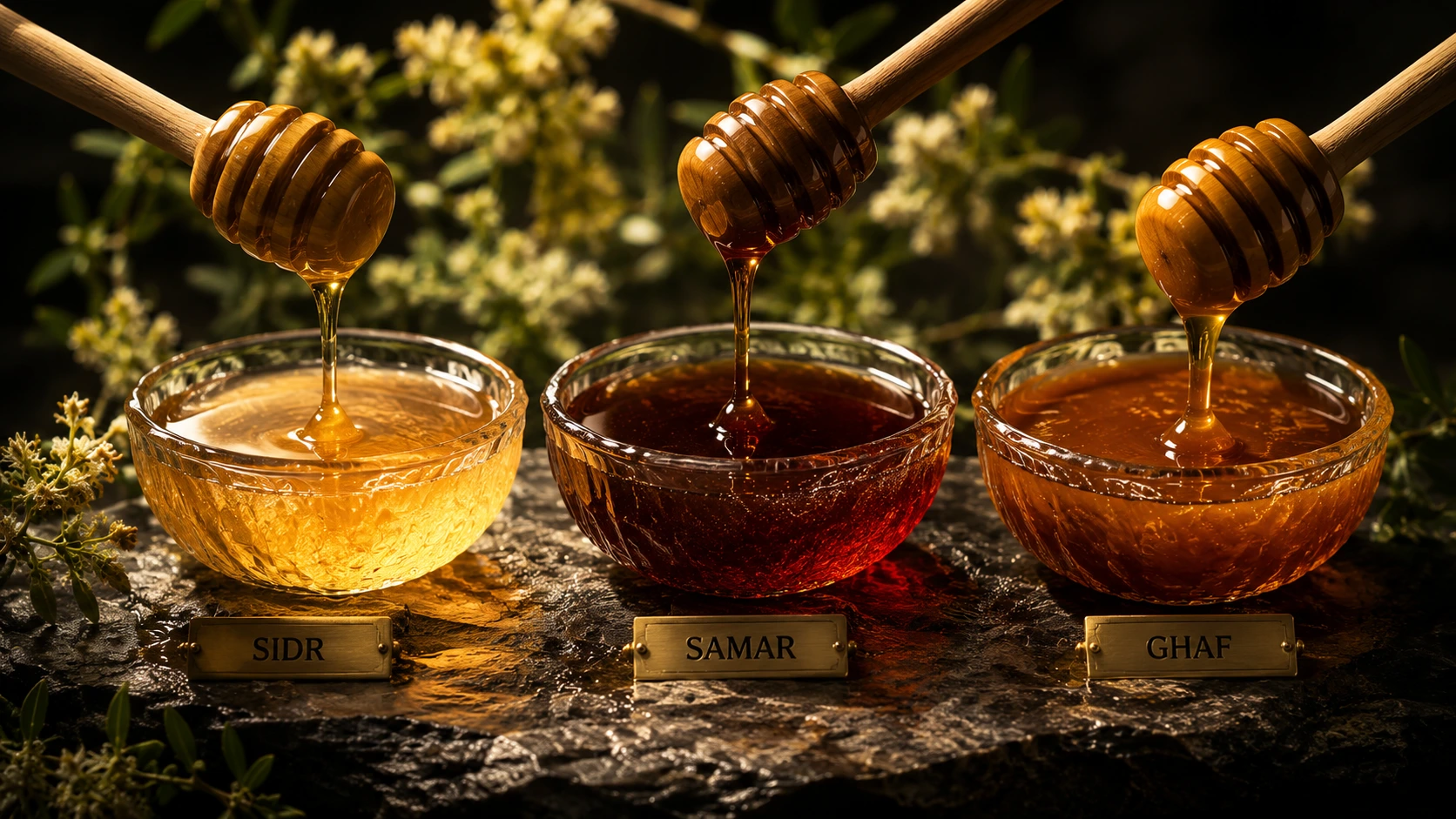
Sidr, Samar, Ghaf and Mountain Harvests
The great Arabian honey families express different trees and microterroirs.
Sidr Honey
Deep, aromatic honey from jujube blossoms across Yemen, Oman, Saudi Arabia and the UAE.
Samar Honey
A darker desert honey often associated with a more robust and persistent profile.
Ghaf Honey
A less familiar Emirati expression connected to the UAE national tree.
Highland Harvests
Small batches shaped by elevation, cooler nights and isolated flowering zones.
How Rarity Reaches the Jar
The beekeeper must position colonies before flowering, wait for maturity and protect the honey from unnecessary heat.
Hive placement
Place colonies where the intended blossom is dominant.
Mature harvest
Wait until the comb is sufficiently capped.
Gentle extraction
Use minimal processing and coarse filtration.
Protected storage
Keep the honey away from excessive heat and light.
How to Compare Rare Arabian Honeys
Compare individual harvests rather than country reputations.
| Criterion | What to seek | What it does not prove alone |
|---|---|---|
| Precise origin | Named valley or apiary | Automatic purity |
| Texture | Natural density | Authenticity |
| Price | Consistency with scarcity | Quality |
| Analysis | Moisture, HMF and sugar profile | Complete sensory excellence |
Can the Story Be Verified?
A trustworthy producer should explain where the honey was harvested, who supplied it and how it was handled.
Luxury begins with truth. Packaging may elevate the experience, but traceability protects the value inside the jar.
Tree
The flowering species provides the botanical starting point.
Terroir
Altitude, soil and water create nuance.
Human care
Harvest and storage preserve quality.
Discover Arabian Honey Terroirs
Explore selected Sidr and Samar honeys chosen for traceability and sensory quality.
Selected Sources and Further Reading
Frequently Asked Questions About Rare Arabian Honeys
Rarity changes by season, location and yield, so no single honey is permanently the rarest.
No. A limited Omani or Emirati harvest may be equally or more scarce.
It is honey associated with regional desert acacia-type flowering known as Samar.
It is honey produced when bees forage significantly on Ghaf blossoms.
No. Price must be assessed with origin, documentation and harvest information.
Through traceability, harvest records and appropriate laboratory analysis.
Minimal processing is generally preferred for preserving aroma and quality markers.
Tightly closed, away from direct sunlight and unnecessary heat.