
Muscat and Zanzibar were not two separate stories during his reign. The Indian Ocean was the road between them.
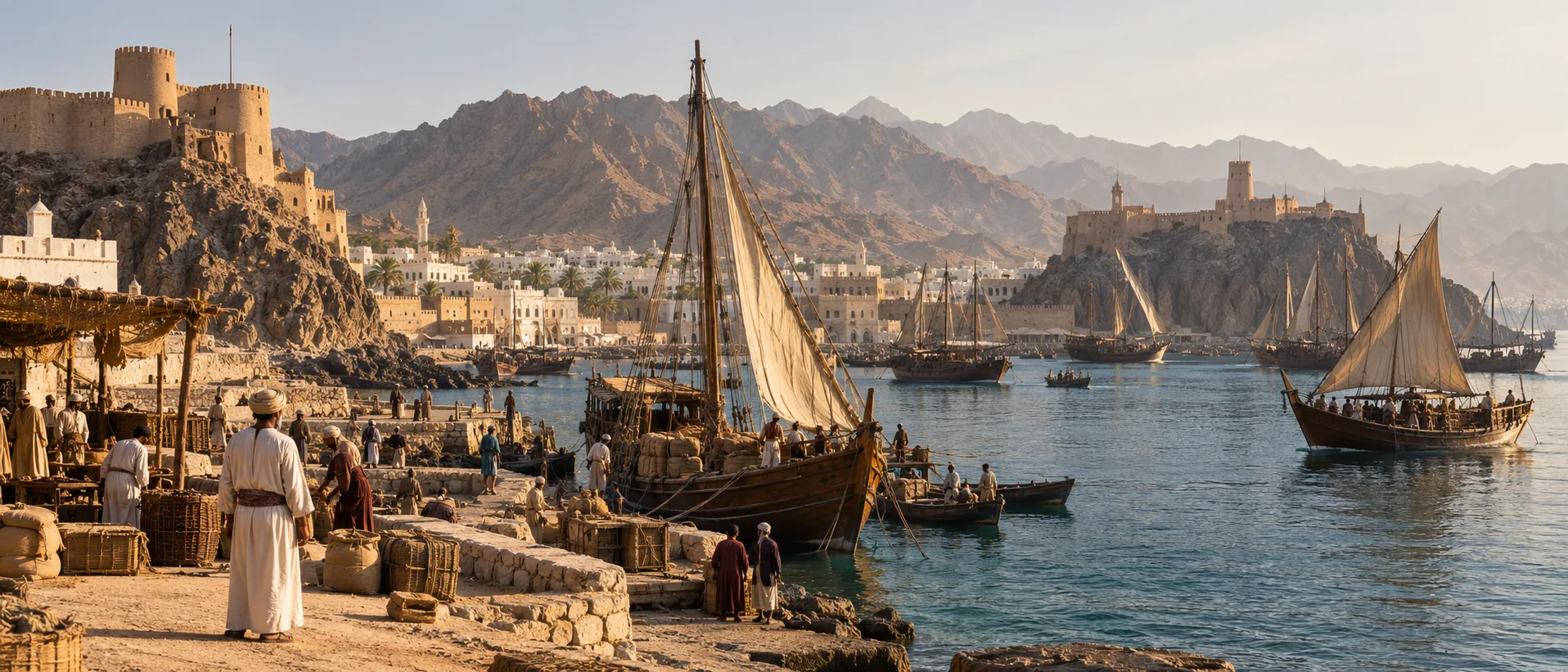
Said bin Sultan is often introduced with one irresistible sentence: the ruler who moved his capital from Muscat to Zanzibar and built an Omani empire in East Africa. The sentence points toward something real, but it also makes the world too neat. His power was maritime, negotiated and spread across ports whose relationships were never identical. To understand him, we have to follow the ships, the merchants, the plantation economy, the diplomacy and the human cost that connected Arabia to East Africa.
He inherited an Omani maritime world, not an empty ocean
Said bin Sultan did not invent Oman’s connection to East Africa. Omani power and commerce had been moving through the western Indian Ocean for generations before he ruled. Muscat was already a major port, Omani influence on the East African coast had older roots, and the Al Busaid dynasty itself had been founded by Ahmad bin Said in the eighteenth century. Said inherited networks, rivalries and ambitions that were already in motion.
That matters because the phrase “Omani empire” can make the story sound like one man drew a map and then filled it. The historical reality was more maritime and more negotiated. Ports, islands, coastal settlements, merchants, governors, tribal groups and local elites were tied together with different degrees of obedience. Modern historians sometimes prefer the word thalassocracy, a sea-based political order, because it captures that uneven geography better than the image of a centrally administered land empire.
Muscat was one centre, Zanzibar became another
Omani official history emphasises Muscat’s enduring role as the capital after it replaced Rustaq in the late eighteenth century. Said bin Sultan, however, increasingly spent time in Zanzibar and made the island a principal residence and political centre. It is common to read that he “moved the capital” to Zanzibar around 1840, but that sentence is too tidy. Muscat did not stop mattering, and Oman did not become an African state with an abandoned Arabian capital.
A better image is a ruler working across two centres connected by sea. Monsoon winds, ship technology and seasonal sailing made the Indian Ocean a highway with its own calendar. Said’s court, officials, family and commercial interests could move through that world in ways that look unusual only if we imagine political power must sit permanently inside one capital building.
Zanzibar offered something Muscat could not
Zanzibar sat close to the fertile East African coast and to commercial routes reaching the mainland. Its climate supported plantation agriculture on a scale impossible around arid Muscat. Cloves, introduced earlier to the islands, expanded dramatically during Said’s era and became one of the commodities most associated with Zanzibar’s nineteenth-century prosperity.
The island also served as an entrepot for goods moving from the African interior and coast into Indian Ocean markets. Ivory, gum copal and other commodities passed through networks involving African producers, Arab landowners, Indian financiers and merchants from many ports. To call that system “Omani” is partly correct, but it should never erase the many communities whose labour and capital made it function.
The clove economy cannot be separated from enslaved labour
This is where any romantic story of dhows and spices has to stop and become more honest. The plantation economy of Zanzibar and Pemba expanded through enslaved labour, and the slave trade was deeply entangled with the commercial system over which Said ruled. Historians of Zanzibar document the growth of slave-based clove production and the movement of enslaved people from the East African mainland to the islands.
Said also operated in a period when British pressure against the slave trade was increasing and treaties attempted to restrict parts of it. The politics were complicated, enforcement was uneven and later anti-slavery legislation continued under his successors. None of that changes the central fact: wealth in cloves and plantation expansion was inseparable from coercion. If we admire Omani maritime reach, we have to keep the people who paid its human cost inside the same story.
His power depended on merchants as much as warships
A dhow can carry a flag, but commerce is what keeps it moving. Said’s world depended heavily on merchant capital, credit and communities that connected Muscat and Zanzibar to India, the Gulf, Europe and North America. Gujarati and other Indian merchant networks were especially important in finance and trade. American and European firms also entered Zanzibar’s expanding commercial environment.
This is one reason Qalhat makes such a useful older comparison. In our article on Qalhat, medieval Oman already appears as part of an Indian Ocean system in which ports lived by movement rather than isolation. Said bin Sultan belonged to a much later century, but the geography of connection was familiar: Arabia looked outward because the sea made distance economically useful.
The Sultanah reached New York in 1840
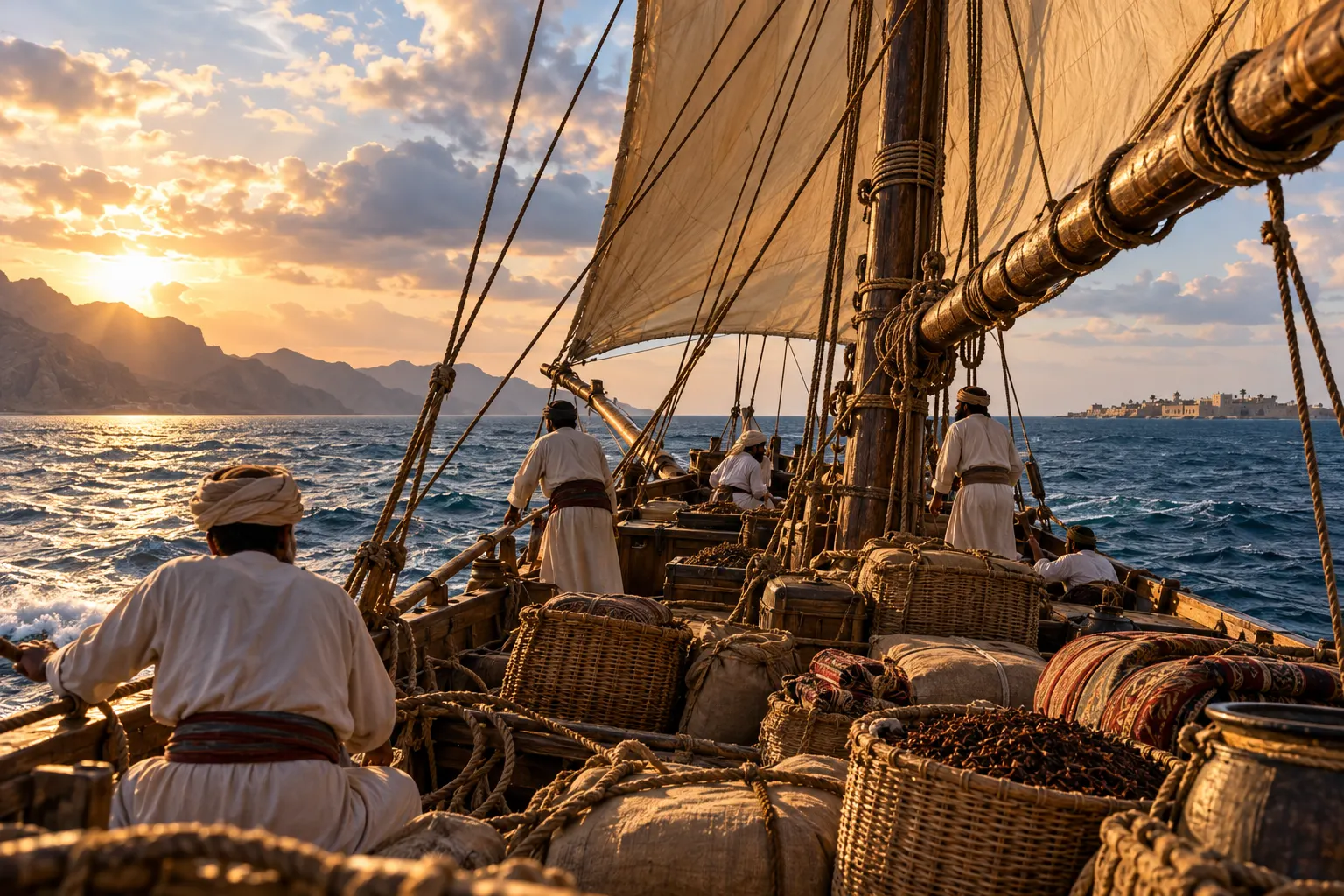
The National Museum of Oman preserves a striking material reminder of Said’s diplomacy: a cannon made in Boston and marked for the “Imaum of Muscat.” The museum links it to the period when Oman developed commercial and diplomatic relations with the United States. In 1840 the Sultanah, owned by Said, reached New York carrying his envoy Ahmad bin Na’aman.
The voyage is remarkable not because it proves Oman was suddenly a global superpower, but because it shows the scale of Said’s horizon. Muscat and Zanzibar were connected not only to neighbouring coasts but to an expanding nineteenth-century world of consuls, treaties, shipping and commodity markets. Dates from Arabia and cloves from Zanzibar could sit inside the same commercial mission.
Diplomacy was part of the maritime system
Said cultivated relations with Britain, the United States, France and other powers while also dealing with local rivals and governors. European consuls sometimes described him through their own interests, which means their correspondence has to be read critically. Still, the record makes clear that diplomacy was not an ornament to trade. It helped secure recognition, access and room to manoeuvre.
This was a period in which British naval dominance in the Indian Ocean was growing. Said could be powerful without being free from that larger structure. His treaties, anti-slave-trade commitments and commercial relations were all negotiated inside an unequal international environment. Maritime strength did not remove dependence; it changed the terms on which dependence was managed.
A sea empire was never fully centralised
Modern maps colour territory evenly. Said’s authority did not work that way. Cambridge scholarship on Oman and Zanzibar stresses the limits of centralisation and the importance of local groups, merchants, clan leaders and coastal rulers. Control could be strong in one port and negotiated in another. The Sultan’s authority over people and places could vary dramatically.
This does not make the polity unreal. It makes it historically different from a modern state. Said’s achievement was to hold together a wide maritime system long enough for Muscat and Zanzibar to function as connected political and commercial centres. The weakness was that so much depended on personal authority, family arrangements and negotiated loyalties that succession would expose the seams.
A sea can divide two shores. In Said bin Sultan’s world, it was also the thing that made them politically imaginable together.
Meskaoui
Sayyida Salme saw the household from inside
One of Said’s daughters, Sayyida Salme, later known as Emily Ruete, left us a different type of source: memory. In our article about Salme, the grand maritime world becomes domestic rooms, siblings, education, family rivalry and the emotional cost of leaving Zanzibar.
She was still young when her father died in 1856, so her memoir is not a ministerial record of his reign. That is precisely why it matters. States are experienced from kitchens, courtyards and family rooms as well as from ships and consulates. The same ruler who appears in diplomatic documents as Sultan of Muscat and Zanzibar appears in family memory as a father whose death changed the balance of an enormous household.
His death exposed a succession problem the sea had been holding together
Said died in 1856, and disputes among his sons quickly revealed how fragile the combined system could be without him. Thuwaini emerged in Muscat while Majid claimed Zanzibar. British-sponsored arbitration culminated in the 1861 Canning Award, recognising separate polities in Muscat and Zanzibar and establishing a payment from Zanzibar to Muscat.
That separation is one of the clearest measures of Said’s reign. During his lifetime one ruler had been able to hold both sides of the ocean within a single dynastic framework. After him, geography, family rivalry, commercial interests and foreign intervention helped divide the system. The ocean still connected Oman and East Africa, but the political map changed.
Frankincense reminds us that Oman had older exports than cloves
Zanzibar can dominate this story so strongly that Oman itself becomes only the point of departure. That would be another distortion. Southern Oman carried its own older commercial worlds. The frankincense routes of Dhofar show how resin, caravan stations and ports had linked Arabia to distant markets long before Said bin Sultan.
The nineteenth century added new scales and commodities, but it did not invent Omani outwardness. Dates, horses, textiles, frankincense, maritime skills and port knowledge belonged to a much longer history. Said’s reign is best understood as one intense chapter inside that continuity.
Two continents is a useful phrase if we remember the water between them
The title of this article says Said ruled an Omani world across two continents. That is true enough to be useful, but the most important geography is the ocean between them. Oman and Zanzibar were not two blocks connected by a line on a map. They were nodes inside a moving system of monsoon winds, sailors, merchants, enslaved people, diplomats, family members and cargo.
The ocean made Said’s political imagination possible. It also made the system uneven and difficult to control. Perhaps that is why his reign still feels larger than a conventional biography. To understand the man, you have to understand the sea.
What should we remember about Said bin Sultan?
Not that he simply “moved Oman to Zanzibar.” Not that every East African coast under Omani influence obeyed Muscat in the same way. Not that cloves were a romantic spice story. And not that his diplomacy can be separated from the commercial and coercive systems around it.
What remains is more interesting: a ruler who used an inherited maritime tradition to build one of the nineteenth century’s most extensive Arab political networks, who made Muscat and Zanzibar speak to each other across the Indian Ocean, and whose success was personal enough that the arrangement began to divide almost as soon as he was gone.
Sources and Archive Notes
Oman’s official information portal places Said bin Sultan within the Al Busaid dynasty and describes the first half of the nineteenth century as a period of Omani maritime power and expansion in East Africa.
The National Museum of Oman documents a Boston-made cannon associated with Said and the 1840 voyage of his ship Sultanah to New York, an important material trace of Omani-American diplomacy.
Cambridge scholarship on modern Oman, Zanzibar and the Indian Ocean emphasises that the domain was a maritime and negotiated political order rather than a uniformly centralised empire. Academic histories of Zanzibar also document the central role of enslaved labour in clove plantation production. This article keeps that coercive system inside the story rather than treating it as a footnote.
Questions People Ask
He came to power in the early nineteenth century and ruled until his death in 1856. Sources commonly give his reign as 1806 or 1807 to 1856 depending on chronology.
He ruled a dynastic maritime domain centred on Oman and Zanzibar, with dependencies and influence along parts of the East African coast. It was not a modern unitary state.
It is common to say he shifted his capital or principal residence to Zanzibar, especially around 1840. A more precise formulation is that Zanzibar became a major residence and political centre while Muscat remained fundamental to Oman.
Its location, fertile land and access to East African trade made it valuable for cloves, ivory, gum copal and wider Indian Ocean commerce.
Clove cultivation expanded dramatically and became a major export, but plantation production was tied to enslaved labour and cannot be separated from that history.
Yes. The slave trade and enslaved plantation labour were deeply embedded in the Zanzibar economy of his period, even as British pressure and treaties increasingly targeted the trade.
Yes. Oman developed early diplomatic and commercial ties with the United States, and Said’s ship Sultanah reached New York in 1840 with his envoy Ahmad bin Na’aman.
A succession dispute divided the dynastic domain. The 1861 Canning Award recognised separate polities in Muscat and Zanzibar under different sons.
Sayyida Salme, later Emily Ruete, was one of Said bin Sultan’s daughters. Her memoir offers a rare family perspective on the Zanzibar court and the world created during his reign.
Follow Oman beyond the shoreline
Read Said bin Sultan beside Sayyida Salme, Qalhat and the frankincense routes to see how many centuries of Omani history face the sea.