
From Ghaf and Samar to Sidr and Manuka, the best jar depends less on hype than on what you want the honey to do.
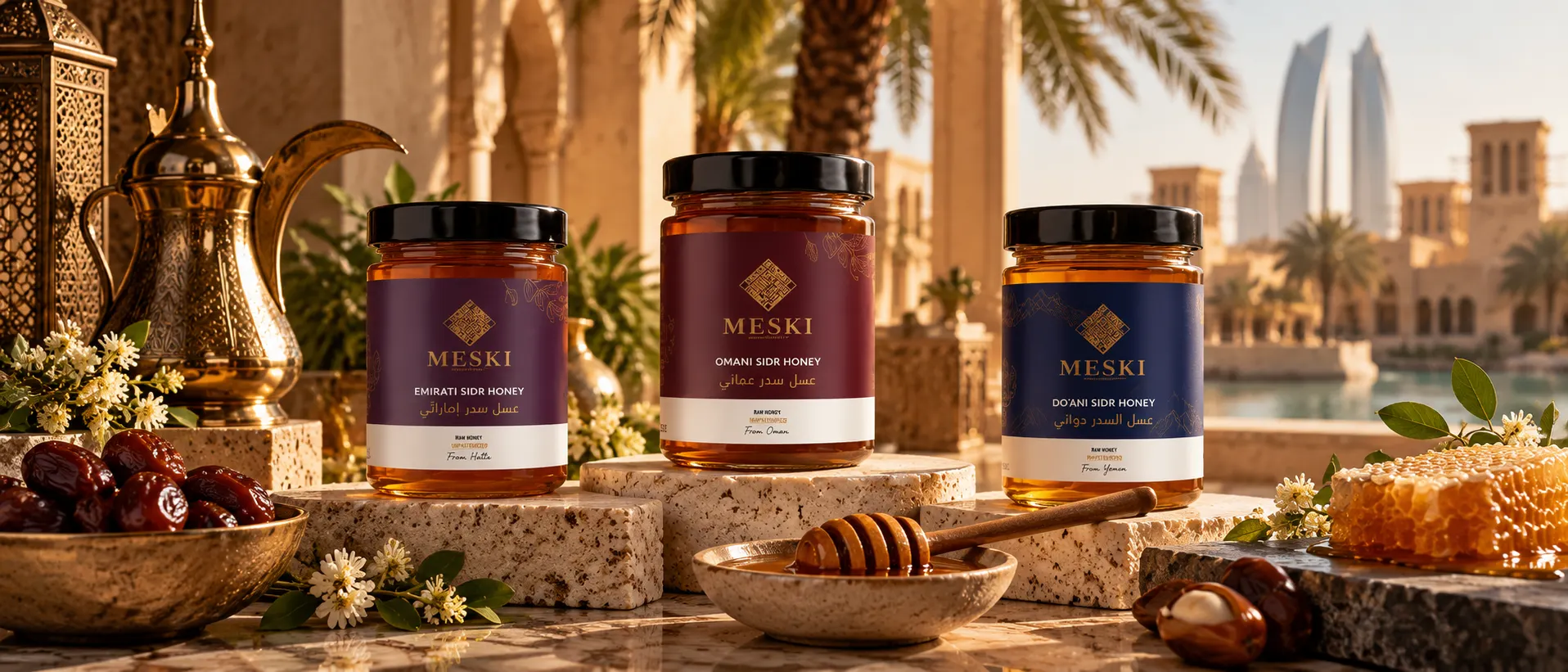
The UAE offers local Ghaf and Samar, Emirati Sidr, Yemeni Sidr, Omani honey and Manuka. This guide helps you choose the right jar for taste, gifting and trust.
Begin with purpose, not with hype
In the UAE, the honey shelf is wide enough to confuse almost any buyer. One jar is presented as a local desert treasure, another as a famous Gulf classic, another as a global wellness icon and another as a luxury gift. The mistake is to imagine that these jars are competing to answer one simple question. They are not. A jar chosen for daily family use is not chosen in the same way as a jar for a majlis visit, a corporate gift, a tasting session or a first introduction to Gulf honey. Once you accept that each purchase begins with a purpose, the market becomes easier to read.
That is why the best buying question is not, ‘Which honey is best in the UAE?’ but rather, ‘What do I need this jar to do?’ If you want a honey that speaks clearly of the Emirates, you will look differently than if you want a gift with instant prestige. If you want something accessible for a newcomer to Gulf honey, you will choose differently than if you are buying for a person who already knows strong regional flavours. Good buying starts with this clarity.
Local, regional and international are three different worlds
The UAE market brings together three overlapping worlds. The first is local honey, which includes Emirati expressions linked to landscapes such as Ghaf, Samar or local Sidr. The second is regional honey, especially jars from Yemen or Oman that are sold widely in the Emirates and are often understood through the wider Gulf conversation around Sidr, Samar and prestige gifting. The third is international honey, above all Manuka, which has its own New Zealand identity and its own vocabulary of grading and global recognition.
None of these worlds should be confused with the others. A jar bought in Dubai is not necessarily Dubai honey. A jar sold in Abu Dhabi may be Omani, Yemeni or New Zealand by origin. The city of sale does not replace the country and landscape of harvest. This is why a careful buyer separates shelf location from true provenance before thinking about flavour or status.
If you want the most clearly Emirati story, start with Ghaf
Ghaf honey answers a very specific desire: the desire to buy something rooted in the Emirates themselves. The Ghaf is not simply a tree name printed on a label. It carries environmental and cultural resonance because it belongs to the arid world of the UAE and is recognised as a symbolically important tree. When a jar is honestly connected to Ghaf, it can express an Emirati story more directly than a famous imported honey ever could.
This does not mean Ghaf automatically defeats every other honey. It means that Ghaf is usually the strongest first answer when someone asks, ‘Which honey should I buy in the UAE if I want something truly local?’ That makes it particularly compelling as a gift for visitors, for residents who want to understand Emirati products better, or for anyone who values place-based identity over borrowed prestige. Our guide to Ghaf honey helps explain that context.
Samar and local desert character
Samar usually attracts buyers who prefer a firmer, deeper and more assertive honey profile. In a market full of prestige language, Samar can feel refreshing because it often wins people through character rather than through reputation alone. It is the kind of jar that makes sense for people who already know that they like stronger honeys and who are less interested in simply following the most famous name on the shelf.
In the UAE context, Samar can also be one of the most satisfying ways to taste dry Arabian ecologies through honey. That makes it a strong personal purchase and, for the right recipient, a memorable gift. It may not be the easiest first jar for everyone, but it is often one of the most expressive once the buyer understands what they are looking for.
Why Sidr still dominates many buying decisions
Sidr continues to dominate because the word itself already carries meaning across the Gulf. Yet it is important to stop treating Sidr as a single uniform category. Emirati Sidr, Yemeni Sidr and Omani Sidr share a family resemblance in the minds of consumers, but they are not interchangeable. Each one belongs to its own landscape, harvest context and market story.
If you want to compare them sensibly, think in terms of intention. Emirati Sidr makes sense when the goal is local or near-local discovery. Yemeni Sidr often carries the strongest prestige aura. Omani Sidr may appeal to buyers who want a refined regional story with a different geography behind it. Our comparison of Emirati, Yemeni and Omani honey is useful precisely because it separates those intentions.
Where Manuka fits and where it does not
Manuka has a legitimate place on UAE shelves, but it plays a different role. People often buy it because the name is globally recognised and because its New Zealand origin and grading systems feel legible. In other words, they are buying a product that belongs to a highly codified international category. That makes sense for some customers.
But Manuka should not automatically displace Gulf honeys when the purpose of the purchase is regional identity, hospitality or discovery. If the point is to give or enjoy a jar that speaks to the Emirates or the broader Arabian world, then Ghaf, Samar or Sidr will usually say more. Manuka works when the buyer values its specific international reputation. Gulf honeys work when the buyer wants a jar that speaks through landscape, tradition and regional taste.
How to choose well in practice
If the gift must feel Emirati, begin with Ghaf or a credible local Samar or Sidr. If the buyer wants a widely recognised prestige jar, compare Yemeni and Omani Sidr rather than buying on reflex. If the buyer wants something for a person who values internationally graded products, then Manuka may fit. If the buyer wants a stronger personal tasting experience, Samar may be the most satisfying route. Once you define the purpose, the shortlist becomes clear.
Most importantly, do not buy by colour, thickness or vague slogans alone. Ask what tree or floral source is being claimed, whether the region is clear, whether the producer can connect the story to the lot and whether the presentation feels honest rather than theatrical. This is the method that turns a crowded shelf into a readable market. Our Hatta honey article is a good reminder that geography changes the jar even within the UAE itself.
How the jar meets the occasion
Buying for breakfast at home is not the same as buying for a host, a colleague or a person discovering Gulf honey for the first time. A home jar can privilege value, consistency and personal taste. A gift jar must also carry a legible story. The UAE shelf is wide enough to tempt buyers into confusing these occasions. That confusion is expensive because it leads either to overpaying for prestige that does not matter or to under-explaining a gift that should have felt thoughtful.
For everyday use, many buyers simply need a trusted jar whose taste fits their table. For gifting, the package and the explanation matter more. For a first introduction, the honey should teach something simple. This is another reason why there is no single best answer. The same buyer could quite reasonably choose local Ghaf for one occasion, Omani Sidr for another and Manuka for a third, without contradiction.
Price, rarity and honesty
The UAE market often trains the buyer to read price as if it were a direct map of quality. Yet price reflects many things at once: scarcity, transportation, branding, packaging, retail margin and the simple power of a famous name. A higher price may sometimes reflect genuine rarity, but it may also reflect presentation. A modestly priced jar from a credible producer can sometimes be more satisfying than a heavily packaged product that relies on prestige language.
This matters because the smart buyer is not anti-luxury. They simply refuse to let luxury replace explanation. If a seller can explain tree, region, season and lot with calm precision, that is worth far more than a theatrical claim of purity or exclusivity. In the long run, honesty is not only an ethical value in honey buying. It is also the most practical buying tool.
Climate, storage and travel
The UAE climate also affects how honey is handled after purchase. Heat, time spent in cars and poor retail storage can all influence the buyer’s experience of the jar. This does not mean honey becomes bad the moment it travels in warm weather, but it does remind the buyer to think beyond the label. A jar chosen carefully should also be transported and stored carefully, especially if it is intended as a gift.
For visitors carrying honey out of the country or across the city, packaging matters. A well-packed jar with a clear seal and tidy presentation travels more confidently into homes, offices and airports. In other words, buying well in the UAE includes considering how the product will live after it leaves the shelf.
A practical short list
If you need the shortest possible buying framework, think of four doors. Door one is local identity: Ghaf or a credible local Samar or Sidr. Door two is regional prestige: compare Yemeni and Omani Sidr. Door three is strong flavour: look seriously at Samar. Door four is international grading culture: Manuka. Once you know which door you are opening, the shelf becomes manageable.
This is why the UAE is actually one of the best places to learn how to buy honey. Its diversity forces the buyer to move beyond one-dimensional ideas. Instead of asking which jar is the absolute champion, you begin to ask which jar answers the purpose with the most honesty. That question produces better purchases every time.
Frequently Asked Questions
Ghaf honey is often the clearest answer when the buyer wants a jar strongly connected to the UAE itself, though local Samar and local Sidr can also matter.
Choose Ghaf if the goal is Emirati identity and Sidr if the goal is familiarity, prestige or a first entry into a famous Gulf category.
Often yes, because people who enjoy deeper and more assertive honey profiles usually appreciate Samar more quickly.
Because it carries a globally recognised origin and grading culture, which many buyers find easy to understand.
No. The place of sale and the place of harvest are different questions and should always be separated.
A jar or set with a clear story, calm presentation and trustworthy provenance usually works better than a louder but less coherent product.
No. Colour can vary naturally and cannot decide quality on its own.
That depends on whether you want local discovery, established prestige or a different regional terroir story.
Start by naming the purpose of the jar, then choose the style and origin that match that purpose most honestly.
Continue Exploring
From local Ghaf to regional Sidr and Samar, the Gulf honey world becomes much clearer once every jar is linked to its purpose and origin.