
Honey Academy · Travel & Places
Samar Honey, From an Ancient Tree to the Hives of Arabia
Before it becomes honey, Samar begins with a resilient tree shaped by heat, arid land and the patience of Arabian seasons.
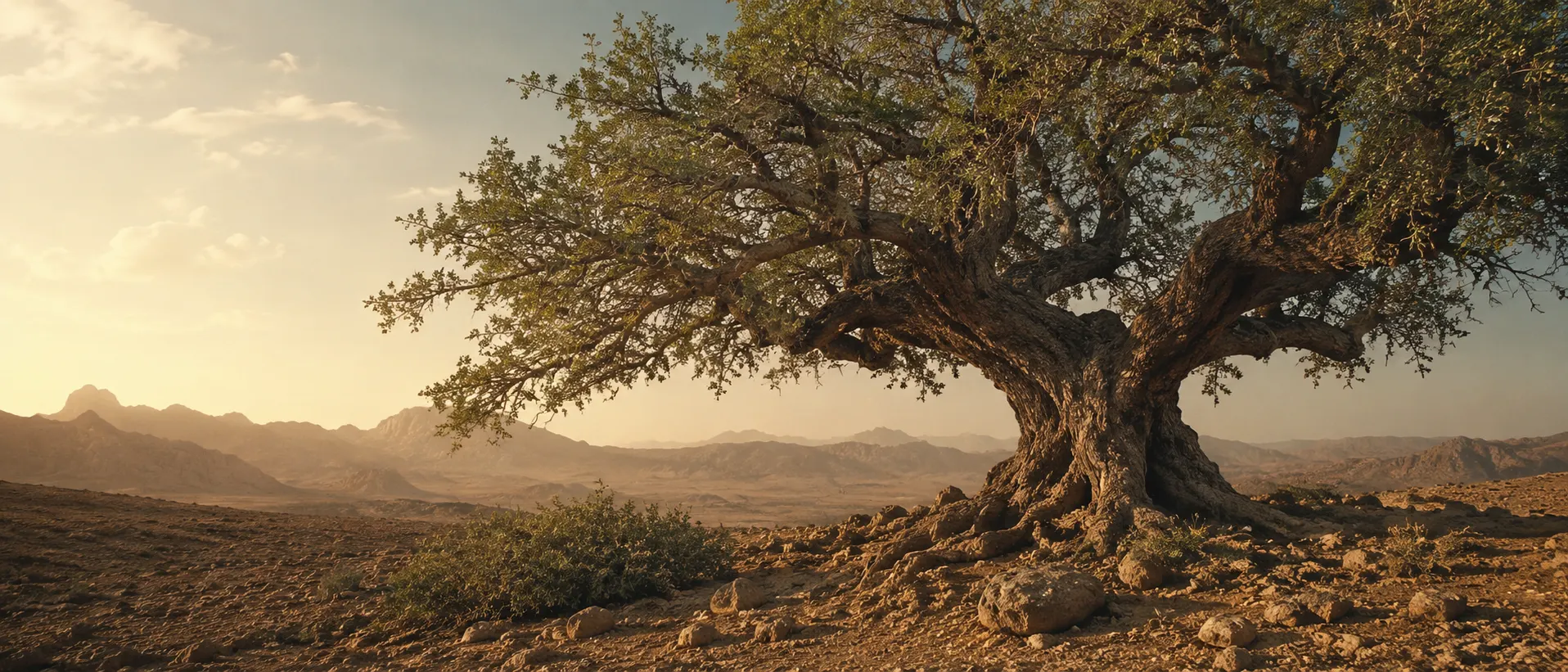
Some honeys are easier to understand when we begin with the tree.
Samar honey is one of them.
Before the jar, before the tasting, before the idea of a Gulf or Arabian honey, there is a tree that learned to live where many others struggle. It accepts heat, scarcity and hard ground, then offers bees a flowering season of real importance.
The tree first
Samar is commonly associated with acacia-type trees of arid environments, although local names and botanical usage can vary from one country to another.
That distinction matters.
For MESKI, the point is not to force every local Samar tree into one simplified botanical story. It is to understand the relationship between the name, the landscape, local beekeeping and the honey itself.
Samar belongs to a world of resilience.
From Yemen across Arabia
Samar honey appears in conversations about Yemen, Oman, the United Arab Emirates, Saudi Arabia and, more quietly in international discussions, Kuwait.
The landscapes are not identical. Neither are the climates.
Yet Samar returns as a thread connecting arid territories.
In Yemen it sits within a honey culture already famous for Sidr and other highly valued honeys. In Oman, the story changes with mountains, wadis and hot plains. In the UAE, Samar becomes part of a wider lesson about biodiversity surviving within an arid country. In Saudi Arabia, regional diversity creates another set of conditions. In Kuwait, beekeeping itself can become an exercise in adaptation to extreme heat and limited natural forage.
A honey like Samar does not begin in the hive. It begins in a tree that has remained faithful to difficult land.
Meskaoui
Why Samar honey matters
Because it is not an obvious honey.
When people first discover the world’s great honeys, they often imagine generous flower meadows, forests or humid valleys.
Samar tells another story.
Difficult land can also produce honey of strong identity. In fact, the difficulty of the environment becomes part of the terroir.
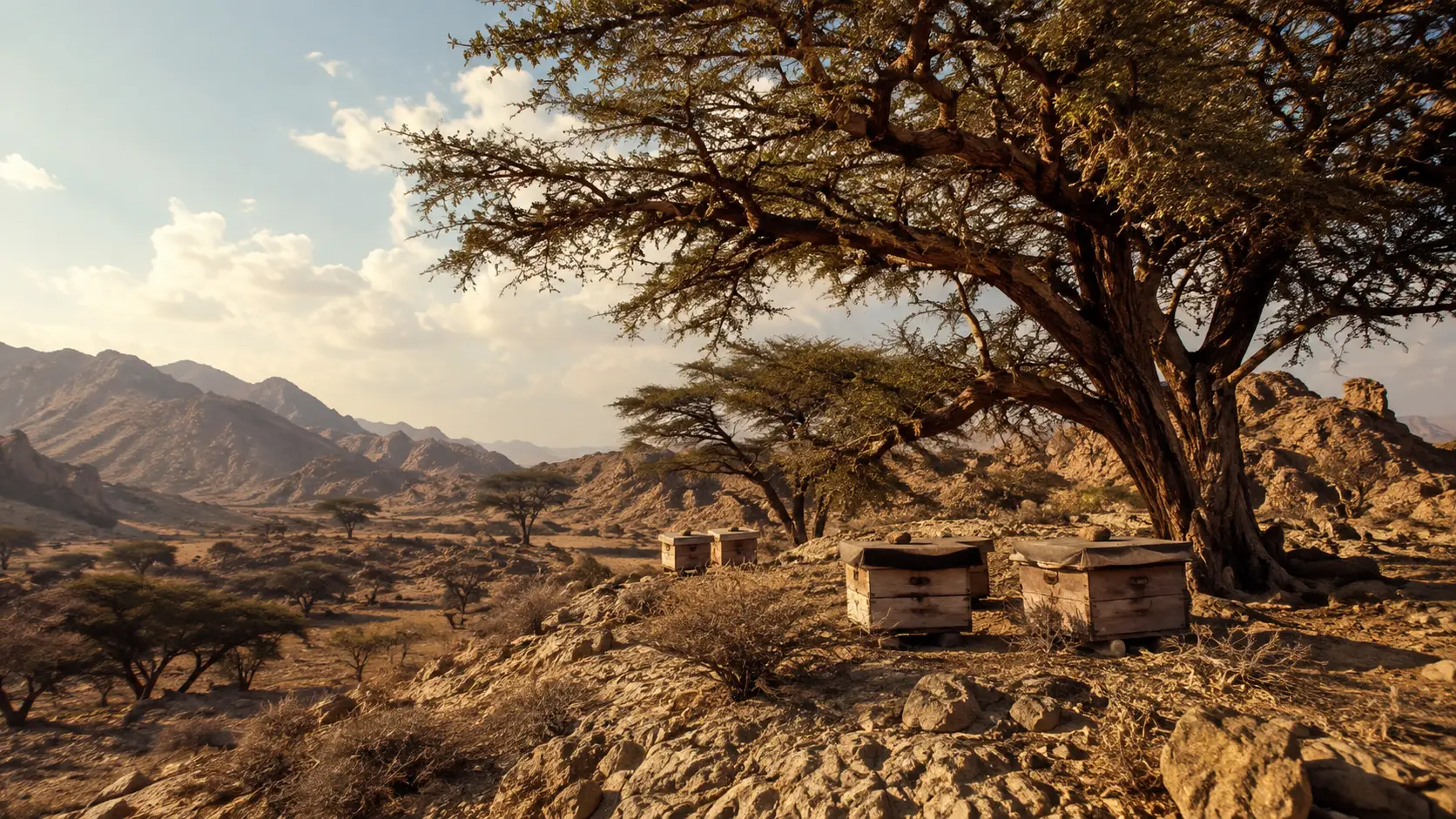
A honey shaped by climate
It is impossible to talk seriously about Samar honey without talking about climate.
That is one of the larger questions behind the MESKI Honey & Climate series: how do heat, rainfall, relief, drought and vegetation decide what bees can actually find?
In Yemen, Oman, the UAE, Saudi Arabia and Kuwait, bees do not face the same world. Yet Samar appears again and again within the ecology of arid land.
Samar honey and Sidr honey
Samar and Sidr are often mentioned together. That makes sense. Both belong to the wider culture of Arabian honey. Both are linked to emblematic trees and both carry strong local value.
But they are not the same story.
Sidr is associated with jujube trees and has become widely recognised internationally. Samar often remains more discreet outside the region, even though beekeepers and honey lovers know its importance well.
Yemen, Oman, UAE, Saudi Arabia and Kuwait
The most interesting approach is not to reduce Samar to one country.
Yemeni Samar honey, Omani Samar honey, Emirati Samar honey, Saudi Samar honey and Samar honey from Kuwait may share a name, yet climate, landscape, flowering conditions and beekeeping practice can differ significantly.
The same word therefore opens several territories.
That is precisely what makes Samar interesting for MESKI: understanding a honey through the places that carry it, rather than repeating one generic description.
An ancient-looking tree, a living honey
What I like about Samar is this mixture of depth and discretion.
The tree seems ancient. The landscape feels old. Yet the honey remains fully alive: harvested, offered, compared, tasted and discussed today.
In a world where origins are often flattened into marketing language, Samar asks us to return to something simple.
A land. A tree. A flowering season. A bee.
And perhaps that is why the story deserves to begin with the tree.
Samar Honey by Tree, Country and Season
Local plant names can shift between countries and communities, so the safest approach is not to assume that every honey labelled Samar has an identical botanical story. Origin and producer information matter.
A shared floral name does not erase terroir. Rainfall, altitude, surrounding vegetation, bloom timing, colony conditions and harvest practices can all influence the final honey.
Yes, genuine floral honey depends on flowering. The exact timing varies by location and year, which is why harvest season is useful information when comparing Samar honeys from different origins.
It highlights the limits and ingenuity of beekeeping under severe heat and restricted forage. In such environments, understanding where and when bees can find nectar becomes especially important.
Start with country and region, then look at harvest season, floral source information, texture, aroma and taste. Comparing origin before colour gives a much more useful picture of the honey.
Explore Samar Beyond One Jar
Compare the tree, the climate and the terroir before deciding what the word Samar means on a label.