
Real vs Fake Sidr Honey:
The Fraud Guide Gulf Buyers Need
Before you spend 300–800 AED on a jar labelled “premium Sidr” — understand what you’re actually buying, and how to know the difference.
Honey fraud is not new — it has existed as long as honey has been valuable enough to fake. But the Sidr honey market in the UAE presents a specific version of the problem: a product of genuine cultural significance, commanding genuinely premium prices, sold in a market where most buyers lack the tools to independently verify what they are getting.
This guide does not exist to scare you away from Sidr honey. It exists because we believe an informed buyer is the market’s best defence — and because the genuine product is extraordinary enough to deserve better than the mislabelled imitations that too frequently trade on its name.
The Scale of the Problem
Understanding why Sidr honey fraud has become a sophisticated industry.
The mechanics of why the Sidr market is particularly vulnerable to fraud are simple: demand for authentic product from the most prized regions has grown significantly, while genuine supply from those same regions has faced constraints. The gap between what buyers want and what exists creates both the incentive and the opportunity for fraud.
According to Wikipedia’s overview of food adulteration, honey adulteration is one of the most frequently detected forms of food fraud globally, partly because honey is consumed in relatively small quantities and consumed in a final form that makes detection by ordinary buyers difficult. Even experienced buyers, including professional apiculturists, have described being deceived by sophisticated product.
Four Types of Sidr Honey Fraud
What you are actually buying when the label doesn’t tell the truth.
Dilution with industrial syrups
The most common method: genuine honey is diluted with high-fructose corn syrup, beet sugar syrup, or rice syrup. The flavour and colour profile are then adjusted with natural extracts — including Sidr flavouring — to approximate the real product. Basic physical and chemical tests often miss this; only isotope ratio analysis reliably detects modern syrup dilutions.
Origin substitution
A real honey — from a lower-value origin — is relabelled as Yemeni or Emirati Sidr. This includes genuine Sidr varieties from Pakistan, Afghanistan, or generic Gulf multifloral honeys sold with premium origin labels. The honey may not be a bad product in itself, but the buyer is paying for a provenance that does not exist.
Blending down
A small proportion of genuine Sidr honey is mixed with a larger quantity of multifloral or lower-grade honey. The blend retains some of the characteristic colour and aroma of Sidr, making it detectable only through careful pollen analysis — which shows a lower-than-expected concentration of Sidr-specific pollen.
Fabrication without honey
The most extreme form: a product containing no genuine honey at all, manufactured from syrups, colourings, and flavourings to visually and aromatically approximate honey. This exists at the lower end of the “premium Sidr” market and is detected only through comprehensive laboratory analysis.
The existence of fraud in the broader Sidr honey market does not mean every seller is fraudulent. It means the buyer cannot rely on the label alone — and that sellers who invest in transparency (named origins, lab analysis, traceable supply chains) are making a meaningful investment in buyer protection that distinguishes them from those who do not.
Seven Ways to Evaluate a Jar Before You Buy
What buyers in the Gulf have relied on — and where each method’s limits are.
Colour — indicative, not definitive
Authentic Sidr honey ranges from medium to dark amber, sometimes with reddish tones depending on origin and harvest period. Very pale, watery-looking honey claiming to be premium Sidr warrants closer inspection. However, colour alone cannot confirm authenticity — it can be manipulated through caramelisation, colouring, or blending.
Texture and viscosity — more reliable
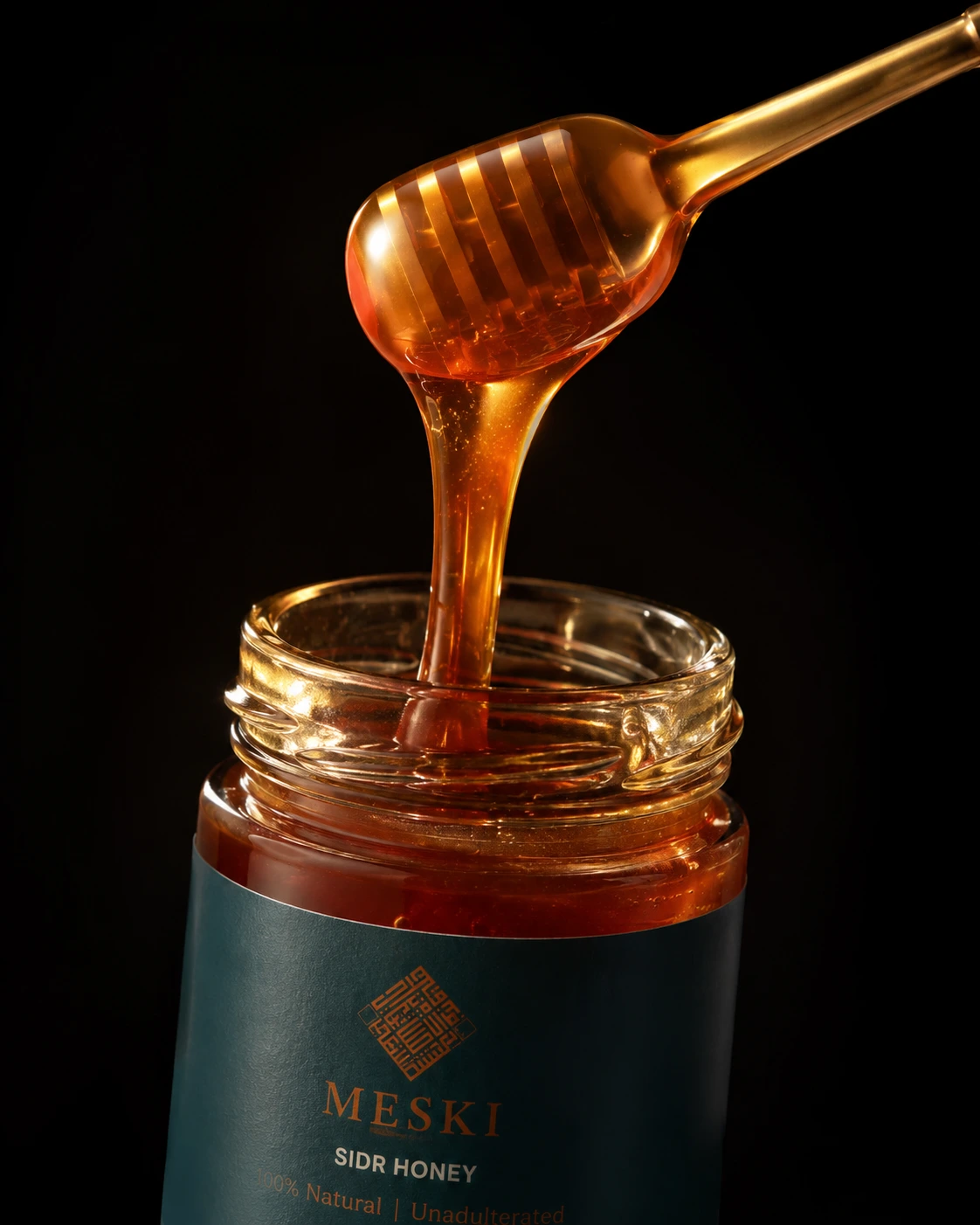
Tilt the jar slowly. Authentic Sidr honey is thick and moves deliberately — it does not pour quickly or flow like water. The movement should be slow and rope-like. Thin, fast-flowing honey at room temperature is a meaningful indicator, though not conclusive on its own.
Aroma on opening — often overlooked
Open the jar and inhale before tasting. Genuine Sidr has an immediate, distinctive aroma — warm, slightly woody, complex in a way that is hard to describe but immediately noticeable once you have encountered it. Weak aroma, generic sweetness, or anything that smells artificial is worth taking seriously.
Finish — the most diagnostic sense
Real Sidr honey has a long, complex finish — warmth and depth that persists for 30–60 seconds after tasting. Honey that tastes sweet initially but fades quickly, or that has a generic caramel note without subsequent complexity, is unlikely to be authentic monofloral Sidr of premium quality.
Geographic specificity — the critical question
“Product of Yemen” is a beginning, not a verification. Ask for the specific region, valley, or mountain range. “Hadhramaut,” “Wadi Do’an,” “Al-Hajar Mountains,” “Hatta” — these are names a genuine seller can provide. Vague geographic claims paired with premium pricing are one of the most consistent fraud signals in the market.
Lab analysis — the only definitive method
As documented in the honey industry and confirmed by expert beekeepers, there is no reliable home test for honey authenticity. Pollen analysis (palynology) can confirm monofloral composition; isotope ratio analysis can detect sugar syrup dilution; microbiological analysis can confirm raw status. For premium Sidr, ask whether lab analysis is available for the specific batch. Absence of analysis for a product claiming premium status is itself informative.
International awards — a meaningful external signal
Competitions such as the London Honey Awards or Great Taste Awards require honey to pass through independent expert judging panels before receiving recognition. A product that has earned competition recognition has had its authenticity validated externally — by palates and experts with no commercial stake in the outcome. Our Emirati Sidr from Hatta received recognition at the London Honey Awards 2022, and previous Yemeni Sidr we carried received 2 stars at Great Taste 2020.
Take care of fake
How We Approach This Problem
What sourcing transparency actually looks like in practice.
We are not going to claim that writing this guide makes us above the problem it describes. What we can say with precision is how we address it in our own sourcing decisions.
Named origins only. Every honey in our range is identified by specific region, not just country. If we cannot name where it came from, we do not carry it.
No wholesale brokers. Our supply relationships are direct — with beekeepers or their direct cooperatives, not intermediaries who have added distance and ambiguity between origin and jar.
Lab analysis for premium lines. For products in our limited-edition range, we request batch-specific analysis confirming monofloral composition.
Honest availability disclosure. When we do not have verified stock of a particular origin — including Yemeni Sidr, which faces genuine supply challenges — we say so rather than substituting and maintaining a label.
ESMA compliance. All products sold in the UAE through our platform meet the labelling and composition standards set by the Emirates Authority for Standardisation and Metrology.
None of this is a guarantee against the inherent difficulties of the premium honey market. It is a set of practices we consider the minimum for operating in it honestly.
Frequently Asked Questions
On honey fraud, detection, and what buyers can do.
This article describes general market patterns and does not make specific claims about individual sellers or products. All statements are made in good faith based on publicly available information and industry knowledge. For product-specific complaints, contact the relevant UAE regulatory authority.