
Arabian Lifestyle · A Place Not Yet Reached
Socotra:
The Island I Have Not Seen Yet, but Already Dream About
There are places we love because we know them. And others that attract us precisely because they still escape us.
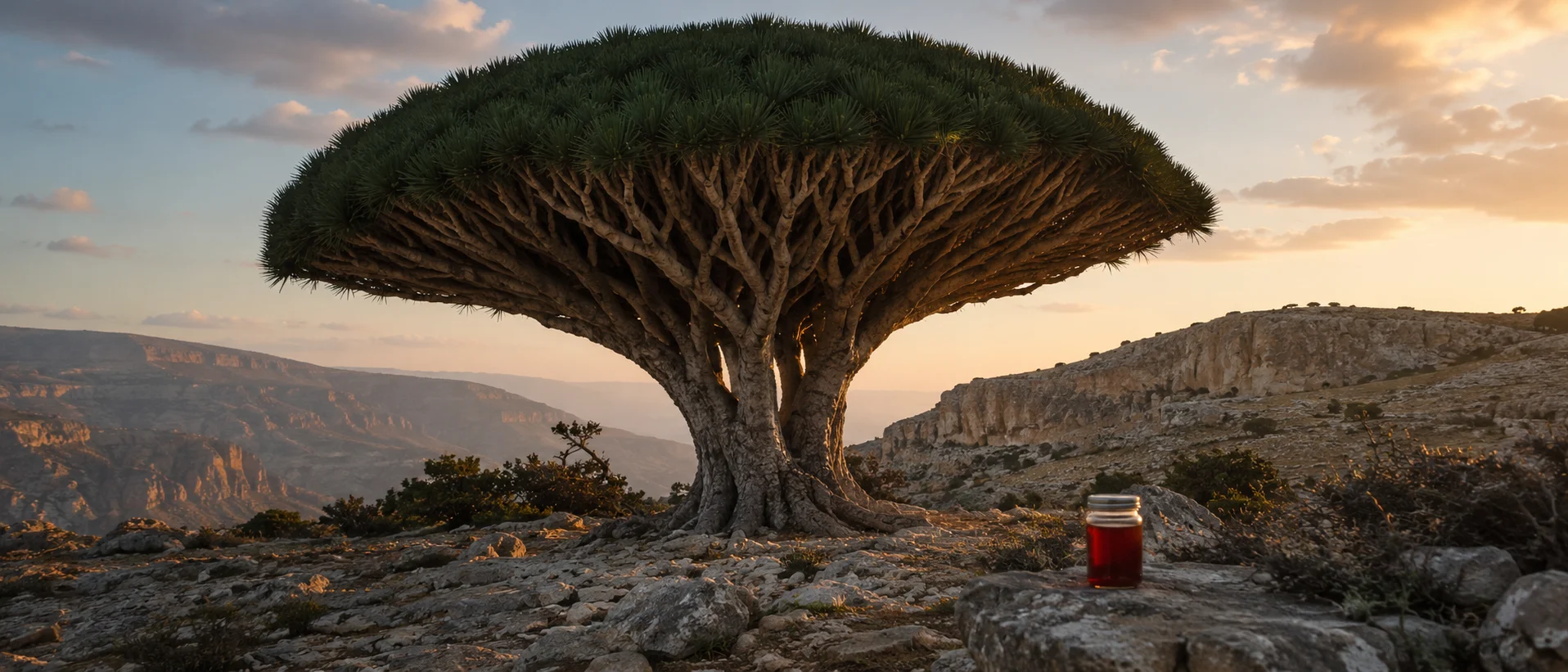
I have never been to Socotra.
I want that sentence near the beginning, not hidden at the end.
I have not walked beneath its dragon’s blood trees. I have not spoken with families there. I have not heard the Socotri language in a village. I have not watched the light change over its mountains or crossed one of its beaches at sunrise.
Everything I know so far has come from reading, images, conversations and curiosity.
Yet few places I have never seen occupy my imagination as much.
“There are places we love because we know them. And others that attract us precisely because they still escape us.”
Meskaoui
I Did Not Grow Up Dreaming About Socotra
This is not a childhood dream.
A few years ago, I barely knew the island existed.
I did not discover it through a schoolbook or a television documentary that stayed with me for years. The curiosity arrived later, indirectly, through Yemen and through natural products I encountered in the Gulf.
Then I started searching.
And Socotra became difficult to forget.
It Looks Like a Place Invented by Someone
The first images can seem almost artificial.
Dragon’s blood trees rise with dense umbrella-shaped crowns. Pale dunes meet turquoise water. Limestone plateaus break into valleys. Plants appear with forms that do not match the landscapes most of us carry in our memory.
But the strangeness is not visual theatre.
UNESCO lists the Socotra Archipelago as a World Heritage Site because of its exceptional biodiversity and endemism. Of its 825 recorded plant species, 307 are endemic. UNESCO also reports extremely high endemism among reptiles and land snails.
In other words, part of what makes Socotra look unlike anywhere else is that, biologically, much of it really is unlike anywhere else.
Four Islands, Two Rocky Islets, One Extraordinary Archipelago
Socotra is not only the main island whose images circulate online.
UNESCO describes an archipelago in the northwest Indian Ocean near the Gulf of Aden, extending around 250 kilometres and comprising four islands and two rocky islets.
That location matters.
It sits close enough to Arabia to belong to Yemen, yet close to the Horn of Africa and exposed to Indian Ocean worlds. Geography has made it both connected and isolated, near major routes yet distinct enough for extraordinary ecological development.
The Mystery Is Not Only in the Trees
Nature is what first attracts many outsiders to Socotra.
But an island is not a botanical garden without people.
UNESCO’s Man and the Biosphere programme highlights Socotra’s rich cultural heritage and its unique Socotri language. In 2024 and again in 2026, UNESCO supported initiatives focused on safeguarding and celebrating that linguistic heritage.
Socotri belongs to the Modern South Arabian language group. It carries vocabulary shaped by pastoral life, weather, plants, livestock and local land use.
This fascinates me because a language can preserve distinctions outsiders do not even know to look for.
If a community has many ways to describe rain, clouds, grazing conditions or stages of animal life, the vocabulary itself becomes a map of attention.
Isolation Preserves, but It Does Not Freeze
It is easy to romanticise an island by imagining nothing ever changes there.
That would be unfair.
Socotra is living through change like everywhere else. Development pressures, climate change, grazing, waste, invasive species and political instability all affect conservation. UNESCO’s recent conservation reporting discusses protected areas, restoration work and the need for stronger management.
A place can be ancient and vulnerable at the same time.
What I Hope to Find One Day
I do not dream of Socotra because I want to collect photographs proving I was there.
I want to understand scale.
How large does a dragon’s blood tree feel when you stand beneath it?
What does the dry air smell like?
How different does the island feel from the images once ordinary life enters the frame?
What do local people find normal that visitors find extraordinary?
Those are questions the internet cannot finish for me.
The Difference Between Knowing and Seeing
Research can teach facts.
It can tell me percentages of endemic species, scientific names, conservation status, linguistic families and the geography of the archipelago.
All of that matters.
But I have always believed there is a second layer.
You can know that a place has a certain smell without smelling it.
You can know the shape of a mountain without understanding the feeling of approaching it.
You can read about hospitality without sitting in the room.
Seeing is not the same as feeling.
If I Ever Reach It
I hope one day this article becomes incomplete.
I hope I return to it after travelling safely and legally when conditions allow, and realise that some of what I imagined was wrong.
That would be the best possible outcome.
Then I could write the second article:
I Finally Reached Socotra.
Not to replace this one.
To place the imagined island beside the lived one.
Socotra
Socotra is a Yemeni archipelago in the northwest Indian Ocean near the Gulf of Aden. UNESCO describes it as four islands and two rocky islets extending across roughly 250 kilometres.
Its long ecological distinctiveness has produced very high levels of endemism. UNESCO reports that 37% of its plant species, 90% of its reptile species and 95% of its land snail species occur nowhere else.
No. This is deliberately a researched article about a place he hopes to experience one day, not a first-hand travel report.