
Honey Academy · Arabian Life
Where to Find Good Honey in Dubai & the UAE:
Sidr, Samar, Ghaf, Hatta and Yemeni Honey
Dubai, Jumeirah, Marina, Deira, Sharjah, RAK, Al Ain, Hatta. The search location changes, but the first question should stay the same: where did the honey really come from?
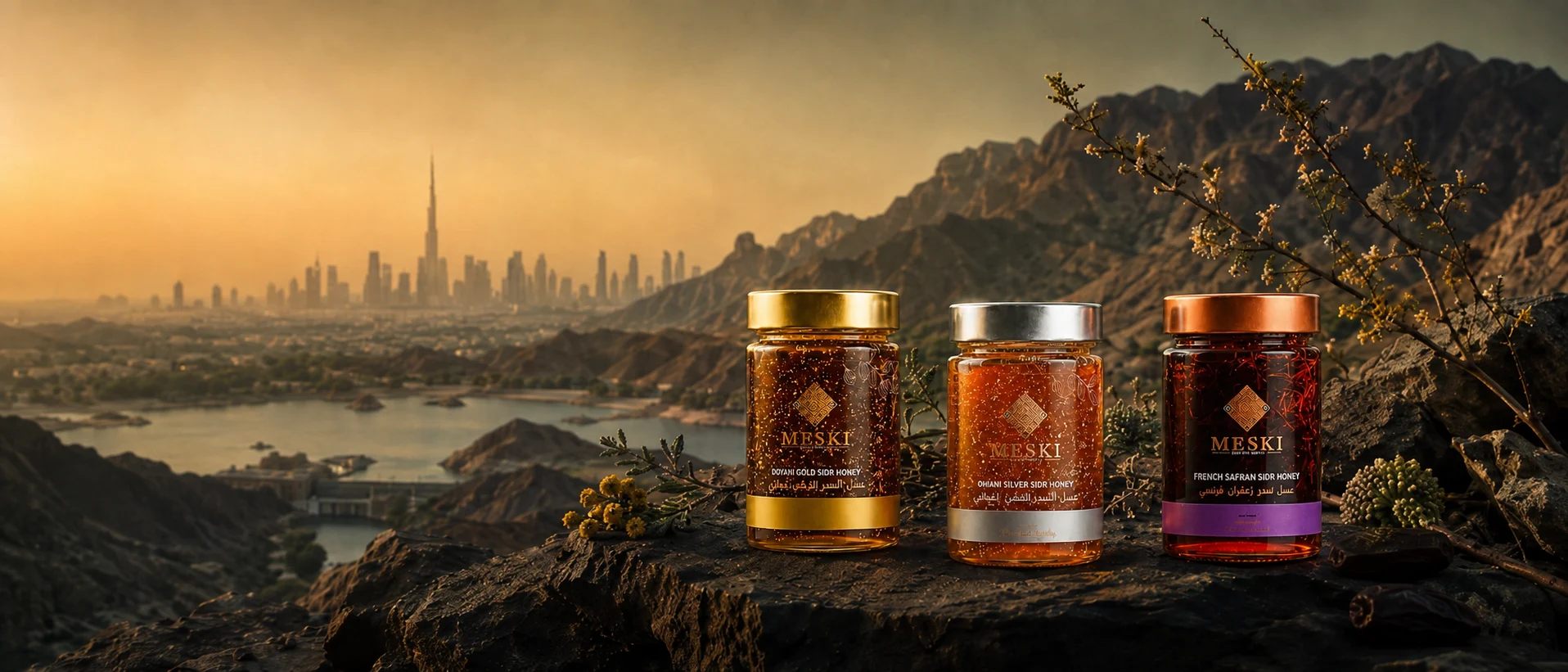
When someone in Dubai asks me where to find good honey, I never want to answer with one shop name.
I want to ask one question first: what do you mean by good?
Do you want Emirati Sidr from Hatta? Yemeni Sidr with a deeper profile? Samar from the Gulf? Ghaf because you want to taste a tree that belongs to the Emirates? A gift near Burj Khalifa? A jar delivered to Jumeirah or Dubai Marina?
These are different searches hiding inside the same sentence.
So this is not a ranking of shops. It is a map for understanding what you are actually looking for.
First, “good honey in Dubai” can mean two different things
When someone types where to find good honey in Dubai, they may be asking where to buy a jar near home, or they may be asking where the honey itself comes from. Those are not the same question. Dubai Marina can be a place to receive a jar, Jumeirah can be a place to shop for one, and Downtown can be where a visitor wants a gift delivered. None of those neighbourhood names automatically tells you the floral origin of the honey inside the jar.
That distinction matters because the UAE honey story is geographic in a different way. Hatta is associated with mountain landscapes. Al Ain brings oasis and agricultural environments into the conversation. Ras Al Khaimah combines mountains, desert, coast and fertile pockets. Abu Dhabi has supported beekeeping across Sidr, Samar, Ghaf, mangrove and wildflower environments. If you are searching for Sidr honey UAE, Samar honey UAE or Ghaf honey UAE, the useful question is not simply “which shop is closest?” It is “what origin, season and producer does this jar actually represent?”
The UAE Government still describes coffee and dates as integral to Emirati hospitality. That matters here because honey does not arrive in a cultural vacuum. Sweetness, dates, coffee, the guest and the act of offering something good already belong to a much older vocabulary of receiving people. The UAE Government cultural portal is a useful starting point for that context.
Sidr, Samar and Ghaf: three names you should know before you buy
The easiest way to improve your search is to stop using “honey” as if it were one product. In the Emirates, three names deserve particular attention: Sidr, Samar and Ghaf. They are not interchangeable labels. They refer to different botanical and seasonal stories, and they can lead to very different aromas and textures.
In March 2026, the Abu Dhabi Agriculture and Food Safety Authority reported gold awards for Sidr and Samar honey and a silver award for crystallised Ghaf honey at the Paris International Honey Awards. The same official announcement notes samples including Sidr, Samar, Ghaf, mangrove and Abu Dhabi wildflower honey. That gives us something more useful than marketing language: it confirms that the modern Emirati honey landscape is genuinely diverse. Abu Dhabi Media Office documents the results and the wider beekeeping programme.
So if you search Sidr and Samar honey UAE, do not treat the phrase as a choice between two packaging styles. Ask where each honey was harvested, what the beekeeper calls the floral source, when it was collected and whether the seller can explain the origin without hiding behind words such as “premium” or “royal”.
Where to find good honey in Dubai: Deira, Jumeirah, Marina and Downtown are buyer locations
Dubai is a city of neighbourhoods with very different rhythms, and search engines reflect that. Someone in Jumeirah may type Sidr honey Jumeirah. A visitor in a hotel may search honey near Burj Khalifa. A resident may type honey Dubai Marina or Samar honey Dubai Marina. Those searches are completely reasonable, but they should not be confused with terroir.
Deira is the most natural place to begin culturally. Visit Dubai describes the Spice Souk as a place of herbs, spices, nuts, oils and saffron, reached through the historic Creek and the old trading side of the city. Visit Dubai also highlights the habit of buying in bulk and talking directly with vendors. That older commercial language is close to how many people still discover dates, spices and honey: by asking, tasting and comparing rather than selecting only by a glossy front label.
Nearby, the modern Waterfront Market continues the food-market role of Deira. If your query is Dubai fish market dates and honey or dates and honey Dubai market, the useful cultural connection is not that every fish market sells the same honey. It is that Dubai’s food markets bring together fresh produce, traditional ingredients and the buying habits of a trading city. Visit Dubai lists Waterfront Market as a major food destination.
Jumeirah, Dubai Marina and Downtown Dubai work differently. Here, the search is more often about convenience, delivery, gifting and presentation. A person typing best Sidr honey Jumeirah, Sidr honey Dubai Marina or honey gift Downtown Dubai may care as much about a reliable delivery and an elegant box as about the jar itself. That is why a good seller should be able to separate two promises: where the honey comes from, and where it can be delivered.
Hatta Sidr honey: here the place can actually be part of the origin
Hatta changes the conversation because this is not simply a Dubai delivery district. It is a mountain area with a distinct landscape, and it has become strongly associated with Emirati honey in the public imagination. Searches such as Hatta Sidr honey, Sidr honey Hatta, Hatta honey Sidr and Emirati Sidr honey Hatta are therefore much closer to questions of origin.
The important thing is still to avoid shortcuts. “Hatta” on a label should not be accepted as proof by itself. Ask who produced it, which harvest it belongs to, whether the seller can document the relationship and how the honey was handled after extraction. MESKI has always preferred this slower conversation because a mountain name is meaningful only when the jar can be traced back to the people working there.
For a broader comparison of origin, see our Sidr Honey by Country guide and our dedicated comparison of Yemeni and Emirati Sidr honey. This page has a different job: it is about helping a buyer searching in Dubai or the UAE understand how location words should be read.
Sharjah, Ajman, Ras Al Khaimah, Al Ain, Abu Dhabi and Fujairah: do not turn every emirate into the same story
A common SEO mistake would be to write six nearly identical pages called “best Sidr honey Sharjah”, “best Sidr honey Ajman”, “best Sidr honey RAK” and so on. That would be useful for a search engine only on paper. For a reader, it would flatten the UAE into a list of place names. The country deserves better.
Sharjah and Ajman matter strongly as buyer locations. People search Sidr honey Sharjah, Yemeni honey Sharjah, honey Ajman or Samar honey Ajman because they live there and want access to a good jar. In those cases, origin can still be Hatta, Yemen, Oman or another clearly identified region.
Ras Al Khaimah deserves more geographical attention. Its official tourism site emphasises the emirate’s combination of mountains, desert, coast, mangroves and fertile areas. It also publishes a guide to places associated with local honey across the UAE, including Hatta, Al Ain, Fujairah and Ras Al Khaimah itself. Visit Ras Al Khaimah is therefore a useful source when someone searches RAK honey, Sidr honey Ras Al Khaimah or mountain honey UAE.
Al Ain brings another landscape into view. Abu Dhabi authorities describe honey environments extending from Al Ain’s mountains to Abu Dhabi’s desert and mangrove coast. Searches such as Sidr honey Al Ain, Ghaf honey Al Ain and Emirati honey Al Ain make sense because buyers are also learning to associate honey with landscape, not only with country.
Abu Dhabi is especially important for the documented development of Emirati queen bees and local honey categories. Fujairah and the eastern mountain belt add another climate and topography. What matters is not forcing one honey story onto every emirate, but understanding that the UAE contains several environments and several ways for bees and beekeepers to meet them.
Yemeni Sidr honey in the UAE: a different origin, bought in the same market
One of the most common searches we see conceptually is Yemeni Sidr honey UAE, followed by variations such as Yemen Sidr honey Dubai, authentic Yemeni Sidr honey UAE or best Yemeni Sidr honey Dubai. These phrases mix two geographies: the origin of the honey and the location of the buyer. That is perfectly normal.
A jar can be harvested in Yemen and sold or delivered in the Emirates. The honest label should keep those two facts separate. Yemen should describe the origin. Dubai, Sharjah or Abu Dhabi should describe the market or delivery location. When those distinctions disappear, marketing becomes more impressive but information becomes less useful.
For Yemeni honey, we recommend asking for the specific region or valley when possible, the harvest, the producer relationship and any available laboratory information. Our separate guide to buying authentic Yemeni Sidr honey in the UAE goes deeper into authentication. Here the important SEO phrase is also the honest sentence: Yemeni Sidr honey in the UAE is Yemeni honey available to a UAE buyer, not Emirati honey with a Yemeni style.
Sidr vs Samar vs Ghaf: choose by character, not by hierarchy
People often ask which honey is “best” as if there must be a single ranking. I do not think that is the most interesting way to taste. Sidr can be dense and commanding. Samar can bring a different aromatic profile. Ghaf can surprise people who know the tree culturally but have never tasted honey associated with it. The best jar depends on what you want from the spoon.
The official UAE beekeeping programme is useful here because it does not reduce national honey to a single flower. Abu Dhabi’s 2026 reporting explicitly mentions Sidr, Samar, Ghaf, mangrove and wildflower environments. That diversity is a reason to compare, not a reason to declare one winner forever.
If you want a direct comparison, our article Sidr Honey vs Samar Honey is the better place. If you want to understand how these names fit into a wider geography, use the MESKI Honey Atlas.
Dates and honey in Dubai: why the pairing feels natural
The UAE Government describes dates and Arabic coffee as traditional elements of welcoming guests, and Visit Dubai maintains a full guide to dates in the city. Honey does not need to be falsely presented as an identical ritual to belong comfortably beside them. It enters the same table through sweetness, generosity and the pleasure of serving something worth tasting.
That is why searches such as dates and honey Dubai, honey and dates UAE, Dubai dates honey gift and traditional food gift Dubai are interesting. They are not only shopping phrases. They connect a buyer to the wider idea of a gift that can be opened, served and shared rather than left in a drawer.
Visit Dubai’s date guide is worth reading for the fruit’s contemporary place in the city: A foodie guide to date fruits.
What does “best Sidr honey UAE” actually mean?
If we are going to use the phrase best Sidr honey UAE, I would rather define it than repeat it. “Best” should not mean the darkest colour, the highest price or the most gold on the label. It should mean the jar is appropriate for what you value.
For one buyer, that may be local Emirati origin. For another, it may be a deep Yemeni profile. For a third, it may be an Omani honey connected to a place they know. For a gift, presentation may matter more than it does for a breakfast jar. For a serious honey enthusiast, harvest information and traceability may matter most of all.
My own checklist is simple: origin, producer, harvest, handling, transparency, taste and purpose. Price comes after those questions, not before them.
The best honey is not the jar with the loudest story. It is the jar whose story survives the questions you ask.
Meskaoui
And if you are searching from Doha?
The same logic applies across the Gulf. Someone searching Sidr honey Doha, Yemeni Sidr honey Doha, honey Qatar or Samar honey Doha is often describing where they want to buy, not where the bees worked. Qatar has its own food and hospitality culture, and the buyer should still keep origin and purchase location separate.
We explore Qatar more deeply in our gifting and culture articles because Doha has a particularly strong relationship between modern business, the majlis and the act of receiving a guest. For honey itself, start with provenance first and city second.
How to read a honey label when you are buying in the UAE
A good label does not have to look like a laboratory report, but it should make the basic geography easy to understand. I want to see the honey type, the country of origin, ideally a more precise region when the producer can support it, a batch or harvest reference where available, and the seller responsible for the jar. If the front says “Hatta Sidr” and the back gives no way to understand who produced it or when, the front has done more work than the information.
For imported honey, the same logic applies. Yemeni Sidr honey Dubai should still tell you Yemen is the origin. Omani Sidr honey UAE should not become “UAE Sidr” simply because a UAE company packed or sold it. The seller and origin can both be important, but they describe different roles.
I also pay attention to words such as “raw”, “natural”, “pure” and “premium”. They can be useful descriptions, but they are not substitutes for traceability. If the seller uses them, ask what they mean operationally. Was the honey heated? Is it filtered heavily? Is there a known harvest? Is there supporting analysis? Good sellers should be able to answer without turning every question into a marketing slogan.
Price in Dubai: why an expensive jar can still be a poor buy
Dubai makes it easy to encounter luxury. That can create a dangerous shortcut in honey: the assumption that the highest price must correspond to the best jar. It does not always work that way. Price can reflect rarity, origin, packaging, import cost, small harvests, retailer margin, gift presentation or simply positioning.
A 400 AED jar may be justified. An 80 AED jar may be excellent value. The number alone cannot tell you. If you are searching best honey Dubai or best Sidr honey UAE, compare what you receive for the price: documented origin, flavour, freshness, handling, relationship with the producer, and the amount of packaging you are paying for.
This matters especially when buying a gift. A luxury box is part of the value if the purpose is gifting. If you are buying for your own kitchen, you may prefer to spend more of the budget on the honey and less on the box. The same jar can be “best” for one purpose and unnecessary for another.
Buying online in Dubai, Sharjah or Abu Dhabi: convenience should not reduce transparency
Online delivery is now a normal way to buy specialist foods in the UAE, and it solves the neighbourhood problem neatly. You do not need a separate article for honey Jumeirah, honey Dubai Marina, Sidr honey Sharjah and honey Abu Dhabi if one transparent seller can explain the origin and deliver responsibly across those areas.
The online page should therefore do more than a shelf label. It has room to tell you the region, tasting notes, harvest context, jar size and any available analysis. It should also tell you who to contact if you have a question. In my view, digital convenience creates a higher obligation to explain, not a lower one.
When a product page gives only “premium Sidr honey, best quality, natural, healthy” and nothing else, the buyer has been given adjectives rather than information. A serious page should help you compare two jars without needing to guess what the seller meant.
Taste before hierarchy: a simple way to compare Sidr, Samar and Ghaf
If you have access to more than one honey, taste them without deciding in advance which one should win. Use the same spoon, similar temperature and small quantities. Smell first. Let the honey sit on the tongue. Notice whether the sweetness arrives quickly or slowly, whether the aroma feels floral, woody, caramel-like, herbal or something else, and how long the finish remains.
You do not need professional tasting vocabulary. “I like this one with bread” is useful. “This one is too strong for breakfast but perfect with cheese” is useful. “This Samar feels more aromatic than the Sidr I expected to prefer” is useful. Taste is not a competition judged by the most expensive label.
This is also why the search permutations matter but should not control the palate. Google may ask Sidr vs Samar honey UAE. Your tongue may answer with a third jar of Ghaf.
Honey in Dubai & the UAE: Questions Buyers Actually Ask
You can find honey through specialist sellers, markets and online delivery across Dubai. Instead of choosing only by neighbourhood, ask for the honey’s origin, harvest and producer. A jar delivered to Jumeirah or Dubai Marina may come from Hatta, Yemen, Oman or another clearly identified region.
There is no single objective winner. Emirati Sidr from Hatta, Yemeni Sidr and Omani Sidr can all be excellent for different reasons. Compare origin, traceability, harvest, handling and taste rather than price or colour alone.
Yes in origin and terroir. Hatta Sidr is Emirati honey associated with the Hajar mountain environment, while Yemeni Sidr comes from Yemeni regions and producers. The floral family may be related, but geography, climate and beekeeping conditions can change the result.
Yes. “Yemeni Sidr honey UAE” describes Yemeni-origin honey sold to a UAE buyer. Check that the seller clearly identifies Yemen as the origin and does not blur the difference between where the honey was harvested and where it is sold.
They are associated with different floral sources and seasons. Taste and aroma can differ considerably. The useful comparison is not which name sounds more premium, but which origin and flavour profile you prefer.
Ghaf honey is honey associated with nectar from the Ghaf tree. UAE authorities include Ghaf among the country’s recognised local honey environments and reported a silver award for crystallised Ghaf honey in 2026.
Usually no. Jumeirah is normally the buyer or delivery location in that search. The floral origin may be Hatta, another UAE environment, Yemen, Oman or elsewhere. Always check the origin separately.
Dubai’s traditional food markets and specialist gift sellers make dates and honey easy to pair. Deira is culturally relevant because of its old markets, while premium gift delivery is common across Jumeirah, Marina and Downtown.
Not necessarily. “Honey near Burj Khalifa” is a location query, not an origin guarantee. Read the label and ask where the honey was actually harvested.
Explore Honey by Origin, Not Only by Label
Start with the Honey Atlas, then compare Sidr and Samar or read how Yemeni and Emirati Sidr differ before choosing your jar.