
Step beyond the glass towers and into a living testament to Qatari heritage —
alleyways, falconry, traditional food, crafts and the rhythms of one of Doha’s
most memorable places.
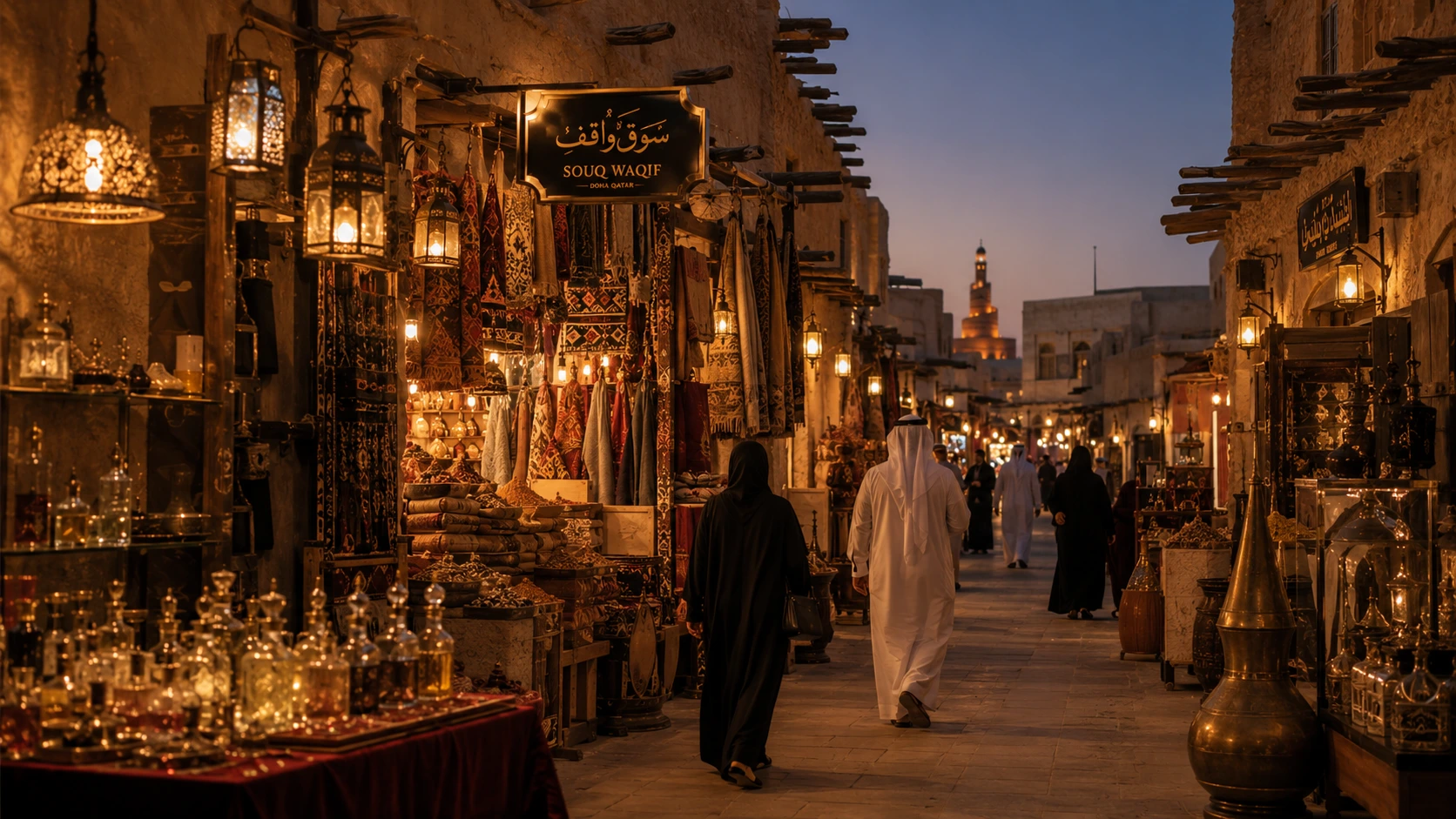
Souq Waqif is one of the places that gives Doha its memory.
Behind its earth-coloured walls and narrow alleyways are generations of trade,
hospitality, food, craft and everyday Qatari life.
Modern Doha rises all around it, but inside the souq the pace changes.
This is a place to walk slowly.
Where Doha’s Soul Has Always Lived
There is a moment, just after you leave the broad avenues of modern Doha
and step beneath the first traditional archways of Souq Waqif,
when the city seems to change character.
Oud and cardamom drift from the shops.
Conversations move between the cafés.
Wooden doors, shaded passages and warm plaster walls replace glass façades
and highways.
Ahead is a maze of lanes that still feels connected to the old trading life
of the Gulf.
For travellers who want to understand Doha beyond its skyline,
Souq Waqif is not simply somewhere to shop.
It is somewhere to observe how trade, food and hospitality still meet.
The History of Souq Waqif
The name itself tells part of the story.
Souq Waqif translates literally as “the standing market”,
a reference traditionally associated with merchants conducting their trade
while standing.
The origins of the souq reach back to the period when this part of Doha
was closely connected to the old shoreline and to the trading activity
moving through the Gulf.
As Doha modernised during the twentieth century,
the relationship between the market and the sea changed.
New construction gradually altered parts of the old souq,
while the city expanded rapidly around it.
A major restoration programme began in 2006.
Later additions were removed and traditional architectural elements
were restored, helping Souq Waqif recover the character
for which it is known today.
Why Souq Waqif Is One of Doha’s Most Iconic Landmarks
In a city known for the towers of West Bay, The Pearl,
museums and ambitious contemporary architecture,
Souq Waqif occupies a completely different place.
It does not compete with modern Doha.
It helps explain what came before it.
Qataris still come here to meet, eat, shop and spend evenings together.
Visitors therefore encounter something more interesting than
a reconstructed historical attraction:
a heritage district that continues to be used.
This continuity is what gives the souq its character.
Falconry equipment, spices, incense, textiles, food and coffee
are not displayed only as reminders of the past.
Many remain part of life in the region today.
Best Time to Visit Souq Waqif
The cooler months, particularly from autumn through early spring,
are the most comfortable for exploring Doha on foot.
During this period the courtyards, cafés and outdoor areas of the souq
become especially pleasant in the evening.
Within the day, two experiences are particularly different.
Morning is quieter and better suited to slow exploration and photography.
After sunset, the market becomes busier, restaurants fill
and the illuminated lanes take on another atmosphere entirely.
Opening Hours
Opening times can vary between shops, restaurants, seasons
and prayer periods.
If a particular shop or experience matters to your visit,
check its current hours before travelling.
What to See and Experience at Souq Waqif
Traditional Qatari Architecture
Before buying anything, give yourself time simply to look.
Souq Waqif’s restored architecture uses the warm colours,
shaded passages, wooden elements and traditional forms
associated with the historic built environment of Qatar and the Gulf.
Move beyond the busiest commercial lanes.
The quieter passages are often where the souq becomes most atmospheric:
narrow walls, deep shadow, wooden doors and the occasional cat
asleep on a warm step.
The Famous Spice, Perfume and Textile Shops
The spice section is one of the most sensory parts of Souq Waqif.
Sacks and jars display saffron, cardamom, dried flowers,
black seed and spice mixtures used throughout regional cooking.
Nearby, perfume shops introduce another part of Gulf culture:
oud, bakhoor, oils and incense.
The textile shops add another layer,
with traditional clothing, fabrics and garments displayed
beside materials imported from across Asia and the wider region.
Authentic Qatari Cuisine and Cafés
Food is part of the Souq Waqif experience rather than simply a break from it.
Depending on where you stop,
you may find grilled meats, rice dishes, breads, sweets,
Arabic coffee, dates and dishes from Qatar
as well as neighbouring Arab cuisines.
The best approach is not to rush from one landmark to another.
Sit down.
Order something.
Watch the market move around you.
A cup of Arabic coffee and a few dates can sometimes tell you more
about Gulf hospitality than another hour spent moving between shops.
Falcon Souq: A Unique Cultural Experience
Falconry remains one of the Arabian Peninsula’s most distinctive
cultural traditions.
At the Falcon Souq, visitors can see specialist merchants,
falconry equipment, perches, hoods and birds
within a setting where the tradition still has a practical life.
What makes this part of Souq Waqif memorable is that falconry
is not presented only as decoration.
It remains connected to knowledge, care, training
and identity across the Gulf.
Traditional Handicrafts and Souvenirs
Souq Waqif also rewards visitors who look beyond generic souvenirs.
You may encounter woven textiles, pottery, dallah coffee pots,
incense burners, decorative metalwork and objects connected
to the everyday traditions of the Gulf.
can carry more memory than a generic souvenir.
Understand what an object represents before deciding to take it home.
Photography Tips for the Perfect Souq Waqif Visit
Souq Waqif rewards photographers who move slowly.
Warm walls, wooden doors, shaded interiors and changing natural light
offer much more than the obvious wide-angle market photograph.
Shoot Around Golden Hour
Late-afternoon light works particularly well with the souq’s
warm architecture.
Arriving before sunset also allows you to photograph
the transition from daylight to illuminated evening streets.
Explore the Narrow Lanes
Leave the main passages occasionally.
Side alleys offer stronger geometry, shadows
and architectural details with fewer visual distractions.
Ask Before You Photograph People
A market is a place of everyday life, not a film set.
Ask permission before photographing people closely,
especially merchants, families and private interactions.
Look for Details
Coffee cups, spices, old doors, falconry equipment,
textiles, incense smoke and hands preparing food
can sometimes communicate the atmosphere of the souq
better than another photograph of the whole street.
Nearby Attractions to Explore After Souq Waqif
Art, Architecture and the Corniche
The Museum of Islamic Art provides another perspective
on the artistic and cultural worlds that connected
the Gulf to a much wider Islamic civilisation.
Qatar’s Contemporary Cultural Meeting Place
Katara brings together galleries, performance spaces,
architecture, restaurants and cultural events
in another major Doha destination.
Understanding Qatar Beyond the Souq
For visitors who want greater historical context,
the National Museum of Qatar tells the story
of the country’s landscape, communities
and transformation into the state seen today.
Essential Visitor Tips for Souq Waqif
| Tip | Details | Status |
|---|---|---|
| Dress respectfully |
Modest, comfortable clothing is appropriate; lightweight fabrics are useful during warmer months. |
Recommended |
| Bargaining |
Bargaining may be possible in some traditional shops, particularly for crafts and souvenirs. Keep it friendly. |
Sometimes |
| Payment |
Cards are widely useful, but carrying some local currency can still be convenient for smaller purchases. |
Useful |
| Prayer times |
Some businesses may briefly change their activity around prayer times. |
Be aware |
| Getting there |
Souq Waqif is accessible by Doha Metro, taxi and private car. |
Easy access |
| Ramadan |
Visiting during Ramadan offers a different rhythm, particularly after sunset and around iftar. Respect local customs and changing opening hours. |
Special experience |
Planning to buy spices, oud, dates, textiles or traditional gifts?
Read our separate guide:
What to Buy at Souq Waqif
.
This visitor guide focuses on experiencing the market itself.
Final Thoughts on Souq Waqif
Every great city eventually reveals something about itself through its markets.
Markets show what people eat, what they give,
what they still make and what they continue to return for.
Souq Waqif reveals Qatar in precisely this way:
through trade, hospitality, food, conversation and traditions
that have found a place inside a rapidly changing modern city.
Do not visit only to collect photographs.
Sit for a while.
Drink something.
Walk without a fixed route.
Seeing the souq is easy.
Giving it enough time to feel different from the rest of Doha
is what makes the visit memorable.
Frequently Asked Questions About Souq Waqif
Souq Waqif itself is a public market area and does not require
a general entrance ticket.
Individual experiences, events or attractions may have
their own conditions.
Evening is usually the most atmospheric period,
when restaurants and cafés become busier
and the market is illuminated.
Morning is better for visitors who prefer quieter lanes
and slower exploration.
Doha’s cooler months are generally the most comfortable
for spending long periods outdoors.
During hotter months, evening visits are usually more pleasant
than exploring during the middle of the day.
For a first visit, allow around two to three hours.
That gives you enough time to explore the main lanes,
visit the Falcon Souq, stop for coffee or food
and wander without turning the experience into a checklist.
If you plan to eat dinner, shop or photograph the market
after sunset, you can easily stay longer.