
A Gulf tradition rooted in faith, generosity and rarity — and how to choose a jar worthy of the gesture today.
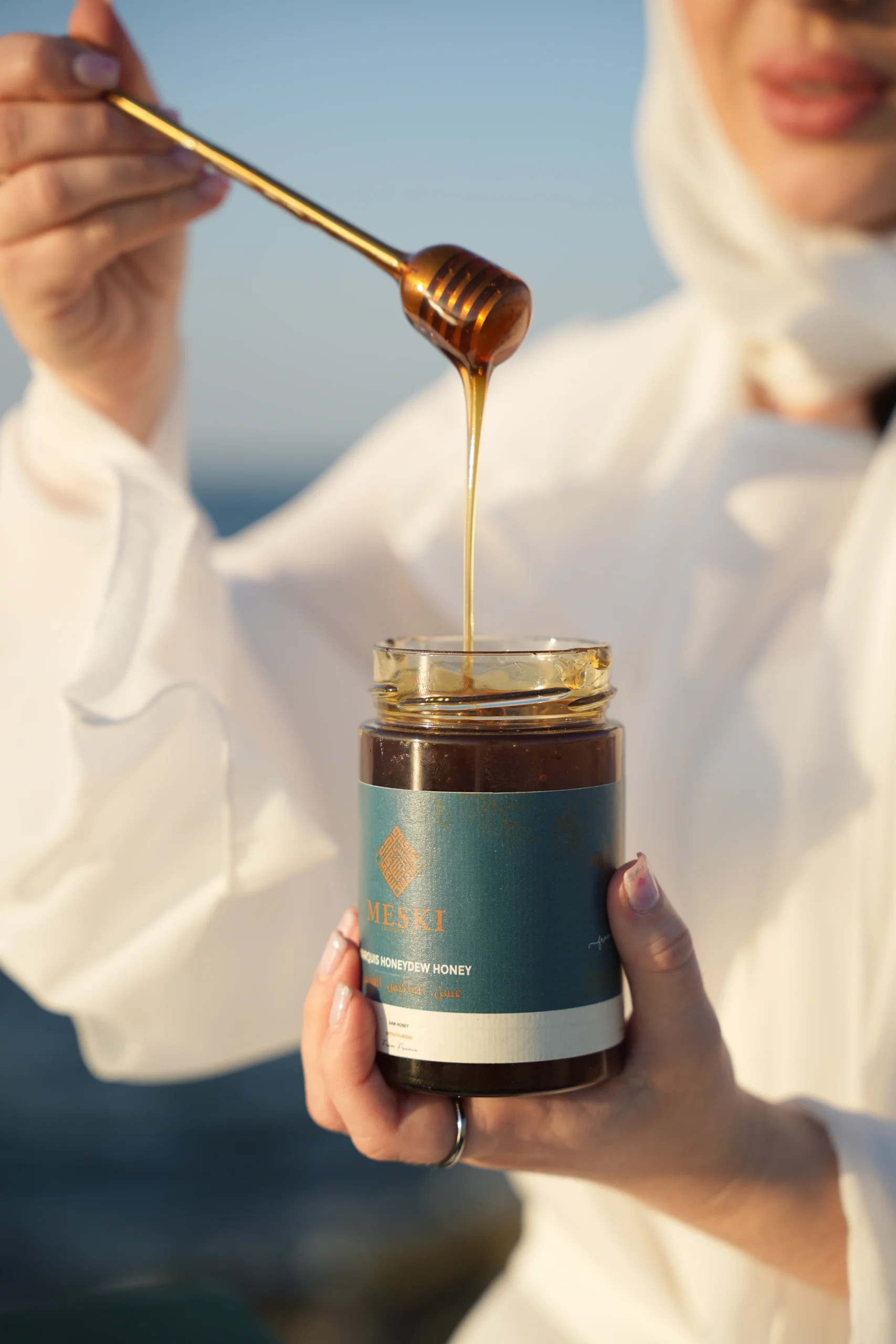
Some gifts speak before they are opened. The weight of the jar, the amber depth visible through the glass, the faint scent of wild blossom — in Gulf culture, a jar of raw honey carries more meaning than its contents alone. It carries history, faith, and a wordless declaration of regard.
A Gift That Predates Commerce
Long before luxury boutiques and curated gift boxes, the tribes of the Arabian Peninsula had already perfected the art of meaningful gifting. Among the most prized offerings exchanged between hosts and guests, between clans forging alliances, between families marking life’s great milestones, honey occupied a singular position. Not because it was sweet — sweetness was never in short supply — but because it was rare, laborious to obtain, and imbued with a significance that reached far beyond the palate.
In pre-Islamic Arabia, honey was traded across caravan routes stretching from the highlands of Yemen to the markets of the Levant. Merchants guarded their stocks as jealously as gold. A gift of honey communicated something that words in any language struggle to articulate: I hold you in the highest esteem, and I offer you the finest thing I possess.
That sentiment has never left the Gulf. It has simply grown more refined.
Honey in the Quran and Prophetic Tradition
For Muslims across the world, the significance of honey is not merely cultural — it is scriptural. In Surah An-Nahl (The Bees), verse 68–69, Allah addresses the bee directly, describing how from its belly emerges a drink “varying in colours, in which there is healing for people.” This Quranic verse transformed honey from a simple foodstuff into something closer to a divine gift — a substance that carries, by its very nature, a reminder of creation’s generosity.
The Prophet Muhammad (peace be upon him) held honey in particular esteem. According to authentic narrations, he was known to begin his mornings with a mixture of honey and water on an empty stomach, and he considered honey among the most beneficial of natural provisions. In the tradition of prophetic medicine — al-tibb al-nabawi — honey holds a place of enduring reverence, recommended not as cure but as sustenance of the highest order.
When a jar of raw honey is offered as a gift in the Gulf, this layered meaning is present whether spoken or not. The giver, consciously or intuitively, is participating in a tradition that stretches back to revelation itself.
The Sidr Tree: A Sacred Source
Not all honey carries the same weight in this tradition. Among connoisseurs and custodians of Gulf heritage alike, Sidr honey — produced by bees that forage almost exclusively on the blossoms of the Ziziphus spina-christi, or Sidr tree — occupies a tier of its own.
The Sidr tree is mentioned four times in the Quran, across three distinct surahs: Surah An-Najm (53:14 and 53:16), Surah Saba (34:16), and Surah Al-Waqi’ah (56:28). In these passages it appears as a tree of the earth and, more profoundly, as Sidrat al-Muntaha — the Lote Tree of the Utmost Boundary, a tree of paradise. Its wood was valued since antiquity; its fruit sustained travelers and nomads; its shade sheltered the weary. And from its blossoms, bees produced what many still consider the finest honey on earth.
The Sidr trees of Yemen’s Hadramout valleys and Oman’s rugged highlands yield honey only once or twice a year, in quantities that are necessarily limited. This natural scarcity is not a marketing construct — it is geography and ecology. A jar of authentic Do’ani Sidr Honey or Omani Sidr Honey is, by definition, a rare object. Giving one says something that a thousand-dirham spa voucher simply cannot.
The Crown of Sidr Honeys
Yemen’s Hadramout valleys produce what is widely regarded as the world’s most prized Sidr honey. Harvested once or twice annually at altitude, its complex floral depth and dark amber colour are immediately recognisable to any connoisseur.
Highland Purity
Oman’s rugged highlands produce Sidr honey with a distinctive lighter profile and extraordinary clarity. Meski sources from verified Omani apiaries, including the prized Omani Samar & Frankincense Honey — a uniquely regional expression of Gulf terroir.
Local Pride, Global Prestige
The Emirates’ own coastal valleys yield a Sidr honey of quiet elegance — deeply connected to Emirati identity and increasingly sought after as a symbol of local heritage. Available at Meski as Emirati Sidr Honey.
The Majlis and the Language of Generosity
To understand why honey matters in Gulf culture, one must understand the Majlis. More than a room, the Majlis is the physical expression of a host’s soul — a space where guests are received with an attentiveness that Western hospitality rarely approaches. Every element of what is served, and how it is served, communicates status, warmth, and the depth of the relationship being honored.
In this context, what sits upon the Majlis table is never accidental. The quality of the dates, the provenance of the coffee beans, the texture of the honey — all of it is read, understood, and remembered. In Gulf households with a strong sense of heritage, serving a premium raw honey alongside gahwa is not an indulgence; it is a statement of values.
Honey as a Social Currency in Gulf Societies
Across the GCC, honey functions as what anthropologists would call a prestige good — an item whose value is simultaneously material and symbolic. Offering honey to a guest in the Majlis conveys brotherhood and honor; presenting it as a gift to a business partner signals that the relationship is viewed as something worth preserving with care. In tribal traditions that persist, quietly, beneath the surface of Gulf modernity, gifting a particularly fine honey to the patriarch of a family you are visiting is an act of respect that lands with a precision that no branded merchandise can replicate.
This is not sentiment. The cultural literature on Gulf hospitality consistently identifies honey as among the most potent symbolic foods in the regional repertoire — alongside dates and frankincense — precisely because of the convergence of religious reverence, historical rarity, and sensory pleasure that it embodies.
The Occasions That Call for Honey
Honey is, in Gulf culture, genuinely seasonless. Its role shifts with the occasion, but it never disappears from relevance.
Eid al-Fitr and Eid al-Adha
Gifting premium honey at Eid is among the most traditional of gestures. After a month of fasting, the sweetness of raw honey carries a particular resonance — nourishing, celebratory, and deeply connected to prophetic tradition.
Weddings and Engagements
In many parts of the Gulf and Yemen, honey features in marriage ceremonies as a symbol of sweetness and prosperity in the life ahead. A luxuriously presented jar is both gesture and statement.
New Home and New Business
Presenting honey at the opening of a new home or business venture carries the wish for abundance, clarity, and a life as rich and purposeful as the gift itself.
Corporate Hospitality
In the UAE’s sophisticated business culture, the shift away from generic branded merchandise towards curated, meaningful gifts has been notable. Premium raw honey communicates a refinement of taste and cultural awareness that boardrooms across Dubai and Abu Dhabi respond to instinctively.
Ramadan Gifting
The holy month is perhaps the most natural moment for honey. Whether shared at Iftar or offered as a gift to mark the occasion, raw honey connects the spiritual and the sensory in a way that few other foods can claim.
What Makes a Honey Gift Truly Worthy
Not every jar earns the right to carry this weight of meaning. The degradation of the word “honey” on supermarket shelves — blended, heated, diluted, treated — has made discernment not just a preference but a necessity for anyone who wishes their gift to say what they intend it to say.
What to look for: the authenticity test
A honey worthy of gifting must begin with an honest answer to a simple question: where, exactly, does this honey come from, and how was it handled between hive and jar? Raw honey — never heated above the natural temperature of the hive, never ultra-filtered, never blended — retains the full complexity of its botanical source. Provenance is not trivia. It is the living proof of a specific place, a specific season, and the irreplaceable labour of specific bees.
Rarity, Provenance and the Question of Authenticity
The Sidr honey of Yemen’s Wadi Do’an differs perceptibly from that of Oman’s Dhofar region; both differ from the Sidr harvested in the Emirates’ own coastal valleys. These distinctions are not trivia for specialists. They are the living proof that what you hold in your hand is a product of a specific place, a specific season, and the irreplaceable labor of specific bees. That specificity is, in itself, a form of luxury.
Authenticity is not only about taste. It is about trust — between producer and buyer, and ultimately between the person who gives the gift and the person who receives it. A jar whose provenance cannot be traced is, regardless of its packaging, not a gift worth the occasion.
The Role of Presentation in Gulf Gift Culture
In Gulf culture, presentation is never superficial. The care taken with packaging communicates the care taken in the selection itself. An exquisitely crafted gift box — weighted, tactile, considered in its materials — tells the recipient, before the lid is even lifted, that what lies inside was chosen with genuine thought.
This is why the convergence of premium raw honey with luxury gift presentation is not a commercial artifice. It is a natural meeting of two things the Gulf has always valued: the excellence of the contents, and the elegance of the gesture. When rare Sidr honey, perhaps infused with the shimmer of 23-carat edible gold, arrives in packaging that reflects the care of its curation, the gift achieves something few objects manage — it honors the recipient and the tradition simultaneously.
At Meski Dates Factory, based in Sharjah, this philosophy shapes every box that leaves our hands. Whether it is a single jar of Yemeni Sidr destined for an Eid table, or a curated collection of Omani and Emirati honeys assembled for a corporate partner in Abu Dhabi, we understand that the gift is only partly about what is inside. It is equally about what it is understood to mean.
Choosing with Intention: A Note on Modern Gifting
The luxury gifting market in the UAE and across the GCC has evolved significantly in recent years. The appetite for meaningful, provenance-driven gifts has grown alongside a broader awareness of what authentic quality looks and tastes like. Today’s discerning recipients — whether Emirati, Saudi, international — are perceptive. They have tasted enough blended honey to recognize the real thing immediately, and they notice, consciously or not, when a gift has been chosen with knowledge rather than convenience.
Choosing a honey gift with intention means asking: Does the person who will receive this have a taste for complexity, for something with character? Do I want the gift to carry a sense of our region’s heritage, or to feel more internationally curated? Is the occasion intimate — a family gathering — or formal — a business relationship I am seeking to honor? Each of these questions leads naturally to a different honey, a different format, a different register of presentation.
The beauty of raw honey as a gift is that it is never generic. Each variety is, by definition, a specific and unrepeatable expression of a place. That specificity is the point. It transforms a gift from a transaction into a conversation.
Provenance-First Sourcing
Every Meski honey is traceable to its region of harvest. We work directly with apiaries in Yemen, Oman, and the Emirates to ensure that what is on the label reflects what is in the jar.
Raw & Uncompromised
Our honeys are never ultra-filtered or blended. They arrive as the bees made them — with the full complexity, crystallisation behaviour and botanical character of their source.
Crafted for the Occasion
From Eid tables in Dubai to corporate gifting programmes across the GCC, Meski’s luxury gift boxes are designed to honour the relationship they represent — not merely to fill a space under a tree.
A Closing Thought
In a culture that has always understood generosity as one of the highest human virtues, the act of choosing the right gift is itself a form of eloquence. Honey — raw, rare, and rooted in a tradition that spans faith, history, and the hospitality of the Majlis — remains, after all this time, one of the most articulate gifts the Gulf has to offer.
It does not shout. It does not need to. Its depth of meaning arrives quietly, in amber, in the faint scent of wild blossom, in the knowledge that what you hold was made not in a factory but in the silence of a highland valley, by creatures whose industry the Quran itself paused to honor.
Some gifts carry weight. This is one of them.
Find the Gift That Speaks
Explore Meski’s curated collection of raw Sidr honeys and luxury gift boxes — crafted for the occasions that matter most, and shipped across the UAE and GCC.
Questions About Honey Gifting in the Gulf
Sidr honey is produced by bees that forage almost exclusively on the blossoms of the Sidr tree (Ziziphus spina-christi), a tree mentioned four times in the Quran. Its natural rarity — harvested only once or twice a year in Yemen, Oman and the UAE — combined with its deep religious and cultural resonance makes it the most symbolically loaded honey in the Arab world. For anyone giving a gift in the Gulf, Sidr honey communicates esteem, knowledge and genuine regard in a way few other products can.
Honey is genuinely seasonless as a gift in the Gulf. It is especially meaningful at Eid al-Fitr and Eid al-Adha, during Ramadan Iftar gatherings, at weddings and engagements (as a symbol of sweetness and prosperity), at the opening of a new home or business, and as a premium corporate gift in the UAE’s business culture. There is no occasion where a jar of authentic raw honey feels out of place.
Authentic Sidr honey should be traceable to a specific region — such as Yemen’s Wadi Do’an or Oman’s highlands — and should never be ultra-filtered or blended with other varieties. Look for producers who can name the apiary region, confirm the honey was not heated above hive temperature, and offer unblended single-origin jars. At Meski Dates Factory, all honeys are sourced directly from verified apiaries and labelled transparently by origin.
In Gulf gift culture, presentation is inseparable from the gift itself. A worthy honey gift box should reflect the weight of the occasion through its materials, craftsmanship and curation. The combination of rare raw Sidr honey — perhaps from multiple provenance regions — with considered packaging communicates that the selection was deliberate and informed. Meski’s luxury gift boxes are designed precisely for this: to honour both the contents and the gesture.