
This time I am home. I grew up beside the Ziz with dates, wild Nbeg and lben. So perhaps I should be the one teaching everything. The problem is that Morocco becomes less simple every time I leave Errachidia.
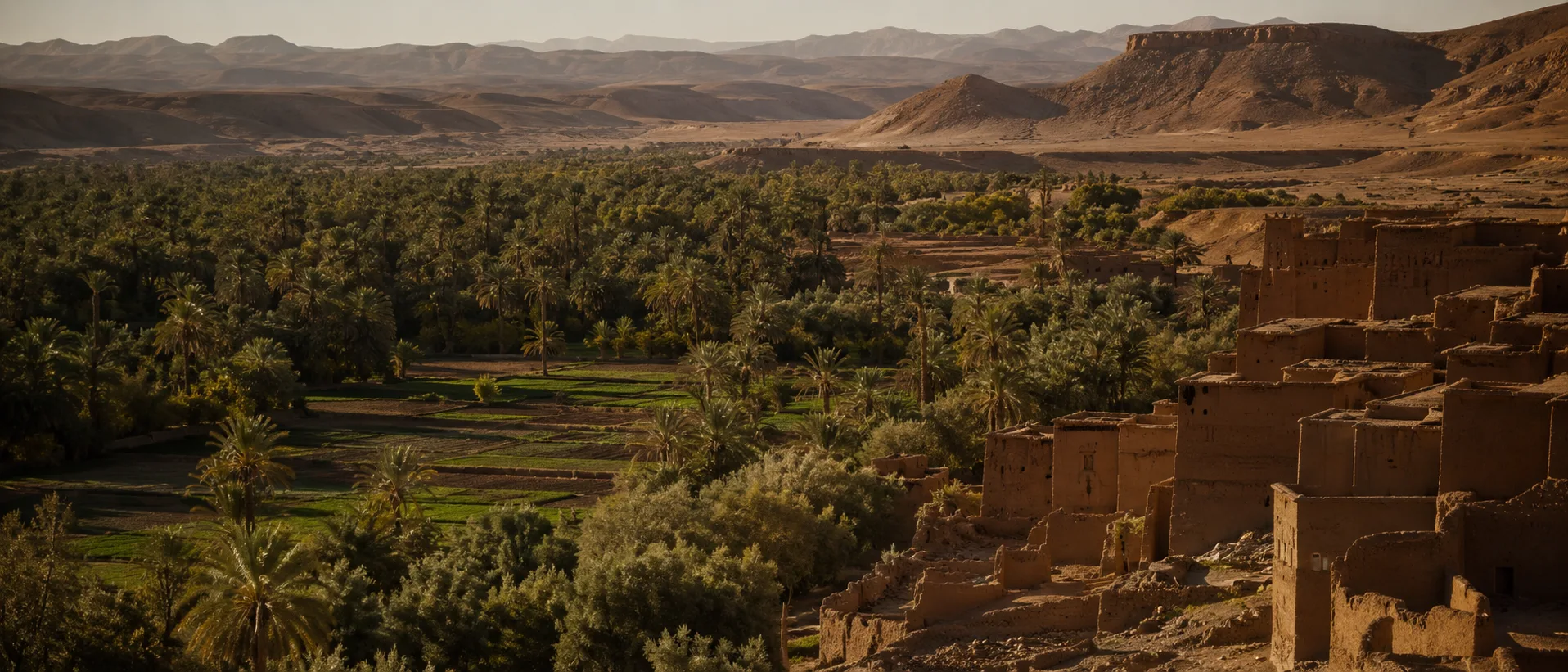
Do you know the Oued Ziz? It comes down from the eastern High Atlas and moves south through a country where water can decide where a village grows, where palms survive and where a family is able to cultivate. I grew up inside that geography. Long before I used words such as biodiversity or terroir, I knew the taste of dates, Nbeg and lben. Honey came later. The landscape was already teaching the lesson.
Do You Know the Ziz?
The question is personal for me.
Not because the Ziz is the largest river in Morocco.
It is not.
Not because everyone who comes to Morocco knows its name.
Many do not.
But follow the water south from the eastern High Atlas and you begin to understand why people settled where they did.
Scientific work on the Errachidia region describes the Ziz Valley as the dominant hydrological system of the area, feeding more than 200 kilometres of riparian activity. The waters of the Ziz and neighbouring Rheris descend from the eastern High Atlas before being captured, diverted, stored and shared through systems built for agriculture and settlement.
From above, parts of the valley can look almost impossible.
Rock.
Dry plateaus.
Heat.
Then a green line.
Palms.
Fields.
Villages.
That green line is not decoration.
It is food.
Dates.
Water.
Shade.
Animal fodder.
Vegetables beneath the palms.
And yes, even a little natural air conditioning in the middle of summer.
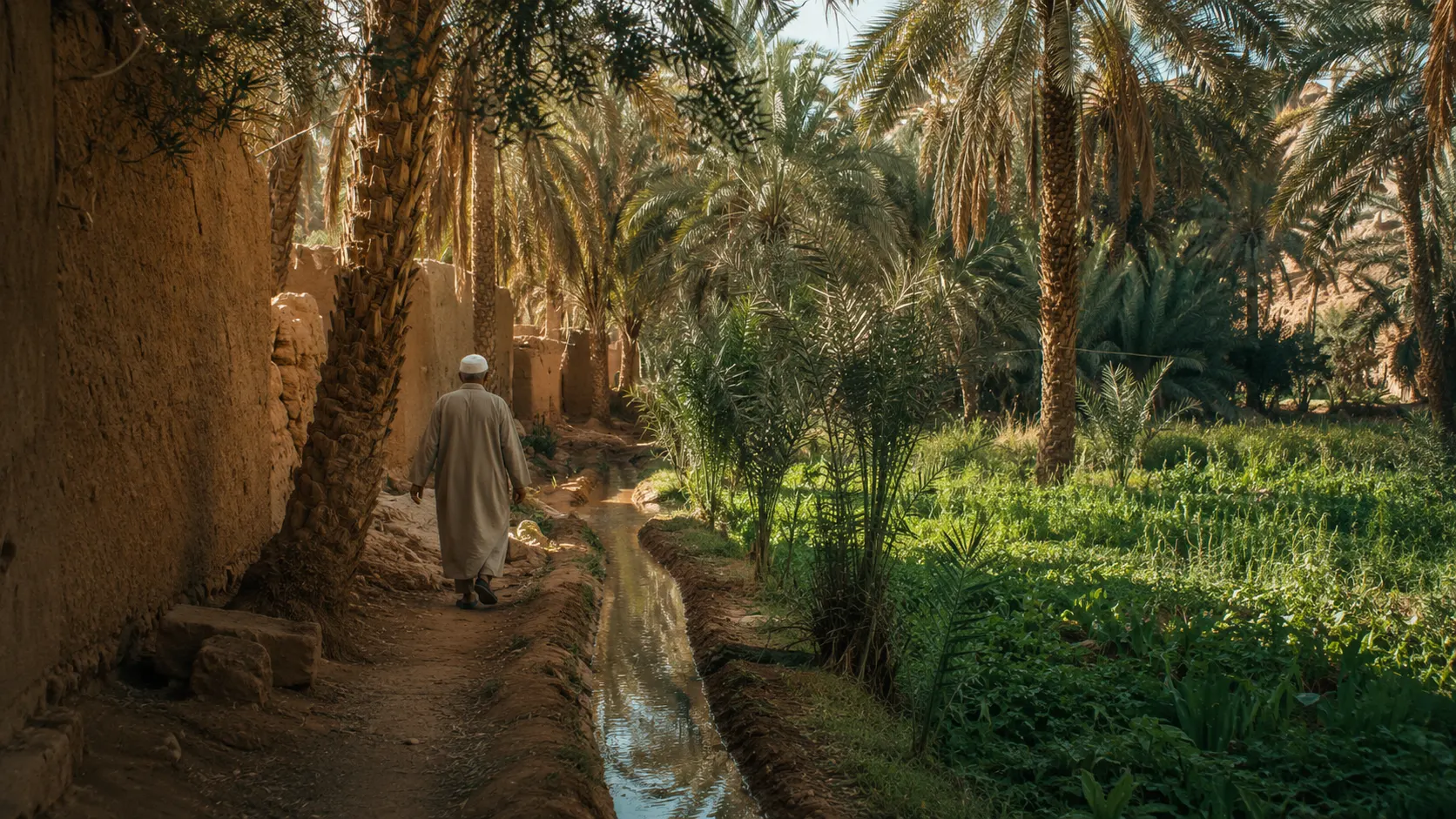
I say that laughing, but the science says something close. Date palms create a favourable microclimate below their canopy. Research on Moroccan oasis agriculture shows that this shade makes it possible to cultivate other crops under conditions that would be much harsher in the open.
People in an oasis did not need a scientific paper to tell them the shade felt different.
They were already living underneath it.
Meski Is Where My Map Begins
For The House of Meski, this is where everything becomes difficult to separate.
A place.
A family.
Dates.
Water.
Memory.
Then, much later, honey.
Ksar Meski is not the whole of Morocco. It is not even the whole of Errachidia.
But it is the part I know without needing a guide.
I know the feeling of walking under the palms.
I know the gardens.
I know how quickly the green can finish and the dry land begin.
And I remember the wild Sidr, what we called Sedra, with the little fruits we called Nbeg.
The plants I knew were not the tall cultivated Chinese jujube trees people sometimes imagine today.
They were low, wild, thorny shrubs. Often around the height of a person or lower in the places I remember. You did not casually reach inside to take the fruit. The thorns made sure of that.
Botanically, that memory fits Ziziphus lotus, the wild jujube documented across Morocco’s arid and semi-arid regions. Scientific descriptions call it a thorny shrub that can form dense clumps and commonly reach around two to three metres. Its fruit is locally known as Nbeg.
That is different from Ziziphus jujuba, the cultivated Chinese jujube.
It is also different from Ziziphus spina-christi, the Sidr species strongly associated with Yemen, Oman and much of Arabia.
One family.
Different plants.
That distinction is why Moroccan Sidr honey should never be treated as a copy of Yemeni Sidr.
Our own Honey Atlas entry for Moroccan Sidr follows Ziziphus lotus in the Wadi Ziz and Errachidia landscape rather than pretending all honey called Sidr begins with the same species.
“My sweets were dates, Nbeg and lben. I am still waiting for someone to convince me I was deprived.”
My Childhood Sweets Grew Around Me
I am only half joking.
Dates were normal.
Nbeg was normal.
Lben was normal.
You do not call something heritage when you are a child eating it.
You eat it.
Later, distance gives ordinary things another value.
This is one reason I am interested in Moroccan jujube honey today. It connects an adult curiosity about bees with a shrub I knew before I ever thought about pollen analysis, monofloral harvests or SEO.
When I see someone search for Sidr honey Morocco, I think first about the plant.
The fruit.
The thorns.
The dry ground around it.
Then the honey.
A bee approaching that shrub sees a floral resource.
A child sees Nbeg.
A farmer may see a plant occupying difficult land.
A botanist sees a resilient Mediterranean and North African species.
All of them are looking at the same shrub from different angles.
This is what I want terroir to mean at The House of Meski.
Not a luxurious word placed below the name of a product.
A place where several lives meet.
The Oasis Is a Forest Built in Layers
Stand outside a palm grove and the date palm dominates everything.
Walk inside and the structure becomes more complicated.
The palms form the upper layer.
Beneath them can grow fruit trees.
Below those, vegetables, cereals, fodder and other crops occupy the cooler ground.
This layered oasis agriculture is one reason date palms are so important beyond the fruit itself. FAO describes the date palm in Morocco as an economic pillar of oasis life and emphasizes its role in creating a microclimate that allows other crops to grow underneath.
That is exactly the oasis I remember.
Not a monoculture of dates.
A small agricultural world.
My grandfather’s family lands around the Ziz included dates, wheat, tomatoes, okra, olives, squash, pomegranates, peppers and grasses for animals. Some fields were close to the house. Others were farther into the valley.
So when I write about Errachidia honey, Ziz Valley honey or bees in a Moroccan oasis, I do not imagine them working inside an empty plantation of one tree.
The possible forage is broader.
Wild shrubs outside cultivated ground.
Fruit blossom.
Herbs.
Plants growing along water.
Whatever the season gives.
That does not mean every plant creates a named monofloral honey.
It means multifloral honey in Morocco can be a very honest expression of an oasis landscape.
Then the Ziz Sends Us Back Toward the Atlas
The Ziz does not begin in the desert.
Its water comes from the mountain world to the north.
That is important because Morocco changes quickly when altitude changes.
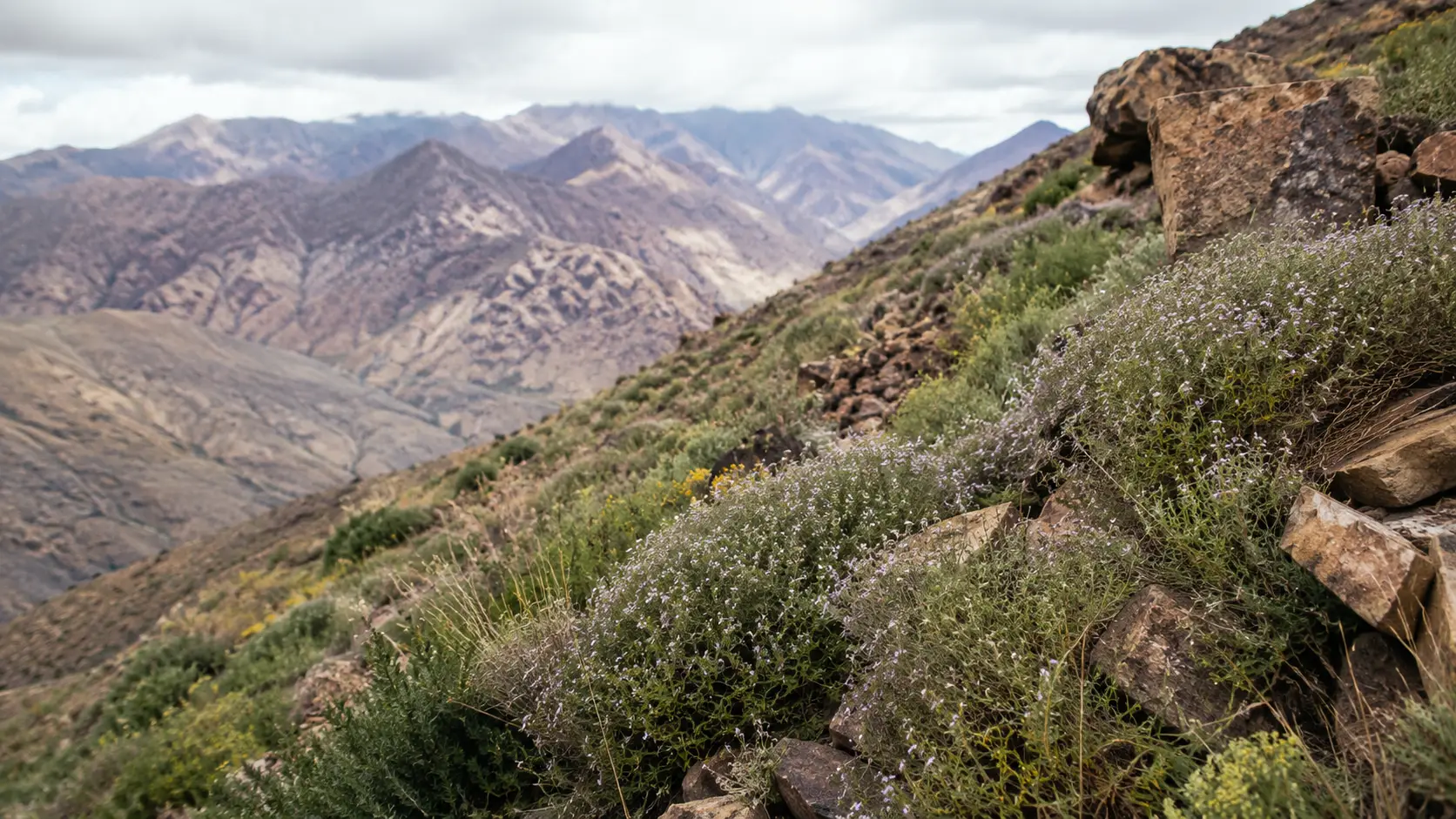
The High Atlas can hold snow while the pre-Saharan valleys below are dry.
Temperatures fall.
Rainfall patterns change.
Plants change with them.
And one of the honey names that belongs naturally in that conversation is thyme.
Moroccan thyme honey, or Assal Zaatar, is one of the country’s well-known floral honeys. Scientific studies of Moroccan honey repeatedly include thyme among authenticated or declared botanical origins.
Our own Moroccan Thyme Honey Atlas page follows wild thyme in rocky Atlas terrain and around Errachidia.
Again, the useful question is not “Which Moroccan honey is best?”
It is why a thyme honey and a jujube honey can both be Moroccan while beginning in very different plant communities.
A wild Ziziphus lotus shrub at the edge of the Sahara.
Thyme on dry mountain slopes.
Same country.
Different altitude.
Different flowering.
Different bee menu.
Azrou Looks Like Another Country
Keep travelling north and the colour changes.
The Middle Atlas around Ifrane and Azrou is not the Morocco of my childhood palms.
Forests.
Cold winters.
Lakes.
Atlas cedar.
Barbary macaques.
Official Moroccan tourism material describes Ifrane National Park as a mountain landscape of forests and freshwater lakes, while the Azrou area is famous for its cedar woodland.
The first time someone says forest honey Morocco, it sounds simple.
It is not.
A forest is a location, not automatically a botanical origin.
Bees in or near Moroccan woodland can forage on flowering shrubs, herbs, trees, forest edges and neighbouring agriculture. In some ecosystems honeydew can also contribute, depending on the vegetation and insects present.
So I would never see “Atlas forest honey” on a label and decide I know what is inside.
I would ask which forest.
Which plants.
Which season.
Was the apiary near Azrou?
Ifrane?
A cedar-dominated landscape?
Oak?
Mixed vegetation?
Those questions make Middle Atlas honey more interesting, not less.
The cedar is majestic enough without forcing it to become the floral source of every nearby jar.
The Rif Brings the Mediterranean Into the Story
Then we reach another Morocco again.
The Rif rises toward the Mediterranean.
Al Hoceima combines mountains, forests, cliffs and sea. Chefchaouen sits inside another northern mountain world. Morocco’s tourism authority describes the country itself as shaped by the Atlantic, Mediterranean, Rif and Atlas, all producing different climatic influences.
This is why I find the phrase Morocco climate almost too singular.
Which Morocco?
The Ziz?
Azrou?
Al Hoceima?
Agadir?
The Atlantic plain?
A scientific study of honeys from eastern and north-eastern Morocco analysed jujube, multifloral, citrus, eucalyptus, thyme, carob and rosemary honeys from areas including Oujda, Berkane, Jerada, Nador and Taourirt.
That list makes sense when you look at the region.
Citrus honey Morocco takes us toward orchards.
Carob honey Morocco belongs to another Mediterranean tree.
Rosemary honey Morocco and thyme bring aromatic shrubs into the picture.
Eucalyptus reflects planted woodland and agricultural landscapes rather than an ancient native forest.
And multifloral Moroccan honey accepts that sometimes the bees refuse our desire to reduce the countryside to one flower.
The farther I move from Meski, the more useful those distinctions become.
Berkane, Orchards and Honey That Begins With Cultivation
We sometimes speak about natural honey as if cultivated trees make it less natural.
I do not agree.
A citrus orchard is a human agricultural landscape.
The blossom is still real.
The bee still has to find it.
Berkane and the wider eastern agricultural region are strongly associated with citrus cultivation, and Moroccan scientific work includes citrus honeys from these environments.
This gives us another way to talk about orange blossom honey Morocco without pretending every valuable honey has to come from a remote mountain.
A farmer can create forage too.
The important questions remain the same.
What was flowering?
Was there enough of it to dominate the harvest?
What else surrounded the apiary?
Can the producer trace the lot?
There is nothing less authentic about asking those questions in an orchard than in a wadi.
Then Morocco Turns Toward Argan, Euphorbia and Cactus
Move toward the south-west and another vocabulary begins.
Argan.
Euphorbia.
Prickly pear.
Dryland plants adapted to different parts of the Moroccan landscape.
The Arganeraie Biosphere Reserve alone covers around 2.5 million hectares across Marrakech-Safi and Souss-Massa, according to UNESCO. It is an ecosystem shaped not only by argan trees but by communities, grazing, agriculture and long-standing systems of resource management.
Bees live inside that complexity too.
But this is where I want to be careful with names.
Euphorbia honey Morocco is well documented scientifically, and Daghmous honey is a familiar local and commercial name associated with Moroccan euphorbias.
Then the translations become messy.
Some shops call Daghmous “cactus honey.”
But Euphorbia is not the same plant as the prickly pear cactus, Opuntia ficus-indica.
Morocco does cultivate enormous quantities of prickly pear, and scientific work confirms that Opuntia ficus-indica is a melliferous plant whose flowers can attract bees.
What I have not found is enough strong Moroccan honey research to place prickly pear honey Morocco beside jujube, thyme, citrus or euphorbia as one of the country’s best-established monofloral categories.
Maybe local beekeepers know more than the literature I have found.
If they do, I want to hear from them.
Until then, I prefer the question mark.
Does Argan Honey Exist?
This is another tempting search query.
Argan honey Morocco.
The argan ecosystem certainly supports pollinators. Beekeeping is practiced in argan country. The tree flowers.
That is not enough for me to declare every jar from Souss a monofloral argan honey.
The same rule applies here that applied to Jabal Akhdar in Oman.
Plant presence is not monofloral proof.
A trustworthy producer may have pollen analysis, local harvest knowledge and a well-defined flowering area that supports the claim. Without that, “honey from the argan region” and “pure argan honey” are not automatically the same statement.
Morocco already has enough real honey diversity.
We do not need to invent more.
What Science Already Confirms Is More Than Enough
Moroccan honey research gives us a long list without needing marketing imagination.
Jujube.
Thyme.
Euphorbia.
Citrus.
Carob.
Rosemary.
Eucalyptus.
Multifloral honeys.
Other studies include acacia, harmal, reseda and additional local floral declarations.
One 2025 study alone examined thirty-five honeys from eastern Morocco representing jujube, multifloral, citrus, eucalyptus, thyme, carob and rosemary origins.
Another Moroccan survey notes the long national tradition of beekeeping and identifies eucalyptus, thyme, euphorbia, citrus and carob among major honey types, with thyme and euphorbia particularly popular with consumers.
This is the SEO opportunity I like.
Not repeating Moroccan honey fifteen times.
Let the country give us the vocabulary.
Moroccan Sidr honey.
Thyme honey Morocco.
Daghmous honey.
Citrus honey Morocco.
Carob honey Morocco.
Rosemary honey Morocco.
Forest honey Morocco.
Flower honey Morocco.
Every term should open a door into a different landscape.
Otherwise it is only a keyword.
“Knowing where you come from is not the same as knowing your whole country. Morocco reminds me of that every time I leave home.”
Biodiversity Is Also What We Are Losing
There is another side to this story.
Drought.
Water pressure.
Salinity.
Desertification.
Forest stress.
Changes in flowering.
The UNESCO Biosphere Reserve of the Southern Moroccan Oases describes extraordinary biodiversity across Mediterranean and Saharan ecoregions, including date-palm agrodiversity, acacia woodland, mountain forests and a large share of Morocco’s bird, reptile and mammal species.
That richness is not guaranteed forever.
FAO’s work in Drâa-Tafilalet on the Saharan yellow bee has highlighted successive droughts among the pressures affecting local apiculture.
The Ziz watershed itself faces rising water demand, groundwater pressure and drought risk.
This is why climate belongs in a honey article.
Not because “climate honey Morocco” is another keyword to squeeze into a paragraph.
Because flowers need a season.
Bees need flowers.
People need water.
The same shortage reaches all three.
This Time I Am Home, So I Should Know Everything
Well.
That would be convenient.
After Oman and the Emirates, perhaps this is the article where I should stop asking readers for help.
I am Moroccan.
The House is called Meski.
The Ziz is part of my childhood.
So this time I should be the professor.
No.
I am joking.
The truth is more embarrassing and more useful.
The region I really know is Errachidia.
Ksar Meski.
The Ziz Valley around it.
The family places I have walked since childhood.
I can tell you what Nbeg meant to me because I ate it.
I can tell you what the shade under the palms feels like because I lived it.
I can tell you that dates, Nbeg and lben were enough to make a child happy because that child was me.
But ask someone from the Rif about a mountain tradition and he may know more than I do.
Ask an Azrou beekeeper what flowers around his hives after a cold winter and I would rather listen than pretend.
Ask a family in Souss what they call a local Euphorbia, or a beekeeper in Berkane how citrus flowering changed this year, and the country becomes a classroom again.
I like it that way.
If You Know a Morocco I Do Not, Do Not Keep It to Yourself
This time, yes, I am at home.
So if you want to discover Meski, Errachidia, the Ziz, the dates, the wild Nbeg or the places that formed this house, I have a few things to tell you.
That part I accept.
But Morocco is too large for one person’s memory.
If you are from Azrou and there is an old honey tradition I should know, tell me.
If your family in the Rif uses a plant in a way that is disappearing, tell me.
If a beekeeper in Souss produces a honey I have treated too cautiously because the scientific literature has not caught up, show me the harvest and teach me.
If there is a local word for a tree that gets translated badly online, correct me.
And if I forgot a honey, that may be the easiest way to get my attention.
Do not keep everything for yourself.
A tradition that stays hidden long enough can disappear with the person who knew it.
The House of Meski was never supposed to know everything.
It was supposed to keep asking.
Even at home.
Meskaoui
Frequently Asked Questions About Moroccan Honey, Biodiversity and Terroir
Morocco combines Mediterranean and Atlantic coasts, the Rif, High, Middle and Anti-Atlas ranges, agricultural plains, forests, semi-arid plateaus, oasis systems and pre-Saharan landscapes. Altitude, rainfall, temperature, cultivated crops and wild flora therefore change sharply between regions, giving bees very different forage.
Nbeg is the local name used for the small fruit of the wild jujube Ziziphus lotus. This thorny shrub is widespread in Morocco’s arid and semi-arid regions and is the species associated with the Moroccan Sidr or jujube honey described in the Meski Honey Atlas. It is botanically different from Chinese jujube, Ziziphus jujuba, and Arabian Ziziphus spina-christi.
Moroccan studies document honeys declared or authenticated from jujube, thyme, euphorbia, citrus, carob, rosemary, eucalyptus and multifloral sources, among others. The relative importance of each type varies by region and season.
Not automatically. Daghmous is commonly associated with Moroccan Euphorbia species, while prickly pear is Opuntia ficus-indica, a true cactus. Commercial translations sometimes blur these names. The botanical source should be checked before treating “Daghmous”, “cactus honey” and “prickly pear honey” as synonyms.
Prickly pear is widely cultivated in Morocco and its flowers are melliferous, so bees can forage on them. However, the scientific documentation located for this article is much stronger for Moroccan jujube, thyme, euphorbia, citrus, carob, rosemary, eucalyptus and multifloral honeys. A commercial claim of monofloral prickly pear honey should therefore be supported by local traceability or botanical analysis rather than assumed from the presence of cactus.
The tall palm canopy provides shade, reduces exposure to wind and temperature extremes and creates a more favourable microclimate for lower layers of fruit trees, cereals, fodder and vegetables. This layered agriculture is one of the foundations of traditional oasis systems in regions such as Tafilalet and Drâa-Tafilalet.
A useful starting route is the Ziz and Errachidia for wild jujube and oasis agriculture, the High Atlas for thyme and mountain flora, the Middle Atlas for forest and mixed mountain forage, eastern and northern Morocco for citrus, carob, rosemary, eucalyptus and multifloral honeys, and the south-west for euphorbia, argan ecosystems and dryland flowering plants. Individual jars still need producer-level traceability because regional vegetation is more diverse than a single honey name.
Begin Where the House Began
Follow the wild jujube of Wadi Ziz through the Honey Atlas, or step into the family memories of Meski to understand why this landscape means more to us than an origin printed on a jar.
Sources & Further Reading
- UNESCO: Oasis du Sud Marocain Biosphere Reserve
- UNESCO: Moroccan Oases, On the Other Side of the Mirage
- FAO Morocco: The Date Palm in Morocco, Economic Pillar of Oases
- Land: Evolution of Landscapes and Land Cover in Old Villages in Errachidia
- Springer: Khettaras in the Tafilalet Oasis and Waters of the Ziz and Rheris
- Plants / PMC: Ziziphus lotus as a thorny wild jujube shrub
- PMC: Ethnobotanical and Pharmacological Review of Ziziphus lotus
- INRA Morocco: Ziziphus lotus in Moroccan agricultural landscapes
- Molecules 2025: Jujube, Multifloral, Citrus, Eucalyptus, Thyme, Carob and Rosemary Honeys from Morocco
- PMC: Moroccan Beekeeping and Major Honey Types
- Moroccan National Tourism Office: Climate and Seasons
- Moroccan National Tourism Office: Rif, Ifrane and Atlas Natural Landscapes
- Moroccan National Tourism Office: Al Hoceima Nature and Rif Landscapes
- UNESCO: Arganeraie Biosphere Reserve and Community Landscapes
- MDPI: Investigation of Special Moroccan Honeys Including Euphorbia
- Agronomy: Prickly Pear Cultivation in Morocco
- The House of Meski Honey Atlas: Moroccan Sidr Honey, Wadi Ziz
- The House of Meski Honey Atlas: Moroccan Thyme Honey
- The Fortress of Memories: My Grandfather and the Family Lands of the Ziz Valley
Editorial note: The childhood memories of Ksar Meski, dates, Nbeg and lben, the appearance and height of the wild jujube shrubs the author personally knew, and the descriptions of shade and family agriculture are Meskaoui’s own memories. Botanical identification, honey categories, oasis microclimate, regional biodiversity and climate claims are supported separately by the sources above. Where Moroccan monofloral claims are less well documented, particularly prickly pear and argan honey, the article deliberately keeps the language cautious rather than converting plant presence into proof of a honey category.