
I stopped asking whether Dubai had real honey after standing beside the hives myself.
Is there really such a thing as Dubai honey?
That question sounds reasonable if the Dubai in your mind is made only of towers, highways, beaches and shopping malls. Where would the bees go? What would they forage on? Where would a local honey even come from?
I used to understand the question. Then I stood in Hatta wearing a full yellow beekeeper suit with bees moving around a live frame in front of me.
After that, ‘Does Dubai really have bees?’ became a much easier question to answer.
I had already met Dubai’s bees before writing about Dubai honey
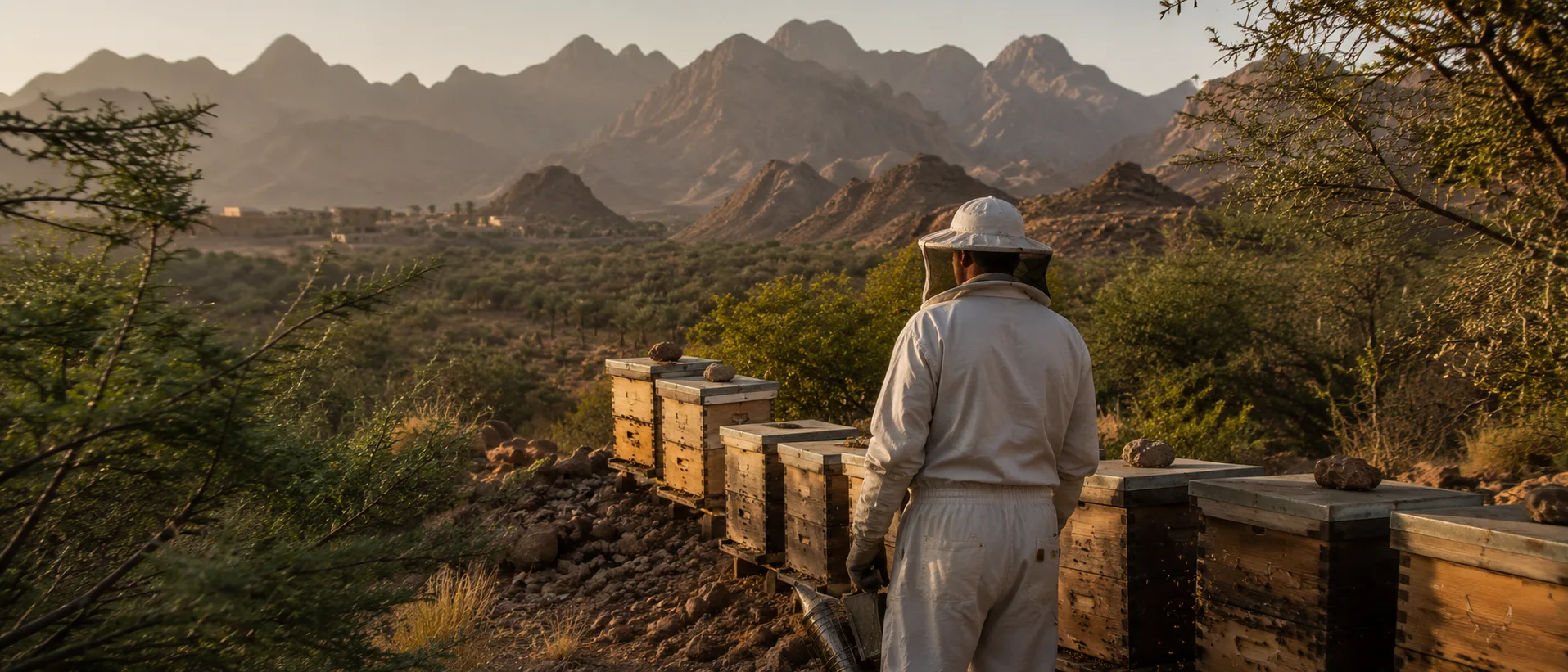
I went to Hatta Honey Bee Garden myself. They gave us the protective clothing, took us close to the hives and showed us the bees on the frames. I remember the mountains behind us, the bright sun, the strange feeling of being covered from head to toe while thousands of bees continued with their work as if we were the unusual species visiting them.
What I liked most was that it was educational rather than intimidating. You do not need to arrive as a beekeeper. Families can visit. Children can learn what a hive looks like, how bees live and why honey is not something that simply appears in a jar.
And yes, once you have finished learning about bees, they also sell their own honey. We are still in Dubai after all.
The photo I kept from Hatta
The photograph from that visit still makes me smile. Two yellow bee suits, one frame covered with bees and the Hajar mountains behind us. It is not a polished advertising photograph. That is precisely why I like it.
It proves something simple. When I write that local honey exists in the Emirate of Dubai, I am not repeating a phrase from a product label. I have stood beside the hives.
That personal memory is the starting point of this article, but the story around it is much bigger.

A real visit to the hives in Hatta, Dubai. MESKI archive.
Dubai Honey vs Honey in Dubai: They Are Not the Same Thing
This distinction should be one of the foundations of Dubai honey search. Honey in Dubai can come from anywhere. Yemeni Sidr, Omani Sidr, Saudi honey, Moroccan honey and European honeys can all be sold in Dubai.
Dubai honey, if we use the phrase precisely, should mean honey actually produced within the Emirate of Dubai. Hatta makes that possible because Hatta is part of Dubai.
So a jar of Yemeni Sidr sold on Sheikh Zayed Road is honey in Dubai. A Sidr harvest produced from hives in Hatta can genuinely be described as Dubai honey.
Emirati Honey, Emirates Honey, UAE Honey: Different Searches, Same Question
People search Emirati honey, Emirates honey, UAE honey, honey UAE, UAE Sidr, Emirati Sidr honey, Emirates Sidr honey and even Emiratie honey. Search language is never as tidy as a catalogue.
Most users are asking a simple question: is there honey genuinely produced in the United Arab Emirates, and where can I find it?
The answer is yes. But the origin matters. A shelf in the Emirates does not make every jar Emirati.
Dubai Bees: They are part of a real local beekeeping system
Gulf News documented the work being done in Dubai around bee protection, local honey production and education. Hatta Honey Bee Discovery Centre produces local honey and works on sustaining bee populations, while the Beekeepers Foundation in Sustainable City has focused on training, awareness and community participation.
This is useful because it moves the discussion beyond one commercial jar. Dubai bees are connected to biodiversity, pollination, agriculture, education and food security.
Local honey is only the visible product at the end of a much larger ecological process.
Does Dubai Really Have Bees?
Yes. The UAE has wild bees, including Apis florea, and managed beekeeping relies on bees adapted to the region’s difficult climate.
Gulf News reported that beekeepers in Hatta work with Omani and Saudi bee stock and selective breeding to produce colonies better suited to UAE heat. The article identifies Apis mellifera jemenitica as particularly well adapted to hot environmental conditions.
This is a much more interesting answer than simply saying ‘yes, Dubai has bees’. The real story is how beekeepers keep colonies healthy through extreme heat.
How can bees survive the UAE climate?
Heat is one of the obvious challenges. Modern insulated hives, ventilation, shade, water and movement between forage areas all matter.
At Hatta, Gulf News described the use of insulated recyclable hive systems designed to reduce heat and humidity problems and make colony inspection easier. Beekeepers also move frames or colonies according to access to nectar and water.
In other words, UAE beekeeping is not about pretending the climate is easy. It is about adapting the practice to the climate that actually exists.
From mud hives to insulated boxes
The Hatta educational experience also places modern beekeeping beside older hive designs. Gulf News described demonstrations of ancient mud and clay hive concepts before showing current insulated hive systems with wooden frames.
This makes Hatta interesting for children and adults because the visit is not only ‘look at bees’. It becomes a small history of how humans learned to house and manage colonies.
The technology changed. The relationship with the bee remained.
Hatta: Where Dubai Honey Leaves the Skyline Behind
Hatta sits around 130 kilometres south-east of central Dubai. That distance is enough to break the usual image of the emirate.
The skyscrapers disappear and the mountains take over. Farms, wadis, old vegetation and beekeeping suddenly make the phrase local honey Dubai much more understandable.
This is why Hatta should sit near the centre of any serious article targeting Dubai honey, Emirati honey or UAE honey.
Hatta Honey, Hatta Sidr and Dubai Mountain Honey
Searchers use many versions: Hatta honey, Hatta Sidr, Hatta Sidr honey, Dubai mountain honey, UAE mountain honey, Emirati honey Hatta and honey Hatta Dubai.
Some terms are cleaner than others, but they all point toward the same curiosity: honey produced in the mountain territory of Dubai.
Hatta gives local honey a geographical story that a generic ‘Made in UAE’ line cannot provide.
Dubai Sidr Honey and the Jujube Tree
Sidr is the word most people in the Gulf know. Jujube is the English bridge. Both terms appear around Ziziphus, and users search Sidr honey Dubai, jujube honey Dubai, jujube tree honey UAE, Emirati jujube honey and UAE Sidr honey.
Exact botanical species and terroir still matter. We should not flatten every Ziziphus tree into one identical plant.
But from a search perspective, Sidr and jujube belong in the same educational conversation.
Sidr, Jujube, Jujube Honey and Sdr Honey
Search is messy. One person types Sidr. Another types jujube. Another writes jujube honey. Someone drops a vowel and searches sdr honey Dubai.
I would never destroy an article by repeating bad spellings. One natural explanation is enough.
The goal is to speak the reader’s language without lowering the quality of the writing.
What makes Sidr honey Emirati?
Not the shop. Not the packaging. Not a UAE flag printed on the box.
Emirati Sidr honey should come from bees foraging within the UAE on Sidr-dominant flowering conditions. The location of the hives and harvest is what gives the geographical claim meaning.
A Sidr jar imported from Yemen and sold in Dubai remains Yemeni Sidr.
Hatta Sidr and Yemeni Sidr should not fight each other
Yemeni Sidr has immense historical and commercial prestige. Hatta Sidr has a different value: it is part of the living beekeeping landscape of the UAE.
There is no need to declare one winner. They belong to different terroirs.
The consumer gains more when the origins remain distinct.
Samar Honey Dubai: The Other Emirati Honey People Forget
Samar deserves far more attention in UAE honey discussions. It belongs to the wider Arabian honey tradition and has its own flowering season, flavour and character.
Searches such as Samar honey Dubai, Emirati Samar honey, UAE Samar honey and honey Samar Emirates may not be as large as Sidr terms, but they strengthen the wider UAE honey map.
An article that targets only Sidr leaves part of the local story unused.
Ghaf Honey UAE: Honey From the National Tree
Ghaf is the national tree of the UAE and one of the country’s strongest symbols of resilience in arid landscapes.
Honey associated with Ghaf gives us another local route into Emirati honey, Dubai honey and desert ecology.
A reader may arrive searching the tree and discover the honey. Another may arrive searching honey and discover why the tree matters.
Dubai Honey Seasons: Sidr, Samar, Ghaf and Wildflowers
Bee forage changes through the year. Gulf News reported an indicative sequence including wildflower honey around March and April, Samar around May, Ghaf around June, mangrove honey around July and Sidr around October.
These are not dates I would treat as an immutable calendar. Flowering responds to weather, rainfall, temperature and location.
But the pattern shows something important: local honey in the UAE is seasonal because the plants are seasonal.
Can Bees Really Produce Honey in the UAE Desert?
Yes, but ‘desert’ does not mean ‘nothing grows’. Wadis, farms, mountain vegetation, Ghaf, Samar, Sidr, mangrove systems and cultivated areas create forage opportunities at different times.
The bee does not need a European meadow. It needs nectar, pollen, water and a colony able to manage the environment.
That is why understanding UAE honey requires understanding UAE landscapes.
Bees are doing more than making honey
Pollination is the larger ecological service. Gulf News highlighted the role bees play in fruits, vegetables, nuts, vegetation and agricultural productivity.
That connects local beekeeping to biodiversity and food security rather than only luxury food.
A jar of honey is valuable. A functioning pollinator population is much more valuable.
Dubai, bees and food security
The Beekeepers Foundation has linked its work with the UAE National Food Security Strategy 2051, according to Gulf News. Community training and school outreach are part of that effort.
This gives Dubai bees a surprisingly large policy context. Beekeeping becomes part of resilience, agriculture and education.
That is far more interesting than treating local honey as a souvenir.
Children should see a hive at least once
This is one of the strongest memories from my Hatta visit. Children can go there and see that honey begins with an animal, a colony, plants and work.
A supermarket jar hides all of this. A live frame reveals it instantly.
I think a child who has watched bees at work will look differently at the spoon of honey on the breakfast table.
The queen bee is not a marketing title
At the centre of the hive is a real queen with a biological role, not a gold label invented for a gift box.
At Hatta, Gulf News described queens being marked by year and monitored as part of colony management.
This is the kind of detail that makes an educational bee visit useful: the vocabulary of beekeeping stops being abstract.
How local honey is extracted
The process is less magical and more interesting when you see the steps. Capped honeycomb must be uncapped, frames can be placed in a centrifugal extractor, honey is strained and then allowed to settle or mature before bottling.
Gulf News documented this process at Hatta.
The jar may look simple, but many weeks of bee work and human handling sit behind it.
Local Honey Dubai: What should the label tell you?
If a jar says local honey Dubai or Emirati honey, I want to know the harvest location. Hatta? Another part of Dubai? Another emirate?
I also want floral information when available: Sidr, Samar, Ghaf, mixed wildflower or another source.
Local should become more precise as the local honey market becomes more mature.
Pure Honey Dubai, Raw Honey Dubai and the words sellers love
Pure honey Dubai, raw honey Dubai, organic honey Dubai, natural honey UAE and premium honey Emirates are strong search phrases.
But each word has a different meaning. ‘Pure’ does not identify origin. ‘Raw’ needs a processing definition. ‘Organic’ should not be treated casually as a decorative adjective.
Aggressive SEO still needs honest vocabulary.
Best Honey in Dubai: Local Emirati Honey or Yemeni Sidr?
The phrase best honey Dubai attracts attention because everyone wants a simple answer.
But the answer depends on the question. Best local honey? Best Yemeni Sidr? Best Emirati Sidr? Best Samar? Best Ghaf? Best gift? Best value?
A useful article does not pretend these are all the same competition.
Best Sidr Honey Dubai
If you search best Sidr honey Dubai, you are likely to encounter Yemeni, Emirati, Omani and Saudi origins.
I would begin with traceability before prestige. Where was it harvested? When? What does the seller know about the beekeeper and region?
The best label is not always the loudest label.
Emirati Honey Dubai: the phrase Google needs to understand
Emirati honey Dubai can mean a consumer in Dubai looking specifically for UAE-produced honey.
That is different from honey Dubai, which can include every imported origin available in the city.
The distinction gives local producers a real search identity instead of disappearing beneath imported honey.
Emirates Honey, Emirati Honey, Emiratie Honey, Emirats Honey
These variants are not elegant English, but real searches are not written by editors. French-speaking users may mix Emirats, Emirates, miel and honey. Others type Emiratie instead of Emirati.
One good article can acknowledge those forms once and then continue in correct language.
This is the old Ahuney lesson I still believe in: do not assume people will type the word exactly as you would.
Miel Dubai, Miel des Emirats and Miel de Jujubier Dubai
Dubai is multilingual. A French-speaking customer may begin with miel Dubai, miel des Emirats, miel de jujubier Dubai or miel Sidr Dubai and later search Emirati honey UAE in English.
The honey did not change. Only the query did.
A small multilingual bridge can capture that journey without turning the whole article into French.
Honey Dubai UAE: why the location stack matters
Users often stack geography because they are unsure which word Google needs: Dubai honey UAE, honey Dubai Emirates, UAE honey Dubai, Emirati honey Dubai.
The answer is simple. Dubai is an emirate and city within the UAE. Hatta is within the Emirate of Dubai.
Once the geography is clear, the honey origin becomes much easier to explain.
Dubai Honey Is Real, But Not Every Dubai Honey Claim Is
That sentence is important. Local production exists. I have seen the hives. Gulf News has documented the sector. Visit Dubai promotes the Hatta Honey Bee Garden.
But that does not mean every jar using Dubai imagery was produced in Dubai.
Real local production is exactly why we should protect the meaning of the words.
My own visit changed the way I sell honey
Standing beside the hive made the product less abstract. It is easy for a honey seller to talk about colour, taste, rarity and packaging. The bees do not care about any of that.
They care about forage, water, colony health, temperature and survival.
That is a useful lesson for anyone who sells honey, including me.
A photo can say more than another paragraph
If this article uses one photograph from my Hatta visit, I would choose the one with the live frame between two yellow bee suits and the mountains behind.
It does not need a luxury table or perfect lighting.
The bees are the luxury in that photograph.
Hatta as eco-tourism, not only honey shopping
Visit Dubai presents Hatta Honey Bee Garden as a place to learn about bees and taste honey, and Gulf News has described it as an eco-tourism destination combining commercial production with education.
That balance is important. Go because the visit teaches you something.
Buying honey at the end is optional, even if the shop is very tempting.
Should you visit Hatta Honey Bee Garden?
If you are interested in bees, honey, children’s education, local agriculture or simply seeing another side of Dubai, yes.
Go in suitable weather, check current opening and booking information, and give yourself time to understand the displays rather than rushing only toward the shop.
Hatta deserves to be more than a stop for a photograph.
And yes, they sell honey
After the hives, the explanations and the bee suits, you can buy their own honey.
I actually think you should support beekeepers when you visit them. Local production survives because people value the work behind it.
Just not too much. We sell honey too.
Meskaoui
“If you visit, take the time to learn, watch the bees and ask questions. And yes, before leaving, you can buy some of their own honey. You should. Supporting beekeepers is part of keeping this story alive.”
“Just not too much. We sell honey too.”
— Meskaoui
The skyline was never the whole of Dubai
Dubai honey sounds surprising only when Dubai is reduced to glass and concrete.
Drive to Hatta and the question changes. Mountains, trees, bees, farms and local harvests become visible.
The city did not disappear. The map simply became larger.
What I learned from standing beside a live frame
A photograph of honey usually shows the finished product: glass, amber colour, perhaps a wooden spoon. A live frame shows the opposite end of the process. It is crowded, noisy and completely uninterested in luxury.
Looking at the bees packed across the comb makes one thing obvious: the honey belongs to a colony before it belongs to a customer. The beekeeper’s job is not simply to collect; it is to manage the colony well enough that it remains healthy after the harvest.
That changes how I think about words such as rare, premium and pure. They matter less than whether the bees have enough forage, water and food stores to survive.
Dubai Honey Starts With Plants, Not With Jars
If we want to understand local honey in Dubai, we need to stop beginning with the bottle. Bees follow flowering plants, so the honey map is really a vegetation map.
Sidr, Samar and Ghaf matter because flowering trees create nectar flows. Farms, gardens and wild vegetation matter too. Hatta’s mountains create a very different foraging landscape from central Dubai.
This is why ‘Dubai honey’ can never be one fixed taste. The emirate contains more than one environment, and seasons change what the bees can collect.
Why Water Matters as Much as Flowers
Nectar gets the attention because it becomes honey, but bees also need water. In extreme heat, water is part of colony survival and temperature regulation.
Gulf News quoted Hatta staff explaining that bees need both nectar and water and that hive management follows those resources. That small detail says a lot about beekeeping in an arid climate.
Local honey production therefore depends on landscape management as much as on the beekeeper’s skill.
Dubai Beekeeping Is Also a Knowledge Industry
The more interesting future of UAE honey may not be measured only in tonnes. It may be measured in people who learn how to keep bees well in this climate.
Training programmes, school visits and public bee gardens create a local knowledge base. Once people understand bee health, queen management, forage and seasonal movement, the country is less dependent on importing the idea of beekeeping from climates that work differently.
That knowledge is part of what makes ‘Emirati beekeeping’ a meaningful phrase rather than only a marketing phrase.
Queens, Genetics and the Search for UAE-Adapted Bees
Heat adaptation is not solved by putting any bee into any hive. Genetics and queen selection matter. The Hatta programme described by Gulf News works with regional bee stock and selective breeding to improve performance under UAE conditions.
This is one of the most technical and least visible parts of local honey production. A customer sees one jar. Behind it may be years of queen selection and colony management.
That is another reason the local honey story deserves more respect than a simple souvenir label.
Why Hatta Matters to Dubai’s Identity Beyond Tourism
Hatta is often marketed for kayaking, hiking, mountain views and weekend escapes. All of that is real. But its farms, water systems and beekeeping add something deeper.
They remind us that Dubai’s territory contains productive landscapes, not only urban spectacle. Honey is one of the easiest products through which a visitor can understand that fact.
You taste the mountain environment in a form you can carry home.
Local Honey and the Problem of Scale
A local honey sector can become successful enough that demand grows faster than genuinely local supply. That is where clear labelling becomes essential.
If consumers search Dubai honey, local honey Dubai and Emirati honey in increasing numbers, the temptation to use local imagery around imported honey will also grow.
The solution is not to distrust every seller. It is to make origin information normal: harvest location, floral source and producer.
What ‘Pure Honey’ Should Not Distract You From
Consumers often ask first whether honey is pure. That is a reasonable question, but it can overshadow another important question: pure honey from where?
A pure imported honey and a pure local honey can both be excellent. Purity does not answer geography.
For anyone searching pure honey Dubai or pure honey UAE, I would ask for both quality and provenance rather than choosing one over the other.
Raw Honey Dubai: A Search Term That Needs Context
Raw honey is another phrase that attracts people because it suggests minimal processing. But sellers use the word differently, and there is no value in pretending every jar labelled raw is identical.
Ask how the honey was extracted, filtered and heated, if at all. Ask whether the description applies to the specific batch.
The stronger the SEO phrase, the more careful the explanation should be.
Organic Honey Dubai: Be Careful With the Word
Organic is not simply another synonym for natural. Certification rules matter, and bees can forage across wide areas that do not respect property boundaries.
So I would never use organic honey Dubai merely because the hive is in a beautiful mountain setting.
Natural scenery and organic certification are not the same claim.
Can Dubai Produce Enough Honey for Everyone Searching for It?
Probably not every person searching Dubai honey will end up buying a honey produced inside Dubai. Local harvests have physical limits.
That is not a weakness. Rarity created by genuine production limits is more credible than infinite ‘local’ supply.
Imported Yemeni, Omani and Saudi honeys will continue to have a place in Dubai. The goal is clarity, not exclusion.
Hatta Honey and the Family Visitor
One reason I would recommend the garden is that it changes the day for people who are not already obsessed with honey. A family can arrive for Hatta, the mountains and a different side of Dubai, then discover bees almost by accident.
That kind of curiosity is valuable. A child may remember the bee suit more than the honey tasting, and that memory may do more for respect toward pollinators than a hundred labels saying ‘save the bees’.
Education works best when it becomes an experience.
From a Hatta Search to a Honey Purchase
This is also why Hatta works so well editorially. Someone may search things to do in Hatta and discover the bee garden. Someone else may search Hatta honey and discover the mountains. Another may search Dubai honey and discover that Hatta belongs to Dubai.
Three different search intentions meet in one real place.
That is the kind of SEO I like: the geography itself creates the keyword network.
From Dubai Honey to the Wider UAE Honey Map
Once the reader understands Hatta, the next step is easy. What happens in Ras Al Khaimah? Fujairah? Al Ain? Abu Dhabi? Different landscapes create different beekeeping opportunities.
Dubai honey should therefore become a gateway into Emirati honey, not a wall around one emirate.
The more we map local origins, the stronger the entire UAE honey category becomes.
Dubai Honey and Hatta Bees FAQ
Yes. Honey is genuinely produced within the Emirate of Dubai, especially in Hatta, where local beekeeping and honey production are well documented.
Dubai honey should refer to honey produced in Dubai; honey in Dubai may be imported from Yemen, Oman, Saudi Arabia, Morocco or elsewhere.
Hatta is one of the best-known local production areas in the Emirate of Dubai.
Yes. Dubai has wild bees and managed honeybee colonies adapted to the UAE climate.
Local beekeepers use bees adapted to hot climates; Gulf News has reported work with Omani and Saudi stock and Apis mellifera jemenitica.
Honey produced by beekeepers in Hatta, the mountain region of the Emirate of Dubai.
Sidr honey produced in Hatta from local UAE flowering conditions.
Yes. Hatta is part of the Emirate of Dubai, around 130 km south-east of central Dubai.
Honey actually produced in the United Arab Emirates.
No. It remains Yemeni honey; Dubai is the market.
Sidr honey genuinely produced in Dubai, such as a local Hatta harvest.
Often a search variant around Sidr/Ziziphus honey; exact species and origin should still be checked.
It is a common shortened or misspelled version of Sidr honey.
Honey associated with Samar flowering in the UAE and other Arabian regions.
Honey linked to Ghaf flowering; Ghaf is the national tree of the UAE.
Local reports often place Sidr flowering and honey production around autumn, but exact timing varies by weather and location.
It depends on whether you want local Emirati honey, Hatta Sidr, Yemeni Sidr, Samar, Ghaf, traceability, gifting or value.
Yes. It is an educational attraction suitable for families; current age and booking rules should be checked before visiting.
Yes. The centre sells its own honey and related products.
Yes. Beekeeping supports pollination, biodiversity, agriculture, education and food-security goals.
Continue the Journey
If this story brought you here, continue the journey through related stories from The House of Meski.