
A specialist honey market is most useful when you treat it as a place to compare origins, sellers and evidence, not simply as a race to find the most expensive Sidr.
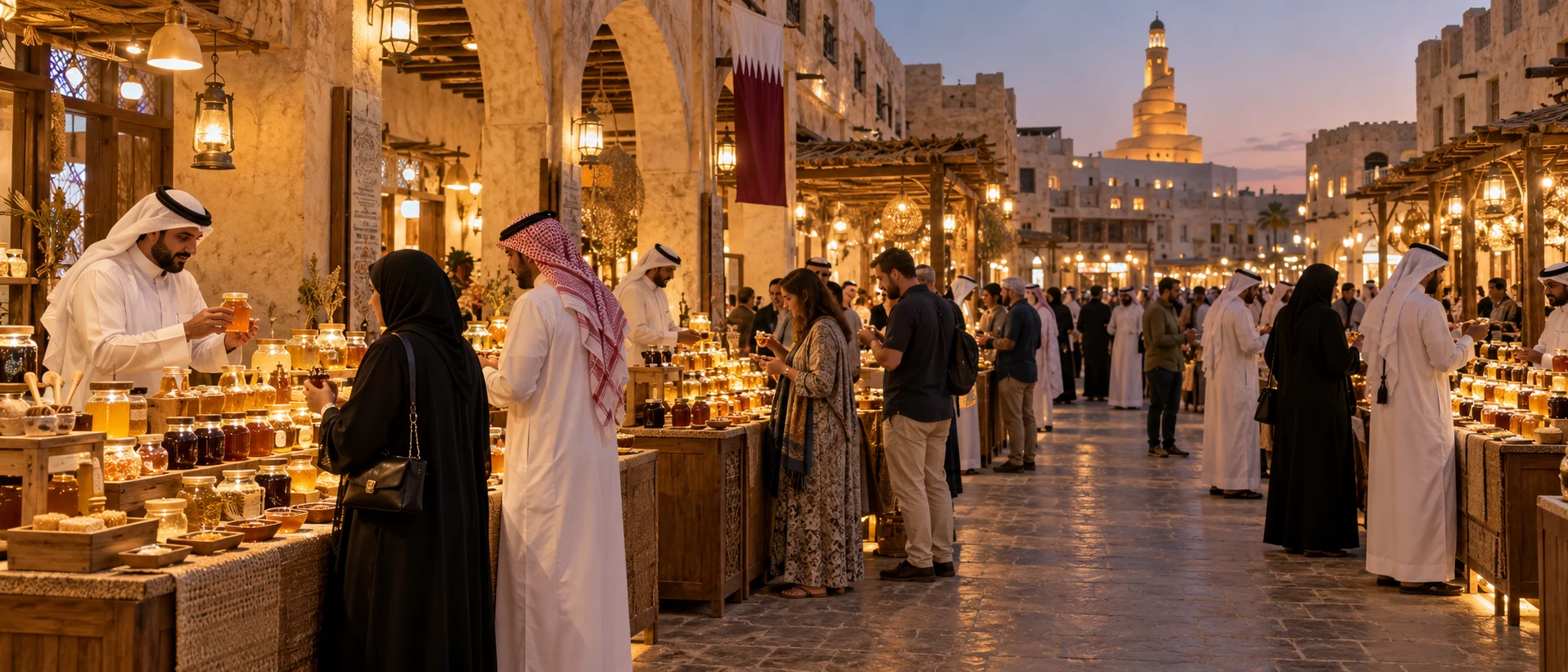
For ten days in January 2026, Souq Waqif turned honey buying into something much more useful than browsing a shelf. Around one hundred pavilions and producers from roughly twenty countries created a place where the same question could be asked again and again: where did this honey actually begin? This guide is designed to remain useful beyond one edition, because the best questions do not expire when the exhibition closes.
Why the exhibition is more useful than an ordinary honey shelf
In a normal shop, honey arrives already sorted by the retailer. At a specialist exhibition, the buyer can move between countries, floral sources, producers and price levels in minutes. The seventh Souq Waqif International Honey Exhibition, held from 22 to 31 January 2026, brought around one hundred pavilions to Doha with producers from roughly twenty countries.
That concentration is what makes the event valuable. It is not simply a place to buy more honey. It is a temporary comparison laboratory for the senses. You can taste two Sidr honeys back to back, ask different sellers the same question and notice how quickly clear provenance separates itself from polished storytelling.
The 2026 laboratory is important, but it should be understood correctly
Organisers highlighted quality control at the 2026 edition, including a permanent laboratory at the exhibition and random sampling with Qatari authorities involved. That is reassuring because honey is a high-value food category where adulteration and misrepresentation are real concerns.
But an on-site laboratory does not mean every claim on every jar has been proven in every possible sense. Food safety, compositional quality, floral authentication and geographic origin are different questions. A buyer should still ask what a test covers and whether it relates to the batch being sold. The presence of testing raises the standard of the market; it does not remove the need to read carefully.
Start your tasting with origin, not sweetness
Before tasting, ask the seller where the honey was harvested. Country first, then region. If the answer is “Yemeni Sidr”, ask Hadramout, Wadi Do’an or another source area if known. If it is Omani, ask which governorate or landscape. If it is Qatari, ask where the hives were placed and what flowering supported the harvest.
This approach prevents your palate from being manipulated by prestige. A famous origin can make us taste what we expect to taste. Geography first, then aroma and flavour, gives the jar a context without allowing the story to decide whether you like it.
Taste from lighter to stronger when possible
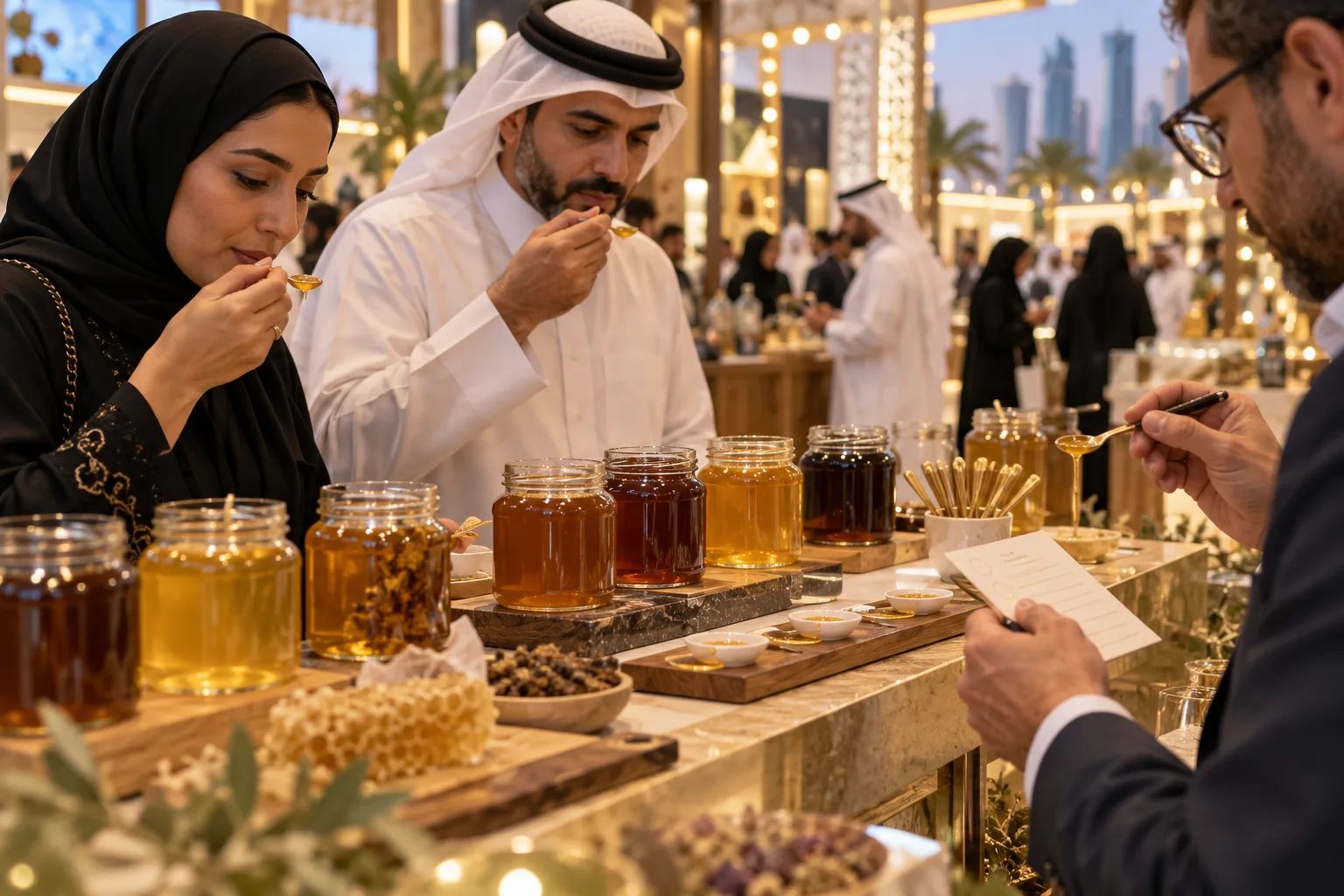
At an exhibition with dozens of honeys, palate fatigue arrives quickly. If you begin with the darkest, strongest jar, delicate floral honeys may disappear afterward. Start with lighter profiles, then move toward deeper Sidr, Samar or other intense harvests. Water between samples helps, and you do not need to finish every tasting spoon.
Notice aroma before sweetness. Then texture, acidity, bitterness if present and length of finish. Do not turn these observations into authentication tests. They are sensory notes. Their purpose is to help you decide what you enjoy and remember differences between jars.
Sidr deserves comparison, not automatic victory
Sidr will attract attention because the name is powerful across the Gulf. The exhibition may bring together Sidr from Yemen, Oman, Saudi Arabia, Qatar or other producing regions. That is a perfect opportunity to compare without declaring one country the permanent winner.
Ask the same five questions at several stalls: where was it harvested, what region, what season, who produced it, and is there batch documentation? Then taste. MESKI’s Doha Sidr buying guide goes deeper into those checks. The exhibition lets you practice them in one place.
Manuka and stingless bee honey require different questions
The 2026 exhibition advertised Manuka and stingless bee honey alongside Sidr. These products should not be judged through the same framework. Genuine New Zealand Manuka for export is authenticated through a regulatory scientific definition. Stingless bee honey has its own composition and moisture characteristics and should not be compared to Apis mellifera honey simply by thickness or sweetness.
This is one of the pleasures of an international event: the category “honey” becomes visibly diverse. The correct question changes with the product. A seller who can explain those differences without turning them into medical promises is worth listening to.
Local Qatari honey should be judged by the same standard
Buying local can be rewarding because it shortens the distance between buyer and beekeeper. But “local” is not an exemption from quality questions. A Qatari harvest should still have an identifiable producer, plausible floral context, batch information and good storage.
At the same time, imported honey should not be treated as suspicious simply because it travelled. Doha has always been connected to regional trade. The important distinction is truthful origin. Our Souq Waqif buying guide makes the same point for dates, oud, spices and other goods: the market is Qatari, but the products can come from many places.
Use the exhibition to buy gifts more intelligently
A honey exhibition can solve one of the hardest gift questions because you can taste before choosing. For a host gift, one excellent jar may be enough. For Ramadan, Eid or corporate gifting, you may want a collection with several origins or a presentation designed for sharing.
Do not let packaging stop the questions. A beautiful box still needs clear contents. If gold or saffron is added, ask about the base honey first. If the gift is for someone who values local Qatar, look for genuinely Qatari provenance rather than a jar that is only bottled in Doha.
What to ask when a stall is busy
Exhibitions are crowded, and long interviews are not always possible. Keep a short sequence ready: Where was it harvested? What flower or season? Who produced it? Is this the current batch? Is there analysis linked to it? Those five questions reveal a surprising amount.
If the seller cannot answer immediately, that is not automatically a problem. They may be managing a busy stand. What matters is whether the information exists and can be shown. A confident “I will check the batch sheet” is better than an instant story invented to keep the sale moving.
Do not rush the purchase because the event is temporary
An exhibition creates urgency. Limited stock, closing dates and crowded aisles can make every jar feel like a once-only opportunity. Slow down. Take photographs of product names where permitted, write down the origin, compare prices by weight and return to the jars you still remember after an hour.
The best purchase is rarely the jar with the most dramatic first sentence. It is the one whose taste you liked, whose origin you understood and whose seller answered questions clearly. Souq Waqif gives you the rare chance to compare many honey worlds side by side. Use that opportunity as a student first and a shopper second.
An annual article should stay useful after the stalls close
The dates and exhibitor count will change with future editions, so this guide should not become a frozen “2026 event recap”. The enduring value lies in the method: compare origins, understand what testing means, taste systematically, separate local from imported and keep provenance visible when buying gifts.
That method also works on an ordinary Doha shopping day. The exhibition simply makes the lesson easier because the contrasts are concentrated. When the next edition opens, update the practical details, but keep the questions.
Plan the visit like a tasting, not a shopping sprint
If you visit a future edition, give yourself enough time to make two passes. On the first, taste broadly and note only the honeys that remain memorable. On the second, return to those stalls and ask the detailed questions. This protects you from buying the first impressive jar before you have a reference point.
Practical details matter too. Compare price by weight, ask how the jar should be stored after purchase and think about transport if you are flying. Honey is a liquid for aviation security purposes in cabin baggage, and destination-country food import rules can differ. Good packaging for a local gift may not be good packaging for a suitcase.
Future editions may change dates, exhibitors and testing arrangements, so verify current event information before travelling. The buying method, however, remains useful every year.
Keep notes if you are comparing several stalls
After five or six samples, memory becomes unreliable. A simple note with origin, floral source, price per weight and one sensory word is enough. You do not need professional tasting vocabulary. “Floral, light, clean” or “dark, woody, long finish” will help you remember more than a photograph of the jar alone.
Notes also make the second pass through the exhibition more efficient. You can return only to the stalls that stood out and spend your questions where they matter most.
Compare the seller as carefully as the honey
An exhibition is also a chance to compare expertise. Notice which sellers can explain origin, harvest and storage without attacking competitors or making medical promises. A calm, precise answer is often more useful than a dramatic claim. If two jars taste equally good, I would choose the one whose seller makes the supply chain easier to understand.
One last rule
Taste first when you can, and keep the origin visible.
Frequently Asked Questions
The seventh edition ran from 22 to 31 January 2026 at Souq Waqif in Doha.
Contemporary reporting described around 100 pavilions and participation from roughly 20 countries.
Yes. Organisers highlighted an on-site laboratory and quality-control procedures, including random sampling with relevant Qatari authorities.
The 2026 event advertised Sidr, Manuka, stingless bee honey and many other local and international varieties, plus bee products such as wax and pollen.
Ask where it was harvested, the region, floral source or season, producer, batch reference and whether any analysis is connected to that batch.
No single test proves every possible claim. Laboratory controls are valuable, but food safety, composition, floral identity and geographic origin may require different evidence.
Start with lighter profiles, move toward stronger honeys, drink water between samples and take notes. Use taste to choose what you enjoy, not as a stand-alone authenticity test.
Yes, because you can compare and often taste before buying. Keep origin and batch information as important as packaging.
It has been organised as a recurring Souq Waqif event, but dates and format can change. Check current official or local announcements before planning a visit.
Visit the souq with better questions
Continue with MESKI’s Doha buying guides, Qatar gift stories and Honey Academy before comparing your next jar.