
Before Said bin Sultan ruled across the Indian Ocean, Ahmad bin Said had to restore authority in an Oman fractured by civil conflict and Persian intervention.
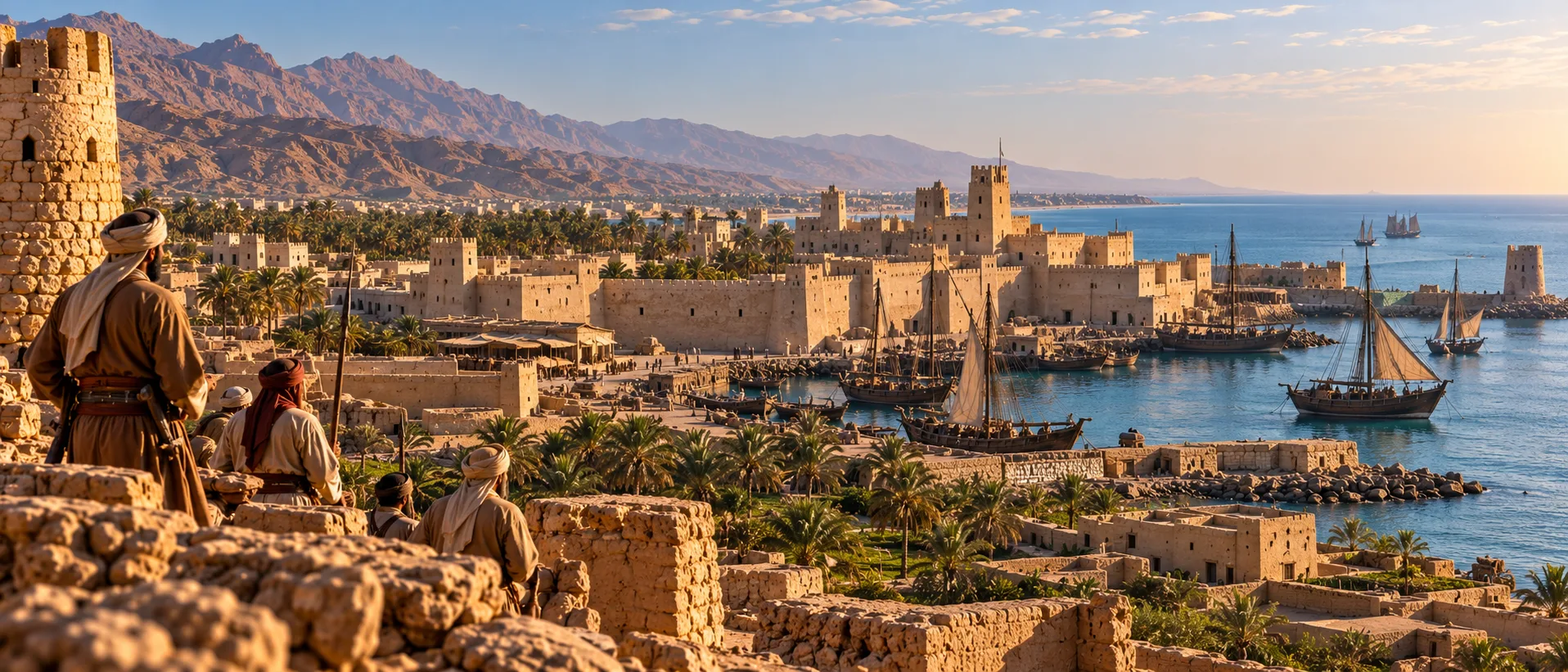
The story of the Al Said dynasty does not begin with an empire, a palace or a ceremonial succession. It begins in an Oman weakened by civil conflict, divided loyalties and Persian military intervention. Ahmad bin Said was not born into the dynasty he would later establish. He emerged as the governor of Sohar, a fortified port on the Batinah coast, at a moment when survival depended on local authority, trade, military endurance and the ability to persuade rival groups that a more stable order was possible. His rise is therefore more useful when read as a reconstruction of power than as a simple founder’s biography. The Oman inherited by his descendants was built from a crisis, and the choices made during that crisis shaped the political house that still rules the country today.
Oman before Ahmad bin Said was not politically empty
The early eighteenth century followed the great maritime successes of the Ya’aruba period, when Omani forces had expelled the Portuguese from Muscat and projected power along the Indian Ocean. Yet dynastic disputes after the death of Imam Sultan bin Saif II fractured that order. Competing claimants, tribal alignments and local centres of power made it increasingly difficult to sustain a single authority across the country.
This matters because later narratives can make Ahmad appear as if he simply replaced one dynasty with another. The transition was much rougher. Oman had forts, towns, ports, tribal coalitions and established religious ideas about the imamate. Any new ruler had to deal with these institutions rather than write on a blank page. Ahmad’s achievement was not the invention of Oman. It was the rebuilding of authority after a period in which several actors could plausibly claim to speak for parts of the country.
Sohar made Ahmad visible
Ahmad bin Said served as wali, or governor, of Sohar and its surrounding area. Sohar was not a minor provincial post. It sat on the Batinah coast, a zone of agriculture, ports and maritime exchange facing the Gulf of Oman. When Persian forces intervened in Omani affairs, Sohar became one of the places where resistance could be organized and measured in practical terms: walls, supplies, ships, alliances and the willingness of a town to hold out.
Official Omani accounts emphasize Ahmad’s courage in resisting the Persian presence and credit his role in the liberation of the country as central to his later selection as imam. It is easy to turn this into a heroic siege story and stop there. More important is what a successful defense demonstrated politically. A governor who could keep a strategic port functioning during a wider crisis showed that he could command men, maintain revenue, negotiate local loyalties and connect land power to the sea. Those were exactly the capacities a fragmented Oman needed.
The Persian intervention was part of an Omani civil crisis
Persian forces did not arrive in a vacuum. Their intervention became possible because Omani factions were already struggling for supremacy. That distinction is important. Describing the episode only as a foreign invasion can hide the internal divisions that opened the door to external power. Describing it only as a civil war can hide the military weight and political ambitions of the Persian presence. Both dimensions belonged to the same crisis.
Sources written at different times also organize the chronology differently. Current official Omani history identifies 1744 as the foundation of the Al Busaid state and the year of Ahmad’s accession. Some older narratives use nearby dates or distinguish between stages of recognition. Rather than pretending the documentary record is perfectly uniform, it is safer to understand the mid-1740s as the decisive transition and to state clearly which chronology is being followed. Here we use the current official Omani chronology.
Election as imam was not the same as uncontested rule
In 1744, influential figures pledged allegiance to Ahmad bin Said as imam. That act gave him a claim to national leadership, but a title did not make every rival disappear. Oman had strong regional communities and political traditions in which legitimacy had to be maintained, not merely announced. Ahmad still faced opposition and had to turn recognition into working government.
This is one reason his career is more interesting than a founder myth. He had to combine religious-political legitimacy with the practical instruments of state: military forces, revenue, appointments, forts, ports and negotiated relationships. The result was a more centralized authority than the immediate period of civil conflict had allowed, but it was not a modern bureaucracy. Power still depended heavily on personal allegiance, family networks, regional notables and control of strategic places.
Rustaq shows how inland authority and maritime power met
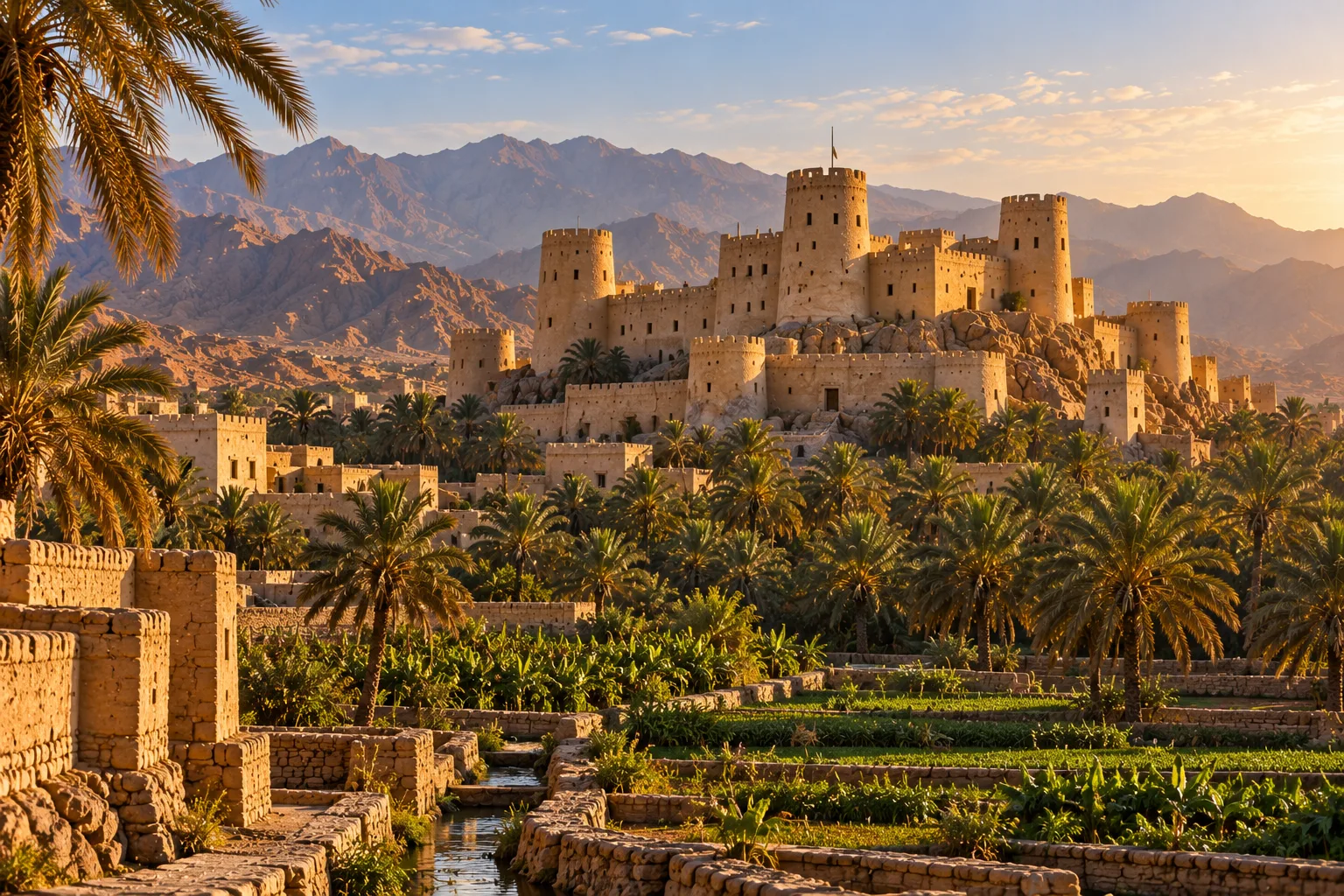
The National Museum of Oman identifies Rustaq Fort as Ahmad bin Said’s seat of government. Rustaq, set among date gardens and near routes through the Hajar Mountains, offered a different political geography from coastal Sohar or Muscat. From here, rule could be anchored in an old centre of Omani authority while remaining connected to the Batinah coast.
That pairing is worth noticing. Oman was never only a maritime state, even when its ships were famous, and it was never only an interior tribal polity, even when inland alliances determined succession. Ahmad’s system had to speak to both worlds. Forts such as Rustaq were not decorative symbols. They stored weapons and provisions, housed officials, protected approaches and made authority physically visible. Ports, meanwhile, produced customs revenue and maintained contact with the wider Indian Ocean economy.
Muscat and the fleet were instruments of recovery
Official Omani sources credit Ahmad with strengthening both naval and commercial fleets and preserving Muscat’s importance as a regional trading city. A fleet mattered for defense, but it also mattered for revenue and diplomacy. Oman sat between the Gulf, the Arabian Sea, India and East Africa. Ships moved dates, textiles, grain, metals, people and correspondence as well as soldiers.
The maritime recovery under Ahmad therefore should not be reduced to naval prestige. Control over shipping helped a ruler collect customs, protect merchants and show that the state could operate beyond the walls of an inland fort. It also prepared the infrastructure his successors would use on a much larger scale. Readers of our article on Said bin Sultan and the Omani world across the Indian Ocean will recognize the later expansion of this maritime logic.
The Basra expedition reveals the regional scale of Omani power
One of the clearest signs that Ahmad’s rule had moved beyond mere survival came in the 1770s, when Omani naval forces assisted Basra during a Persian siege. Official Omani accounts remember this as evidence of the strength of the fleet and of Oman’s regional role. The episode connects the state not only to Muscat and Sohar but to the politics of the wider Gulf.
It also reminds us that alliances in the eighteenth-century Gulf did not follow modern national categories. Omani rulers could cooperate with Ottoman-held Basra against Persian forces while simultaneously managing rivalries at home and commerce with Indian ports. The map was political, but its lines were different from today’s borders. That wider mobility is explored in Arabia Before Modern Borders, where ports, rulers and tribal ranges overlap across eastern Arabia.
State building also rested on revenue and unequal systems
Dynastic history often records battles and successions more clearly than taxation, debt, coerced labour or the movement of enslaved people. Yet eighteenth-century Indian Ocean economies cannot be understood without those harder subjects. Muscat’s commercial world was connected to trading systems in which slavery existed alongside legitimate commerce, and rulers benefited from customs and maritime activity shaped by those systems.
Acknowledging this does not erase Ahmad’s political achievement. It makes the world in which he governed more complete. A state that rebuilt security and commerce could improve conditions for some merchants and communities while remaining embedded in hierarchies we would not accept today. MESKI’s historical approach is to resist both extremes: neither reducing a ruler to modern moral judgement alone nor polishing the past until its human costs disappear.
Ahmad founded a dynasty, but succession remained a political problem
Ahmad bin Said died in 1783. The dynasty survived him, but succession was not automatically smooth. His sons and descendants competed, negotiated and shifted the balance of power between Muscat, interior centres and overseas interests. The later title of sultan and the shape of Omani government evolved over time. Calling Ahmad the founder is accurate, but it should not make us imagine that every later institution already existed in finished form during his lifetime.
The strongest evidence of his legacy is continuity through change. The Al Busaid house endured internal rivalries, the rise of Said bin Sultan, the nineteenth-century division between Muscat and Zanzibar, periods of British influence, twentieth-century conflicts and the modern transformations associated with Sultan Qaboos and Sultan Haitham. The dynasty remained, while the state around it changed profoundly.
Why Ahmad bin Said matters before we read Said bin Sultan
Said bin Sultan is often easier to visualize because his story stretches from Muscat to Zanzibar and includes diplomacy, plantations, commerce and the Indian Ocean. Ahmad’s world can seem smaller by comparison. In political terms, however, Said inherited possibilities that Ahmad had helped restore: a functioning dynasty, strategic ports, a maritime tradition and a claim to authority that could survive beyond one man’s career.
This is why Ahmad belongs beside our articles on Sayyida Salme, Muscat and Muttrah and Qalhat. Those stories show different centuries of the same geographic fact: Oman’s political life repeatedly joined mountains, oases and interior alliances to ports that faced India, the Gulf and East Africa. Ahmad bin Said did not create that geography. He succeeded because he learned how to govern through it.
A founder is most useful when we see the crisis he solved
The simplest version of Ahmad’s biography says that he expelled Persian forces, became imam and founded the Al Busaid dynasty. All three statements point toward the truth, but they are not enough. The deeper story is that a governor from Sohar converted wartime credibility into a broader political coalition, then used forts, revenue, maritime force and negotiated legitimacy to rebuild a state after fragmentation.
That is a more useful legacy than a heroic portrait. It explains why Sohar matters, why Rustaq became a seat of government, why Muscat’s commerce could recover and why later rulers possessed a political platform from which to project Omani influence much farther. The dynasty is still visible today. The conditions that made its founding necessary belong to a more difficult eighteenth century, when survival depended on holding together a country whose regions had powerful identities of their own.
Frequently Asked Questions
Ahmad bin Said Al Busaidi was governor of Sohar during a period of Omani civil conflict and Persian intervention. He became imam in the mid-eighteenth century and founded the Al Busaid state, the ruling house from which Oman’s present dynasty descends.
Current official Omani history identifies 1744 as the foundation year and the beginning of Ahmad bin Said’s rule. Some older sources use nearby dates or distinguish stages of recognition, so readers may encounter small chronological differences.
Sohar was a strategic fortified port on the Batinah coast. Ahmad’s ability to defend and administer it during the wider crisis demonstrated military, commercial and political competence and helped establish the reputation on which his later leadership rested.
No. Persian intervention was entangled with an Omani civil struggle. Even after foreign forces were pushed out and Ahmad was recognized as imam, he still had to manage internal opposition, regional loyalties and the practical work of rebuilding authority.
The National Museum of Oman identifies Rustaq Fort as Ahmad’s seat of government. Its location linked an old inland political centre and productive oasis landscape with the Batinah coast, illustrating how Omani authority depended on both interior and maritime geography.
Yes. Official Omani accounts describe Ahmad as maintaining Muscat’s commercial importance and developing naval and trading fleets. The port connected state revenue and diplomacy to the Gulf, India and the wider Indian Ocean.
He is generally described as Imam Ahmad bin Said in accounts of his own reign. Titles and institutions evolved under later Al Busaid rulers. It is better not to project the later sultanate structure backward as if it already existed unchanged in 1744.
Ahmad bin Said died in 1783 according to the chronology used by Oman’s National Museum. His death did not end the dynasty, although later succession and internal rivalry repeatedly reshaped how Al Busaid authority operated.
Said bin Sultan was a later descendant of the house Ahmad founded. Said’s nineteenth-century power across Oman and Zanzibar depended on institutions, ports and a dynastic framework that developed from the political recovery begun under Ahmad.
Continue exploring the Gulf
From Ahmad bin Said, continue to Said bin Sultan, Sayyida Salme, Muscat and the ports that connected Oman to the Indian Ocean.