
The famous raid on Riyadh in 1902 was not the creation of a kingdom. It was the beginning of thirty years of war, alliance, negotiation and state building.
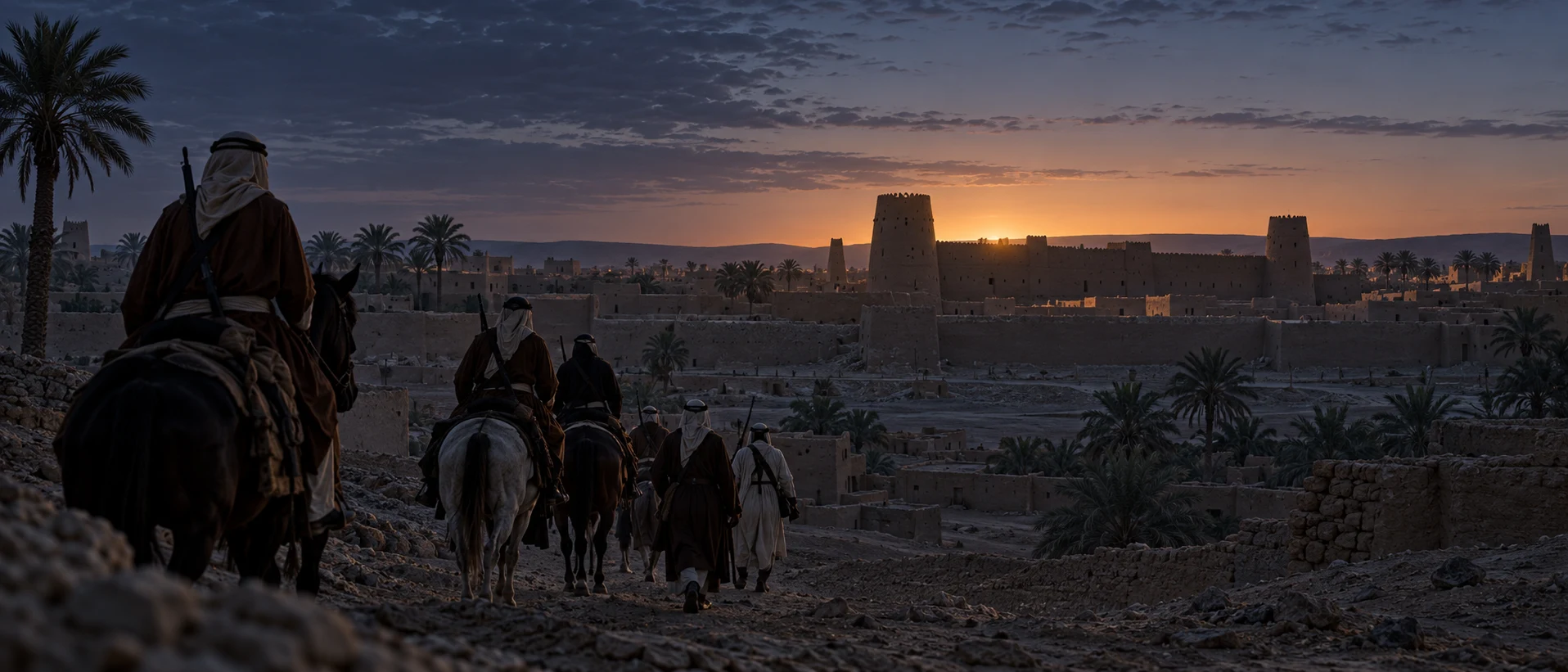
The story is often told in one cinematic scene: a young Abdulaziz bin Abdulrahman Al Saud approaches Riyadh with a small band of men, enters the city before dawn and captures Masmak. The scene matters. It is also dangerously easy to let it swallow the next thirty years. A fort can be taken in hours. A state cannot. The Saudi Arabia proclaimed in 1932 emerged through campaigns across Najd, Al-Ahsa, Ha’il, Asir and the Hijaz, through treaties with Britain, bargains with tribes and towns, religious mobilisation, internal rebellion and the slow construction of institutions. The recapture of Riyadh was the opening move, not the finished kingdom.
1902 only makes sense after the loss of Riyadh
The Al Saud had ruled from Riyadh during the Second Saudi State, but internal conflict and the rise of the Al Rashid of Ha’il ended that order. In 1891, the Al Saud leadership left Najd and eventually settled in Kuwait. Abdulaziz therefore grew up with both dynastic memory and political exile. Riyadh was not an abstract prize. It was a lost capital connected to his father and grandfather.
That is why the MESKI article on Ha’il and Jabal Shammar belongs beside this one. The Al Rashid were not a footnote created to give Abdulaziz an opponent. They ruled a substantial emirate with their own alliances and regional influence. The recapture of Riyadh began inside a genuine contest between rival centres of power.
The Masmak episode was a calculated gamble
According to Saudi accounts, Abdulaziz left Kuwait with a small following, moved through difficult desert terrain and approached Riyadh in secrecy. On 15 January 1902, his group attacked the governor Ajlan bin Mohammed al-Ajlan near Masmak and took control of the fort. The speed of the action became central to Saudi national memory because it turned a seemingly weak exile into a ruler with a capital.
But even the most dramatic version of the raid cannot explain why the victory lasted. Abdulaziz needed local support, supplies and recognition immediately afterwards. A successful attack without a political network would have produced a brief occupation. The more important achievement was converting surprise into durable authority across nearby Najdi settlements.
Riyadh was a base, not yet a country
After 1902, Abdulaziz expanded through southern and central Najd and fought repeatedly against Al Rashid forces. Qassim became a major arena of conflict. Towns did not all submit in the same way, and allegiance could change when military fortunes shifted. This was not a clean march across an empty map. It was a process in which local leaders, merchants, tribes and religious figures weighed security and advantage.
The titles Abdulaziz used changed as his power grew. That detail is useful because it shows state formation in motion. He was not called King of Saudi Arabia in 1902. Different titles reflected different territorial realities until the final name of the kingdom was proclaimed three decades later.
Al-Ahsa changed the geography of his state
In 1913 Abdulaziz took Al-Ahsa from Ottoman control. The move gave his state access to the Gulf coast and to one of eastern Arabia’s great oasis regions. It also changed his relationship with imperial powers because he now controlled territory facing maritime routes watched closely by Britain.
Al-Ahsa should not be treated as just another coloured block on a unification map. Its agriculture, towns and Shi’a communities had their own history. Our article on Al-Ahsa’s water and date culture helps restore that local texture. Incorporation into a growing Saudi state meant administrative change for a place that already possessed a complex social world.
Britain was a partner, constraint and outside power
During the First World War, British officials sought alliances across Arabia. The 1915 Treaty of Darin recognised Abdulaziz’s position while binding him within a British strategic framework. Britain provided subsidies and arms at different moments, but it also maintained relationships with other rulers, including Sharif Hussein in the Hijaz. Abdulaziz was never simply a British client, nor was he operating outside imperial politics.
The relationship shifted as his power increased. The 1927 Treaty of Jeddah recognised the independence of his realms. Between those two treaties lies a useful lesson: state builders use external powers while trying not to become controlled by them, and external powers support local rulers while pursuing their own routes, borders and security interests.
Ha’il was the decisive northern rival
The struggle with the Al Rashid continued for years after the recapture of Riyadh. Their emirate connected Ha’il to northern Arabian routes and had once displaced the Al Saud from Najd. Its defeat was therefore both strategic and symbolic. Ha’il fell in the 1921 to 1922 phase of Abdulaziz’s expansion, ending the principal rival state in central Arabia.
This is exactly where separate articles help. If we tell the episode only from Riyadh, Ha’il becomes the city that lost. Read the Jabal Shammar story first and the outcome feels less inevitable. Saudi unification was made by defeating political alternatives that had once looked durable.
The Hijaz transformed Abdulaziz from Najdi ruler to king of the holy cities
The move into the Hijaz in 1924 and 1925 changed the scale of Abdulaziz’s authority again. Taif, Makkah, Madinah and Jeddah entered his control through different combinations of military pressure, negotiation and surrender. In 1926 he was proclaimed King of the Hijaz while continuing to rule Najd.
Control of Makkah and Madinah brought immense religious responsibility and international scrutiny because pilgrims came from across the Muslim world. Administration could no longer be designed only for Najdi towns and tribal politics. The ruler now had to manage ports, pilgrimage, foreign consulates and a more diverse population.
The second image: Masmak is a beginning, not a summary
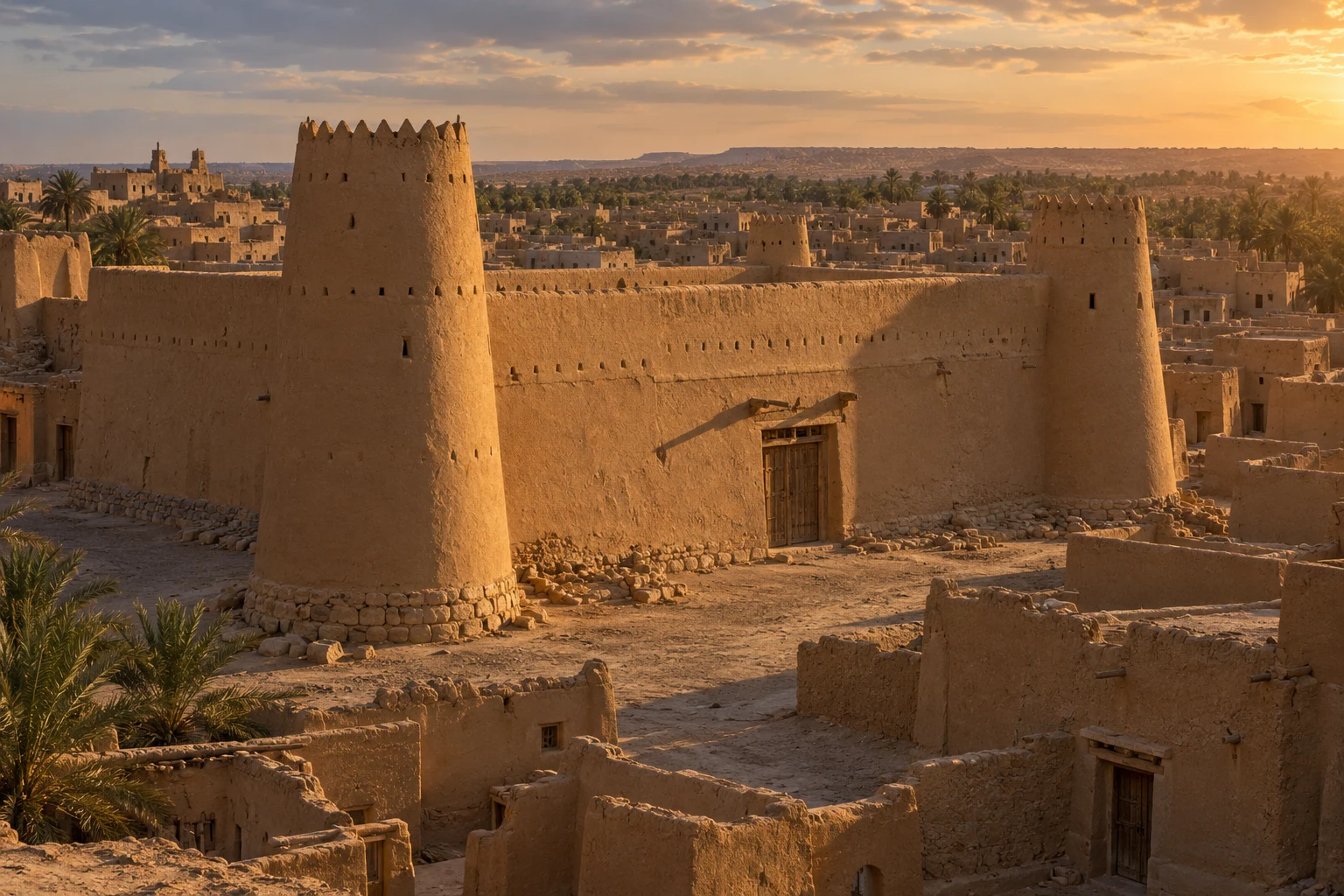
Masmak survives because it gives the unification story a physical starting point. Its walls are tangible in a way that thirty years of treaties and campaigns are not. That makes it powerful, but also risky. Visitors can leave thinking the kingdom was born at the moment the fort changed hands.
A better reading is to use Masmak as a doorway. From there, follow the map east to Al-Ahsa, north to Ha’il, west to the Hijaz and south toward Asir and Jazan. The distances themselves explain why unification required decades. Arabia was not waiting to be connected. It contained multiple political landscapes with their own loyalties and interests.
The remarkable part of 1902 is not that a fort was taken. It is that a victory small enough to fit inside one courtyard became the first line of a thirty-year political project.
Meskaoui
The Ikhwan helped expansion and then challenged the state
One of the hardest parts of this history is the Ikhwan. Settled tribal fighters inspired by a strict religious program became a major military force in Abdulaziz’s campaigns. Their mobility and commitment helped extend Saudi authority. But their vision of expansion and religious discipline eventually collided with Abdulaziz’s need for borders, diplomacy and a central state that could control its own armed supporters.
The conflict culminated in rebellion and the defeat of Ikhwan forces at the Battle of Sabilla in 1929. This episode matters because it prevents a simple story of ruler plus loyal followers. State formation creates coalitions, and successful rulers sometimes later suppress allies whose goals no longer fit the state being built.
Unification required administration after conquest
By the late 1920s, Abdulaziz governed territories with very different administrative traditions. Najd, the Hijaz, Al-Ahsa and southern regions could not be held together by personal allegiance alone. Ministries, consultative bodies, provincial administration, courts, communications and fiscal systems developed gradually. The modern state remained highly personal around the ruler, but it was becoming more institutional.
This transition is easy to overlook because military episodes produce better stories than paperwork. Yet a kingdom survives through records, salaries, judges, roads, customs and officials. The political achievement of 1932 depended on this less cinematic layer as much as on cavalry and forts.
1932 gave a name to a political reality still being built
On 23 September 1932, the Kingdom of Saudi Arabia was proclaimed. The name brought Najd, the Hijaz and other territories under one state title. It did not mean every regional distinction disappeared overnight. Integration continued, and the state would be transformed again by oil revenues after commercial production began later in the decade.
The useful point is chronological. Saudi unification preceded the oil economy that would later reshape the kingdom. Abdulaziz built his territorial state with resources, technologies and constraints of a pre-oil Arabian world. Oil changed the possibilities of government, but it did not create the political map from nothing.
A founder can be important without becoming a myth
King Abdulaziz deserves attention because few twentieth-century rulers altered the political map of Arabia so dramatically. But serious history does not become disrespectful when it examines violence, rival states, imperial diplomacy or defeated allies. In fact, the achievement becomes easier to understand once the obstacles remain visible.
The recapture of Riyadh is memorable because it compresses courage, secrecy and risk into one scene. The larger accomplishment was different: Abdulaziz repeatedly turned temporary victories into new political structures. That took thirty years. The kingdom announced in 1932 was the result of accumulation, not a single heroic morning.
From Diriyah to Riyadh, and from Riyadh to a kingdom
The deeper Saudi chronology begins before Abdulaziz. Our companion article on Diriyah and the First Saudi State shows where the ruling tradition first acquired a capital and broader territorial ambition. Riyadh then became the centre of the Second State and the place Abdulaziz chose to recover in 1902.
This sequence matters because it turns a national origin story into a history of repeated collapse and rebuilding. Diriyah fell. Riyadh was lost. Ha’il rose. The Al Saud went into exile. Then Riyadh was recaptured and a new state expanded. Continuity existed, but never without interruption.
Sources and Archive Notes
Saudipedia dates the recapture of Riyadh to 15 January 1902 and describes the small force that entered Masmak. Its biographies and unification timeline also trace the expansion into Al-Ahsa, Ha’il, Asir, the Hijaz and Jazan before the 1932 proclamation.
Official Saudi narratives understandably centre Abdulaziz as founder and unifier. This article uses their chronology while also keeping rival polities, British imperial interests, the Ikhwan conflict and regional diversity visible.
Dates surrounding the final defeat and incorporation of Ha’il can appear as 1921 or 1922 in different summaries depending on whether the focus is surrender, campaign chronology or formal integration. The article therefore treats it as the 1921 to 1922 phase rather than pretending the sources are perfectly uniform.
Questions People Ask
Saudi sources date the recapture to 15 January 1902, when Abdulaziz and a small force took Masmak and re-established Al Saud rule in the city.
Not under that name or in its final territorial form. Riyadh became the base for a long process of expansion and unification that culminated in 1932.
The city was under the authority of the Al Rashid emirate of Ha’il, whose governor in Riyadh was Ajlan bin Mohammed al-Ajlan.
He took Al-Ahsa in 1913, bringing the eastern oasis region and Gulf access under his rule.
The Al Rashid emirate was defeated during the 1921 to 1922 phase of Saudi expansion and incorporated into Abdulaziz’s state.
The Saudi advance into the Hijaz began in 1924. Makkah, Madinah and Jeddah came under his control through 1924 and 1925.
They were a powerful religiously inspired tribal military movement that supported Saudi expansion but later rebelled when their goals clashed with Abdulaziz’s state and foreign policy.
The unified kingdom was proclaimed in September 1932, with 23 September becoming Saudi National Day.
No. The territorial unification was substantially complete before commercial oil production transformed state revenues later in the 1930s.
Read the unification from more than one capital
Begin in Diriyah, look north to the rival emirate of Ha’il, and return to Riyadh with a clearer sense of what Abdulaziz actually had to overcome.