
The Dubai Chocolate I Actually Wanted to Eat
I love what Dubai chocolate represents. I don’t love sugar. So one evening, in my own kitchen, I made a version I could actually enjoy — and I haven’t stopped thinking about it since.
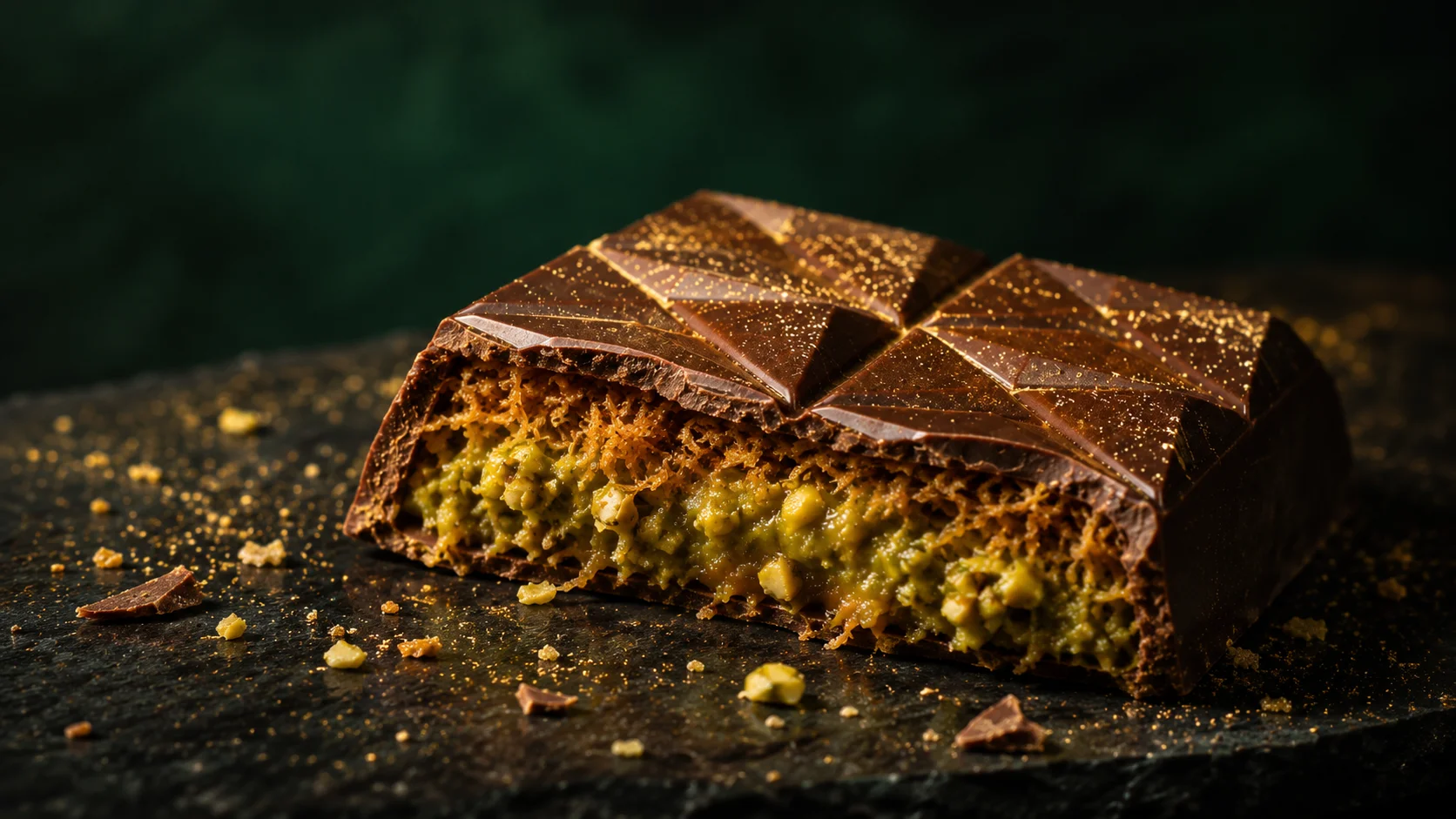
I need to say this plainly before anything else: I am someone who avoids sugar. Not as a trend, not for a season — it is simply how I choose to eat. So when the whole city seemed to fall in love with Dubai chocolate — the pistachio, the kunafa, the impossible crunch everyone was posting about — I found myself in an odd position. I wanted it. I genuinely did. I just could not bring myself to eat it the way it was made.
Wanting Something You Won’t Let Yourself Have
There is a particular kind of craving that comes from watching everyone around you enjoy something you’ve decided not to touch. Friends were bringing bars back from Dubai as gifts. Colleagues were describing the sound it made when you broke it in half. I kept nodding along, and kept declining a taste, and kept thinking about it anyway.
Eventually I did what I always do when something bothers me enough: I went looking for the version I could actually say yes to.
Building It From What I Actually Trust
I did not set out to copy the original bar exactly. I set out to keep what I understood to be its soul — the crunch, the pistachio, the sense of something a little indulgent — and rebuild it around ingredients I would put my own name on.
I should be honest about one thing here, because I don’t want to oversell it: honey is not the opposite of sugar. It is a form of sugar. What raw honey carries that refined white sugar does not is trace enzymes, antioxidants and minerals — refined sugar, by the time it reaches that white crystalline form, has had almost everything stripped from it except sweetness. Whether that difference matters much in the small amount anyone eats in a piece of chocolate is a fair question, and I won’t pretend to answer it for you. If you manage a health condition tied to sugar or insulin, this bar is still sugar, and deserves to be treated that way — that decision belongs with you and whoever helps you manage it, not with me.
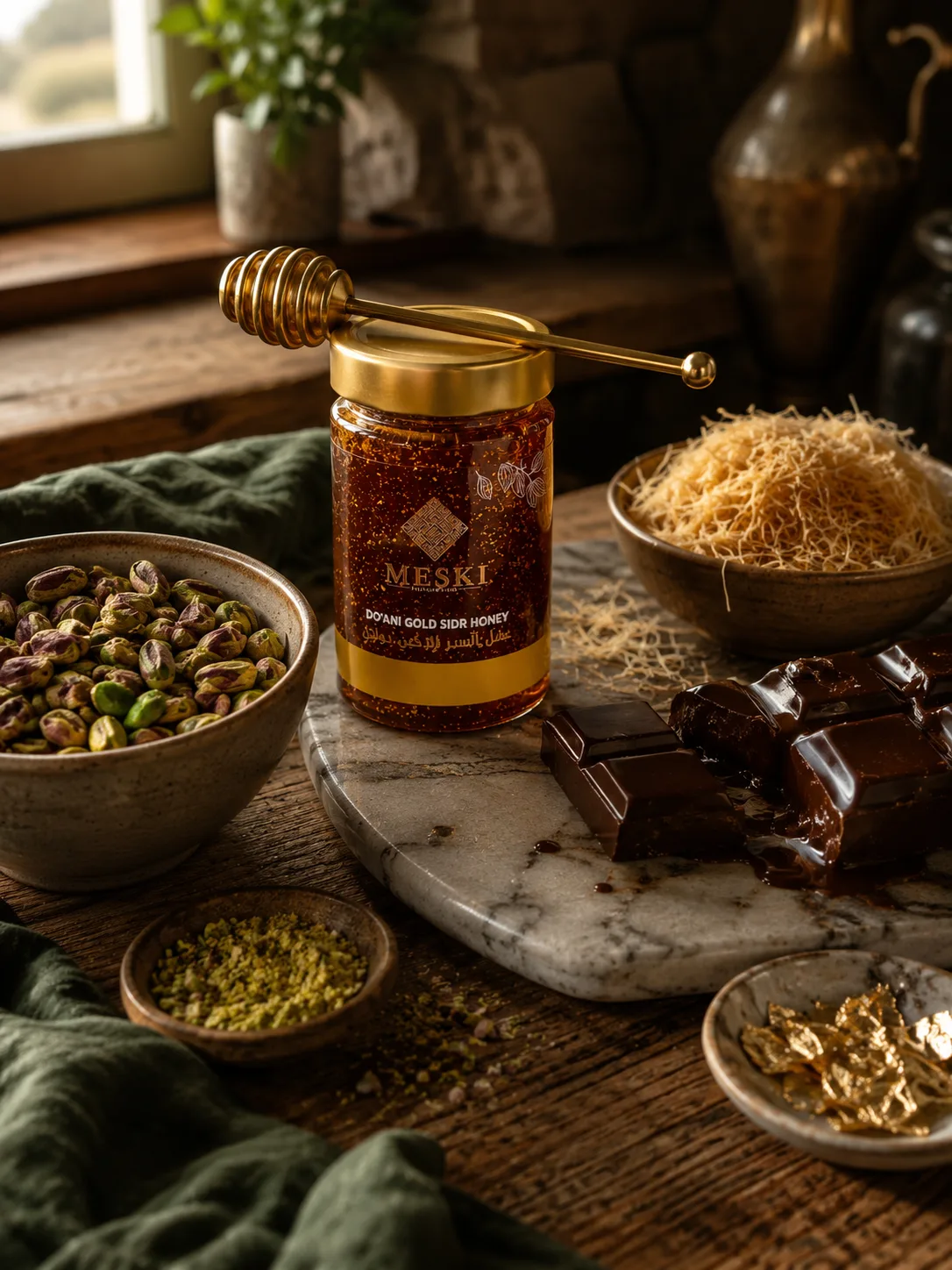
I started with pistachios from Italy, well-roasted — not lightly toasted, properly roasted, until the smell alone fills the kitchen and makes the decision for you before you’ve done anything else. I added a thread of sesame paste, for depth more than sweetness. And instead of the sugar syrup that usually binds a kunafa filling, I used our own Emirati Gold Sidr Honey — just enough to bring everything together, not a spoonful more than the filling actually needed.
The chocolate shell is a high-grade Swiss couverture — this was never a place to compromise. And across the top, the smallest scatter of edible gold, less for decoration than for honesty: this bar was always meant to feel like something precious, not something ordinary dressed up.
The Moment You Break It
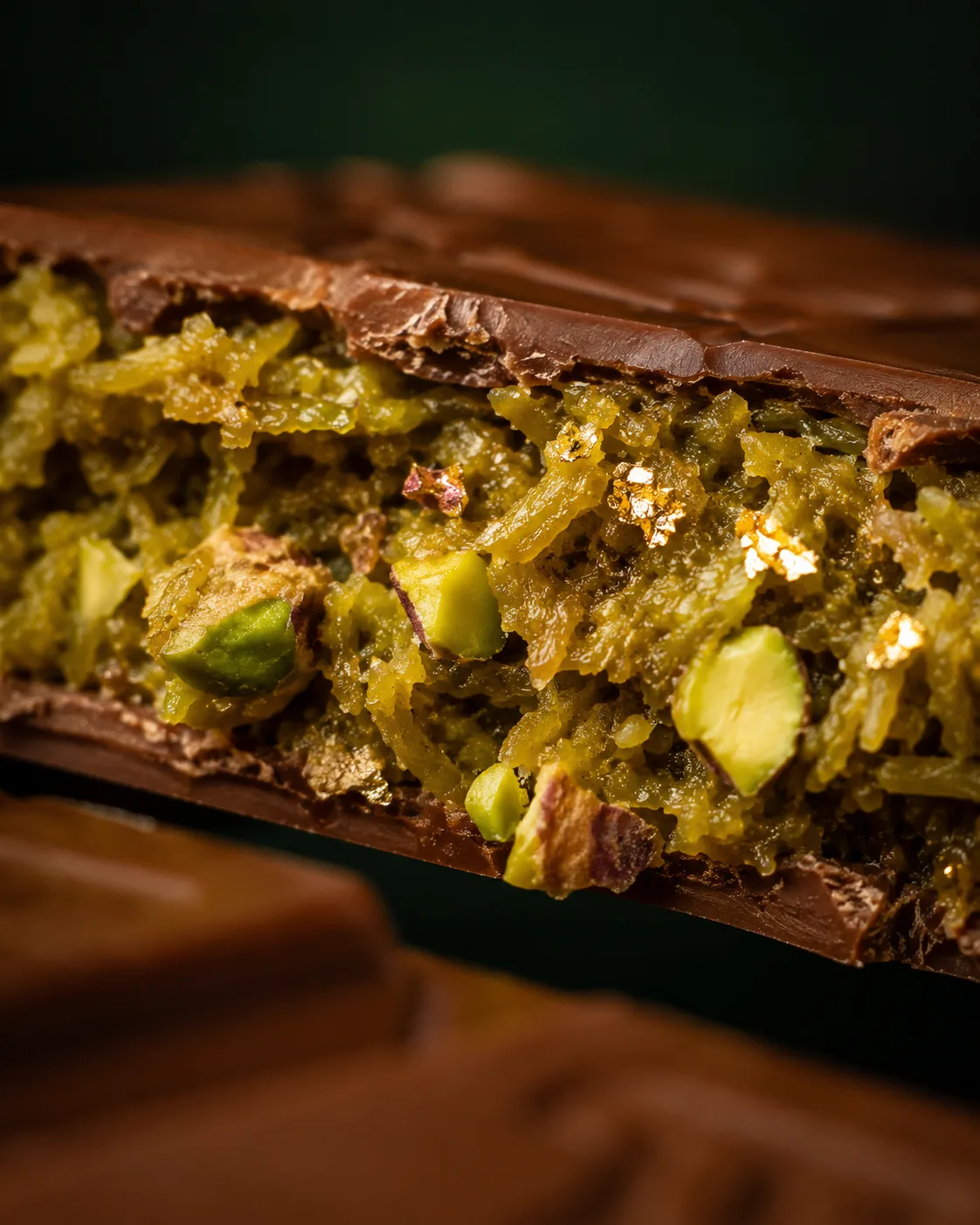
There is a specific pleasure in that first break — the shell cracking clean along its geometric ridges, catching the light for just a second before it gives way entirely. The kunafa underneath resists a moment, then surrenders with that particular dry crunch that made the original bar famous in the first place. Mine had it, unmistakably. A faint scatter of gold caught along the fracture line, and for a second I just looked at it, before eating anything at all.
Then the taste arrives in stages, the way a good bite always does: pistachio first, roasted and generous, almost nutty enough to stand alone. Then the honey beneath it, not sugary-sharp the way I remembered the original being, but warm and rounded, closer to caramel than to sweetness itself. The sesame sits quietly underneath the whole thing, the way a good supporting note should — present, but never asking for attention. It did not taste like a “healthy version” of something. It tasted like its own thing, and to me, a better one.
Sharing It — and Watching People’s Faces
I did what anyone proud of something does: I made friends and colleagues try it before I trusted my own opinion. I watched faces more than I listened to words, because faces don’t perform politeness the way words sometimes do.
What I heard, more than once, in different phrasings from different people: that it tasted rich without tasting like sugar. That the honey came through clearly — not hidden, not disguised, but present in a way that made the bar feel more honest than sweet. One colleague, who had bought and eaten the original from a well-known Dubai spot, told me plainly that she preferred mine — and that for what the original costs, this one felt like the better value entirely.
I will not pretend that is a scientific verdict. It is a handful of honest reactions from people who had no reason to flatter me. But it was enough to make me keep the recipe, and keep thinking about what comes next.
What I’m Left Wondering
I made this bar for myself, out of simple stubbornness — I wanted something everyone else was enjoying, and I was not willing to eat sugar to get it. I did not make it thinking about a product line, a shop shelf, or a launch.
But I keep coming back to the same question, and I would rather ask it honestly than assume the answer: would this be something worth bringing to the House of Meski properly — a Sidr-honey pistachio kunafa bar, made with the same care as everything else we put our name on?
I don’t know yet. That is genuinely up to whether enough people reading this would actually want it.
Questions About Dubai Chocolate
It started, honestly, the way most things do today — with influence. Someone filmed themselves breaking one open, the sound and the colour did the rest, and within weeks half the world wanted to taste what they’d just watched. But influence alone doesn’t explain why it stayed popular months later. That part is simpler: it’s genuinely, unapologetically delicious. Curiosity opened the door; the taste is what kept people coming back.
At its heart: chocolate, pistachio, and kunafa. Beyond that, it depends entirely on who’s making it — every pastry chef seems to hold their own version close, changing the sweetener, the ratio, sometimes the pastry itself. There isn’t one official recipe so much as a shared idea everyone interprets a little differently. Mine happens to swap the syrup for honey — but that was never a rule, just my own answer to it.
Nearly everywhere at this point — it’s travelled further and faster than most food trends manage to. Mine, though? You’ll only find that one here. (I’m joking. Mostly.)
There’s the original, and then there are the countless variations it inspired — mine included. I don’t think there’s one honest answer to this. Everyone ends up with their own preference, and mine will always lean toward whichever version tastes most like something real, made with ingredients I’d recognise, rather than something engineered purely to go viral.
Slowly, if you can manage it. Break it, don’t cut it — the crack matters, it’s part of the experience. Let the shell go first, then the crunch of the kunafa. I’ve never once seen anyone eat it quickly.
No, and I won’t pretend otherwise — it’s still chocolate, still sugar, and it’s meant to be a treat, not a health food. My own version swaps refined sugar for raw honey, which brings something real to the sweetness. But “better than the alternative” isn’t the same as “healthy,” and I’d rather be honest about that than sell you something I don’t believe.
No refined sugar — Sidr honey in its place. High-grade Swiss chocolate rather than a generic shell. And honestly, it was never really made to compete with the original. It was made because I wanted to taste what everyone else was enjoying, without eating something I’d already chosen not to eat.
Would You Want a Meski Version of This?
If a Sidr-honey pistachio kunafa chocolate bar — made the way I’ve described here, without refined sugar — sounds like something you’d want to find in our shop, tell us. Genuinely, your answer decides whether this becomes real.