
Honey Academy · Gulf Terroirs
Sidr Honey vs Samar Honey:
Two Gulf Honeys, Two Different Terroirs
They can come from the same country, the same beekeeper and sometimes the same landscape. Yet Sidr and Samar can taste as if they belong to two different worlds.
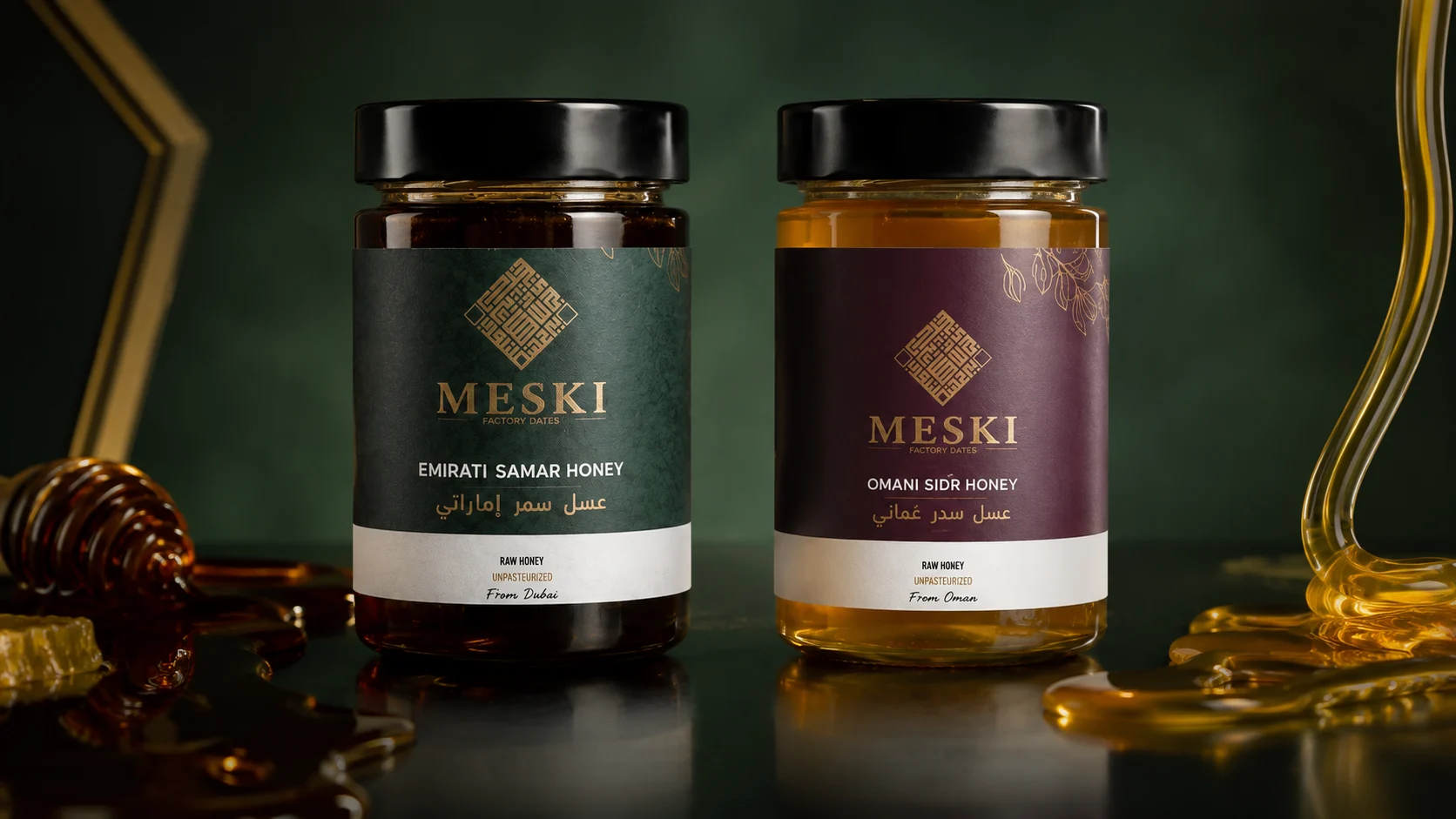
Ask for a serious local honey in the UAE and two names appear again and again: Sidr and Samar.
They are often sold beside each other. They can both be raw, seasonal and deeply connected to desert landscapes. That is where the similarity ends.
One comes from the Sidr tree. The other comes from the Samar. The bloom is different. The aroma is different. The colour often changes. And on the spoon, the difference is immediate.
First: Sidr and Samar Are Not Two Grades of the Same Honey
Sidr honey and Samar honey come from different floral sources. In the UAE, the tree locally called Sidr is identified as Ziziphus spina-christi. The UAE Department of Health records Sidr as a local name for this species, and Dubai Municipality lists it among native plants found in desert environments.
Samar is a different tree. UAE authorities commonly list it as Acacia tortilis. Modern botanical databases such as Kew accept the name Vachellia tortilis, with Acacia tortilis treated as a synonym.
That distinction matters. “Sidr” and “Samar” are not marketing names for dark and light honey. They begin with different trees.
Tree: Ziziphus spina-christi
UAE context: wadis, farms, mountain and desert-edge landscapes
Typical impression: rounded sweetness, caramel, floral warmth, sometimes woody depth
Tree: Vachellia tortilis, often listed locally as Acacia tortilis
UAE context: dry desert and shrubland, highly drought-adapted landscapes
Typical impression: darker, more assertive, warm, sometimes smoky or malt-like
What Does Sidr Honey Taste Like?
There is no single Sidr flavour. Yemeni Do’ani Sidr is not the same experience as Emirati Sidr from Hatta, and Omani Sidr has its own character.
But good Sidr often gives a rounded first impression. Sweetness arrives clearly, followed by notes that can suggest caramel, dried fruit, flowers or warm wood. Some harvests are dense and slow. Others, including certain Emirati lots, can remain more fluid.
If you want to explore these differences by country, our World of Sidr Honey and the MESKI Honey Atlas go deeper into individual origins.
What Does Samar Honey Taste Like?
Samar tends to surprise people who expect all Arabian honey to taste like Sidr.
The profile is often darker and more direct. Depending on the harvest, there may be smoky, toasted, malted or deep caramel notes. It can feel less floral and more grounded.
That does not make Samar “stronger” in a medical sense. It simply describes the sensory character of the honey.
The UAE treats Samar as a honey category in its own right. The Al Dhaid Honey Festival, organised by the Sharjah Chamber, has separate competition categories for Sidr and Samar honey. That is a useful reminder that local honey culture does not see them as interchangeable.
The interesting question is not which honey is stronger. It is which landscape you can still taste after the sweetness is gone.
Sidr vs Samar Honey: Colour
Samar is often associated with a darker appearance, while many Sidr honeys sit in a golden to amber range. But colour should never be used as an authenticity test.
Honey colour changes with floral origin, season, storage and individual batch. A dark jar is not automatically Samar. A light jar is not automatically Sidr. And darker does not mean better.
If a seller describes a product only as “black honey” or “dark honey”, ask for the floral source. The tree is more useful than the colour.
Sidr vs Samar Honey: Which Is Sweeter?
Sidr often feels sweeter on the first taste because its caramel and floral notes can make the sweetness more obvious. Samar can feel darker, warmer or more bitter-edged, even though it is still honey and still naturally rich in sugars.
This is a tasting difference, not a nutritional rule.
Which One Is More “Emirati”?
Both belong to the UAE landscape.
Dubai Municipality lists both Sidr and Samar among native trees in local protected areas. The Ministry of Climate Change and Environment has also described Samar as important to beekeepers because its flowers provide nectar for honey production.
So if you are looking for Emirati honey, do not reduce the answer to Sidr. Emirati Samar honey is just as interesting as a local expression of desert flora.
Our guide to native trees of the UAE explains how Sidr, Samar, Ghaf and mangroves occupy very different botanical worlds.
2
Different trees, not two grades of one honey
1
Shared lesson: origin matters more than colour
What About Omani Sidr and Omani Samar?
Oman is another place where the comparison becomes especially interesting. Both Ziziphus spina-christi and Vachellia tortilis occur naturally across the Arabian Peninsula, including Oman according to Kew’s botanical distribution data.
Omani Sidr and Omani Samar should therefore be treated as separate terroirs, not as interchangeable “Omani honey”.
A useful tasting exercise is to compare Omani Sidr with Omani Samar. The country stays the same. The floral source changes. That is where terroir becomes easy to understand.
Which Is Better: Sidr or Samar Honey?
I would not choose a winner.
Choose Sidr if you enjoy a rounder, often more floral or caramel-led profile. Choose Samar if you want something darker, deeper and less expected.
For a gift, Sidr has the more famous name. For someone who already knows Gulf honey, Samar can be the more interesting discovery.
For your own table, taste both.
Raw Sidr Honey vs Raw Samar Honey
“Raw” describes handling. “Sidr” and “Samar” describe floral origin.
A Sidr can be minimally processed. So can a Samar. The word raw does not tell you which tree the bees visited, and the floral name does not tell you how the honey was handled after extraction.
We explain that distinction in our raw honey guide.
Sidr and Samar Honey Questions
Sidr honey is associated with Ziziphus spina-christi. Samar honey is associated locally with Acacia tortilis, now accepted by Kew as Vachellia tortilis. Different trees create different floral origins and usually different sensory profiles.
Often, but not always. Colour varies by origin, harvest, storage and batch. It should not be used alone to identify or authenticate honey.
No. “Black honey” is an imprecise market description. A serious label should identify the floral source and origin rather than rely only on colour.
There is no universal winner. Both are important UAE honeys. The better choice depends on the individual harvest, traceability and your taste.
Compare the Terroirs, Not the Marketing
Explore Sidr and Samar by origin, tree, season and taste.