
Hatta is still Dubai, but the bees work a very different Dubai: wadis, farms, mountain slopes and seasonal desert trees.
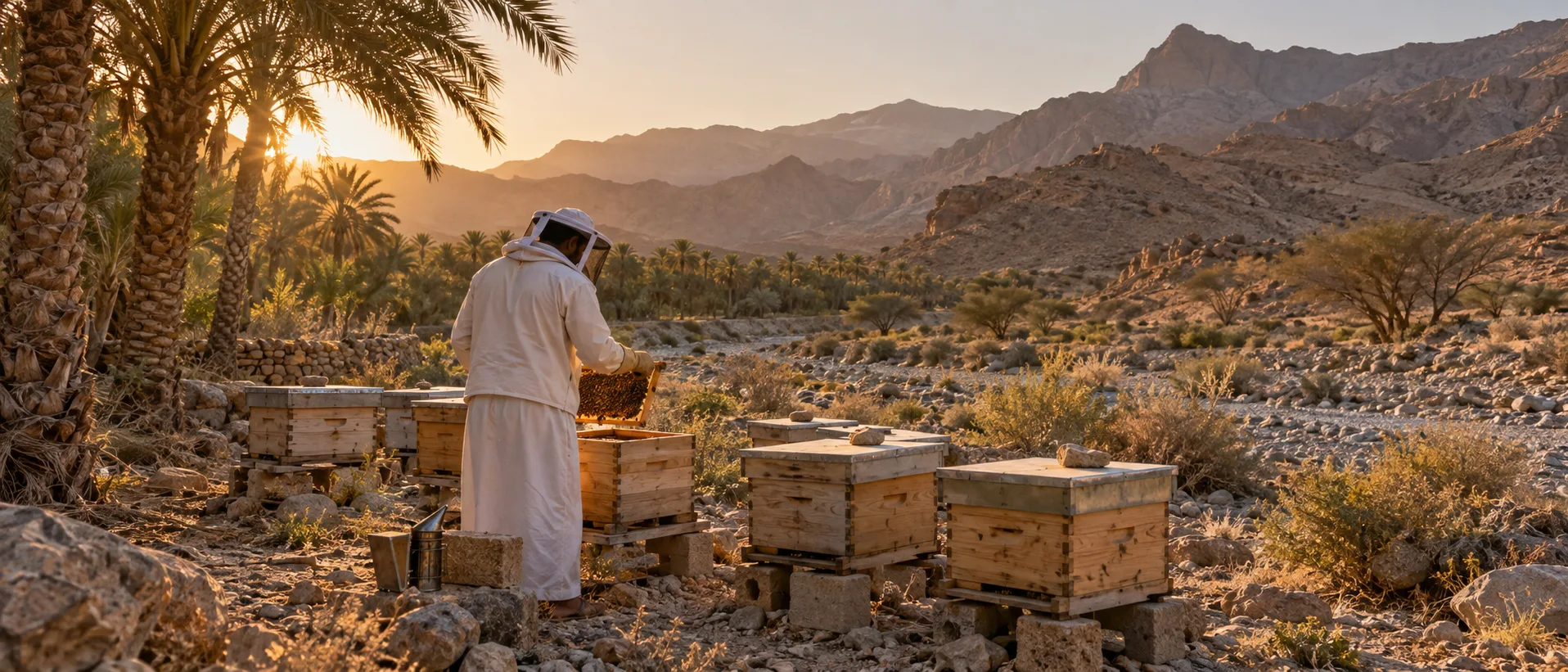
The most useful thing about Hatta honey is not the word mountain. It is everything the mountain changes around the hive: water, vegetation, temperature, access and the order in which plants flower.
Hatta changes the image of Dubai before it changes the honey
Dubai is usually introduced through coast, skyline and speed. Hatta sits about 130 kilometres away in the Hajar Mountains, where wadis, farms, reservoirs and rugged slopes create a completely different environment. Dubai Municipality describes Hatta as an enclave located relatively high in the Hajar Mountains, while its protected-area material highlights elevations from roughly 250 to 1,060 metres, wadi systems and rainwater storage.
That geography is why Hatta honey interests me. Not because mountains automatically make better honey, but because they change the physical conditions around flowering and beekeeping.
The Hajar landscape is not decoration
In honey marketing, mountains often become a background image. In Hatta they are part of the ecology. Dubai Municipality notes that the Hatta Mountain Reserve contains numerous wadis that store and distribute rainwater, supporting distinctive flora, fauna and agriculture.
Water in a dry mountain system is never a small detail. Runoff can concentrate vegetation in places that look insignificant from a distance. A beekeeper cares less about the dramatic peak than the slope, terrace or wadi where plants actually flower.
The mountain is not an ingredient. It changes the conditions that create the ingredients.
Meskaoui
Hatta is also agricultural
Visit Dubai now presents Hatta Farms as part of the area’s mountain identity, while Dubai Municipality’s farming festivals bring together Emirati farmers, estate owners and agricultural companies. Hatta therefore should not be described as untouched wilderness.
It is a lived rural landscape where agriculture, water management, homes, roads, tourism and wild vegetation overlap. For bees, that mixed landscape can mean both native forage and cultivated flowering plants.
Honey has become part of Hatta’s public identity
The Hatta Honey Festival reached its tenth edition in December 2025. Dubai Municipality describes it as an event celebrating local honey production and Hatta’s natural and rural heritage, bringing together beekeepers, producers, testing and retail.
A festival does not prove that every jar sold under the word Hatta was harvested there. But it does show that beekeeping is not a decorative side story. It has become an organised part of the area’s agricultural economy and public image.
There is more than one Hatta honey season
Commercial local sources list different harvest windows for different forage. Hatta Honey lists wildflower honey from February to March and Ghaf honey from June to July. The point is not to treat those dates as universal rules for every beekeeper. The point is that Hatta honey is seasonal before it is branded.
A spring wildflower crop and a summer Ghaf crop are biologically different events. If we put both under one generic label, we throw away the most interesting part of the story.
Sidr, Samar, Ghaf and wildflower are not one taste
Hatta and the wider UAE honey scene include Sidr, Samar, Ghaf and wildflower harvests. Each is connected to a different flowering pattern, and sometimes a different part of the year.
This is why I prefer a producer who tells me exactly which harvest I am buying. ‘Mountain honey from Hatta’ is attractive. ‘Ghaf harvest, June-July, Hatta, batch X’ is useful.
Hatta honey becomes more interesting when we stop asking for one Hatta taste.
Meskaoui
Does altitude change honey?
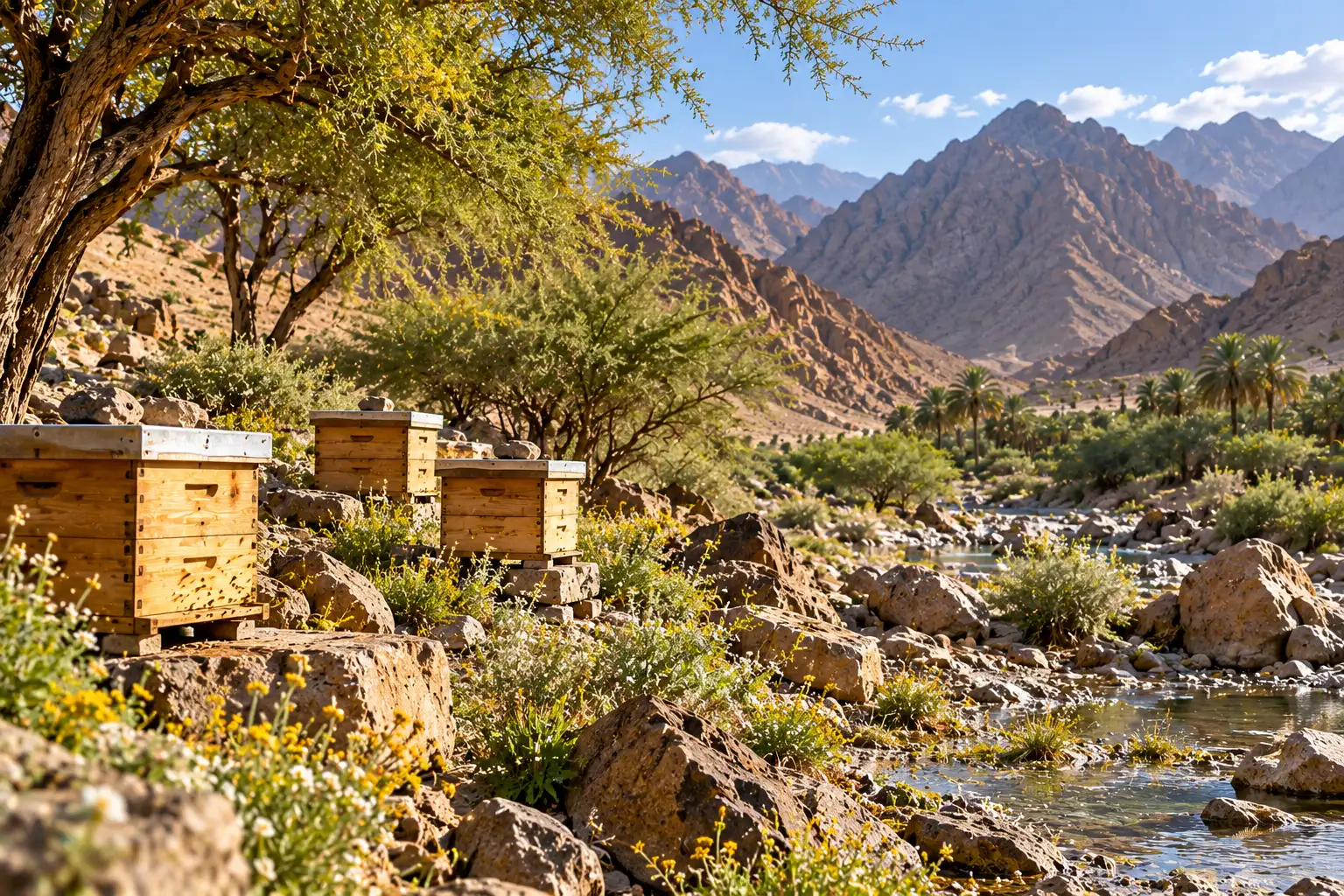
Altitude can change temperature, exposure, moisture and flowering time. In Hatta, the range from lower wadis to higher slopes can create microclimates within a relatively short distance. But altitude does not enter a jar like an ingredient.
The effect is indirect. It changes the plants and the conditions in which they flower, and it changes how a beekeeper manages colonies. That is enough to matter without turning height into a magical quality score.
What about pollution?
Mountain settings can be farther from dense traffic or heavy urban activity than city centres, and that is one reason people, including me, are attracted to mountain honey. But distance is not proof of purity. Bees forage over a wide area, pollutants can travel, farms can use treatments and roads can cross apparently remote valleys.
Scientific reviews use bees as environmental biomonitors precisely because they collect information from air, water and plants across their forage area. A mountain label should therefore make us curious, not complacent.
The bee sees a larger map than the beekeeper’s photograph
A photograph may show one pristine valley. The colony can forage beyond the frame. Depending on resources, honey bees may travel kilometres from the hive.
This is why traceability should include the actual apiary landscape rather than one dramatic viewpoint. If a beekeeper understands what lies around the colonies, the mountain story becomes much stronger.
Hatta’s wildflower honey is especially honest as a category
I like the term wildflower when it is used correctly because it admits botanical mixture instead of forcing a single famous tree onto every jar. Hatta Honey itself notes that the taste, colour and consistency of its wildflower honey depend on the flowers in bloom at the time.
That is exactly how seasonal honey should behave. Variation is not necessarily a defect. It can be evidence that the bees worked a changing landscape.
Ghaf gives summer another identity
The Ghaf crop shows the other side of Hatta. A June-July harvest is not a spring meadow story. It is a desert tree flowering during a demanding part of the year.
Our separate Ghaf honey article looks at that tree more closely. In Hatta, the useful point is that mountain topography and desert-adapted trees can coexist in the same regional honey map.
Why Hatta honey should not become one fixed flavour
If consumers start expecting all Hatta honey to be dark, thick and caramel-like, producers will eventually be pressured to fit the expectation. That would be a mistake. Spring wildflower, Ghaf, Sidr and Samar should be allowed to look and taste different.
A place becomes more credible when it produces variation that makes botanical sense.
The best question at the Hatta Honey Festival
If I had one question for every stall, it would not be ‘which is your best honey?’ I would ask: which harvest are you most proud of this year, and why?
That question forces the conversation toward season, weather, flowering, difficulty and the beekeeper’s own judgement. You learn far more than you do from a generic ranking.
Hatta is part of Dubai, but it should keep its own name
Calling everything ‘Dubai honey’ may help search engines, but it erases the landscape. Hatta has its own mountain environment, agricultural heritage and beekeeping identity.
Our Emirati honey guide compares the UAE with Yemen and Oman, while this article stays local enough to ask what Hatta itself changes.
What mountains change in the hive
They change access, shade, temperature, wind, water patterns, flowering sequence and the practical work of moving equipment. They can create isolation between valleys and concentrate forage in pockets. They can also make transport harder.
None of this guarantees a better jar. It explains why two honeys from the same country can feel as if they come from different worlds.
Rain in Hatta is episodic, which makes timing important
Hatta’s wadis can carry and store rainwater, but that does not mean the mountains are continuously wet. Rainfall is episodic. A short event can change vegetation for a period and then disappear from the landscape.
Beekeepers therefore work with windows. The value of a flowering period may depend on what happened weeks earlier in the catchment.
Mountain agriculture and wild forage overlap
Farms can add flowering resources while wild wadis contribute native and semi-wild plants. Bees do not respect the conceptual border between agriculture and nature.
This mixed forage can be an advantage for colony nutrition and a complication for monofloral claims. Again, the answer is better records, not simpler stories.
Why Hatta can become a serious honey origin
Hatta already has public events, local producers, an educational honeybee garden and a landscape that visitors can physically understand. Those pieces create the conditions for a strong regional origin.
The next step is consistency in provenance: named apiary areas, harvest dates, clear botanical claims and batch-linked testing when appropriate. A famous origin is built by repetition, not by one festival.
One last MESKI rule
I would rather leave a documented limit visible than fill it with a perfect story. A tree can be real and a honey claim still need proof. A brand can be prestigious and a historical anecdote still need sourcing.
That distinction is part of the Journal’s voice. Curiosity is stronger when it is allowed to say: this is what we know, and this is where the evidence stops.
What makes the story worth publishing
The subject earns its place when it teaches something beyond the product: how a landscape works, how a gift carries meaning, how a material moves through history or how a beekeeper reads a season.
If the reader only remembers the jar, we have written an advertisement. If the jar becomes more interesting because the world around it is clearer, we have written MESKI.
One last MESKI rule
I would rather leave a documented limit visible than fill it with a perfect story. A tree can be real and a honey claim still need proof. A brand can be prestigious and a historical anecdote still need sourcing.
That distinction is part of the Journal’s voice. Curiosity is stronger when it is allowed to say: this is what we know, and this is where the evidence stops.
What makes the story worth publishing
The subject earns its place when it teaches something beyond the product: how a landscape works, how a gift carries meaning, how a material moves through history or how a beekeeper reads a season.
If the reader only remembers the jar, we have written an advertisement. If the jar becomes more interesting because the world around it is clearer, we have written MESKI.
Questions People Ask
Hatta is an exclave of Dubai in the Hajar Mountains, around 130 kilometres from central Dubai.
Yes. Dubai Municipality organises the Hatta Honey Festival, which reached its tenth edition in 2025 and supports Emirati beekeepers and local production.
Local producers offer varieties including Sidr, Samar, Ghaf and wildflower honey.
Hatta Honey lists its Ghaf harvest season from June to July.
Hatta Honey lists a February to March season for its wildflower harvest.
Not automatically. Altitude can change climate and flowering, but quality still depends on forage, beekeeper practice, storage and the actual batch.
No location label can guarantee that. Bees forage over wide areas, and environmental exposure must be assessed rather than assumed.
Rainfall, temperature, flowering density and the mixture of plants available to bees change between seasons.
Ask for the exact forage claim, harvest period, apiary area, batch identity, beekeeper or supplier and storage conditions.
Read Hatta harvest by harvest
Continue into Ghaf, Emirati honey and mountain honey to separate what the landscape changes from what marketing merely suggests.